| Classique, Jazz |
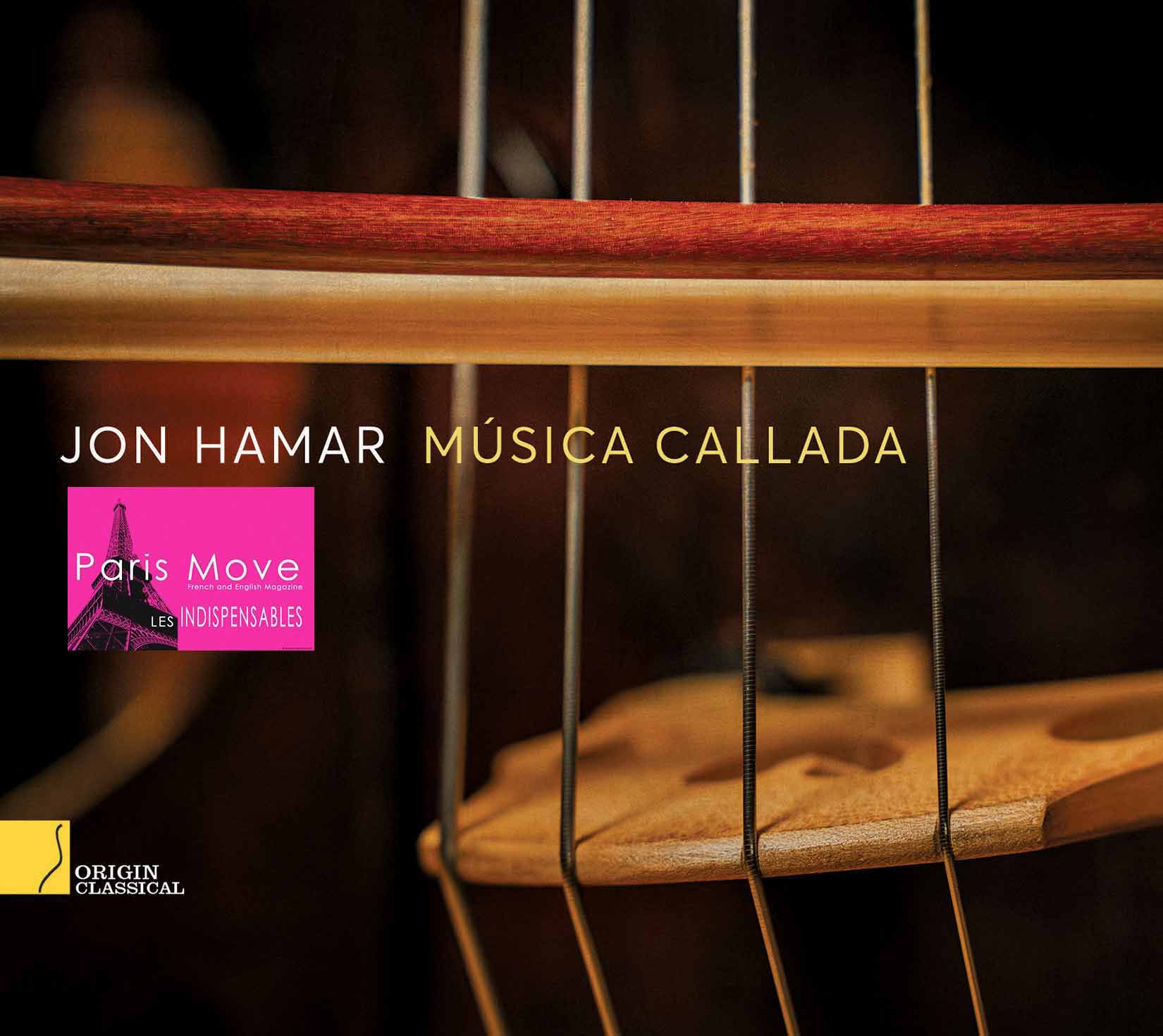
Summary: Double bassist Jon Hamar delivers a hauntingly beautiful and genre-defying performance on Música Callada, blending classical depth, jazz freedom and masterful restraint alongside pianist Adrienne Fontenot.
Jon Hamar’s Música Callada Redefines the Boundaries Between Classical Music and Jazz
It is rare to encounter a classical recording in which the double bass stands at the center of the artistic vision. Yet with Música Callada, released this June, Jon Hamar has created an album that feels quietly transformative, a work of uncommon depth that lingers long after the final notes fade. The first surprise arrives almost immediately: the double bass, played with the bow and elevated to the role traditionally occupied by the cello, becomes the emotional and structural heart of the project. Where listeners might expect the familiar warmth of a cello line, Hamar offers something darker, richer and more expansive, drawing from the immense resonance and gravity of his instrument.
Alongside him, pianist Adrienne Fontenot provides the album’s sole accompaniment, though “accompaniment” hardly captures the intimacy of the musical conversation unfolding between the two performers. Fontenot plays with extraordinary restraint and sensitivity, allowing silence and space to breathe naturally around Hamar’s phrasing. The result is an atmosphere that feels almost suspended in time. The recording itself possesses a remarkable clarity and warmth, as though each note had been placed carefully into open air. One can hear the grain of the bow against the strings, the subtle decay of the piano, even the lingering resonance between phrases. There are moments when the studio seems less like a recording space than a private room where two musicians are thinking aloud together.
The album’s title, Música Callada, meaning “silent music,” becomes increasingly revealing as the recording unfolds. The phrase evokes the paradox at the core of Hamar’s artistic approach: music that speaks softly yet carries enormous emotional weight. Silence is not treated here as emptiness, but as an active force, something sculpted and shaped with as much care as melody itself. The pauses matter as much as the notes. The stillness becomes part of the composition.
What makes Música Callada especially compelling is the way it quietly transcends the boundaries of classical music. Many jazz listeners are likely to find themselves unexpectedly captivated by this recording. In spirit, the album resembles some of the most adventurous contemporary jazz projects being made today. Hamar approaches a little-known repertoire, reshaping and adapting it for his own instrument while weaving fluid exchanges between interpretation and improvisation. Works by David P. Jones appear alongside Hamar’s own compositions, and throughout the album there is a sense that the music is continuously discovering itself in real time.
This approach places Hamar within a growing lineage of contemporary musicians who refuse to recognize strict divisions between genres. In different ways, artists such as Vijay Iyer, Esperanza Spalding and Avishai Cohen have explored similar territory, blending classical discipline, improvisational freedom and deeply personal storytelling. Yet Hamar’s voice remains distinctly his own. Rather than pursuing crossover effects for their own sake, he seems motivated by something more organic: the search for emotional truth wherever it may lead.
That freedom is striking because classical music is so often associated with precision, structure and fidelity to tradition. Here, however, Hamar introduces something far more elusive: a sense of liberty that feels almost revolutionary in its quietness. Fontenot understands this instinctively and mirrors it perfectly. After all, why should intensity, spontaneity and improvisation belong exclusively to jazz? Listening to this album, one realizes how artificial those divisions can become. There is as much to learn here about touch, pacing, tonal color and the use of silence as in any modern jazz recording.
Several tracks illuminate this beautifully. “Winter Crows” may be the emotional centerpiece of the album. As the piece unfolds, sparse lines gradually gather emotional weight until the music feels suspended between meditation and lament. Listening to it, an old and endlessly repeated debate resurfaces almost automatically: Is this jazz, or is it not? But at a certain artistic level, the question begins to dissolve. Perhaps the more interesting question becomes: Is this classical music, or something else entirely? Again, the answer hardly matters. By the end of the piece, intellectual categorization gives way to something simpler and more satisfying: recognition, admiration, and finally a quiet smile of agreement.
Elsewhere, Hamar’s interpretation of John Clayton’s “Back to Blue” reveals another dimension of his artistry. The performance carries an almost conversational warmth, balancing melancholy with understated elegance. Rather than treating the composition as a showcase for technical command, Hamar approaches it with patience and emotional openness. The effect is deeply human. Even listeners unfamiliar with the language of classical performance or jazz improvisation will immediately recognize the sincerity in the playing.
Other moments throughout the album deserve similar attention. Certain passages unfold with the intimacy of chamber music, while others drift toward something more atmospheric and contemporary, recalling the spacious minimalism of artists like Arvo Pärt or the genre-fluid sensibilities of Nik Bärtsch. Yet the album never feels derivative. Hamar absorbs these influences without imitating them, allowing his own musical identity to emerge naturally through tone, pacing and restraint.
To understand what drives Jon Hamar creatively, it helps to look briefly at his background. One detail from his biography is especially revealing: Hamar was born in Kennewick, Washington, and began playing double bass at the age of 11 before adding electric bass a year later. Raised by musician parents, he grew up hearing his father play gospel, boogie-woogie and classical piano, while his mother played oboe and sang in church. That musical environment clearly shaped his instincts from an early age.
From there, the trajectory almost explains itself. What emerges most strongly in Hamar’s work is not virtuosity alone, but a profound affection for beauty, nuance and emotional honesty. Rather than returning endlessly to the obvious masterworks of the repertoire, he searches for overlooked compositions and unexplored emotional spaces. In doing so, he opens classical music outward instead of closing it in. Much like today’s most imaginative jazz artists, Hamar creates a bridge between heritage and modernity, honoring the past while speaking in a distinctly contemporary voice.
Classical performers rarely surprise me anymore, but in recent years a younger generation has emerged that seems determined to reshape old conventions without rejecting tradition outright. Jon Hamar belongs unmistakably to that generation. He is an artist worth watching closely because one senses that this is only the beginning of what he may accomplish.
There is something fascinating about a musician who can sound more deeply connected to jazz than many jazz players, while remaining more profoundly rooted in classical sensibility than many classical performers. Hamar seems to understand what Henry Purcell understood centuries ago: that music gains its power not through density or excess, but through space, restraint and the careful shaping of silence. On Música Callada, Jon Hamar demonstrates a mastery of that principle with remarkable elegance.
Thierry De Clemensat
Member at Jazz Journalists Association
USA correspondent for Paris-Move and ABS magazine
Editor in chief – Bayou Blue Radio, Bayou Blue News
PARIS-MOVE, May 21st, 2026
Follow PARIS-MOVE on X
::::::::::::::::::::::::
Musicians:
Jon Hamar – double bass
Adrienne Fontenot – piano (except 12,15)
Track Listing:
Música Callada 15:36 Frederic Mompou
1 I: Angelico 1:39
2 II: Lent 1:18
3 III: Placide 1:34
4 IV: Afflitto e Penoso 2:01
5 V 1:55
6 VI: Lento 1:48
7 VII: Lento 2:37
8 VIII: Semplice 0:39
9 IX: Lento 2:26
10 Winter Crow 9:09 David P. Jones
11 Song of the Lighthouse 4:05 Jones
12 Bach to Blues 7:12 John Clayton
13 Lazy Dragon 6:36 Hamar
14 Nocturne 2:36 Ned Rorem
15 Mosaic 1:33 Hamar
Production Info:
Produced by Jon Hamar
Recorded by Mischa Goldman at the University of Tennessee,
Natalie L. Haslam College of Music, Knoxville, TN, on May 21-22, 2025
Mixed by Benjamin Lange at Lange Studios, Edgewood, WA
Mastered by Peter Doell at 21st Century Audio, Los Angeles, CA
Artist photo by Austin Orr
Cover design & layout by John Bishop