| Classique, Musique improvisée |
Summary: German pianist Johanna Summer delivers one of the year’s most daring releases with Dialoge, an album where classical music and improvisation merge into a deeply emotional and unpredictable conversation between some of today’s most remarkable pianists.
Johanna Summer’s “Dialoge” Feels Less Like an Album Than a Living Conversation Across Time
There are records that accompany an evening quietly in the background, and there are records that completely alter the atmosphere of a room the moment they begin. Dialoge, released by ACT Music, belongs firmly to the second category. Listening to it for the first time feels almost disorienting: the silence between notes matters as much as the notes themselves, the resonance of the pianos seems to linger in the air like unfinished thoughts, and every phrase carries the tension of something being invented in real time. It is music that demands attention, patience and emotional availability.
This is also, without question, one of the most ambitious and difficult projects the label has presented in recent years. Spread across 25 short pieces balanced delicately between classical repertoire and improvisation, Dialoge never attempts to simplify itself for accessibility’s sake. This is not an album designed for casual listeners searching for immediate melodies or easy emotional gratification. It challenges the audience from the very first moments. Yet for those willing to enter its world completely, the rewards become immense.
The origin of the project now feels almost mythical in retrospect. At the 2023 Lucerne Piano Festival, pianist Igor Levit performed Robert Schumann’s Waldszenen (“Forest Scenes”) in its original form. Then came Johanna Summer. Rather than offering a reinterpretation in the traditional sense, she entered directly into the emotional fabric of Schumann’s work, extending each miniature through improvisation as though continuing a conversation left unfinished more than a century ago.
Nothing had been planned. Nothing rehearsed. The music unfolded entirely within the uncertainty of the present moment.
Levit would later describe the experience as one of the most artistically fulfilling moments of recent years, and hearing Dialoge, it becomes obvious why. There is something profoundly exposed about this music. The performers do not appear to be executing compositions as much as discovering them while playing.
Before this album, Johanna Summer was not an artist I knew particularly well. Yet her musical language immediately recalled the fearless artistic freedom of figures such as Satoko Fujii or Wadada Leo Smith, artists capable of transforming improvisation into philosophy, architecture and emotional storytelling simultaneously. But Summer’s approach reaches toward something even more elusive. She does not merely converse with classical music; she appears to extend it temporally, projecting these compositions into the 21st century and perhaps even beyond.
That difference is essential.
Many crossover projects between jazz and classical music remain trapped in admiration of the past. Dialoge does not. Johanna Summer approaches these works as living entities still capable of mutation and transformation. Her improvisations are not decorative additions placed around the compositions. They challenge the originals, stretch them, destabilize them and occasionally reveal emotional dimensions hidden beneath their familiar surfaces.
The album itself emerged naturally from that Lucerne performance. Summer’s previous collaborations with producer Andreas Brandis had already resulted in acclaimed recordings such as Resonanzen and Cameo, the latter alongside saxophonist Jakob Manz. But Dialoge feels like the moment where her artistic vision fully crystallizes.
The structure is deceptively simple. Four separate piano duos place Summer opposite another pianist at a second grand piano: Claire Huangci, Kit Armstrong, Danae Dörken and Igor Levit. Yet within this framework, the possibilities become endless.
Summer encouraged each guest to bring pieces with which they shared a deeply personal connection, works flexible enough to allow her improvisational voice to enter organically. The result is not confrontation but coexistence. Tradition and spontaneity move side by side, sometimes gently, sometimes turbulently.
And slowly, almost without noticing, the listener falls under the album’s spell.
A particular moment involving Claire Huangci becomes especially revealing: a passage begins with crystalline classical precision before Summer quietly introduces harmonic shadows beneath it, subtly shifting the emotional gravity of the piece until the music no longer belongs entirely to Schumann, or to improvisation, but to a strange intermediate territory existing only in that instant. Elsewhere, Kit Armstrong’s refined and cerebral touch collides beautifully with Summer’s instinctive phrasing, producing moments that feel suspended somewhere between meditation and collapse.
The technical sound of the recording contributes enormously to this sensation. The album possesses an intimacy that borders on intrusive. One hears the weight of the keys, the lingering decay of the piano strings, the breathing space between gestures. At times the recording feels almost architectural, as though the listener were seated physically between the two instruments inside the studio itself. Nothing is overly polished. The warmth and natural resonance remain intact, allowing the improvisations to retain their fragility.
What initially appears fragmented, 25 short works interpreted by multiple musicians, gradually reveals itself as a single emotional continuum. Even after several listens, there remains the uncanny impression that every improvisation and every interpretation belong to one vast composition unfolding invisibly beneath the surface.
This may ultimately be Johanna Summer’s greatest accomplishment. She succeeds in transmitting the philosophical core of her vision to every musician involved while simultaneously granting them complete artistic freedom. The balance should not work as seamlessly as it does. Yet somehow it does.
There is also a larger cultural significance to Dialoge. Contemporary classical music increasingly finds itself caught between preservation and reinvention. Too often, younger artists are expected either to protect the canon with reverence or reject it entirely in pursuit of modernity. Johanna Summer proposes another path altogether. She treats classical music not as a monument, but as a living language still capable of evolution.
In that sense, one can hear distant echoes of artists such as Keith Jarrett or Brad Mehldau, musicians who also blurred the borders between improvisation, classical structures and contemporary expression. Yet Summer’s voice remains entirely her own, quieter perhaps, but no less radical.
So what exactly is this album?
Classical music? Jazz? Contemporary improvisation?
By the end, the question feels almost meaningless. Johanna Summer herself rejects the label of “jazz pianist.” She is simply a pianist. Legendary pianist Joachim Kühn, another lifelong explorer between genres and eras, described her work as “music filled with imagination that escapes categorization.”
That may ultimately be the most accurate description possible.
Still, if this album must find a place within our own classifications, it will sit under “Classical,” if only because its roots undeniably emerge from that tradition. But this categorization should be understood merely as a compass for listeners, not a definition. Artists like Johanna Summer remind us that music’s most important evolutions often happen precisely at the moment when categories begin to fail.
Thierry De Clemensat
Member at Jazz Journalists Association
USA correspondent for Paris-Move and ABS magazine
Editor in chief – Bayou Blue Radio, Bayou Blue News
PARIS-MOVE, May 7th, 2026
Follow PARIS-MOVE on X

::::::::::::::::::::::::
Musicians :
Johanna Summer: piano
Claire Huangci: piano
Danae Dörken: piano
Kit Armstrong: piano
Igor Levit: piano
Track Listing :
01 Arrival (Johanna Summer) – 2:08
Johanna Summer
02 Sostenuto e cantabile (Mikis Theodorakis) – 2:11
Danae Dörken
03 Obstinacy (Minako Tokuyama) – 1:01
Claire Huangci
04 On a Mission (J. Summer) – 0:30
Johanna Summer
05 Fugatino (J. Summer, Kit Armstrong) – 0:36
Johanna Summer, Kit Armstrong
06 Espressivo, poco animato (Zhou Tian) – 0:47
Claire Huangci
07 I Can Only Be Me (J. Summer) – 1:58
Johanna Summer
08 Silhouettes (J. Summer) – 0:50
Johanna Summer
09 For Lila Lalaouni (Manolis Kalomiris) – 2:06
Danae Dörken
10 Andantino de Clara (Robert Schumann, J. Summer) – 3:15
Johanna Summer & Igor Levit
11 Mirage (J. Summer) – 1:35
Johanna Summer
12 Adagio (M. Theodorakis) – 1:16
Danae Dörken
13 Laughing Buddha (M. Tokuyama) – 0:33
Claire Huangci
14 Seeing Faces (J. Summer) – 1:33
Johanna Summer
15 Evening Edge (J. Summer) – 2:12
Johanna Summer
16 Andante semplice (M. Theodorakis) – 1:14
Danae Dörken
17 Douce Dame Jolie (Guillaume de Machaut, J. Summer, K. Armstrong) – 2:29
Johanna Summer, Kit Armstrong
18 Blue Deep (J. Summer) – 1:31
Johanna Summer
19 Deva King (M. Tokuyama) – 1:30
Claire Huangci
20 Your Embrace (J. Summer) – 1:57
Johanna Summer
21 Allegro con brio (Z. Tian) – 1:26
Claire Huangci
22 Sergei’s Spirit (J. Summer) – 1:10
Johanna Summer
23 Blutmond (Ludwig v. Beethoven, J. Summer, K. Armstrong) – 4:42
Johanna Summer, Kit Armstrong
24 Silence, after the Temple Gong (M. Tokuyama) – 1:04
Claire Huangci
25 Departure (J. Summer) – 1:31
Johanna Summer
Recorded 19.06. and 23.07.2025 at Emil Berliner Studios
Recorded by Lukas Kowalski
Mixed and mastered by Emanuel Uch
Produced by Andreas Brandis
Photos by Gregor Hohenberg, Ilan Hamra
Lacquer disc cutting by Schnittstelle Berlin
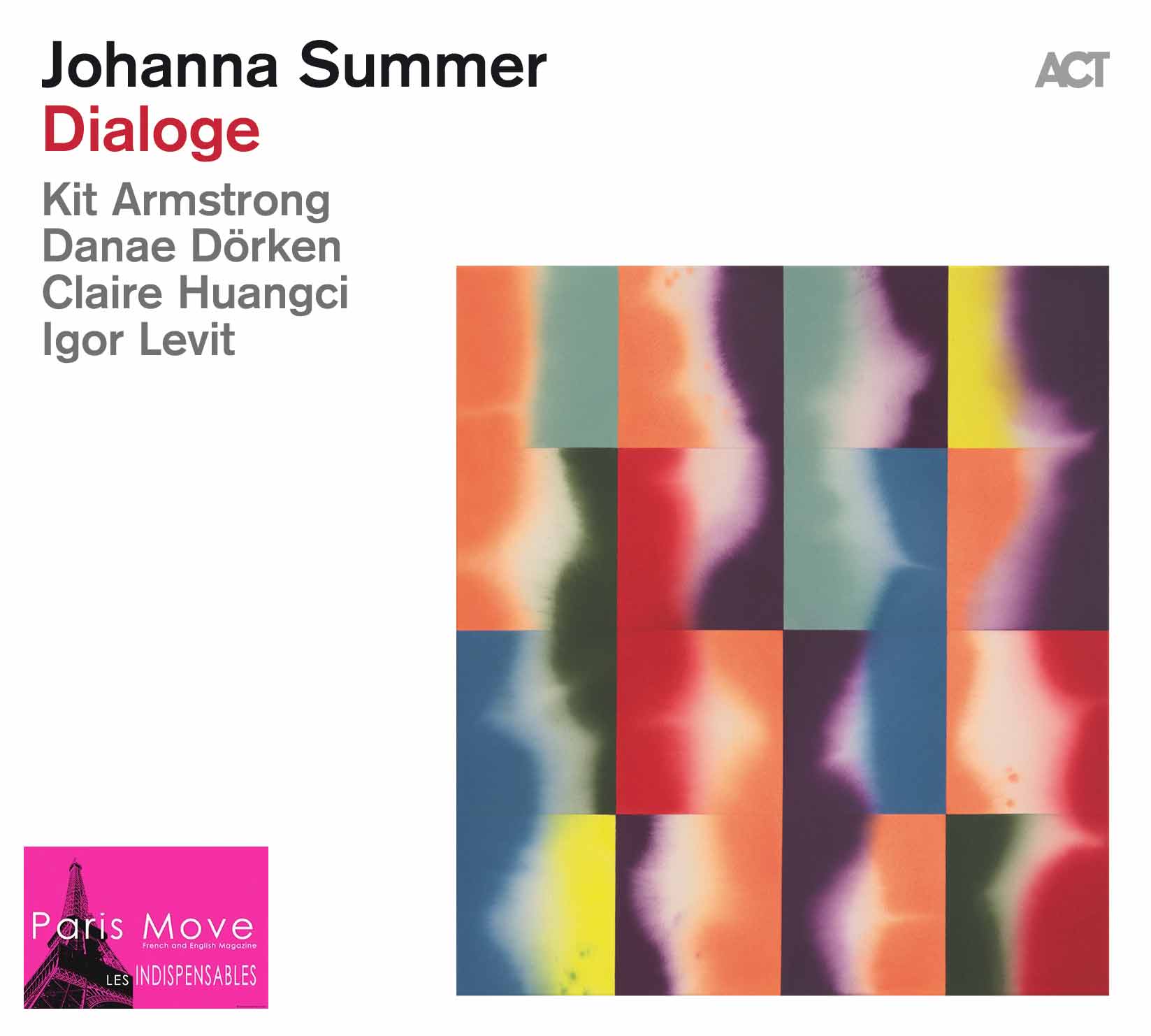
Cover art by Małgorzata Szymankiewicz, Untitled 390, 2025, acrylic on canvas, 100 × 90 cm – used by kind permission of the artist and BWA Warszawa
Photographed by Tomasz Koszewnik
Design by Siggi Loch