
| Jazz |
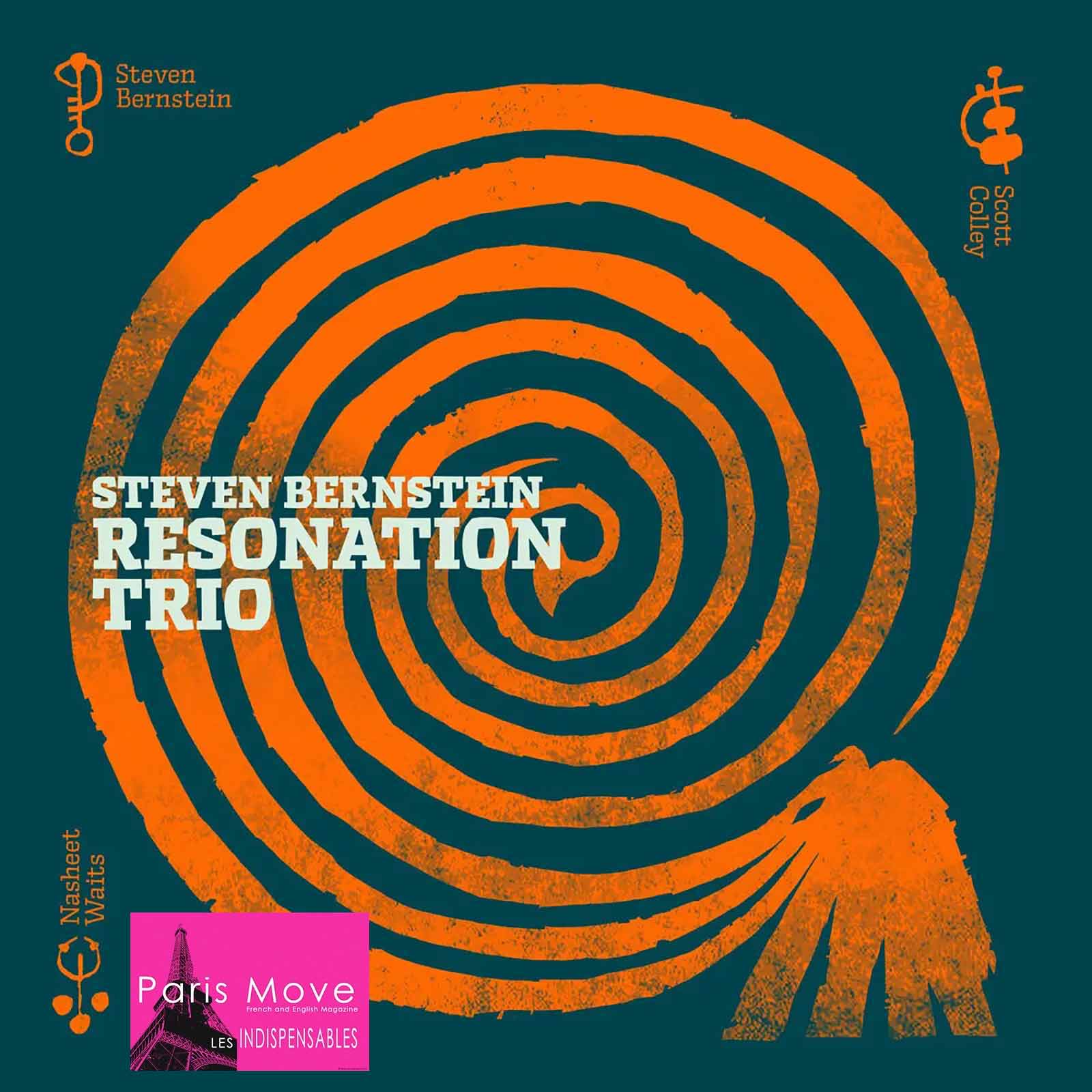
Steven Bernstein Finds Beauty in Uncertainty on ResoNation Trio
The first sounds on “Turf” do not arrive with force so much as emerge from the shadows. A deep bass line moves cautiously through the silence before the drums begin to circle around it. Then comes the trumpet of Steven Bernstein, sharp but restrained, less interested in commanding attention than in opening space. From the very beginning, Bernstein and his ResoNation Trio invite the listener into a world where atmosphere matters as much as melody, where tension and silence become part of the composition itself.
There are moments throughout the album that recall the exploratory spirit of Wadada Leo Smith, though Bernstein’s language remains unmistakably his own. Behind the sessions stands producer Scotty Hard, whose subtle studio presence gives the music a supple and almost voluptuous movement. The album unfolds through brief forms, interrupted phrases and sudden detours. Bernstein rarely lingers in one place for long. His trumpet lines appear like fragments of conversation overheard in the middle of the night, musical commas suspended in space.
Yet nothing here feels fragmented for the sake of abstraction. Slowly, these scattered gestures begin to assemble into something coherent and strangely moving. The music reveals an inner landscape shaped by jazz tradition, urban unease, political tension and a kind of post industrial poetry. Rather than offering conventional themes and resolutions, Bernstein constructs moods, fleeting impressions and emotional textures that continue to expand long after the tracks themselves have ended.
In reality, ResoNation Trio arrives as part of a larger artistic statement. Alongside this release comes Ultra Resonance, a companion work operating within the same exploratory framework. Together, the two albums emerge during one of the busiest and most eclectic periods of Bernstein’s career. His schedule currently stretches from international performances alongside the legendary performance artist Laurie Anderson to appearances with his long running New York ensemble Sexmob, whose latest release, XLet X=X (Live), recently appeared through Nonesuch Records. Bernstein is also participating in celebrations honoring what would have been the centennial of Miles Davis in Italy, while appearing at the celebrated “Helm Family Midnight Ramble” concerts founded by Levon Helm. At the same time, he marks the 30th anniversary of Sexmob, a reminder of his remarkable longevity within New York’s experimental jazz landscape.
The trio itself is striking in its austerity. Bernstein performs alongside Scott Colley on double bass and Nasheet Waits on drums, without the presence of any harmonic instrument to soften the edges or stabilize the music. The result is exposed and intimate, music that seems to balance permanently on the edge of collapse without ever losing its internal logic.
Colley’s bass often functions both as anchor and narrator. At times it moves with deep physical weight, at others with surprising delicacy, creating melodic pathways beneath Bernstein’s fractured phrases. Waits approaches rhythm less as timekeeping than as atmosphere. He rarely attacks the drums directly. Instead, he stalks the music from the edges, transforming silence itself into part of the percussion. Together, the trio creates an unstable but deeply expressive terrain where every pause feels intentional.
For listeners familiar with Bernstein’s earlier work, another detail immediately stands out. The musician, whose mastery of the slide trumpet has become central to his sonic identity, abandons that instrument entirely here. Instead, he performs exclusively on valve trumpet and flugelhorn. The decision subtly transforms the emotional character of the album. The sound becomes warmer, darker and more vulnerable, stripped of some of the ironic theatricality often associated with his playing.
The origins of the trio can be traced to Bernstein hearing Colley and Waits perform alongside the visionary pianist Andrew Hill. Their chemistry on these recordings feels less like accompaniment than collective construction. One rarely knows where composition ends and improvisation begins. That ambiguity ultimately becomes the defining feature of Bernstein’s writing.
The project itself remains deceptively ambitious. Bernstein has described his interest in exploring something close to a dub reinterpretation of abstract improvised music, applying forms of sonic manipulation more commonly associated with pop or electronic production to avant garde jazz structures. That tension between raw acoustic improvisation and subtle studio treatment gives the albums much of their unpredictability.
As with many important artistic works, the music exists between tradition and experimentation. Certain passages briefly touch recognizable jazz forms before drifting into stranger and more uncertain territories. Yet even in its most exploratory moments, the trio never loses its aesthetic coherence. Bernstein is not pursuing experimentation as provocation. He is searching for another emotional vocabulary.
Even listeners who are not deeply immersed in avant garde jazz may recognize the emotional tension running beneath these fractured surfaces. Beneath the abstraction lies something profoundly human: doubt, instability, melancholy and fleeting beauty.
What ultimately makes ResoNation Trio so compelling is the sense of exposure running through every performance. This is music stripped bare, balancing delicately on a wire. It feels cinematic at times, almost choreographic in the way rhythms collide and dissolve into open space. One can easily imagine dancers responding to these shifting textures and unstable movements, because Bernstein’s writing constantly invites reinterpretation and physical response.
Rather than delivering easy resolutions, the album asks listeners to remain inside uncertainty. For some, that openness may feel demanding. For others, it will feel liberating. Either way, Bernstein continues to pursue new artistic territory with unusual conviction, proving once again that jazz remains capable of reinvention when placed in the hands of musicians willing to challenge its boundaries without abandoning its emotional core.
Thierry De Clemensat
Member at Jazz Journalists Association
USA correspondent for Paris-Move and ABS magazine
Editor in chief – Bayou Blue Radio, Bayou Blue News
PARIS-MOVE, May 18th, 2026
Follow PARIS-MOVE on X

::::::::::::::::::::::::
To buy this album https://stevenbernstein.bandcamp.com/album/resonation-trio-ultra-resonance
2 CD-set
“Limited Edition” 180-Gram 2-LP Double Album
Musicians: Steven Bernstein ‘ResoNation Trio’
Steven Bernstein – Trumpet, G Trumpet, Flugelhorn
Scott Colley – Acoustic Bass
Nasheet Waits – Drums
Track Listing :
1.Turf
2.Pettiford
3.Two Shakes
4.Woodstock
5.August 3
6.West
7.Mammoth
8.Question
9.South
10.Sitting
11.Scotty Hard & Steven Bernstein – Argon
12.Scotty Hard & Steven Bernstein – Erbium
13.Scotty Hard & Steven Bernstein – Chromium
14.Scotty Hard & Steven Bernstein – Vibranium
15.Scotty Hard & Steven Bernstein – Rubidium
16.Scotty Hard & Steven Bernstein – Titano
17.Scotty Hard & Steven Bernstein – Radon
18.Scotty Hard & Steven Bernstein – Niobium
Musicians:
Steven Bernstein – Trumpet, G Trumpet, Flugelhorn
Scott Colley – Acoustic Bass
Nasheet Waits – Drums
All compositions by Steven Bernstein (Spanish Fly Music, ASCAP)
Except “Sitting on Top of the World” by Walter Vinson & Lonnie Chatman (Public Domain)
Recorded & Mixed by Andy Taub, Brooklyn Recording
Assistant Engineer: Sam Wahl
Mastered by Gene Paul at DB Plus Digital Services
Produced by Steven Bernstein