| Jazz |
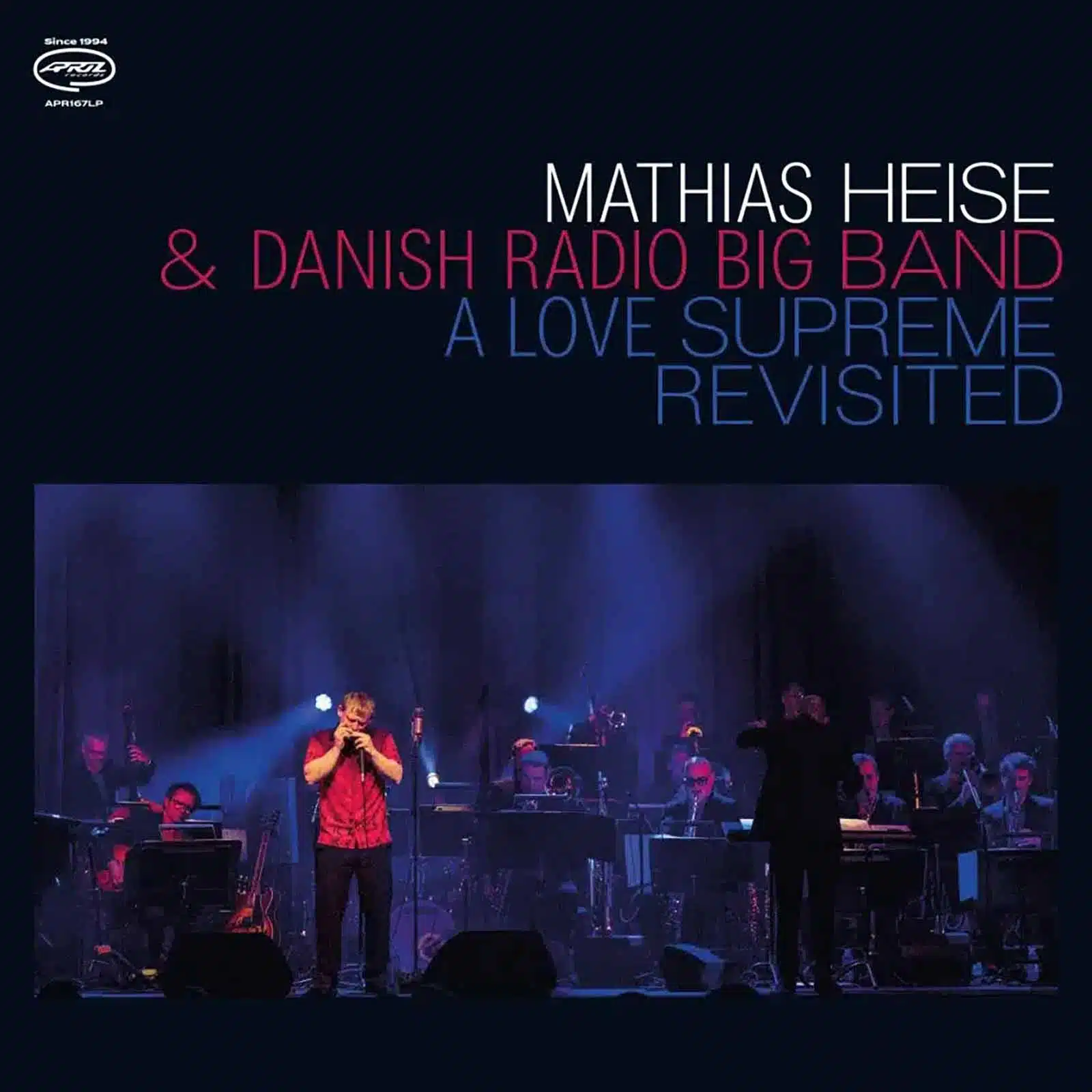
Summary: Mathias Heise and the Danish Radio Big Band attempt a bold reinterpretation of John Coltrane, delivering a technically impressive but emotionally uneven jazz experiment.
Mathias Heise and the Danish Radio Big Band Revisit John Coltrane With Ambition and Uneven Brilliance
When a chromatic harmonica player decides to confront the towering legacy of John Coltrane, and does so alongside an institution as formidable as the Danish Radio Big Band, expectations naturally begin to rise. For listeners familiar with the astonishing possibilities of the chromatic harmonica in the hands of masters such as Sébastien Charlier, the concept alone suggests an open field of innovation and daring reinterpretation. One imagines an encounter capable of reshaping the instrument’s place within modern jazz orchestration, perhaps even revealing new emotional dimensions within music that many listeners already consider untouchable.
The album opens like a cold Nordic morning slowly giving way to light. There is a spaciousness in the production, a polished studio clarity that immediately places the listener inside a carefully controlled acoustic environment. Brass sections rise with cinematic depth, the rhythm section breathes with discipline and elegance, and the arrangements possess the kind of refined craftsmanship long associated with Scandinavian jazz recording traditions. From a purely technical perspective, the album is beautifully assembled.
What emerges artistically, however, is a more complex and ultimately more uneven experience.
The playing of Mathias Heise is undeniably accomplished. His technical command is evident from the opening moments of “Pt. I – Acknowledgement,” where phrases spill forward with speed, accuracy and control. There is never any question regarding his dexterity or his understanding of the chromatic harmonica’s mechanics. Yet virtuosity alone rarely guarantees emotional impact, especially when approaching material so deeply embedded in the collective memory of jazz listeners.
That becomes the album’s central dilemma.
Throughout much of the recording, the abundance of notes does not entirely compensate for the absence of a deeper artistic signature. The listener admires the effort, respects the ambition, but continues searching for that elusive spark, the interpretive insight capable of transforming technical performance into revelation. Coltrane’s music demands more than fluency. It asks for spiritual tension, narrative gravity and a sense of personal urgency. Here, the harmonica often sounds polished and disciplined, but not fully inhabited.
The challenge is amplified by the unavoidable historical weight attached to this repertoire. Any artist who revisits John Coltrane inevitably enters into dialogue with decades of transformative reinterpretations. One thinks of the radical freedom brought by later spiritual jazz ensembles, or the orchestral experiments that sought not merely to reproduce Coltrane’s work but to reframe it emotionally and philosophically. Those projects succeeded because they carried a strong internal identity of their own. This album occasionally struggles to establish that same necessity.
That difficulty becomes especially apparent in the large ensemble passages. Against the expansive architecture of the Danish Radio Big Band, the harmonica sometimes struggles to assert its acoustic presence. The chromatic harmonica remains, by nature, a fragile instrument in orchestral jazz settings. Unlike the tenor saxophone, whose dense harmonic body can slice through brass and percussion with almost vocal authority, the harmonica occupies a more delicate frequency range. Even amplified, it can lose physical presence once surrounded by full brass harmonies, layered trombones and aggressively textured percussion.
This is one of the album’s most fascinating aspects, because it unintentionally raises broader questions about orchestration in contemporary jazz. How does one preserve intimacy within large-scale arrangements? How can an instrument associated with subtle nuance maintain authority inside a powerful big band structure? These questions hover constantly over the record.
As a result, the ear frequently gravitates toward the orchestra itself, whose writing, textures and solo contributions become the true focal point of the album. And to be fair, the orchestra delivers several remarkable moments. The brass arrangements possess remarkable fluidity, moving between spiritual grandeur and tightly controlled modern jazz phrasing. The saxophone sections, particularly during the more rhythmically aggressive passages, inject the music with a level of tension that occasionally surpasses the emotional impact of the harmonica itself.
Ironically, one of the project’s most convincing moments arrives when the orchestration recedes.
“Harmonica Cadenza” offers the instrument space to breathe without excessive layering or harmonic overcrowding. In this more exposed setting, Heise’s musical intelligence becomes far easier to appreciate. The phrasing feels more intentional, the silences more meaningful, the tonal nuances more expressive. One suddenly hears not only the technician, but the storyteller behind the instrument. It is perhaps the track that most clearly suggests another possible direction for the artist. Listening to it, one cannot help but wonder whether a repertoire built around contemporary original compositions, rather than the monumental shadow of Coltrane, might have allowed the harmonica to flourish more naturally.
That question remains important because it becomes difficult to form a definitive judgment on Heise as an artist solely through this project. An album centered on his own compositional voice would likely provide a far clearer portrait of his creative identity. In many ways, the decision to frame the recording around Coltrane may have been its most limiting artistic choice. The audience inevitably arrives carrying memories, expectations and emotional attachments connected to the original works. Any reinterpretation therefore enters into direct comparison with music that has long since achieved canonical status.
Still, the project deserves genuine respect for its ambition.
Rather than replacing Coltrane’s improvisational material, the album often preserves and reframes it, orchestrating existing ideas while expanding their harmonic environment. There is intelligence in that approach, and moments where the concept genuinely comes alive. “Pursuance,” for example, gradually builds dramatic momentum with exceptional patience. The rhythm section slowly thickens the pulse while the brass arrangements become increasingly turbulent, creating a sensation of controlled ascent. Then come the tenor exchanges, arguably among the strongest moments on the entire record. The soloists from the Danish Radio Big Band attack the harmonic structure with conviction, pushing against one another with escalating urgency before the music finally dissolves into a solo harmonica cadence.
That transition is revealing.
For a brief instant, the listener understands precisely what Heise may have envisioned from the beginning: the harmonica not as a dominant force, but as a reflective voice emerging from collective intensity. In theory, it is a compelling artistic concept. In execution, however, the balance remains inconsistent across the album’s full duration.
From this listener’s perspective, the material may have been far more effective in a stripped-down trio format, where the harmonica could occupy the center of the sonic landscape rather than fighting for space within a dense orchestral framework. In the current production, the orchestra frequently dominates the emotional and acoustic field, leaving the harmonica partially obscured at precisely the moments when it should command attention.
None of this diminishes the musicianship of Mathias Heise or the excellence of the Danish Radio Big Band. The album remains an intriguing and honorable artistic risk, one that attempts to broaden the language surrounding Coltrane’s music while simultaneously exploring the expressive possibilities of the chromatic harmonica within contemporary jazz orchestration.
In today’s jazz landscape, where innovation increasingly pushes artists toward hybrid forms, radical reinterpretations and technical extremes, this recording may not ultimately stand as a defining reference point. Yet there is still something admirable about its willingness to engage directly with sacred repertoire instead of avoiding it altogether. Reinterpreting John Coltrane is never a neutral act. His music carries the weight of spiritual searching, artistic revolution and emotional vulnerability.
And perhaps that is what lingers after the final notes fade.
Not necessarily the harmonica itself, nor even the arrangements, but the reminder that every generation of jazz musicians eventually feels compelled to walk into Coltrane’s shadow, hoping to discover something personal there, even while knowing the light surrounding that legacy can sometimes be overwhelming.
Thierry De Clemensat
Member at Jazz Journalists Association
USA correspondent for Paris-Move and ABS magazine
Editor in chief – Bayou Blue Radio, Bayou Blue News
PARIS-MOVE, May 16th, 2026
Follow PARIS-MOVE on X

::::::::::::::::::::::::
Musicians :
Nikolai Bøgelund | Conductor
Mathias Heise | Main Soloist
John Coltrane | Composer
Mathias Heise | Arranger
Track Listing:
A Love Supreme – Introduction
Part 1 – Acknowledgement
Interlude #1
Part 2 – Resolution
Interlude #2
Part 3 – Pursuance
Harmonica Cadenza
Part 4 – Psalm/Alabama