
| Jazz |
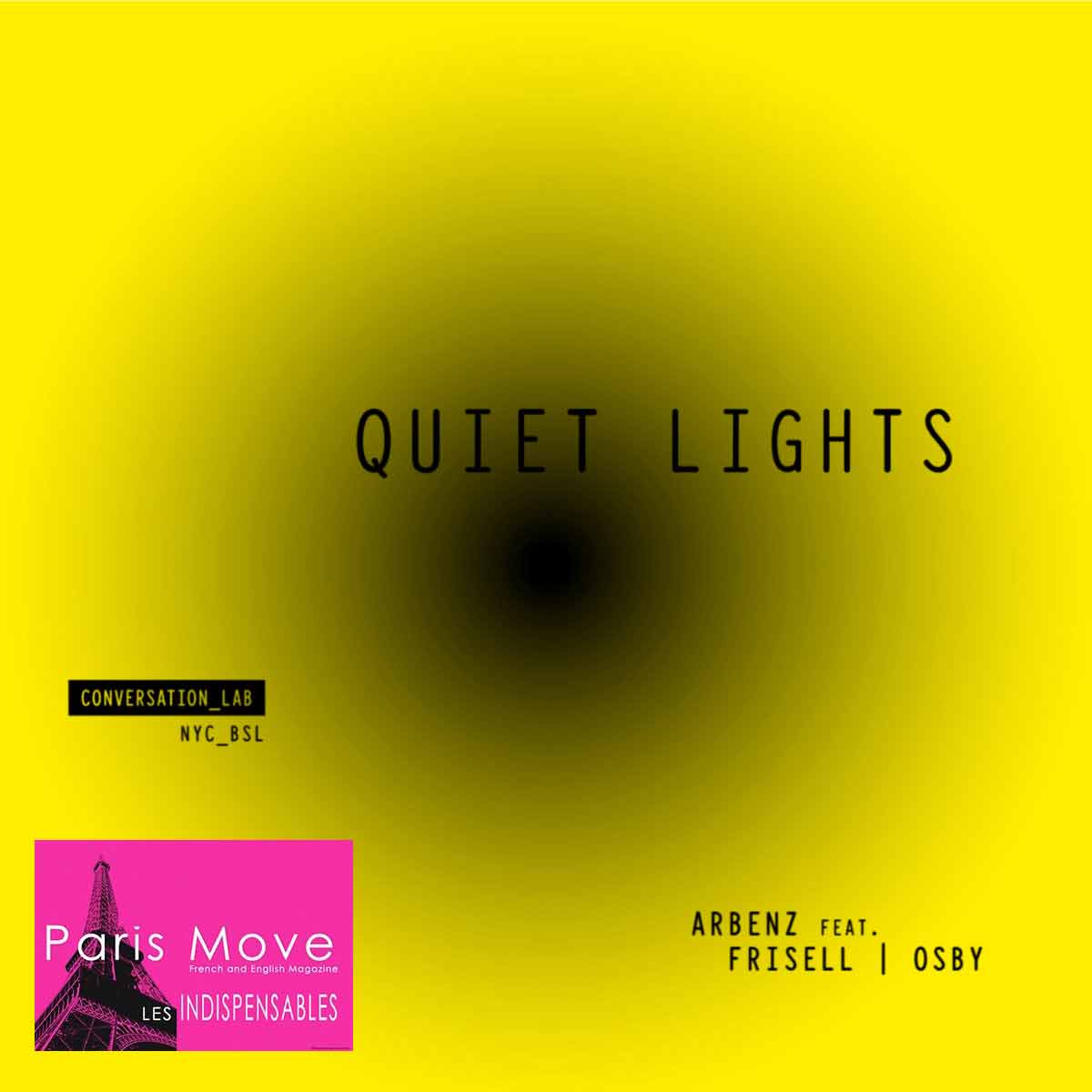
Summary : Swiss drummer Florian Arbenz delivers a deeply atmospheric and emotionally rich jazz album alongside Bill Frisell and Greg Osby, blending sophisticated improvisation with remarkable accessibility on Quiet Lights.
Florian Arbenz’s Quiet Lights Is Contemporary Jazz at Its Most Immersive
The sunlight cuts sharply through the windows of the office, flooding the room with the pale gold of an early Texas morning. Outside, the city still feels half asleep, suspended in that fragile silence that exists only before the machinery of the day fully awakens. A cup of coffee cools beside the mixing console, notebooks remain scattered across the desk, and then, almost imperceptibly, a rhythm begins to emerge from the speakers. Light, restrained, perfectly measured. Moments later, a saxophone enters the scene like a figure stepping slowly onto a theater stage, carrying with it tension, elegance, and mystery. That is exactly the sensation that accompanies the opening moments of Quiet Lights, the remarkable new recording from Swiss drummer and composer Florian Arbenz.
Before even reaching the middle of the first track, one already senses the presence of an artist of rare sensitivity, a musician whose compositions mirror his personality with striking precision. This album confirms something essential: Arbenz belongs among the most important contemporary European jazz voices of his generation. Rhythm may be his foundation, but over the years he has patiently constructed a musical language entirely his own, one that resists easy categorization while remaining deeply human.
What makes his work so compelling is the way he balances complexity with accessibility. The architecture of these compositions is undeniably sophisticated, layered with subtle rhythmic shifts, changing textures, and emotional contrasts, yet nothing ever feels cold or academically distant. The listener is never excluded from the experience. Instead, the music opens itself gradually, revealing its depth with patience and elegance. That rare balance between intellectual construction and emotional immediacy is perhaps what separates major artists from merely gifted technicians.
In many ways, Quiet Lights also says something important about the current state of contemporary European jazz itself. For years, European improvisers have continued moving away from direct American imitation, searching instead for more atmospheric, narrative, and textural forms of expression. Florian Arbenz belongs fully to that evolution, yet his work avoids the trap of abstraction for abstraction’s sake. His compositions never disappear into conceptual experimentation alone. There remains warmth here, melody, tension, and above all, storytelling. One senses a musician deeply aware of jazz history while simultaneously refusing to become imprisoned by it.
What makes the achievement even more astonishing is the fact that the album was recorded entirely live in just four hours. Yet nothing about Quiet Lights feels rushed or unfinished. Quite the opposite. The recording captures the meeting of three masters of improvisation, musicians united by openness, trust, and an almost immediate creative chemistry. For Arbenz, who has admired both musicians for many years, this project represented what he himself described as “a dream come true.”
For this recording, Arbenz designed simple structural frameworks for each composition, allowing the musicians space to inhabit the music freely while shaping singular sonic textures around them. These structures were conceived specifically to highlight the unmistakable guitar tone of Bill Frisell and the visionary, daring voice of saxophonist Greg Osby. The resulting pieces unfold almost like independent cinematic scenes, each one defined less by unnecessary virtuosity than by atmosphere, texture, and spatial tension.
The formula works beautifully. Arbenz, moving between drums and percussion, delivers deeply original work throughout the album, while the musicians surrounding him rise magnificently to the challenge. Frisell, in particular, seems inspired from the very first note. His playing adapts effortlessly to the complexity of the compositions while adding something profoundly human and intellectual at the same time. There is a narrative poetry in the way he constructs phrases with his guitar, as though every chord were part of a larger conversation unfolding quietly beneath the surface.
Greg Osby, meanwhile, brings a completely different energy to the recording. His saxophone language constantly balances abstraction and melodic clarity, moving between sharp angular phrases and moments of almost lyrical vulnerability. There are passages where his tone cuts through the ensemble with extraordinary intensity, only to dissolve seconds later into something softer, nearly conversational. That ability to remain adventurous without ever losing emotional coherence is one of the album’s greatest strengths. Osby never dominates the music. He inhabits it, shaping the emotional temperature of each composition from within.
Across the album’s seven pieces, the trio somehow creates the illusion of a much larger ensemble. Arbenz expands the sonic palette through custom-designed percussion instruments, pushing his role far beyond traditional drumming. At times he introduces bass-like resonances, counter-rhythms, or atmospheric soundscapes that broaden the emotional dimension of the music. Frisell’s rich, expansive guitar tone, combined with Osby’s bold phrasing and collective instinct, completes a sonic universe that moves fluidly between restraint and incandescent intensity.
The listener remains fascinated from the very first encounter, almost as if wandering through a museum filled with contemporary paintings whose meaning reveals itself gradually with every glance. After only a few tracks, the album imposes a kind of immersion upon you. That sensation becomes especially powerful upon reaching the fourth piece, “Lueget Vo Berg Und Tal,” where the emotional and atmospheric qualities of the trio seem to fully crystallize. The composition unfolds slowly, almost meditatively, allowing silence and resonance to become as important as the notes themselves.
Other pieces leave equally lasting impressions. “Jamin’ in The Childrenscornerfor example”, develops with a quiet cinematic quality, its restrained opening gradually evolving into something emotionally expansive and almost hypnotic. Meanwhile, “Quiet Lights” itself functions as the album’s emotional center, bringing together Arbenz’s structural intelligence and the trio’s instinctive interplay in a way that feels both intimate and immense. These tracks offer listeners essential landmarks within an album that rewards full immersion rather than fragmented listening.
For Arbenz, the experience carried not only immense musical value but also deep human significance. Reflecting on the collaboration, he explained that Greg Osby and Bill Frisell approached the project with unconditional support and such an overwhelmingly positive spirit that the encounter felt less like a first collaboration and more like a reunion between old friends. The music itself reflects that feeling constantly. It is exploratory yet grounded, adventurous yet warm, and sustained by the collective histories each musician brings into the room.
That, ultimately, is exactly what one feels while listening to Quiet Lights. Beneath the sophistication of the compositions lies a profound sense of complicity between the three artists, a shared trust that elevates Florian Arbenz’s vision and gives the album its emotional coherence. At the same time, this remains music that asks something of its listener. To fully appreciate its nuances, its silences, and its subtle architectural beauty, a certain cultural and musical sensitivity is required.
But perhaps that is precisely what makes the album so rewarding. Improvisation here is never treated as technical demonstration or competitive virtuosity. Instead, it becomes a form of human dialogue, an exchange of listening, patience, and intuition between artists who understand that silence can sometimes speak louder than complexity.
In an era where so much contemporary music feels designed for immediacy and distraction, Quiet Lights asks for something increasingly rare: attention, contemplation, and emotional openness. For those willing to enter its world patiently, Florian Arbenz has created one of the most intelligent, immersive, and emotionally resonant contemporary jazz recordings in recent memory.
Thierry De Clemensat
Member at Jazz Journalists Association
USA correspondent for Paris-Move and ABS magazine
Editor in chief – Bayou Blue Radio, Bayou Blue News
PARIS-MOVE, May 15th, 2026
Follow PARIS-MOVE on X

::::::::::::::::::::::::
Musicians :
Greg Osby: alto sax / soprano sax
Bill Frisell: guitar
Florian Arbenz: drums / percussion
Track Listing :
1 Homenaje (by F. Arbenz) 7:47
2 Chant (by Florian Arbenz) 4:54
3 Jammin’ in the Childrenscorner (by F. Arbenz) 4:15
4 Lueget vo Berg und Tal (Swiss traditional) 4:16
5 The Barradas Opening (by F. Arbenz) 5:28
6 Quiet Light (by F. Arbenz) 7:14
7 Rhumba (by F. Arbenz) 7:04
Florian Arbenz: executive producer for Hammer-Recordings
Chris Allen: recording
Hannes Kumke: mixing, mastering
Gabriel Heuberger, Daniel Roth: graphic design
Florian Arbenz plays instruments made by TwicePercussion.ch
Recorded 8. September 2025