
| Jazz |
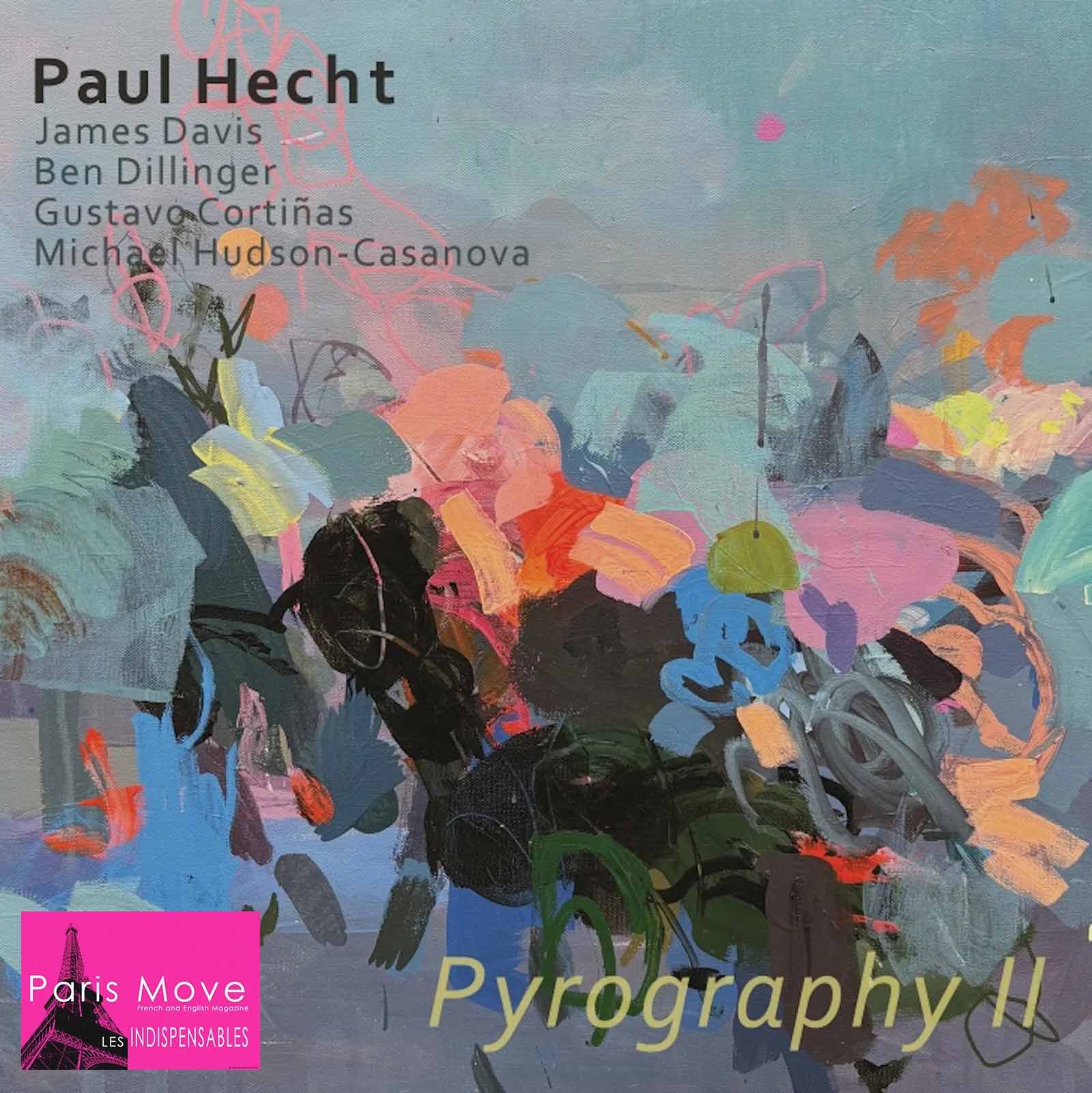
Summary: Paul Hecht’s Pyrography II is an ambitious modern jazz album blending post-bop energy, theatrical composition, and controlled improvisation. The record stands out for its intricate structures, emotional ambiguity, and a strong ensemble performance that blurs the line between written music and spontaneous creation.
Paul Hecht’s “Pyrography II” Turns Jazz Into an Intellectual Fever Dream
It is late in a rehearsal space where nothing feels fully settled. Instruments are warming rather than playing, fragments of sound testing the air, as if the music is still deciding what it wants to become. In that in-between space, where intention and accident briefly overlap, Paul Hecht appears less like a traditional bandleader than a quiet stage director, listening more than speaking, already shaping the contours of something that has not yet fully revealed itself. What emerges from this environment on “Pyrography II” feels less like a collection of compositions than a living system in motion.
There are albums that demand attention before a single note has fully settled into silence. Sometimes, the mere presence of a musician’s name is enough to trigger that rare form of concentrated listening, the kind practiced by the most meticulous jazz critics, where every phrase, every hesitation, every tonal shift matters. Hecht has long belonged to that category of composers whose work inspires both patience and a kind of analytical surrender. From the opening moments of “Pyrography II,” the listener is drawn into a post-bop atmosphere that recalls the spirit of Miles Davis, not through imitation but through structural ambition and collective risk. The music unfolds in a constant state of becoming, each idea appearing as if it might either dissolve or transform at any moment.
At times, that density borders on excess, as though the architecture of the music is pressing against its own limits. Yet it never quite breaks. Instead, it holds, teetering between control and unraveling, and it is precisely in that tension that its power resides. The result is a record that feels intellectually commanding but also slightly unstable, as if it could reconfigure itself differently on each listening.
Hecht’s compositional language is highly constructed, but never static. His writing develops through extended forms, through juxtaposition and revision, through ideas carefully assembled, dismantled, and reassembled across rehearsals and performances. Nothing arrives fully formed. Themes emerge, fracture, and return in altered states, shaped by the evolving chemistry of the ensemble. Drawing on his background in theater, Hecht approaches the group almost as a director might approach a cast, assigning not roles in a fixed sense, but trajectories of interaction. Each musician becomes both character and narrator within a shifting structure.
That theatrical instinct gives the music a peculiar sense of staging. It is not simply that instruments respond to one another, but that they seem aware of being observed within a larger unfolding scene. Silence carries as much intention as sound. Even hesitation feels composed.
The piano work is particularly striking in this regard, not as ornament but as structural turning point. These moments do not interrupt the narrative, they redirect it. Yet what makes Hecht’s approach most compelling is also what makes it elusive. His influences are deliberately obscured, filtered through such a dense network of ideas that they become difficult to isolate. Literature, modernist composition, experimental theater, visual art, all seem present, but none announce themselves clearly. The listener is left in a productive uncertainty, required to participate rather than simply receive.
One of the most fascinating aspects of the record is how it resists the usual boundary between composition and improvisation. That boundary is not blurred so much as continuously renegotiated. Bassist Ben Dillinger, drummer Gustavo Cortiñas, and trumpeter James Davis perform with a precision that never feels rigid. Their playing suggests not constraint but heightened attention, as if every gesture is the result of collective listening rather than individual assertion.
When asked, musicians in this orbit often describe Hecht’s structures less as restrictions than as invitations. The framework sharpens instinct. It forces decisions that might otherwise remain unspoken. In this sense, the ensemble functions less like a traditional jazz group and more like a chamber theater company, where each voice carries narrative responsibility, and meaning emerges through interaction rather than hierarchy.
The emotional center of the music is equally complex. It does not settle into a single dominant mood. Instead, it moves through overlapping states of curiosity, tension, clarity, and rupture. What lingers is not melody in a conventional sense, but a persistent sense of motion, as if the music refuses to remain still long enough to be fully named.
The album’s title, drawn from the poem “Pyrography” by John Ashbery, offers a key to its underlying philosophy. Pyrography, writing with fire, implies both inscription and disappearance. What is written burns into presence and then fades. Improvisation functions in a similar way, carrying both permanence and impermanence in the same gesture. Hecht has pointed to Ashbery’s ability to weave kitsch and irony into forms that ultimately feel sincere, a tension that runs throughout this record. Beneath its intellectual density lies a surprising emotional openness.
That openness becomes especially evident in “LDD,” or “Low Dissonant Development,” which unfolds like a nocturne built from sustained tension rather than resolution. Here, Hecht asks Davis to approximate on trumpet the texture of tightly stopped violin strings, producing tones that feel physically resistant, almost strained. The instrument seems to push back against its own sound production, creating a kind of expressive friction. The effect is not decorative but structural, shaping the listener’s perception of instability itself.
The album occasionally invites comparison to political and theatrical experiments that sought to unsettle rather than soothe. The influence of Bertolt Brecht is difficult to ignore, particularly in his rejection of passive spectatorship, and his collaboration with composer Kurt Weill on works such as The Threepenny Opera and Rise and Fall of the City of Mahagonny. Those works used popular idioms to disrupt expectation, a strategy that resonates here, though in a more abstract musical language. The listener is continuously placed in a position of interpretive uncertainty, encouraged to question what is composed, what is spontaneous, and what lies somewhere in between.
Hecht himself seems less interested in resolution than in perpetual reconfiguration. As he has suggested, the goal is to keep reshuffling the possibilities until new combinations emerge, new energies reveal themselves. In that sense, his approach resembles painting as much as composition, closer perhaps to the logic of transformation found in the work of Salvador Dalí than to conventional jazz writing. The material is never fixed. It is continuously revised in real time.
This is also where the music begins to feel emotionally recursive. It does not end so much as it returns. Even after repeated listening, it resists final comprehension, as though each encounter is only a partial reading of something larger still unfolding elsewhere. There is pleasure in that resistance, but also a subtle provocation. The listener is never fully outside the work, but never fully inside it either.
In the end, “Pyrography II” leaves behind something closer to a trace than a statement. Like its title suggests, it feels inscribed rather than simply composed, as if the music were burned into memory in fragments rather than whole forms. One returns not because it has been understood, but because it continues to rearrange the terms of its own meaning. And perhaps that is its most compelling achievement.
Thierry De Clemensat
Member at Jazz Journalists Association
USA correspondent for Paris-Move and ABS magazine
Editor in chief – Bayou Blue Radio, Bayou Blue News
PARIS-MOVE, May 17th, 2026
Follow PARIS-MOVE on X

::::::::::::::::::::::::
Musicians:
Paul Hecht, piano
Ben Dillinger, bass
Gustavo Cortiñas, drums
James Davis, trumpet
Michael Hudson-Casanova, alto sax
Track Listing :
Hero Complex
My Chromatic Romance
LDD
Seriously
Wayne
WWFH
Countdown
A Lullaby
Like Someone in Love
Femme R
Recorded by Vijay Tellis-Nayak at Transient Sound in Chicago IL
Mixed by Scott Steinman, Studiomedia Recording, GardenView Sound Studio, Evanston IL
Mastered by Anthony Gravino, High Cross Sound, Urbana IL
Produced by Paul Hecht and Gustavo Cortiñas
Paintings by Emily Pfaff
Design by Matthew Golbombisky
Videos by Ryan Bennett
All compositions by Paul Hecht, WWFH Music (ASCAP), except #2, by Rodgers & Hart, #7, by John Coltrane, and #9, by Van Heusen & Burke
Special thanks to KM, WW, FDK, and DFH, to Gustavo, Ben, James, Rob, Dan, Mark, Vijay, Scott, Emily, Matthew, and Anthony