| Jazz |
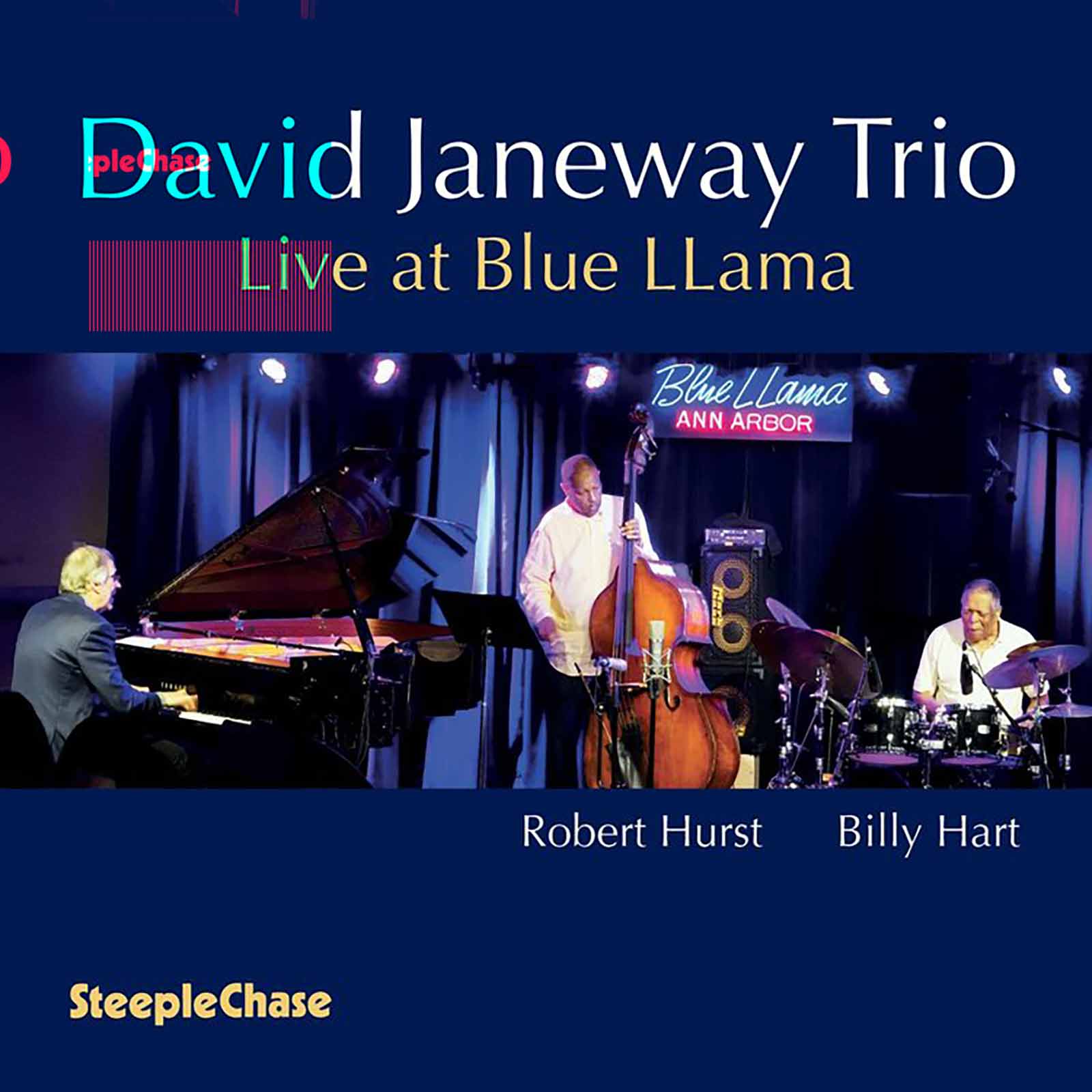
Summary: Pianist David Janeway delivers an elegant and deeply human live recording alongside Billy Hart and Robert Hurst, blending Detroit jazz tradition with subtle contemporary emotion on Live at the Blue Llama.
David Janeway’s Live at the Blue Llama Revives the Timeless Spirit of Jazz Trio Tradition
A warm summer evening settles over Ann Arbor, the kind of night where conversations soften as the lights dim inside the intimate room of the Blue LLama Jazz Club. Glasses clink quietly in the background, musicians exchange a brief glance, and within seconds the atmosphere changes completely. Jazz, when performed at this level, does not merely entertain. It transforms a room. Released at the beginning of this month, Live at the Blue Llama captures precisely that sensation, a recording where spontaneity, elegance, and decades of shared musical experience merge into something deeply human.
Majestically recorded and mixed, the album presents pianist David Janeway in a trio setting that feels timeless without ever sounding trapped in nostalgia. It is classical jazz in the noblest sense of the word, rooted in swing, lyricism, and collective interplay, yet performed with such grace and conviction that resisting its charm becomes nearly impossible. This marks Janeway’s third trio recording for SteepleChase Records, and by now the relationship between the musicians has evolved far beyond technical chemistry.
Over the years, Janeway has built profound musical connections with drummer Billy Hart, a Jazz Master recognized by the NEA whose influence on modern jazz spans generations, and bassist Robert Hurst, another Detroit-born musician with whom Janeway first performed during the early 1980s. Yet the true strength of this trio does not come simply from the format itself. Jazz history is filled with piano trios. What distinguishes this ensemble is the accumulated weight of experience carried by each player, decades of touring, improvising, listening, adapting, and refining their musical instincts night after night before live audiences.
Anyone revisiting the group’s previous recordings immediately hears that sense of lived experience flowing through every phrase. The cohesion is not rehearsed into existence. It has been earned slowly over time. On this album, the trio largely turns toward compositions by other writers, a choice that ultimately makes perfect sense when one considers Janeway’s artistic upbringing. He emerged from an environment where mentorship, groove, and collective spirit were inseparable from the music itself.
As a teenager, Janeway encountered the artists who would permanently shape his musical identity. He listened to Oscar Peterson perform at Detroit’s legendary Baker’s Keyboard Lounge, then soon afterward discovered The Creative Profile, an ensemble deeply influenced by John Coltrane and led by trumpeter Marcus Belgrave alongside tenor saxophonist Sam Sanders. Those experiences redirected his artistic path entirely, placing him within the long lineage of Detroit jazz musicians committed to preserving individuality while remaining firmly connected to tradition.
To reach this level of artistry, however, heritage alone is never enough. Passion becomes the essential force. Listening to Live at the Blue Llama, one inevitably thinks of classic recordings by Peterson, Duke Ellington, and other towering figures from jazz’s golden eras. Janeway’s trio clearly understands that legacy, but what makes the album compelling is the subtle manner in which contemporary sensibilities quietly emerge beneath the traditional framework. This is not an exercise in nostalgia. It is a continuation of the language.
That delicate balance becomes especially noticeable after several listens. Janeway’s own compositional voice reveals itself gradually through moments of quiet dramaturgy and emotional restraint. Fragments of his personality surface throughout the album, but perhaps nowhere more strikingly than during the trio’s interpretation of Peacock’s “Gardena.” There, Hart’s drumming never overwhelms the conversation. Instead, he shapes the music through small rhythmic accents and shifting textures while Hurst anchors the performance with a bass line that feels simultaneously grounded and fluid. Janeway responds with phrasing that unfolds almost conversationally, allowing silence and space to become part of the melody itself. The result is less a demonstration of virtuosity than a lesson in collective listening.
There is something deeply reassuring about musicians continuing to explore jazz within a traditional framework. It allows listeners to reconnect with the roots of the music even as contemporary jazz continues branching into increasingly experimental directions.
The beauty of this trio lies precisely in that balance between reverence and evolution.
Recorded live on June 15, 2024, at the Blue Llama Jazz Club, the album captures three virtuoso musicians engaged in constant spontaneous dialogue. Standards and original compositions unfold naturally, never rushed, never forced, allowing the music to breathe with the kind of openness and mutual understanding that only years of collaboration can produce. The production itself deserves recognition as well. The recording preserves the warmth of the room without sacrificing detail, allowing every cymbal shimmer, bass resonance, and piano nuance to remain vividly present. In an age where many live jazz albums feel overly polished, this recording retains the fragile immediacy that makes live performance meaningful.
And perhaps that is the defining beauty of jazz itself. Unlike many genres that reward immediacy or youth, jazz often allows musicians to deepen artistically across an entire lifetime. Every career follows a different rhythm. Miles Davis, for instance, sometimes appeared years ahead of his era and at other moments embraced the changing currents around him. Yet throughout countless interviews, Davis repeatedly insisted that a true jazz musician must understand every dimension of the music.
Looking at the careers of Janeway, Hart, and Hurst, one senses that exact philosophy guiding this album. Their playing carries not only technical mastery, but memory, patience, and a profound understanding of the tradition expansive enough to leave room for transformation. In many ways, Live at the Blue Llama feels connected to the enduring spirit of Detroit jazz itself, a tradition built on discipline, individuality, and collective conversation. Long after the final notes fade, that spirit continues to resonate quietly in the listener’s mind, much like the lingering atmosphere of a great late-night set that nobody in the room truly wanted to end.
Thierry De Clemensat
Member at Jazz Journalists Association
USA correspondent for Paris-Move and ABS magazine
Editor in chief – Bayou Blue Radio, Bayou Blue News
PARIS-MOVE, May 13th, 2026
Follow PARIS-MOVE on X
::::::::::::::::::::::::
Musicians:
David Janeway: piano
Robert Hurst: bass
Billy Hart: drums
Track Listing :
ALL THE THINGS YOU ARE (Jerome Kern) 6:28
A CHILD IS BORN (Thad Jones) 4:51
FORWARD MOTION (David Janeway) 5:49
SWEET AND LOVELY (Gus Arnheim) 7:07
GARDENIA (Gary Peacock) 7:30
K’S SHUFFLE (David Janeway) 4:40
STAR CROSSED LOVERS (Billy Strayhorn) 6:46
YOU AND THE NIGHT AND THE MUSIC (Arthur Schwartz) 5:47
I SHOULD CARE (Sammy Cahn) 5:38
SEARCH FOR PEACE/BLUES ON THE CORNER (McCoy Tyner) 8:39