| Contemporary music |

Alex Lubet: Songs in Time of Plague – A Solo Journey for Resonator Guitar and Mountain Dulcimer
After listening many, many times to the great album Songs of Love and Loss by Alex Lubet & Amy Levy (online review on Paris-Move), to which I gave the “a must” mark, the highest one on Paris-Move, I discovered on Neuma Records’ website the album that came just before it, Songs in Time of Plague, released in 2022. I had missed it at the time, and I immediately wanted to hear it. Listening to this earlier record, and then returning to Songs of Love and Loss, confirms the immense talent of Alex Lubet for that fantastic instrument, the mountain dulcimer, an instrument that Brian Jones played with the Rolling Stones (think of “Lady Jane” and “I am waiting”, on Aftermath, in 1966), a proof of the talent of Brian, who left us far too soon.
But Songs in Time of Plague is more than a prequel. It is a complete world of its own, and one of the most original solo albums to come out of the pandemic years. Two works, two very different instruments, one man alone with his thoughts: an eighteen-minute piece for resonator guitar, then seventeen miniatures for dulcimer. Lubet’s music has been described as bringing together the universe of Muddy Waters, the tape-splicing adventures of ‘musique concrète’ and the suspended time of Morton Feldman. After this record, you understand why the description fits.
Alex Lubet, a one-man universe: Born and raised in Chicago, Alex Lubet has lived in Minnesota since 1979. He is a composer, a multi-instrumentalist, an author and a teacher at the University of Minnesota, equally at ease with notated scores, improvisation and everything in between. He is also a pioneer: he is widely credited with founding the field of disability studies in music, and he has spent decades writing about artists whose hands or arms were impaired, jazz guitar legend Django Reinhardt being the most famous of them. In recent years he has concentrated on solo performance with fretted string instruments, because it lets him explore subtle shades of timbre and move freely in time.
What gives this album its depth is that the two halves of the story meet in one life. In 2020, after years of studying creativity born from physical limitation, Lubet temporarily lost the use of his right arm. The scholar became his own case study, and the result is the first track of this record.
“On the Seventh Hour”: a guitar turned into an orchestra of percussion. The album opens with its monumental piece, 18 minutes and 12 seconds for resonator guitar (the metal-bodied instrument known as the National steel guitar or dobro), played here on a National Delphi. Because Lubet could only play with one hand, helped by an adaptive table, he did not try to work around the limitation: he built a piece from it. The guitar becomes a percussion ensemble as much as a string instrument. Sticks, beaters and mallets strike the strings and the metal body with its built-in resonators, a slide is used one-handed, which gives it a colour of its own, the left hand frets and plucks at the same time, producing chords on individual strings and, once some use of the right hand returned, a double-bass bow added a long, singing breath to the palette. Dozens of new timbres were found along the way.
The making of the piece is as fascinating as the music. Nearly every sound was recorded separately, one take at a time, with each change of mallet or beater, and the sounds were so delicate that Lubet had to hold his breath while playing them. Then, in the studio, with the help of producer Steve Barnett, the sounds were assembled one after another. Apart from some reverb, balance and editing, everything you hear is the unprocessed sound of a single resonator guitar! This makes On the Seventh Hour a work of old-school ‘musique concrète’ with only one sound source, which happens to be a musical instrument. It is, by the way, a piece that cannot be performed live: it exists only on this recording, which makes owning the album essential.
The title comes from a line of Muddy Waters’ 1954 classic “Hoochie Coochie Man”, a tribute to Chicago blues, but also a hint at the numerology behind the form: the hidden structure is made of fourteen (2 x 7) choruses of twelve-bar blues. You will not hear a blues in the usual sense, yet its pulse and its pitches are there, buried deep in the sounds, while a sense of time inspired by Feldman lets every note, every knock, every shimmer of resonance take the space it needs. The effect is mysterious, spacious, almost ritual. Close your eyes and you could be inside the body of the guitar, listening to it think.
Then comes the second work, tracks 2 to 18, for the mountain dulcimer, a McSpadden Model 4FHWR. This American plucked folk instrument, born in the 19th century in the Appalachian mountains, usually has three strings, as it does here. Lubet gives himself rules that would make most musicians pale: seventeen different tunings, each with open strings in equal temperament, climbing from the lowest to the highest, one step higher with every song; improvisation throughout; and no capo, no glass slide, no dulcimer hammer, nothing but the hands. A challenge to improvise a complete concert-length work with only three strings, and an answer to the isolation of lockdown, though not a programmatic depiction of it.
The tunings give the cycle its architecture, but the music itself is free, and this is where the album enchants. Each song has its own character, and the range of colours that Lubet draws from three strings is simply astonishing: soft and pretty at the beginning, with “Generation”, intricate and flowing in the middle, as in “Occasion”, sparse and poetic in “Space”, where silence plays as big a role as the strings, and dreamy and luminous at the end, in “Eternity”, which at more than five minutes is the longest of the seventeen and the perfect final bow. The pieces are short, most of them between two and three and a half minutes, like pages turned in a diary. Listen to them one after another and you hear a man slowly climbing, tuning by tuning, out of the dark.
The titles themselves tell a story. Read them in order: Generation, Go, Moment, Tide, Occasion, Stage, Pace, Span, Present, Shift, Continuance, Extent, Space, Juncture, Lastingness, Infinity, Eternity. It is a meditation on time, from its smallest units and its passing, to the idea that nothing ends. In a period when the world stood still and so many people were lost, the progression from “Moment” to “Eternity” carries a gentle, consoling power. “Solo” here does not mean “lonely”.
A shorter version of the cycle, with twelve movements, was premiered at the 2021 Alba Festival in Italy, and the enthusiastic reception convinced Lubet to concentrate, as a dulcimerist, exclusively on solo improvisation. Today he uses thirty-five unique tunings. You can hear in this record the moment this path was chosen, and why it was the right one.
A word about the sound, which is crucial for such delicate music. The album was recorded in January 2022 at the Lloyd Ultan Recital Hall of the School of Music of the University of Minnesota, produced by Steve Barnett and engineered by Preston Smith, the team who also stand behind Songs of Love and Loss. They capture the grain of the strikes on the resonator, the bloom of the overtones, the breath of the dulcimer’s open strings and the silences between them, with a natural warmth that makes headphones a joy. Philip Blackburn designed the package, and funding came from the Grant-in-Aid Program and the Imagine Fund of the University of Minnesota.
At almost an hour and four minutes, this is an album to enter slowly, in a quiet moment, and to hear in one go, from the first strike of mallet on metal to the last echo of “Eternity”. It asks for attention, and it rewards it generously. It is contemplative, inventive and deeply human: a record that turns a surgery, a pandemic and three strings into something beautiful, and shows that limitation, far from closing doors, can open entire worlds.
For those who already know Alex Lubet through Songs of Love and Loss, it is the missing chapter, a look into the workshop of an artist who keeps reinventing what a folk instrument can do. For those who discover him here, it is the perfect introduction to one of the most singular musicians of our time. Songs in Time of Plague is a rare, moving and original album, and an absolute pleasure.
Frankie Pfeiffer
Editor in chief – PARIS-MOVE
PARIS-MOVE, October 17th, 2026
Follow PARIS-MOVE on X
:::::::::::::::::::::
To buy the album on the Bandcamp
To buy the album on NEUMA Records’ wesite
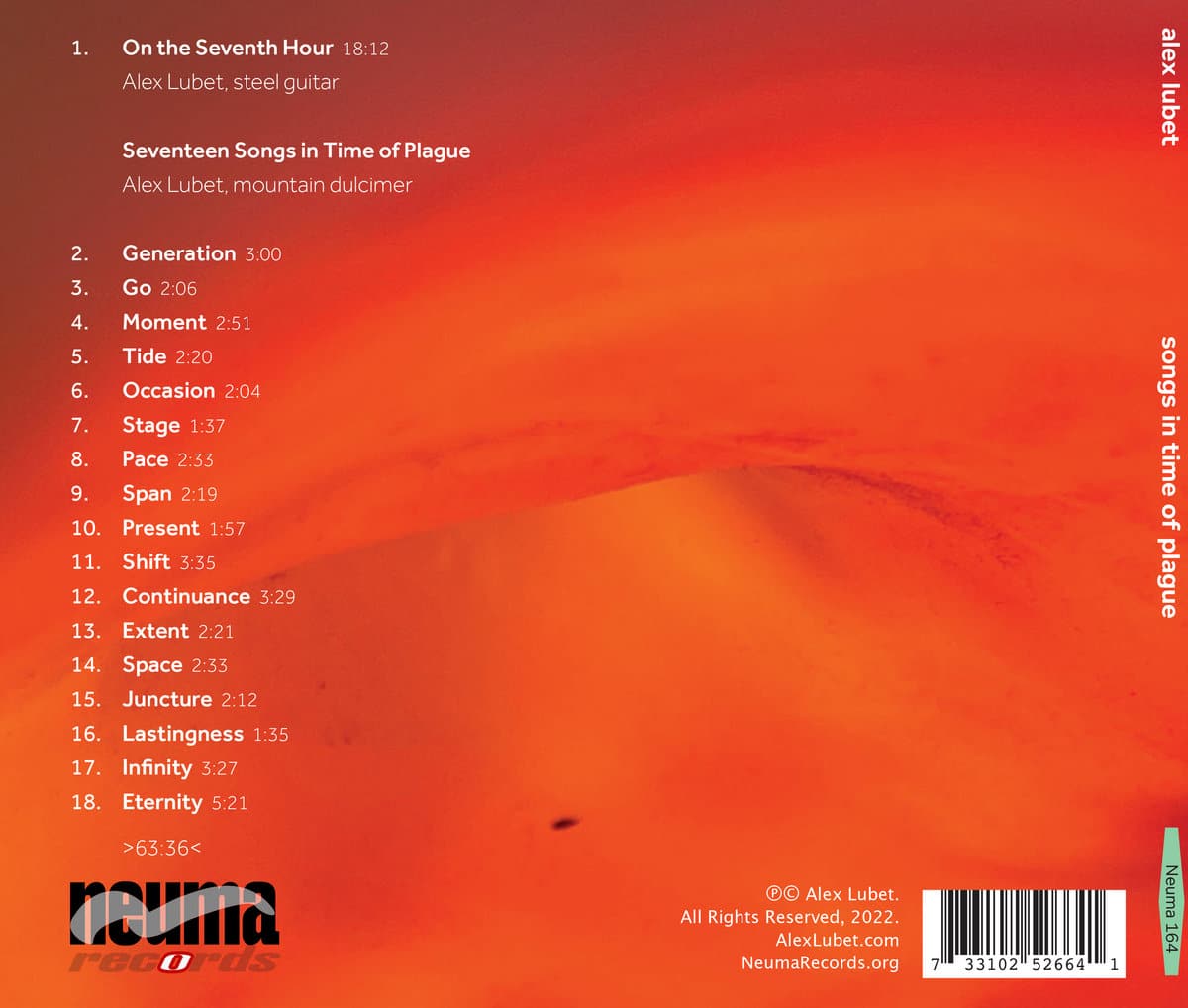
Tracklisting:
1. On the Seventh Hour 18:12
Alex Lubet, steel guitar
Seventeen Songs in Time of Plague
Alex Lubet, mountain dulcimer
2. Generation 3:00
3. Go 2:06
4. Moment 2:51
5. Tide 2:20
6. Occasion 2:04
7. Stage 1:37
8. Pace 2:33
9. Span 2:19
10. Present 1:57
11. Shift 3:35
12. Continuance 3:29
13. Extent 2:21
14. Space 2:33
15. Juncture 2:12
16. Lastingness 1:35
17. Infinity 3:27
18. Eternity 5:21
Total running time: 63:36
Credits:
Alex Lubet – National Delphi steel guitar (track 1), McSpadden Model 4FHWR mountain dulcimer (tracks 2–18)
Producer (recording, mixing, mastering): Steve Barnett (Barnett Music Productions, Minneapolis)
Engineer (recording, mixing, mastering): Preston Smith (Perfect Record, Mendota Heights, MN)
Recorded January 2022 at the Lloyd Ultan Recital Hall, School of Music, University of Minnesota
Design: Philip Blackburn
Neuma Records – CD Neuma 164 – 2022