
| Jazz |
Franck Amsallem and the Art of the Transatlantic Jazz Trio
New York has long been a proving ground for jazz musicians seeking not only recognition, but transformation. Franck Amsallem arrived there in 1986, joining a lineage of artists who crossed the Atlantic to test their craft against the city’s unforgiving standards. Nearly four decades later, his music bears the imprint of that decision: deeply shaped by New York’s jazz culture, yet inseparable from a European sensibility that privileges form, composition, and architectural clarity.
Trained in France, Amsallem belongs to a generation educated almost exclusively in classical conservatories, where jazz was absent from the curriculum. Like many of his peers, he learned jazz indirectly, through listening, transcription, and eventually immersion. That immersion became complete in New York, where he studied jazz composition with Bob Brookmeyer at the Manhattan School of Music and classical piano with Phil Kawin. Brookmeyer’s emphasis on large-scale form and harmonic logic, and Kawin’s rigorous pianistic discipline, would leave a lasting mark on Amsallem’s writing.
“There are many good pianists,” Amsallem once remarked, “but good pianists who are also good composers, that’s what makes the difference.” The statement is less a provocation than a personal manifesto. In New York, he learned jazz as it has traditionally been learned: first as an accompanist, absorbing time feel, repertoire, and professional discipline; then as a leader, confronting his own ideas with musicians who would not indulge vagueness or sentimentality. Recognition followed early, including second prize at the Great American Jazz Competition in Jacksonville. Still, ambition pushed him further. “All of that was wonderful,” he later said, “but the desire to lead was simply too strong.”
That desire took concrete form in 1990, when, at 28, Amsallem recorded Out A Day, a trio album with Gary Peacock and Bill Stewart, supported by the Fondation de la Vocation and a National Endowment for the Arts grant. Critics noted not only the maturity of his piano playing, precise touch, balanced voicings, a firm sense of swing, but also the coherence of his compositions, which resisted both virtuoso display and casual looseness.
This dual identity, as pianist and composer, is central to understanding Amsallem’s latest work. His writing aligns him less with the European free-jazz tradition than with composers who value structure and melodic durability. In that sense, his lineage is closer to Bob James than to Joachim Kühn. The new album’s interest lies precisely there: in the way familiar material is not merely interpreted, but reorganized. Several “covers” function as near-recompositions, while the originals reinforce an overall logic that makes the album feel conceived rather than assembled.
The opening track, “Agrigento,” sets the tone immediately. Built on a clear formal arc, it unfolds through carefully voiced harmonies and controlled dynamic shifts, offering a lucid example of Amsallem’s compositional priorities. This is jazz for listeners attentive to form, balance, and long-term development, music that invites analysis without sacrificing lyricism.
If Amsallem resists easy comparison, it is because his style results from a complete fusion of cultural influences. He has absorbed New York’s rhythmic authority and professional rigor, while retaining a European concern for proportion and harmonic coloration. The question of whether he is “more American than French” ultimately feels beside the point. For artists open to transformation, the United States often functions as a creative crucible—a place where inherited languages are reshaped under pressure. Amsallem’s music reflects that process in real time.
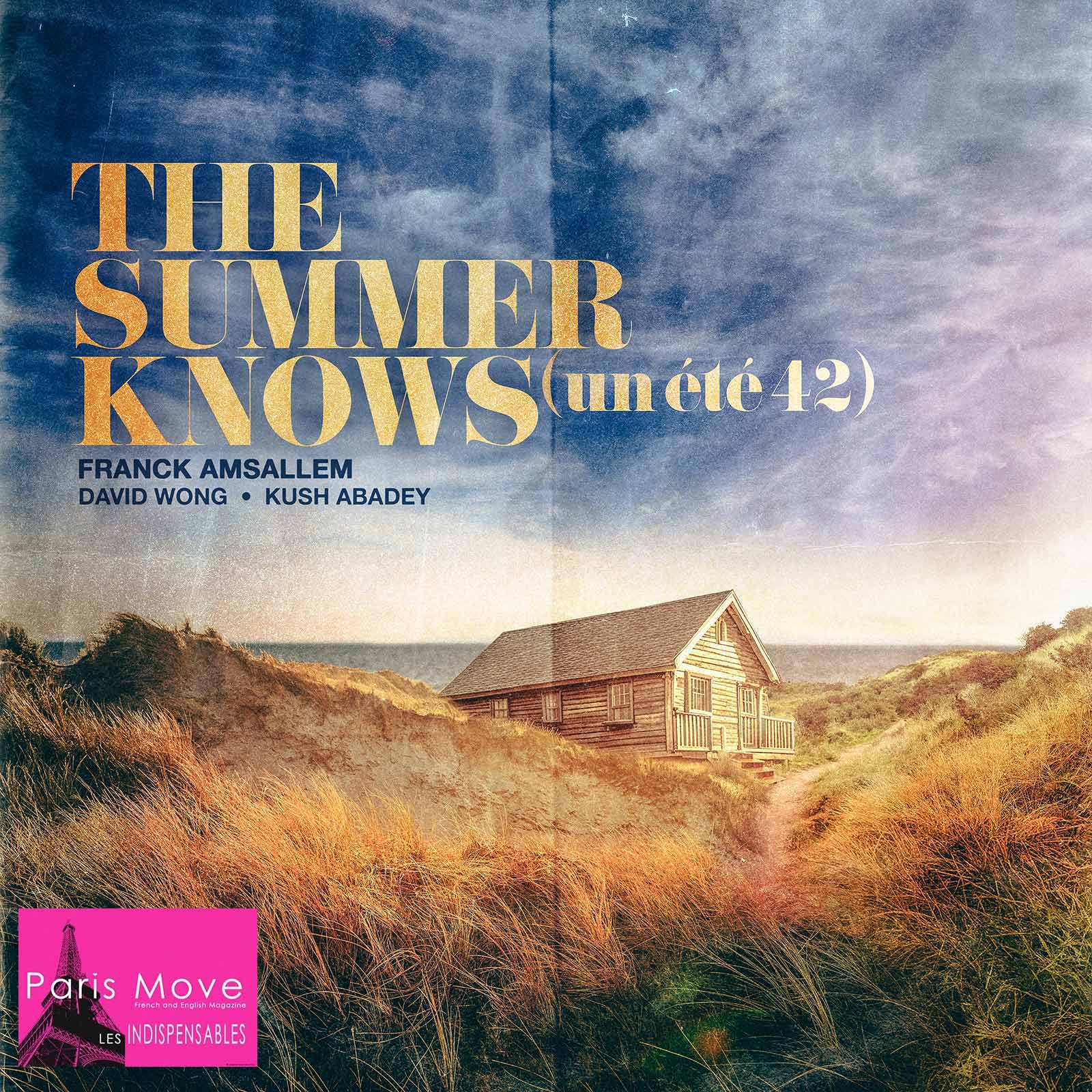
The Summer Knows, his eleventh album, represents a return to fundamentals through renewal. It revives what critic Franck Médioni aptly calls the “isosceles trio”: piano, bass, and drums in a relationship of strict equality. For the first time, Amsallem records with bassist David Wong and drummer Kush Abadey, both more than two decades his junior. Wong’s playing is notable for its economy, notes placed precisely, with a supple, singing tone, while Abadey combines physical intensity with acute responsiveness, shaping form as much as driving pulse.
Recorded at Samurai Studio in New York, the album centers on reinterpretation. Standards drawn from the shared memory of jazz coexist with two French film themes: Michel Legrand’s “The Summer of ’42” and Philippe Sarde’s “La chanson d’Hélène.” Rather than treating them as vehicles for nostalgia, Amsallem rebuilds them harmonically, clarifying their inner logic and extending their expressive range. For listeners long indifferent to cinematic jazz adaptations, these versions may come as a surprise: the melodies are neither ornamented nor sentimentalized, but integrated into a coherent pianistic language.
Risk-taking remains a defining principle. “I wanted to surround myself with musicians who would give me new energy,” Amsallem explains. “They are 25 years younger than I am. When I heard David Wong and Kush Abadey play together, I knew they would naturally grasp my particular tempos and grooves, as well as my European-inflected harmonic approach. I also knew they would help shape my solos—far from neo-bebop clichés or improvisation without structure.”
The result is music of striking elegance and control, grounded in dialogue rather than display. One can only hope that Franck Amsallem will soon bring this trio back to American stages. It is not merely a new configuration, but a compelling statement about where composition, experience, and generational exchange can still take modern jazz.
Thierry De Clemensat
Member at Jazz Journalists Association
USA correspondent for Paris-Move and ABS magazine
Editor in chief – Bayou Blue Radio, Bayou Blue News
PARIS-MOVE, January 22nd 2026
Follow PARIS-MOVE on X

::::::::::::::::::::::::
Musicians :
Franck Amsallem: Piano
David Wong: Bass
Kush Abadey: Drums
Track Listing :
Agrigento
Blue Gardenia
Cotton Trails
Disclosure
La chanson d’Hélène
Morning Star
The Summer Knows (Un été 42)
Unforgettable
You Won’t Forget Me
Recorded at Samurai Studios — New York, NY • June 18, 2024
Mixed and Mastered by Alban Sautour
Art Direction + Design: Guillaume Saix