| World |
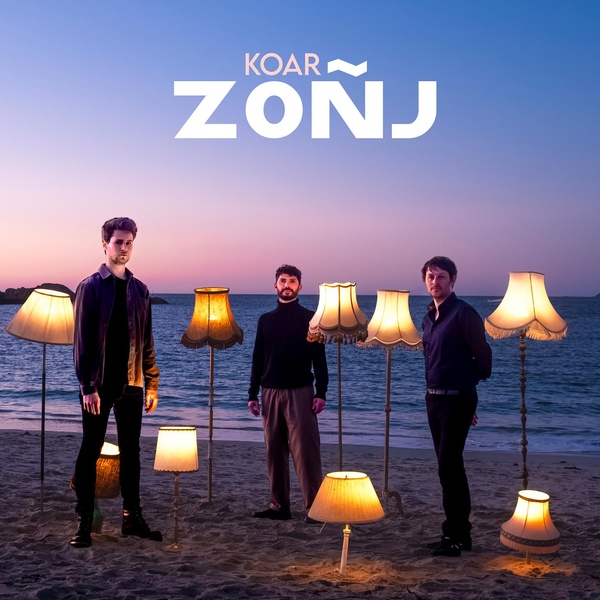
Koar is one of those albums that quietly announces itself before revealing remarkable depth. There are no flashy production tricks, no attempts to modernize tradition through electronics or crossover effects. Instead, this Breton trio places its faith in something far more enduring: the strength of melody, the vitality of dance, and the living heartbeat of a musical tradition that continues to evolve while remaining deeply rooted in its origins. The result is an album that feels timeless and refreshingly contemporary at the same time.
The title Koar (“wax” in Breton, but also suggestive of something shaped, moulded and patiently refined) perfectly reflects the trio’s artistic approach. Over several years of performing together, Baptiste Barbier, Elouan Le Couls and Julien Daniélo have patiently forged a collective voice that now sounds entirely their own. If ZOÑJ’s excellent self-titled debut in 2018 introduced a promising ensemble, Koar is the record that confirms its artistic maturity.
At the heart of ZOÑJ’s identity lies an original instrumental balance. Baptiste Barbier’s transverse wooden flutes and Elouan Le Couls’ violin weave melodies of remarkable fluidity and elegance, while Julien Daniélo’s chromatic accordion, who joined the group after the first album, transforms the trio’s entire sonic landscape. Rather than simply accompanying the melodies, the accordion becomes a rhythmic engine. It is a subtle but decisive evolution that gives Koar its unmistakable personality.
Instead of reproducing tradition, ZOÑJ translates its essence into a new instrumental language where flute and violin assume the melodic dialogue while the accordion supplies the rhythmic propulsion usually associated with percussion. It is an ingenious solution that allows the music to remain unmistakably Breton while sounding entirely fresh.
Everything here is acoustic. There are no effects, no studio embellishments, no unnecessary virtuoso displays. That apparent simplicity is deceptive, because beneath it lies extraordinary musicianship. Every phrase feels carefully considered, every ornament perfectly placed, every rhythmic shift natural and inevitable. The trio’s years of playing together are evident in the almost telepathic interaction between the musicians. They breathe together, accelerate together, pause together, creating music that feels organic rather than constructed.
One of the album’s greatest achievements is its ability to satisfy two audiences simultaneously. For dancers, Koar is first and foremost a magnificent fest-noz album. The pulse never weakens, the grooves remain irresistible, and nearly every piece seems destined to fill dance floors across Brittany. The rhythmic energy is contagious without ever becoming repetitive, preserving that hypnotic momentum that makes Breton dance music so captivating. Yet for listeners approaching the album simply as a musical experience, Koar offers much more than functional dance tunes. Listening attentively reveals a wealth of subtle harmonic choices, modal inflections and elegant melodic developments. ZOÑJ clearly sees Breton music not as a museum piece but as a living art form capable of absorbing influences from both folk traditions and more sophisticated compositional thinking. Without ever abandoning its roots, the music continually expands its expressive vocabulary.
Throughout the twelve pieces, the trio moves effortlessly between contemplative lyricism and exhilarating dance energy. Certain melodies evoke the windswept landscapes of Trégor, while others burst with an almost celebratory exuberance. There is poetry in the quieter passages and irresistible momentum whenever the rhythmic pulse takes over. Even listeners unfamiliar with Breton music quickly discover that its emotional language is universal.
The first track, like the entire album, is intended for dancers with its “A temps perdus – Ridée 6 temps”. The ridée is a collective dance from the south of Brittany, in circle, with quite fast arms moves, and the steps are based on a 6 beats (“6 temps”) cycle. Perfect for starting to listen to this album and letting yourself get carried away by the trio’s infectious energy. That first dance is followed byt another one, “Raki’s jigs – Cercle circassien” (or Circassian Circle) which is a popular traditional folk dance originating from northern England (Northumberland), danced in a large circle with alternating partners. But just how and when did this English dance establish itself in Brittany to the point where it appears on this album? It was simply introduced between the World Wars by Miss Pledge and later popularized in the 1970s folk revival by Yvon Guilcher. The album invites you to continue dancing, including two Rondes de Loudéac, a traditional Breton dance, to which several tunes are played, a tune that was popularized through the playing of fiddler Christian LeMaítre of the Breton band Kornog.
The appearance of Anjela Lorho-Pasco adds another welcome dimension. Her unmistakable voice, carrying the warm colours of the Vannes dialect, brings an additional layer of authenticity and emotion. Rather than becoming the album’s focal point, her contributions blend naturally into ZOÑJ’s sonic world, enriching the musical palette while reminding us of the inseparable relationship between Breton language, song and instrumental tradition.
Special mention should also be made of artistic director Floriane Le Pottier, whose sensitive guidance helps shape the album’s remarkable coherence, and recording engineer Heikki Bourgault, whose work at Les Logelloù captures every nuance with impressive clarity. The recording possesses warmth, air and intimacy, allowing each instrument to resonate naturally while preserving the energy of live performance.
Perhaps the most admirable aspect of Koar is that it never feels nostalgic. Many traditional music projects look backwards, preserving heritage with almost archival caution. ZOÑJ chooses another path. Their music honours tradition precisely by allowing it to continue evolving. The trio demonstrates that Breton music remains vibrant, inventive and fully relevant in the twenty-first century. This is heritage not preserved under glass but lived, danced and continuously reinvented.
There is also something deeply human about the album’s philosophy. In the Trégor dialect, ZOÑJ means thought, reflection, ideas. Yet the group wisely recalls an old gwerz that says: “Ne chomin ket da ZOÑJal… Me ‘zaio da zañsal!” (“I won’t just sit here thinking… I’m going to dance!”). That single sentence perhaps encapsulates the spirit of the entire record. Reflection and movement, poetry and celebration, tradition and renewal coexist naturally throughout these performances.
For listeners already passionate about Breton music, Koar will undoubtedly rank among the finest releases of recent years. For newcomers, it is a magnificent gateway into a rich tradition whose emotional power transcends language and geography. And for anyone who values acoustic music at its highest level, it proves that imagination, craftsmanship and genuine sincerity are worth far more than technological excess.
With Koar, ZOÑJ has made far more than another traditional music album: deeply rooted yet constantly looking forward, it celebrates community, memory and musical dialogue with extraordinary grace, and confirms the band as one of the most imaginative voices on today’s Breton scene. An album to listen to, to admire… and above all, to dance to.
Frankie Pfeiffer
Editor in chief – PARIS-MOVE
PARIS-MOVE, July 27th, 2026
Follow PARIS-MOVE on X
::::::::::::::::::::::::
PS: And a few words about Compagnie Beliza, an organization dedicated to creating, promoting, supporting, and disseminating artistic and cultural activities centered on traditional, acoustic, and improvised music. It is an organization, and a label, well worth supporting via their website.
::::::::::::::::::::::::
To buy the album on the FNAC website
Tracklisting :
- A temps perdus – Ridée 6 temps
- Raki’s jigs – Cercle circassien
- La belle Isa – Mazurka
- Feniciia – Laridé 8 temps (feat. Floriane Le Pottier)
- Tri faotr ieuank – Kas a-barh (feat. Pandero)
- Skluziou – Kost ar c’hoad
- Un détour par Caden – Ronde de Loudéac
- Le rozier – Baleu
- Le bon café – Ronde de Loudéac
- Ma tantine penouille – Riqueniée
- Scottish al logellou
- Disul vintin
ZOÑJ – Scottish al Logelloù:
ZOÑJ – Eus Loudieg da Gaden (Rond de Loudéac):