| Contemporary music |

Mary Ellen Childs’s North, Performed by Zeitgeist: An Arctic Soundscape That Listens to a Fragile Planet
The Arctic is famous for silence, but it is not an absence of sound. Wind changes direction, ice creaks and cracks, water moves under frozen surfaces, and distant noises rise out of a landscape that looks almost motionless. North, the new album from composer Mary Ellen Childs, is about that paradox: a record that sounds very still and is full of movement if you listen closely enough. It is performed by Zeitgeist, the Minnesota new music ensemble that has been championing adventurous music for around fifty years. The result is one of the most immersive music albums of the year, and one that asks you to slow down, sit still and pay attention.
The story starts with the Arctic Circle Expedition, a residency that places artists aboard an Arctic-bound vessel. Childs lived on a masted tall ship that left from Svalbard, an international territory only ten degrees from the North Pole and went ashore every day to explore the terrain and collect recordings and images. She came back with a deep impression of the sounds of the Arctic, which she describes as spare, often subtle and occasionally violent, and of an overwhelming breadth of land and sea. The colours she remembers are white, pink and blue. She also came back with a warning. Svalbard has never supported an indigenous population and has few residents today, and nature there “rules and demands the upper hand”, yet plastic and rubbish from faraway places pile up on the shore, and the receding glaciers and ice floes show the effects of human-caused climate change. For Childs, the lesson is that the air we breathe, the water we use and the ground we walk on are shared by everyone on the planet.
North did not begin as a CD. It was created as an immersive installation, commissioned by Zeitgeist as part of its DECADE FIVE project celebrating its 50 years. Childs worked with visual artist Lindsy Halleckson, who contributed abstract paintings in winter hues, and with videographers Tamara Ober and Caitlin Hammel, whose images of northern snowscapes were projected onto textured surfaces over four channels. Sculptural elements and a subtle scent designed by Childs completed the picture.
The piece premiered at the Anderson Center in Red Wing, Minnesota, in early 2023, and travelled to Carleton College’s Weitz Center and the University of Wisconsin-La Crosse. A new version then ran in the B Tunnel at Minneapolis-St. Paul International Airport from November 2025 to the summer of 2026, where thousands of travellers passed through it on their way somewhere else. It is a lovely idea, to offer a few minutes of Arctic stillness to people in transit. The album is the music from that installation, in twelve interconnected sections rather than one linear story, and it is built to work on its own, even without the paintings, the video and the perfume.
Mary Ellen Childs is one of the most original composers working in the United States. Her early reputation came from rhythmic, exuberant instrumental pieces such as Click, which the Village Voice compared to Steve Reich’s Clapping Music, and from “visual percussion” works for her ensemble CRASH, in which drummers move around on wheels. She has since written for Kronos Quartet, the Saint Paul Chamber Orchestra and many others, and her work crosses music, dance, theatre, video and, more recently, scent. She has studied fragrance design at the Institute for Art and Olfaction in Los Angeles and at the Institute for Perfumery in Grasse, and she hosts “scent dinners” at home, in which courses of food alternate with courses of scent and music. With that background, it is no surprise that North thinks of sound as a physical, almost tactile thing.
Zeitgeist is a quartet of two percussionists, piano and woodwinds, one of the longest-established new music groups in the country, with more than 500 commissioned works to its name. That adventurous background pays off here. Pat O’Keefe (clarinets) is a performer with a wide range, from orchestral work to improvised and world music, who brings long, breathing tones and a lot of colours. Nicola Melville (piano), a New Zealand-born pianist, is praised for her tone and nuance, and she gives the record much of its glitter and its sense of space. Heather Barringer and Patti Cudd (percussion) both have long experience with contemporary repertoire, and Barringer is also a member of Childs’s ensemble CRASH.
All of the sounds were made acoustically by the four musicians, except for the wind heard in “Floe” (track 9). Through layering, resonance and post-production, the recording gives them a depth and dimension that go beyond a normal chamber recording. It was recorded at Wild Sound by engineer Steve Kaul, and produced by Pat O’Keefe, Heather Barringer and Mary Ellen Childs.
The album is best heard from start to finish, but a few moments stand out. “Pink Blue White” opens the album and sets out its language. High, resonant tones seem to hover in the air, a lower voice gradually joins the pattern, and single notes drift away and are replaced by others. When the pitches finally meet, they produce a two-tone effect, broken by delicate percussion and a high piano motif. It sounds like a study of colour and light more than a tune.
“Aurora” adds movement. Plucked piano figures and shimmering chimes dance around held notes, while a low, breathy clarinet keeps the music grounded. The flicker of the northern lights is easy to imagine, and a deep rumble at the end gives the piece unexpected weight. “Earth as Body” moves from tone to suggestion: soft rattles, breath-like noises, birdlike whistles and shuffling percussion, a quiet scene that slowly becomes turbulent. There is no conventional melody, but there is a vocabulary, as if the earth were speaking.
“Boreas: Bringer of Cold” is named after the Greek god of the north wind and is the most ominous so far, with low vibraphone chimes, a distant rumble and floating clarinet. The pace quickens and the percussion grows more forceful. “The World Is Blue at Its Edges” is more restrained but just as uneasy, with fine high sounds set against hollow, earthy wind tones and distant, sonar-like chimes that suggest vast, unknowable space. “Frazil Ice” is one of the most enchanting moments. Named after the first fragile crystals that form in cold water, it focuses on bells and chimes, and offers a moment of rest in the middle of the album.
“Fallen Pieces of the Moon” brings piano, percussion and clarinet back together in a gently fantastical conversation, with a bell-like low motif, a climbing piano line and a clarinet that wanders freely. “Rumble” is short and elemental, distant thunder swelling and fading, a small reminder that nature can inspire awe and fear at the same time.
“Floe” is the album’s first long piece after the short ones, and it brings the sound of real wind. Widely spaced piano chords appear out of a sonar-like pulse, bells dust the surface, and the wind finally pushes the piano into the distance, leaving only chimes. “Dripping” evokes an ice cave with water falling from melting icicles. Echoing tones suggest cold air moving through a huge hollow space, and there is a sense of exploring a place whose shape you can only guess.
“Falling to the Sea” pairs gently shifting tones with scattered piano notes and soft chimes, while a darker undercurrent slowly creeps in under the fragile upper sounds. “Home” is the nearly ten-minute finale. It starts with a deep, vibrating tone that grows slowly, like a huge force gathering under the surface. A higher buzzing line cuts across it, and then the clarinet enters with unexpected warmth. The tension between foreboding and beauty makes it a gripping close, and at moments the upper voices have a strangely sacred, organ-like quality. The title is a quiet question: where is home, and who is it shared with?
Childs shows that chamber music can suggest a physical environment without literal imitation. The ensemble becomes a palette of textures, timbres and gestures that emerge, overlap and fade like the elements of a changing landscape. Zeitgeist treats a single struck chime, or a held clarinet note as a major event and plays the stormier passages with the same conviction.
This album has a considerable effect on the listener. It lets us feel both the enormous scale of this pole of ice and snow, its density and its power over human beings, its ability to dominate or even kill us, as history has shown, and at the same time its immense gentleness and its fragility in front of humanity and our power of destruction. It is an album that forces us to ask who we are, and what we want to leave to future generations, if humanity can still manage to think about the future rather than only the present. North is an invitation to reflect, and to act.
Beautiful, vulnerable and never entirely predictable, like the Arctic itself, North is a richly imagined reminder that the natural world is speaking all around us if we take the time to listen. Put on headphones, dim the lights, and let it take you north.
Frankie Pfeiffer
Editor in chief – PARIS-MOVE
PARIS-MOVE, November 15th, 2026
Follow PARIS-MOVE on X
:::::::::::::::::::::
Order the album on Neuma Records’ website
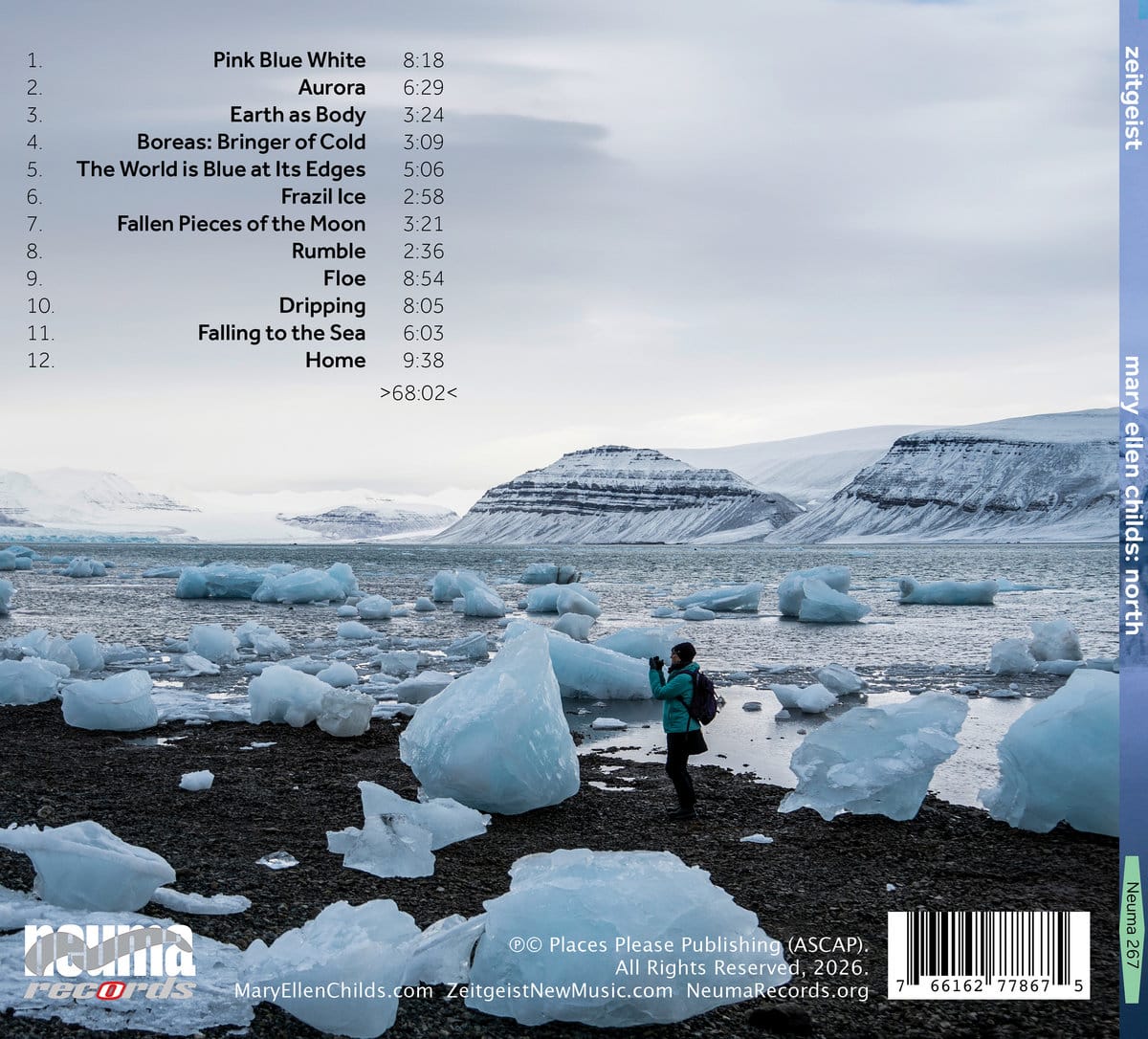
Tracklisting:
- Pink Blue White 8:18
- Aurora 6:29
- Earth as Body 3:24
- Boreas: Bringer of Cold 3:09
- The World is Blue at Its Edges 5:06
- Frazil Ice 2:58
- Fallen Pieces of the Moon 3:21
- Rumble 2:36
- Floe 8:54
- Dripping 8:05
- Falling to the Sea 6:03
- Home 9:38
Total length: 68:02
Musicians – Zeitgeist:
Pat O’Keefe: Clarinets
Nicola Melville: Piano
Heather Barringer: Percussion
Patti Cudd: Percussion
All sounds made acoustically by the musicians, except for the wind sound in Floe, Track 9
All compositions published by Places Please Publishing (ASCAP)
Recorded at Wild Sound, Steve Kaul, recording engineer
Recording produced by Pat O’Keefe, Heather Barringer, and Mary Ellen Childs
Photos: Mary Ellen Childs and Tamara Enz
Design: Philip Blackburn