| Jazz |
The Midnight Hour: When a Remarkable Voice Meets the Wrong Musical Setting
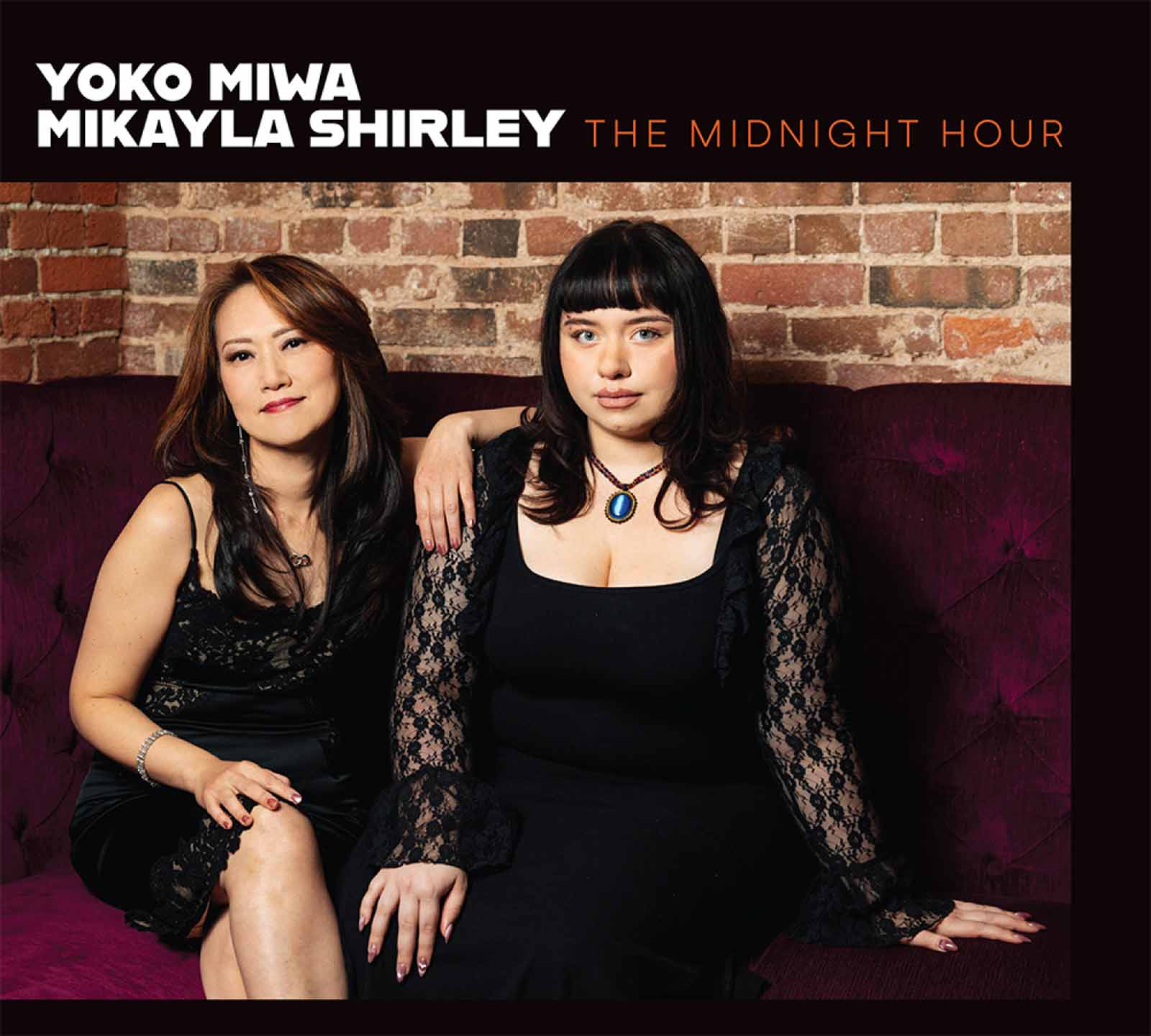
It was barely past noon on Aug. 10, and the August heat had already reached the point where the idea of spending any unnecessary time outdoors seemed almost unreasonable. I was going through the CDs arriving for the end of the month, a ritual that still has something pleasantly anachronistic about it in an era when most music arrives as a file, a stream or an algorithmically generated recommendation. Among the new releases was an album whose cover immediately established a familiar visual language: a pianist and a singer, presented in an understated and deliberately traditional setting.
I put the disc into the player and reached for the headphones. The opening moments of “Alfie” establish the atmosphere quickly. Mikayla Shirley’s voice is beautiful, controlled and technically assured, while Yoko Miwa provides the piano accompaniment with the confidence one would expect from a musician whose career has been deeply rooted in the Boston jazz scene. There is nothing unpleasant about the experience. On the contrary, the recording is warm, polished and easy to live with, the kind of album that can accompany a late afternoon on a terrace while a glass of lemonade begins to sweat in the heat. The difficulty is that an album can be pleasant without becoming particularly compelling, and The Midnight Hour occasionally falls into that space.
The repertoire is built largely around songs that have already traveled an extraordinarily long distance through American popular music and jazz. That in itself should not be considered a weakness. Jazz has always depended upon reinterpretation, and some of the greatest recordings in the tradition have been built around songs that listeners already knew intimately. The challenge, however, is to make the familiar sound newly discovered, to reveal something in a song that previous interpretations have left unexplored or to impose such a distinctive personality upon it that the listener temporarily forgets how many times the material has been recorded before.
That is where The Midnight Hour leaves me less convinced. There are moments of genuine beauty, but too rarely does the music create the feeling that something unexpected is about to happen.
A Voice That Deserves More Than Perfection
The most obvious reason to pay attention to Mikayla Shirley is her voice. There is no question that she possesses an impressive instrument. Her technical command is considerable, her pitch is secure, her range allows her to move comfortably through demanding material and there is a sophistication in her phrasing that reflects serious attention to the great tradition of jazz singing. Her own description of what she looks for in a song is revealing. Shirley has said that she is drawn to something authentic in a song, something real enough to allow her to disappear into it for a few moments and, ideally, invite another listener to share that experience. She has also spoken about the songs that continue to reveal something new after repeated listening, the kind of compositions to which one can return year after year and discover another layer.
That is precisely the ambition one hopes to hear in a singer of her ability. The frustrating part is that the recording does not always allow that ambition to emerge fully. Shirley’s technical strengths are so apparent that they sometimes become the most noticeable feature of the performance. There are passages in which one becomes conscious of the precision of the singing before becoming absorbed by the meaning of the song itself. It is a subtle distinction, but an important one. Technical mastery should ultimately disappear into interpretation. When the listener becomes aware of the machinery behind the performance, some of the emotional mystery is inevitably lost.
This is not an argument for less technique. Shirley does not need to become less accomplished. She needs to become freer from the obligation to demonstrate that accomplishment. The next stage in her development, at least from what can be heard here, may involve learning how to allow an imperfect phrase, a hesitation, an unexpected silence or an unusual rhythmic choice to carry as much expressive weight as a perfectly executed vocal passage. That would make her considerably more interesting.
The Question of the Pianist
This is also where I find myself questioning the fundamental musical pairing at the center of The Midnight Hour. Yoko Miwa is an accomplished pianist whose career gives her considerable authority within the jazz world. Her work as a leader, her long association with the Boston scene and her years of performing with her trio have established a musical identity of her own. She has performed at important venues and festivals and has worked with musicians whose names carry considerable weight in contemporary jazz. Her own writing about the piano trio repeatedly emphasizes communication, spontaneity and the interaction between musicians.
None of that is in question here. What I question is whether Miwa’s particular approach to the piano is the ideal environment for Shirley’s voice. The problem is not that Miwa plays badly or that she lacks sensitivity. It is almost the opposite. Her playing is so complete, so harmonically informed and so consistently present that it can leave surprisingly little room for the singer to create the kind of emotional space that her voice appears to require. The piano often seems to be answering before the vocal phrase has had enough time to disappear. For an album built around the intimacy of a voice and a piano, that matters enormously. Intimacy is not created simply by reducing the size of the ensemble. It depends upon the musicians understanding when to speak and when to remain silent, when to support a phrase and when to allow it to exist without immediate commentary.
At several points, I found myself imagining a different pianist beside Shirley, not necessarily a technically superior musician, but someone whose instinct might be to leave more space around her. A player willing to allow a note to hang in the air, to let a vocal phrase remain unresolved for a moment longer, or to create tension through absence rather than through additional harmonic information. That difference could have transformed the character of the recording.
It is entirely possible that the issue is not the individual musicians but the musical language created when they are placed together. A great pianist does not automatically become the right pianist for every singer, just as a great singer does not necessarily become more expressive when placed alongside the most accomplished accompanist available. Musical compatibility is a separate quality from technical excellence. And on The Midnight Hour, I am not convinced that the two musicians always find the most revealing territory between them.
What Shirley Might Sound Like With More Freedom
This is why I kept imagining a larger ensemble while listening to the album. At first that may seem contradictory. The record is deliberately intimate, and adding bass, drums or another instrumental voice might appear to move it away from the very intimacy it is trying to create. But a trio or quartet could actually give Shirley more freedom because the piano would no longer have to carry so much of the harmonic and rhythmic responsibility.
A bassist and drummer could create a foundation underneath the singer, allowing the pianist to become more selective. A quartet could introduce tension and contrast without overwhelming her. A horn player could answer a vocal phrase rather than the piano doing so every time. Most importantly, Shirley could become part of a larger musical conversation instead of remaining at the center of a dialogue that sometimes feels too carefully controlled.
I found myself imagining her with musicians whose approach is somewhat less conventional, including artists such as Emmet Cohen, whose playing often has a conversational quality and a willingness to allow rhythm, interaction and personality to reshape familiar material.
That is not to suggest that Cohen is the missing ingredient or that another particular musician would automatically solve the problem. The larger point is that Shirley seems ready for an environment in which she is encouraged to react, rather than simply execute. She needs musicians capable of surprising her. She needs arrangements that do not always tell her where the next phrase is going. She needs moments in which the music can become slightly uncomfortable. That is often where an artist begins to reveal a personality that technique alone cannot provide.
Familiar Songs Require an Unfamiliar Point of View
The choice of repertoire presents another challenge. There is nothing wrong with recording “Alfie,” or any of the other familiar songs on the album. The history of jazz is full of artists returning to the same material and discovering completely different meanings within it. The question is therefore not why Shirley chose these songs, but what she has found in them that makes her version necessary. That is a much more demanding question. A listener who has heard “Alfie” performed by many different singers is not simply asking whether Shirley can sing it beautifully. The listener is asking what Shirley hears in the song that others have missed. At its best, jazz answers that question through interpretation rather than explanation. The melody may be familiar, but the rhythm changes, the harmony shifts, the singer alters the placement of a phrase and suddenly the song seems to belong to someone else.
The Midnight Hour does not consistently reach that point. Too often, the arrangements appear to respect the songs rather than interrogate them. There is elegance in that approach, but there is also a certain safety. For a young singer with Shirley’s vocal ability, safety may ultimately be less valuable than discovery.
The Album Cover and the Music It Promises
The cover of an album can sometimes tell the listener more than the liner notes do. The image of the singer and pianist on The Midnight Hour is traditional, understated and immediately recognizable as the presentation of a classic jazz vocal record. There is no visual suggestion that the music inside will challenge the listener’s expectations, and in that respect the cover is remarkably honest. The album sounds much like it looks. For listeners who are drawn to traditional jazz vocals, that will probably be part of its appeal. There is craftsmanship here, and there is a respect for the repertoire that is never in doubt. The performances are professionally executed, the sound is clean and the overall atmosphere is intimate without becoming artificial.
But the visual conservatism also reinforces the larger question raised by the music itself: when will Shirley begin moving beyond the tradition, she has mastered sufficiently well to establish a musical identity that belongs unmistakably to her? That is the question I would like her next recording to answer.
Boston, the Studio and the Value of Listening Closely
The Boston connection is important to understanding the project. Shirley and Miwa developed their collaboration through performances in the Boston area, including late night sessions at the Mad Monkfish in Cambridge. Their partnership therefore has a genuine performance history behind it rather than existing solely as a studio concept. Shirley’s performances with the Yoko Miwa Trio have also given the two musicians an opportunity to explore this material before committing it to record.
The album was recorded at Q Division Studios in Boston, a facility with a long history in the city’s recording culture. The production serves the project well. The sound is intimate enough to place the listener close to the musicians, and the recording captures the details of Shirley’s voice and Miwa’s piano with considerable clarity. Rather than surrounding the performances with unnecessary production effects, the recording allows the relationship between voice and piano to remain at the center.
That is one of the reasons the album remains enjoyable even when the musical concept begins to feel restrictive. There is something undeniably appealing about hearing a singer and pianist this clearly, especially when the listener is using headphones. The recording provides enough space to hear breathing, articulation, the attack of individual piano notes and the subtle changes in Shirley’s phrasing. The sonic intimacy works. The artistic intimacy is more complicated.
What the Next Record Should Explore
If The Midnight Hour represents a stage in Shirley’s development rather than a definitive statement, then the most interesting question is what comes next. I would like to hear her record original material, even if only alongside a smaller number of standards. I would like to hear her work with a trio or quartet in which the rhythm section is allowed to become a genuine creative partner rather than simply support. I would like to hear arrangements that create more contrast and more silence, and I would like to hear Shirley placed in situations where she cannot rely entirely on the technical security that comes so naturally to her. Most of all, I would like to hear her surrounded by musicians who challenge her. The great singers of jazz have never been defined solely by the beauty of their voices. What distinguishes them is their ability to make a listener believe that a familiar lyric has suddenly become personal, even when that lyric has been recorded hundreds of times. They manipulate time, silence, consonants, breath and rhythm until the song no longer feels like an inherited object but something being created in front of us.
Shirley clearly has the tools to reach that level of individuality. What remains uncertain is whether the current musical setting is helping her get there. The answer, at least on this recording, is not always yes. And that is why I would not dismiss The Midnight Hour simply as a conservative jazz vocal album. There is a more interesting story underneath it, one involving a young singer with an unusually accomplished voice who may now need to move beyond the environment in which that voice can be presented most safely.
The challenge is not to find someone who can accompany her more competently than Yoko Miwa. That would be the wrong conclusion to draw from the record. Miwa is an accomplished musician with a substantial career and a musical vocabulary of her own. The more useful question is whether Shirley needs a different kind of musical partner, someone whose instincts create enough silence and unpredictability for her to discover aspects of her voice that technical control currently keeps hidden. That is where I would like to hear her go.
A Promising Beginning Rather Than a Final Statement
The Midnight Hour is an enjoyable record, and there is no shortage of musical competence within it. Mikayla Shirley has a genuinely impressive voice, Yoko Miwa is a highly accomplished pianist, the repertoire has been selected from a tradition rich enough to sustain endless reinterpretation, and the recording itself offers the kind of intimate sound that rewards careful listening.
What the album does not yet provide is a sufficiently distinctive reason for this particular combination to exist. That may sound harsh, but it is ultimately a reflection of how much more interesting Shirley could become. There are young singers who need more technique, more confidence or more experience before they can begin to establish a distinctive identity. Shirley’s situation seems different. She already has much of the technical foundation. What she needs now is an artistic environment that makes it possible for her to forget about that foundation and concentrate on interpretation, interaction and discovery. Perhaps the next record should be less concerned with sounding beautiful and more concerned with sounding like Mikayla Shirley.
That might mean taking the songs apart and rebuilding them. It might mean choosing material that does not come with decades of interpretive history. It might mean working with a rhythm section that refuses to let her settle into predictable phrasing. It might mean bringing in musicians who are willing to interrupt her, challenge her and occasionally make her uncomfortable.
It might even mean discovering that the most intimate recording is not necessarily the one with the fewest musicians, but the one in which every musician knows when to leave enough room for another artist to reveal something unexpected. For now, The Midnight Hour remains a pleasant and beautifully recorded introduction to a singer who appears capable of considerably more. It is not a failure, and it would be unfair to treat it as one. It is instead a record that makes its own limitations unusually visible because the talent at its center is so apparent.
Mikayla Shirley has already demonstrated that she can sing these songs. The more interesting record will be the one in which she makes us understand why only she could have sung them this way.
Thierry De Clemensat
Member at Jazz Journalists Association
USA correspondent for Paris-Move and ABS magazine
Editor in chief – Bayou Blue Radio, Bayou Blue News
PARIS-MOVE, August 11th, 2026
Follow PARIS-MOVE on X
::::::::::::::::::::::::
Musicians :
YOKO MIWA: piano
MIKAYLA SHIRLEY: voice
Track Listing :
- Alfie (05:35) Hal David, Burt Bacharach
- On the Street Where You Live (04:38) Alan Jay Lerner, Frederick Lowe
- God Only Knows (04:38) Brian Wilson, Tony Asher
- Garota de Ipanema – Girl from Ipanema (03:52) Vinicius De Moraes, Antonio Carlos Jobim
- I Loves You, Porgy (06:17) Du Bose Heyward, Ira Gershwin,George Gershwin
- I Didn’t Know What Time It Was (03:42) Lorenz Hart, Richard Rodgers
- Too Late Now (05:26) Alan Jay Lerner, Burton Lane
- But Not for Me (04:08) Ira Gershwin,George Gershwin
- Tenderly (04:35) Jack Lawrence, Walter Gross
- Love Dance (06:16) Ivan Lins, Gilson Peranzatta, Paul Williams
- Centerpiece (03:34) Jon Hendricks, Harry “Sweets” Edison
- Modinha (04:15) Vinícius De Moraes, Antônio Carlos Jobim
- Song of Joy (05:56) Reginald L Boutté, Billy Preston
Recorded and mixed by Chuck Hargreaves at Q Division Recording Studios in Cambridge, MA, USA
Mastered by Toby Mountain at Northeastern Digital
Produced by Yoko Miwa and Scott Goulding
Photography by Caroline Alden
Album design by David Greenberg for theMKTG.c