| Jazz |
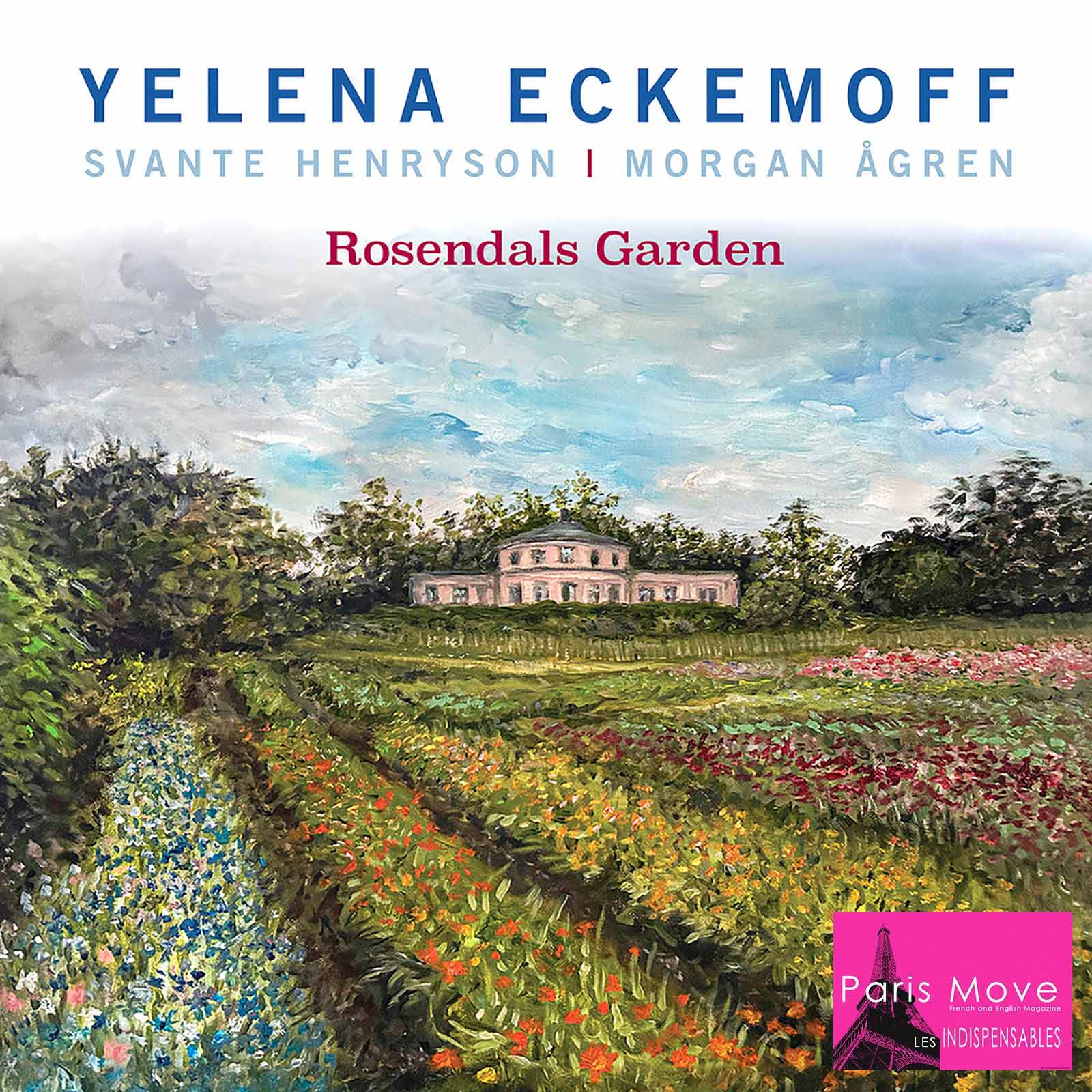
On a warm Scandinavian evening, when the light lingers long past expectation and the air seems suspended between memory and possibility, Rosendal feels less like a garden than a state of mind. The benches face water and sky; silence becomes textured rather than empty. It is precisely this atmosphere — luminous, restrained, quietly emotional, that animates Yelena Eckemoff’s latest release, Rosendals Garden.
Practically every year, I await a new creation from Eckemoff with something close to mischievous anticipation. Born in Russia and shaped by a deeply European sensibility, she has long placed classical architecture at the core of her artistic identity. But she does not treat tradition as a museum artifact. Instead, she reshapes it, folding its structural rigor into jazz, narrative, and chamber-like intimacy.
With Rosendals Garden, Eckemoff ventures into particularly fertile terrain: a refined form of symphonic jazz that is as intricate as it is welcoming. The compositions are sophisticated in construction, the arrangements layered and harmonically adventurous, yet nothing feels hermetic.
Accessibility, in her hands, is not compromise but strategy. In an era when jazz often competes for attention through volume or technical spectacle, Eckemoff opts instead for narrative patience and emotional architecture.
Known for jazz steeped in storytelling, she frames this album as a trio homage to Sweden’s natural beauty and understated magic. Yet the music avoids postcard romanticism. Instead, it feels observational, attentive to texture, space and subtle shifts in mood.
The opening track, “ABBA Museum,” carries a touch of playful irony. For listeners familiar with contemporary Swedish jazz pianism, its clarity of touch, its spacious lyricism, there is an immediate recognition. Eckemoff has not simply absorbed those influences; she has metabolized them. The tonal transparency recalls the Nordic school, yet her phrasing retains a distinct Slavic depth, a slightly darker emotional undercurrent beneath the light.
Here, substance mirrors form. Eckemoff composes like a painter working with a restrained but luminous palette: pale Nordic blues, soft summer golds, muted greys that dissolve into silence. She chooses only what is essential. From the first track onward, her rapport with her ensemble is unmistakable. The music breathes.
The trio format, inherently exposed, leaves no room for decorative excess. Only the most assured musicians can sustain such a structure across an entire album while preserving its emotional and narrative core. Eckemoff achieves this balance with remarkable elegance. At times, she feels both architect and protagonist, shaping the environment while inhabiting it fully.
Her collaborators are central to that achievement. The eclectic, subtly propulsive percussion of Morgan Ågren provides both grounding and unpredictability; his textures shimmer rather than dominate. Meanwhile, Svante Henryson expands the trio’s dimensionality, alternating between acoustic and electric bass throughout, and adding cello on the majority of tracks. His bowed passages lend the music a chamber-music resonance, blurring the boundary between jazz trio and contemporary classical ensemble.
Eckemoff’s mastery lies in the precision of choice, not only which note to play, but how long to let it resonate before yielding to silence. The romantic and emotional undercurrents never spill into sentimentality. Instead, they unfold with quiet authority. The effect can be momentarily disorienting, but in the best possible way: the listener senses both control and vulnerability coexisting.
After more than a dozen albums, one might assume Eckemoff’s artistic vocabulary is fully mapped. Yet Rosendals Garden suggests otherwise. The thematic focus, Sweden as emotional landscape rather than geographic reference, and the carefully selected collaborators reveal an artist still in motion.
Within the broader contemporary jazz landscape, Eckemoff occupies a distinctive space. While American jazz often leans into rhythmic assertiveness and European jazz sometimes drifts toward abstraction, she forges a synthesis: structurally rigorous yet narratively intimate, classically grounded yet improvisationally fluid. As a composer in a field still disproportionately defined by male bandleaders, her authority feels neither declarative nor defensive, it is simply assumed.
In the end, Rosendals Garden does more than add another entry to an already substantial discography. It reframes Eckemoff’s artistic identity. The album suggests a composer increasingly comfortable with restraint, willing to let atmosphere carry meaning, confident enough to allow silence equal weight with sound.
And perhaps that is the quiet revelation here: in a cultural moment saturated with urgency and noise, Eckemoff offers something rarer, attentiveness. She invites the listener to sit, to observe, to linger. Like a Scandinavian summer evening, the music does not demand attention. It earns it.
Thierry De Clemensat
Member at Jazz Journalists Association
USA correspondent for Paris-Move and ABS magazine
Editor in chief – Bayou Blue Radio, Bayou Blue News
PARIS-MOVE, March 2nd 2026
Follow PARIS-MOVE on X

::::::::::::::::::::::::
Musicians :
Yelena Eckemoff – piano, synths and compositions
Svante Henryson – cello, electric and acoustic basses
Morgan Ågren – drums and percussion
Tracklisting:
CD1 :
ABBA MUSEUM
Rosendals Garden
Gamla Stan
Country Orchard Cafe
Oresund Bridge
CD 2 :
Skansen Park
Sunrise in Rimbo
Ruins of Alvsborg
Storaden Nature Reserve
Stranvagen Pier
Gropsholm Castle
Recorded on Aug. 28-29, 2024 at RMV Studio, Stockholm, Sweden.
Tracking engineer – Linn Final.
Mixing and mastering – by Stefano Amerio.