| Jazz |
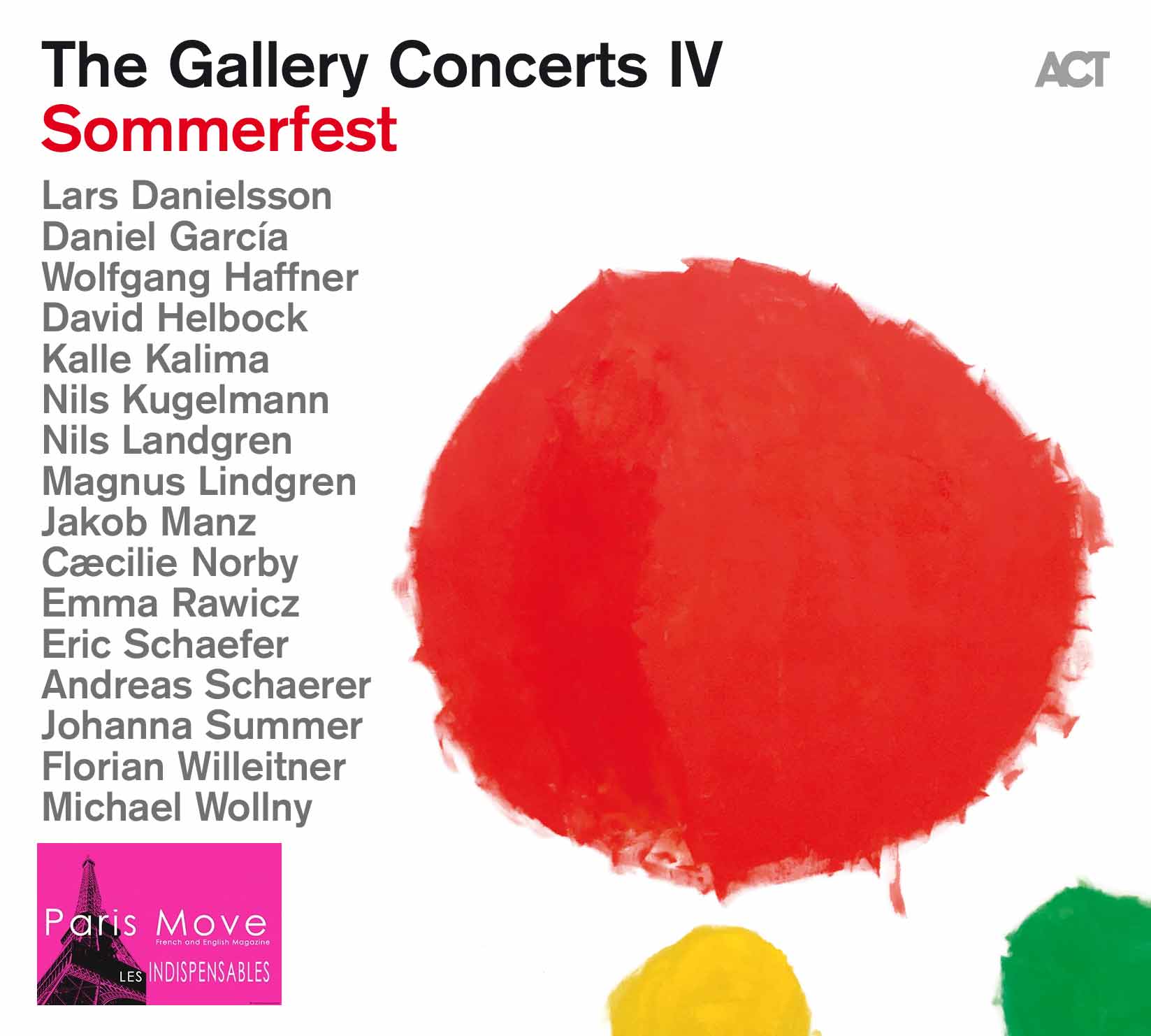
Summary: ACT’s Berlin jazz celebration blends European jazz, contemporary art, classical influences and world music in a superbly recorded live album.
ACT in Berlin: When Jazz and Art Become One
There are concert halls designed to give music grandeur, clubs designed to make it intimate, and then there are places where music becomes part of a much larger artistic conversation. The ACT art gallery in Berlin belongs to that last category. Here, jazz is not presented as an isolated musical genre, separated from the other arts by institutional boundaries. It exists alongside contemporary art in an environment where listeners are encouraged to discover connections between different forms of artistic expression. The philosophy behind the project is summed up in a deceptively simple phrase, “The ART in MUSIC,” but in Berlin that idea feels much more substantial than a clever slogan.
The concerts initiated by Siggi Loch, the founder of ACT, are built around the conviction that contemporary jazz and contemporary art share something fundamental. Both depend on freedom, interpretation and the willingness to question established conventions. Both can move between disciplines without necessarily asking permission, and both become particularly interesting when artists are given enough space to take risks. The gallery therefore becomes more than a venue in which musicians happen to perform. It becomes a meeting place where visual art and music can influence the way we experience one another.
At the center of the gallery’s musical space stands a Steinway D concert grand with an extraordinary history. This is the instrument Alfred Brendel chose for his concerts at the Berlin Philharmonie, and its presence gives the room a remarkable connection to the European classical tradition. Yet the piano is now part of a very different musical environment, one in which improvisation, contemporary jazz and musical crossovers have become central. That juxtaposition seems entirely appropriate because the relationship between classical music, contemporary jazz and visual art has never been as rigid as the traditional categories might suggest.
The similarities between contemporary art and today’s jazz are particularly striking. Both are concerned with freedom of expression, individual interpretation and the constant redefinition of boundaries. Jazz musicians increasingly move naturally between jazz, classical music, folk traditions, world music, electronic music and contemporary composition, while visual artists similarly move between painting, photography, installation and digital media. The most interesting work often emerges precisely where those disciplines overlap, and ACT’s Berlin gallery provides a remarkably natural environment for such encounters.
The summer celebration held on August 30, 2025, gave that philosophy an especially personal dimension because it also marked Siggi Loch’s 85th birthday. Loch normally oversees the programming of the gallery’s concert series himself, but on this occasion Andreas Brandis took a different approach and offered him a particularly meaningful gift. More than 20 artists connected with ACT, representing three generations of musicians, were brought together for a special day that combined emerging talents, established performers and some of the most recognizable figures in European jazz. Rather than simply assembling a succession of individual performances, Brandis created different musical formations, allowing the artists to interact in contrasting combinations.
The result is an unusually eclectic recording, and that eclecticism is precisely what makes it so attractive. This is not an album that can comfortably be placed inside a single genre. At different moments the listener moves between contemporary jazz, classical influences and world music, while subtle changes in instrumentation, rhythm and atmosphere continually reshape the musical landscape. The transitions are often more interesting than the labels themselves because the musicians appear completely unconcerned with the boundaries separating one tradition from another.
That approach has become one of the defining characteristics of the ACT catalog. The label has developed a distinctive understanding of European jazz, one that does not attempt to make its artists conform to a single sound. Instead, it has created an environment in which very different musical personalities can coexist. Jakob Manz, Emma Rawicz, Andreas Schaerer, David Helbock and Nils Landgren, among many others, represent very different approaches to music, yet they can comfortably inhabit the same artistic universe. The breadth of the ACT roster makes it possible to see this album not simply as the documentation of one concert, but as a snapshot of a much larger European musical community.
There is also an important geographical dimension to the project. Many of the musicians represented here come from Northern Europe, and the album should therefore not be mistaken for a complete portrait of European jazz. Europe’s jazz scene is far too diverse for any single label, country or concert to represent it in its entirety. Yet this particular concentration of Northern European artists gives the recording a distinctive identity, reflecting a musical culture in which Scandinavian traditions, contemporary composition, improvisation, classical influences and international styles have been interacting for decades. The result feels unmistakably European without ever becoming narrowly regional.
For serious listeners, there is another reason to pay close attention to this recording: the sound quality. This is not the kind of album that should be treated simply as background music. There is too much information contained in the performances, from the changing dynamics and instrumental textures to the subtle interactions between musicians. A modest system will reproduce the recording perfectly well, but a revealing hi-fi system can expose another layer of the music, allowing the listener to appreciate the space around the instruments, the attack of a piano note, the decay of a cymbal or the smallest changes in dynamics.
That is where ACT’s production philosophy becomes particularly valuable. When an album brings together so many musicians, instruments and musical languages, the recording itself has to remain transparent enough for those differences to survive. Excessive processing or an overly compressed presentation could easily flatten the performance, turning a complex musical event into something sonically uniform. Instead, the production gives the instruments room to breathe and allows the listener to follow the relationships between them. For anyone who takes both music and high fidelity seriously, this is an album that deserves to be heard on a genuinely capable system.
The musicians themselves provide another reason to spend time with the recording. Johanna Summer appears on the first three tracks, bringing her highly individual approach to the piano, while Lars Danielsson contributes to the final two. The appearance of Cæcilie Norby is particularly welcome because the singer has become a relatively rare presence in recent years, making her participation one of those moments that longtime followers of European jazz will immediately appreciate. Together, these appearances reinforce the feeling that the ACT family is genuinely represented, even though the concert was assembled for one specific occasion rather than as a conventional label showcase.
The choice of repertoire also reveals how such a large gathering can function. Not every artist associated with the music is necessarily present on stage, and that is perfectly understandable when an event involves more than 20 musicians during the European summer festival season. Chris Jennings provides a good example. The excellent bassist does not appear at this particular concert, but his composition “Casbah Radio” is performed here. In the middle of the summer festival circuit, when musicians are constantly traveling between cities and countries, assembling everyone on one specific date would be almost impossible. What matters is therefore not the physical presence of every member of the ACT community, but the way their compositions and musical personalities continue to circulate within it.
This also explains why the recording feels more like a snapshot of a living musical community than a carefully constructed studio project. The performances capture a particular moment, with musicians coming together from different places and different generations, bringing their own histories into a common environment. The album consequently has a sense of spontaneity that would be difficult to reproduce in a conventional recording session.
There is a wonderful contradiction at the heart of the project. The concert takes place inside an intimate gallery, yet the energy is unmistakably that of a major European jazz festival. Many of these musicians are experienced performers on large international stages, and that experience is evident in the way they communicate with the audience and build musical momentum. The physical space may be relatively small, but the ambition of the performances is anything but. The result is an atmosphere in which the listener can feel the intimacy of the gallery while simultaneously sensing the collective energy normally associated with much larger festivals.
That energy reaches its most convincing expression on the final track, “Wholly Earth.” By this point, the celebratory nature of the event has become impossible to ignore. The performance feels expansive and joyful, with the musicians and audience sharing the sense that something unusual has happened. It is the kind of finale that works because it does not feel artificially designed to provide a dramatic ending. Instead, it seems to emerge naturally from everything that came before it, bringing the various musical strands together in one final burst of energy.
There is also a larger lesson here about the role of a record label. A label can simply release albums, distribute them and move on to the next project, or it can become a cultural community capable of creating encounters between artists who might otherwise never share a stage. ACT has consistently leaned toward the second model, and this celebration demonstrates the possibilities of that approach. The value of such an event is not simply the number of famous musicians involved, but the relationships that emerge when artists from different generations and backgrounds are given the opportunity to play together.
That is why this recording should not be reduced to a simple birthday celebration. Siggi Loch’s 85th birthday provides the occasion, but the music looks forward rather than backward. The younger musicians are not simply repeating what previous generations accomplished, and the established artists are not presented as monuments to a finished era. Instead, they appear together as participants in a continuing European jazz story.
Calling this simply a jazz album would therefore be misleading. Jazz is its foundation, but classical music, world music, improvisation and European musical traditions are all part of the picture. More importantly, there is a sense of curiosity running through the entire project. The album does not ask the listener to choose between genres. It asks the listener to remain open to what happens when those genres meet.
That openness is increasingly valuable at a time when music is often divided into increasingly narrow categories. Streaming platforms encourage listeners to remain close to what they already know, while algorithms constantly recommend music that resembles the music they have previously enjoyed. A project such as this does something different. It invites discovery. Someone who arrives because of Nils Landgren may discover Emma Rawicz. A listener familiar with Johanna Summer may find new interest in Andreas Schaerer. Someone attracted by European jazz may suddenly find themselves listening more closely to classical influences or world music.
That is what a good artistic project should accomplish. It should not simply confirm what the listener already knows. It should make the listener curious about what comes next.
In that respect, ACT’s Berlin celebration is a convincing demonstration of how a record label can function as a cultural bridge. More galleries could host concerts. More concert halls could collaborate with visual artists. More labels could create opportunities for musicians from different generations to meet without forcing them into rigid stylistic categories. And audiences could be given more opportunities to encounter music beyond the boundaries of the genres they already understand.
The Berlin gallery offers a particularly persuasive example because everything seems to reinforce the same idea. The setting belongs to contemporary art, the piano carries the history of European classical music, the musicians represent several generations of contemporary jazz, and the repertoire moves freely between jazz, classical influences and world music. The recording itself preserves the clarity necessary to appreciate those differences, while the energy of the performances reminds us that this is ultimately about live music and human interaction.
Perhaps that is the most convincing tribute to Siggi Loch. After decades spent building a label and supporting musicians, his 85th birthday was not turned into a nostalgic look at the past. Instead, it became an opportunity to bring different generations together and to demonstrate that the European jazz scene remains remarkably inventive.
The final track may sound like fireworks, but the real achievement of the project lies in what comes before them. It is the creation of a space where musicians can meet, where genres can overlap and where an audience can be reminded that music does not need to remain inside the boundaries we have created for it.
In Berlin, ACT has turned that philosophy into something tangible. A gallery becomes a concert venue, a concert becomes a meeting of generations, and a recording becomes a portrait of a musical community still in motion. For jazz listeners, European music enthusiasts and audiophiles looking for a recording that rewards serious listening, this is much more than a souvenir from a summer celebration. It is a compelling reminder that the most interesting music often begins precisely where the categories end.
Thierry De Clemensat
Member at Jazz Journalists Association
USA correspondent for Paris-Move and ABS magazine
Editor in chief – Bayou Blue Radio, Bayou Blue News
PARIS-MOVE, August 22nd, 2026
Follow PARIS-MOVE on X
::::::::::::::::::::::::
Musicians :
Johanna Summer piano on #1 ,2, 3
Jakob Manz alto saxophone on #1, recorder on #2, 3
Nils Kugelmann double bass on #3, 7
Emma Rawicz tenor saxophone on #3
David Helbock piano on #4, 5
Florian Willeitner violin on #4-5, vocals on #5
Daniel García piano on #6, 7
Andreas Schaerer voice, mouth percussion on #6
Kalle Kalima electric guitar on #7
Eric Schaefer drums on #7
Michael Wollny piano on #8, 9
Lars Danielsson double bass & cello on #8, 9
Wolfgang Haffner drums #8, 9
Nils Landgren trombone on #8, 9
Cæcilie Norby vocals on #9
Magnus Lindgren flute on #9
Track Listing :
01 The Opposite 02:56 (Johanna Summer)
02 The Turmoil 03:40 (Jakob Manz)
03 Unexpected Love 06:18 (Nils Kugelmann)
04 Hymn for Sophie Scholl 05:08 (David Helbock)
05 Traveller’s Melody 04:54 (Florian Willeitner)
06 La Leyenda del Tiempo 08:37 (Daniel García, P. de Lucía, R. Capitán, M. de Falla)
07 Casbah Radio 07:55 (Chris Jennings)
08 Lady Madonna 07:48 (Paul McCartney, John Lennon)
09 Wholly Earth 08:00 (Abbey Lincoln)
Produced by Siggi Loch
Recorded live on 30 August 2025 at ACT Art Gallery, Berlin
Recorded live by Klaus Scheuermann
Mixed and mastered by Klaus Scheuerm