| Jazz |
Lost and Found: Vance Thompson’s Reinvention, Between Resilience and Modern Jazz Lineage
In 2017, when illness forced Vance Thompson to confront a sudden and profound rupture in his life, the future of his musical career appeared uncertain. For decades, Thompson had been recognized as a gifted trumpeter, deeply rooted in the modern jazz tradition. Yet rather than viewing this health crisis as an endpoint, he transformed it into a point of departure. Lost and Found is the result of that reckoning, a deeply personal album that documents not only recovery, but reinvention.
The most striking aspect of Lost and Found lies in Thompson’s artistic pivot: the trumpet gives way to the vibraphone. This is no cosmetic change, no simple adjustment of color or texture. It is a fundamental reorientation of musical identity, one that demands humility, discipline, and courage, especially at a stage of life when many artists settle into familiar terrain. In Thompson’s case, the vibraphone becomes both a physical necessity and a creative catalyst, opening new harmonic and rhythmic pathways while preserving the core of his musical voice.
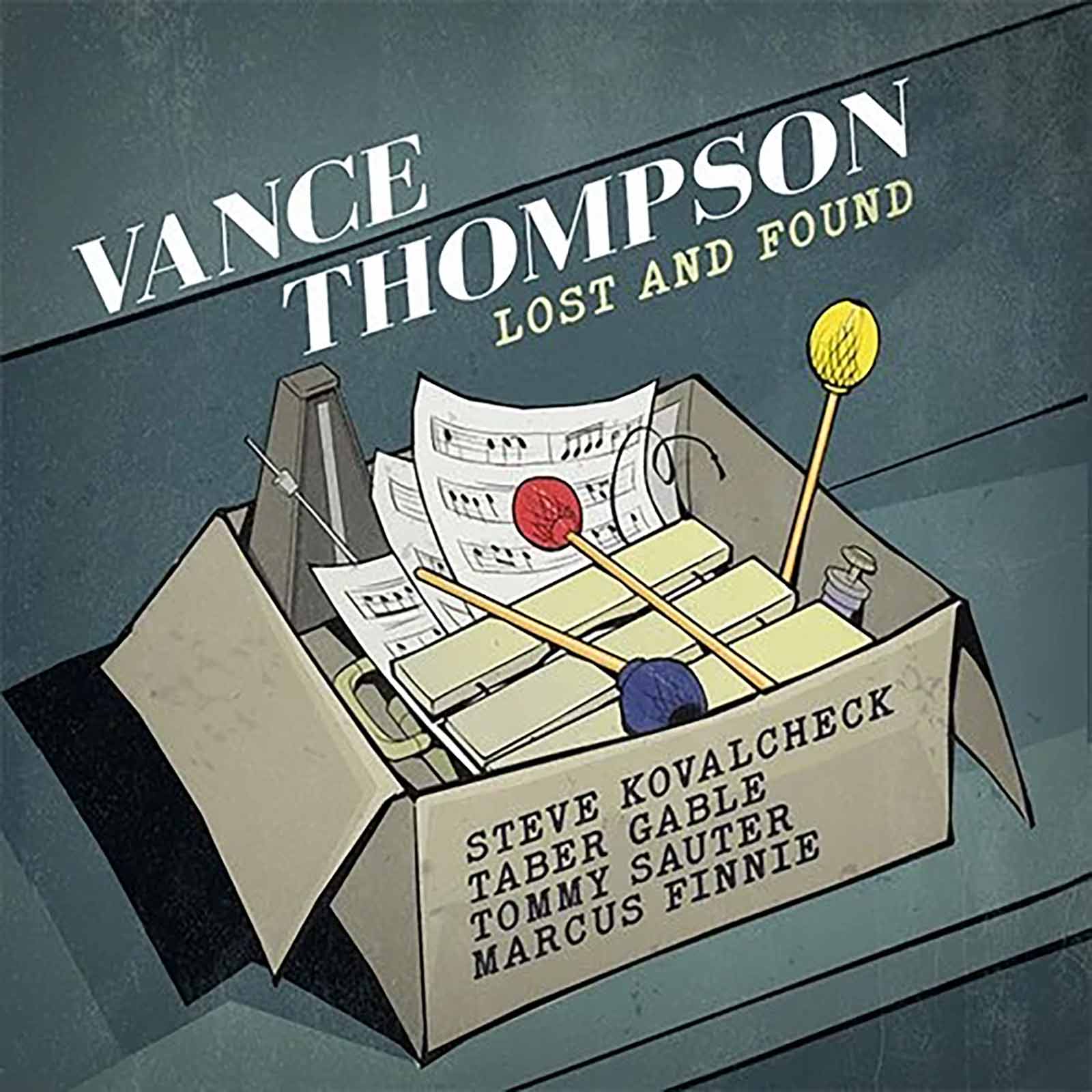
Recorded as an acoustic quintet, the album brings together an exceptional ensemble: pianist Taber Gable (Marcus & E.J. Strickland, Braxton Cook), guitarist Steve Kovalcheck (Jeff Hamilton, Clayton-Hamilton Jazz Orchestra), bassist Tommy Sauter (Jason Marsalis, Russell Malone), and drummer Marcus Finnie (Kirk Whalum, Kurt Elling). The collective chemistry is immediate and assured. Experience, here, is not merely an asset, it is the foundation upon which the entire project rests. Every composition, every transition, every dynamic shift feels considered, balanced, and deeply informed by jazz tradition.
Thompson’s stated ambition—to build a bridge between jazz history and a modern compositional language, is fully realized. The writing is sophisticated and often complex, yet never academic. The arrangements are finely chiseled, allowing space for individual expression while maintaining a strong architectural coherence. One hears echoes of Horace Silver’s earthiness, Wayne Shorter’s abstract lyricism, Bobby Hutcherson’s shimmering vibraphone legacy, and, at times, the funk-inflected spirit of Herbie Hancock’s Headhunters. These influences surface organically, never as quotation or imitation, but as part of a living continuum.
At the heart of the album stands drummer Marcus Finnie, whose contribution deserves particular attention. Finnie is the quiet engine of Lost and Found, providing both propulsion and restraint, structure and elasticity. His sense of time, touch, and dynamics elevates the entire ensemble, creating an environment in which each musician can perform at their highest level. The more one listens, the more his presence asserts itself, not through virtuoso display, but through intelligence and intention. It is no exaggeration to suggest that Finnie belongs among the most compelling jazz drummers of his generation.
While the album includes inspired interpretations of Chick Corea’s Pud Powell, Donald Brown’s My Three Sons, and Harold Arlen’s timeless Over the Rainbow, its true emotional and artistic center lies in Thompson’s original compositions. These pieces reveal a composer who understands both tradition and risk, clarity and complexity. They also reflect a lifetime of musical dialogue.
Over the years, Thompson has collaborated with an extraordinary range of jazz figures, Monty Alexander, Hank Jones, Eric Reed, Michael Dease, Donald Brown, Carmen Bradford, Gregory Tardy, John Clayton, Stefon Harris, among many others. Traces of these encounters are audible. Certain compositions carry the rhythmic warmth and melodic openness associated with Monty Alexander, while others display a harmonic density and structural ambition reminiscent of Chick Corea. Yet in an era where influence often overshadows individuality, Thompson’s identity remains unmistakable. What might have been a difficult debut for a new vibraphonist instead emerges as a fully realized, first-rank album.
The sequencing of Lost and Found further reinforces its artistic coherence. Track order matters, particularly for listeners who resist the modern tendency to consume music in fragments and still value the album as a complete narrative. Here, such an approach is essential. Each piece gains meaning through its relationship to the others, contributing to a cumulative listening experience that rewards patience and attention.
Perhaps the most remarkable achievement of Lost and Found is that, despite the change of instrument, Vance Thompson’s musical voice remains intact. If anything, it may be sharper, more inquisitive, more adventurous than before. Whether this heightened inventiveness is the product of necessity, maturity, or liberation is open to interpretation. What is certain is that Lost and Found stands as a powerful statement about resilience, artistic evolution, and the enduring vitality of modern jazz.
Thierry De Clemensat
Member at Jazz Journalists Association
USA correspondent for Paris-Move and ABS magazine
Editor in chief – Bayou Blue Radio, Bayou Blue News
PARIS-MOVE, January 6th 2026
Follow PARIS-MOVE on X

::::::::::::::::::::::::
To buy this album (January 16)
Musicians :
Vance Thompson: Producer, Composer, Performer, Vibraphone
Steve Kovalcheck: Performer, Guitar
Taber Gable: Performer, Piano
Tommy Sauter: Performer, Acoustic Bass Guitar
Marcus Finnie: Performer, Drums
Brook Sutton: Recording Engineer
Will Tyson: Mixing Engineer, Mastering Engineer
Track Listing :
Tell It Like It Is
The Thread Of All Sorrows
Mixed Feelings
Sleight Of Hand
Lost And Found
Bud Powell
The Ladies at Rose Bocage
My Three Suns
Over The Rainbow