| Jazz |
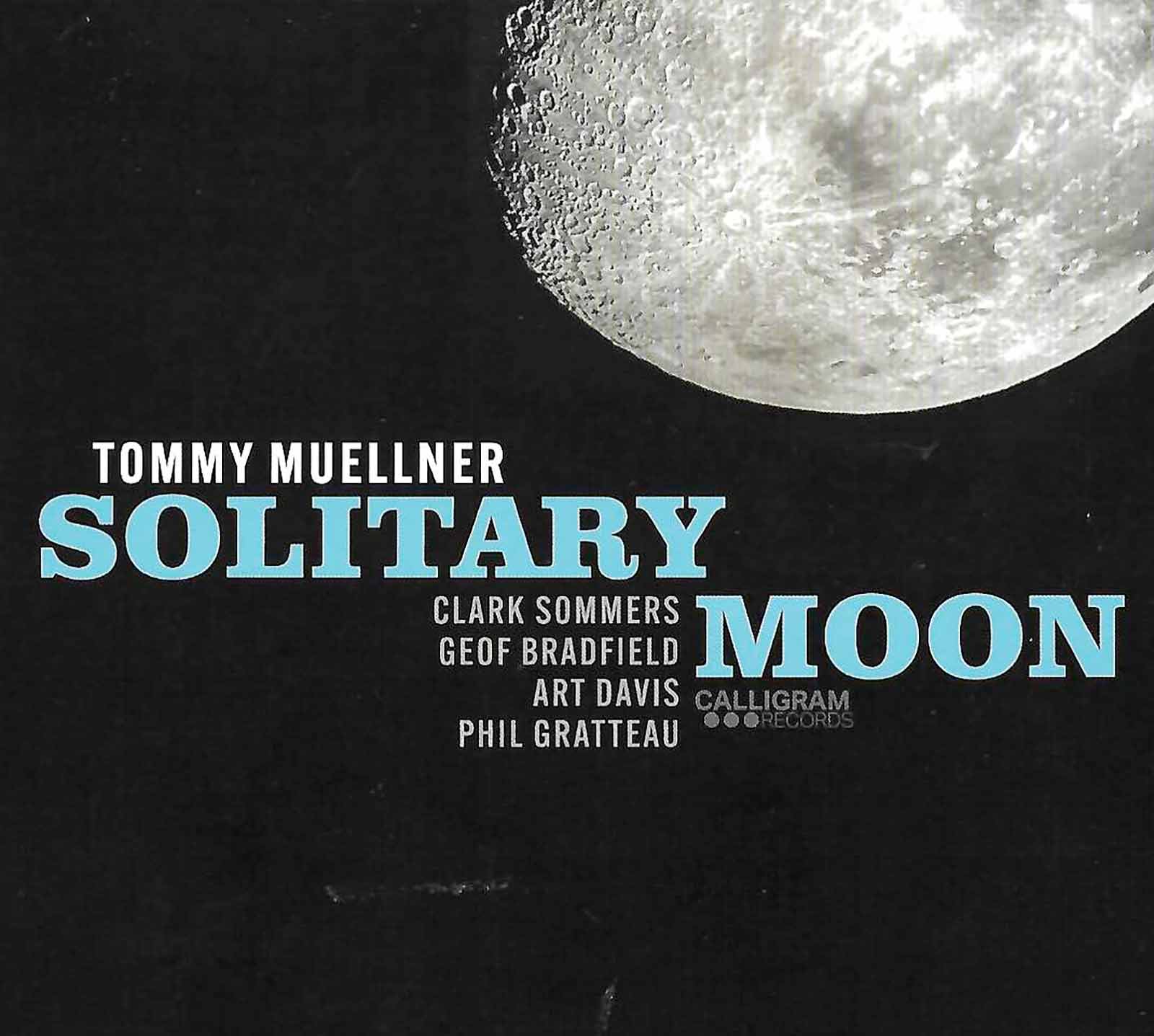
Summary : Tommy Muellner’s Solitary Moon brings together four seasoned jazz musicians in a warm, sophisticated and deeply human post bop album that connects jazz tradition with the present.
Tommy Muellner’s Solitary Moon: A Powerful Return to Post Bop Jazz
Calligram Records returns with Solitary Moon, an album that knows exactly where it comes from and, more importantly, does not seem particularly interested in pretending that jazz needs to be reinvented every time a new record appears. At a moment when too many contemporary jazz releases confuse complexity with substance and experimentation with personality, Tommy Muellner takes a more difficult and ultimately more rewarding approach: he trusts the music. “Having spent a lifetime as a jazz musician, and lover of music. I just wanted to express some musical idea in my Heart,” Muellner writes, and there is something refreshingly direct about that statement. Solitary Moon does not arrive wrapped in an elaborate manifesto. It does not need one. The record makes its case through the quality of the playing, the strength of the compositions and, above all, the obvious pleasure these musicians take in being together. That pleasure is not a minor detail. It is the emotional engine of the album. The music has the accumulated knowledge of musicians who have spent decades absorbing jazz, but it does not sound burdened by that knowledge. Instead, the quartet uses history as raw material. The result is a record that looks backward without becoming nostalgic, and looks forward without desperately trying to sound modern. That distinction matters because contemporary jazz has developed an unfortunate habit of mistaking novelty for relevance. Solitary Moon offers a useful corrective. It suggests that a musician does not have to destroy the language of jazz in order to have something meaningful to say within it.
The quartet is also where the album makes its strongest argument. Clark Sommers, known for his work with Kurt Elling, is the kind of bassist whose importance becomes clearer the longer you listen. His playing does not demand attention, but it quietly changes the behavior of everyone around him. The sound is warm and substantial, yet there is a restless intelligence underneath it. Sommers seems to understand that the bass is not merely there to mark the harmony or keep the machinery moving. He listens, responds and occasionally pushes the quartet into uncomfortable territory, forcing the music to reveal more of itself. That interaction is crucial because Solitary Moon is at its best when the musicians stop sounding like four individuals delivering their assigned parts and start sounding like a single organism. There are no gratuitous fireworks here, no desperate attempts to manufacture a “moment” for the listener. In fact, one of the album’s strengths is what it refuses to do. It does not rely on gimmicks, excessive production or artificial drama. Rhythm and melody are allowed to do the heavy lifting, which may sound simple until you remember how difficult it is to make simplicity convincing. The quartet succeeds because the musicians know how much information can be contained in a single phrase, a carefully delayed accent or a bass line that changes the direction of a melody without announcing that it has done so. The music rewards attention rather than demanding it, and that is a significant difference.
Geof Bradfield brings a particularly refined sensibility to the proceedings. As a saxophonist, composer and one of the musicians associated with the creation of Calligram Records, he has a clear understanding of the tradition, but he is not interested in treating it as a collection of sacred objects. His best moments arrive when he pares things down and lets the emotional character of a melody emerge naturally. The Wind is a good example. Bradfield does not attack the piece; he inhabits it. There is a delicacy to his phrasing that suggests someone more interested in discovering what a note can mean than in demonstrating how many notes he can play. That restraint gives his performance a poetic quality, and it is one of the reasons the album leaves you wanting to hear more from him in a leadership role. Art Davis, on trumpet and cornet, brings something very different: the weight of experience. With a career that includes work with artists such as Ray Charles and Frank Sinatra, Davis carries an enormous amount of jazz history into the session. Yet the impressive thing is how little he seems interested in displaying it. There is no sense of a veteran musician walking into the room to remind everyone of his credentials. Instead, Davis uses that history as a vocabulary, speaking fluently without turning the conversation into a lecture. His playing gives the quartet a direct connection to an older jazz tradition, but it never feels archival. Phil Gratteau, meanwhile, may be the least demonstrative member of the group and perhaps for that very reason one of the most important. His drumming is precise, economical and deeply musical, with an instinctive sense of time that gives the quartet its pulse without ever suffocating it. He knows when to push and, perhaps more importantly, when not to. There is nothing to prove in his playing. Every decision serves the music, and the groove that results is considerably more powerful than any display of technical virtuosity would have been.
Muellner’s compositions become easier to understand once his musical history enters the picture. He grew up in a family of professional musicians, with both his father and brother involved in music, and he began performing at an early age. He explored several instruments, including drums, guitar, bass and organ, before the piano emerged as his natural voice. His early fascination with jazz led him toward some of the great recordings of the tradition, and Erroll Garner became a particularly important influence. Garner’s joyous piano playing, his swing and his almost physical relationship with rhythm clearly left an impression on Muellner. But anyone expecting Solitary Moon to sound like a tribute to Garner is likely to be disappointed, and that is precisely the point. The resemblance is largely rhythmic. Muellner’s writing belongs to another temperament and another time. His compositions are more cerebral, more reflective and more overtly poetic, with a restrained nostalgia that never quite becomes sentimentality. Where Garner could make the piano sound as though it were laughing in real time, Muellner often seems more interested in what remains after the laughter has disappeared. His music pauses, reflects and remembers. That difference is not a weakness. It is evidence that influence has been absorbed rather than copied. The most interesting musicians are rarely the ones who sound exactly like their heroes. They are the ones who understand what made those heroes distinctive and then find a way to turn those lessons into something of their own.
What makes Solitary Moon ultimately convincing is that it does not ask the listener to choose between tradition and contemporary expression. That false choice has become one of the more tiresome arguments surrounding jazz. On one side, there are musicians who treat the past as untouchable scripture; on the other, there are artists so determined to escape tradition that they sometimes forget why the language mattered in the first place. Muellner occupies a more interesting middle ground. He accepts the history, but he does not surrender to it. The quartet understands that jazz is not preserved by repeating old formulas. It survives when musicians continue to listen, reinterpret and argue with the tradition through their own playing. That is what happens here. The record may not be revolutionary, and it would be misleading to pretend that it is. Its ambitions are more modest and, in some ways, more serious. It wants to make good music, and it wants that music to communicate something human. In an environment where albums are increasingly discussed in terms of concepts, branding and stylistic categories, that can almost seem radical.
The Soldier in the Rain makes the point particularly well. Art Davis delivers a performance that does not need to shout to make itself heard. His trumpet carries a sense of history, but also a certain vulnerability, and the emotional force comes from the tension between those two qualities. It is one of those moments when the distinction between composition and interpretation begins to disappear. The written material matters, but so does everything the musician brings to it: memory, experience, taste, restraint and instinct. That is where Solitary Moon becomes more than a collection of well-played tunes. The quartet gives the compositions a human dimension that cannot be reduced to technique. These musicians sound as though they are listening to one another, and in jazz that remains one of the hardest things to fake. The album therefore leaves a strong impression not because it tries to overwhelm the listener, but because it refuses to underestimate the listener. It gives the music time to develop and allows the details to accumulate. After several listens, the record begins to reveal the conversations taking place beneath the surface, particularly between the bass and drums, between Bradfield’s melodic sensitivity and Davis’s experience, and between Muellner’s compositions and the musicians interpreting them. That is also why Solitary Moon creates such a strong desire to hear this quartet on stage. If the studio recording already contains this degree of interaction, a live performance could expose an even more spontaneous side of the music.
Solitary Moon is not an album that needs exaggerated claims of greatness to justify its existence. In fact, the record is stronger when judged without them. It is not attempting to reinvent jazz, nor does it need to. Its achievement is more grounded and perhaps more difficult: it demonstrates that a group of experienced musicians can enter a familiar musical language and still make it sound personal, alive and worth hearing. There is craft here, certainly, but there is also something that craft alone cannot manufacture. There is affection for the music, respect for the musicians beside them and an understanding that jazz at its best is not a competition for attention. It is a conversation. That conversation is what gives Solitary Moon its lasting appeal. The album connects generations not by pretending their differences do not exist, but by allowing those differences to become part of the music. Muellner brings his history, Bradfield brings his lyrical intelligence, Davis brings decades of accumulated experience, Sommers brings an extraordinary sense of musical direction, and Gratteau supplies the rhythmic architecture that allows everything to move. None of them needs to dominate. Together they make a record that feels increasingly rare in contemporary jazz: mature without being conservative, sophisticated without being self-important, melodic without being predictable, and deeply rooted without becoming imprisoned by its own history. Solitary Moon ultimately succeeds because it understands a truth that jazz has known from the beginning and that critics sometimes forget: the future of the music does not necessarily belong to whoever makes the most noise. Sometimes it belongs to the musicians who know how to listen.
Thierry De Clemensat
Member at Jazz Journalists Association
USA correspondent for Paris-Move and ABS magazine
Editor in chief – Bayou Blue Radio, Bayou Blue News
PARIS-MOVE, September 3rd, 2026
Follow PARIS-MOVE on X
::::::::::::::::::::::::
Tommy Muellner Album Release : October 5, 2026 – Jazz Showcase – 806 S Plymouth Ct Chicago
To buy this album (Octoner 2nd, 2026)
Musicians :
Tommy Muellner, piano
Clark Sommers, Bass
Geof Bradfield, Reeds & flutes
Art Davis trumpet & Flughorn
Phil Gratteau, drums
Track Listing :
While We’re Young
Like Someone In Love
Sandy Samba (Ahma’s Garden)
The Wind
I Remember you
The Soldier In The Rain
Cruz Tunes
Oceans In The Sky
Monk See, Monk Do
Make someone Happy
Polka Dots & Moonbeams
Solitary Moon (Aka Moon Song)
Somewhere
Diana/Dany Boy
Why Did I Choose you