| Jazz |
Summary: A close look at Thompson Egbo-Egbo’s Just A Thought, an evocative album blending jazz, classical music, strings and reinterpretations of familiar songs.
Thompson Egbo-Egbo’s Just A Thought: Jazz, Memory and Musical Freedom
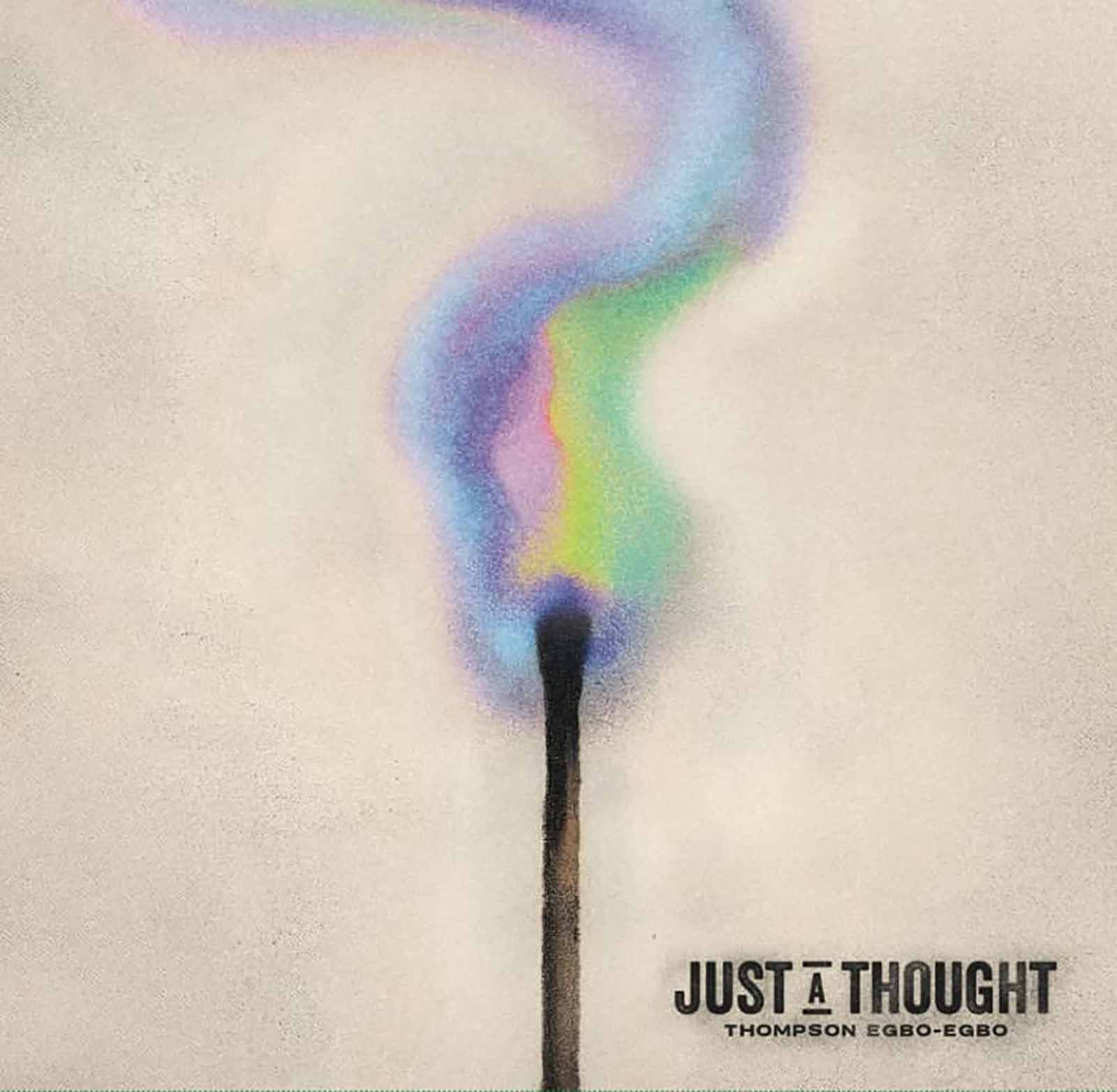
The rain does not seem willing to stop. It is almost as if the endless supply of sunshine accumulated over the summer had kept the liquid element at bay for too long and now it has come back to claim its due. A still-steaming cup of coffee sits carefully between the computer and the mixing board. Beside it, the sleeve of a matchbook burning in rainbow colors seems to hint at what is about to happen when I press play on the CD player. There are records we listen to, and then there are records that, before the first note has fully settled into the room, awaken another music within us, another time, memories we thought we had put away for good. Thompson Egbo-Egbo’s Just A Thought belongs to that second category. From the opening notes of Sing a Song of Song, something begins to shift. The title inevitably takes me back to Kenny Garrett’s Songbook, an album I played almost obsessively when it was released, to the point that some of its melodies still seem to inhabit my memory. Yet Egbo-Egbo approaches the material from somewhere else, stripping it of anything that might feel like mere quotation or imitation. The familiar becomes something leaner, more contemplative, yet still recognizable enough to produce that peculiar sensation that only musical memory can create: the feeling of recognizing something without knowing exactly where memory ends and the present begins. Then comes 50 Ways to Leave Your Lover, and another door opens. Paul Simon enters the room not as a monument to be politely acknowledged, but as a living part of a musical culture that continues to move from one artist to another. That movement is precisely what interests me about Egbo-Egbo. He never seems concerned with proving that he knows his classics. He lets them enter his world, removes some of their obviousness, looks at them again and gives them another life.
By the third track, however, the album gradually stops being a collection of personal associations and becomes the portrait of a musician. I begin to hear something deeply romantic in the way Egbo-Egbo conceives music, not romantic in the sentimental sense, but in his ability to turn melody into a space for projection, a place where the listener can deposit his or her own images. There is a classical education here, a deep familiarity with jazz, but also an almost literary attention to the song, to what its words tell us and to what they deliberately leave unsaid. That may explain the otherwise unlikely coherence of references ranging from Kenny Garrett and Paul Simon to Bud Powell, Robert Glasper, Oscar Peterson and Astor Piazzolla. At first, those names might seem to belong to different musical worlds. In Egbo-Egbo’s hands, they become different sections of the same inner library. Jazz is less an orthodoxy than a way of thinking. Classical music provides architecture, the song provides memory, jazz brings improvisation, Piazzolla pushes against borders, and contemporary music makes it possible for these elements to coexist without requiring him to choose among them.
Thompson Egbo-Egbo was born in Nigeria and grew up in Canada from the age of four. He began playing piano at six and pursued a musical education that would eventually bring together jazz, composition, contemporary music, production and work with other artists. That history matters, not because it offers a biographical formula for explaining his music, but because it helps illuminate a particular understanding of how cultures move. His story contains several geographies, several memories, several ways of inhabiting music. It also carries a strong sense of transmission and human connection. You can hear that in Just A Thought. The album never feels entirely closed in on itself. It suggests that music truly comes alive when it can be shared, transformed, revisited and carried somewhere else. Perhaps that is why Egbo-Egbo’s piano seems constantly to be searching for space rather than effect. He does not play to fill the room. He leaves room for what is about to arrive, for what has just disappeared and, most importantly, for the listener. At times, some passages even suggest that he possesses the qualities required to write a major film score, so naturally does his music create atmosphere without dictating the image. Yet the cinematic quality of his work is never an end in itself. It is simply another way of allowing the music to breathe.
This becomes particularly clear in the album’s unusual balance between intimacy and scale. Just A Thought is built around a piano trio, with bass and drums forming the core of Egbo-Egbo’s musical language, joined by the Odin Quartet. The combination could easily have turned into an exercise in refinement for its own sake, or into a form of chamber jazz so carefully polished that the life had been taken out of it. Instead, the strings expand the sonic landscape without disturbing the intimacy of the trio. They add another depth of field, as if the music had suddenly turned around to look behind itself. The piano remains at the center, but it is no longer telling the story alone. The strings extend certain phrases, shift their light and occasionally give a melody an unexpected gravity, while the trio retains its mobility and instinct for conversation. The result is not a collision of two musical worlds but a seamless continuation of one. There is an understated architecture at work, sophisticated enough to reward close listening but natural enough that the listener thinks about the music before thinking about how it was constructed.
The Odin Quartet also allows Egbo-Egbo to deepen what may be one of the album’s defining qualities: its relationship to cinema. He has a remarkable way of building atmosphere, suggesting places and situations without ever describing them. The music seems to accompany a film whose images do not yet exist, or perhaps one whose images each listener is free to create. That is a rare quality. The most effective film music does not tell us what we are supposed to feel; it creates the conditions in which a feeling can emerge. Egbo-Egbo has that instinct. But it would be too narrow to reduce his work to the possibility of becoming a film composer. What matters is his understanding of music as a narrative space. His compositions tell stories without words. They offer clues without instructions. They leave the listener free to project his or her own places, faces and histories onto them. In that sense, his classical training, his love of jazz and his sensitivity to the song converge: even after the words have disappeared, the music continues to speak.
The title Just A Thought might seem almost too modest for such a carefully constructed album. But that modesty is part of its appeal. A thought is never final. It appears, changes, disappears and sometimes returns years later carrying an entirely different meaning. Egbo-Egbo’s music behaves in much the same way. It does not constantly seek resolution; it prefers to leave doors open. Time and Space establishes the album’s meditation on distance and time. Sing a Song of Song and 50 Ways to Leave Your Lover then move the listener into familiar territory only to make that territory feel new again. Just A Thought, the title track, almost seems to comment on everything that precedes it: this could be nothing more than a thought, a musical idea, a recollection, yet the idea becomes sufficiently precise to build a world around it. Other compositions extend that movement, allowing different temporalities and intensities to coexist. The album feels less like a display of influences than a conversation among them, with each voice retaining its character without needing to dominate the others.
That approach is especially revealing in the way Egbo-Egbo handles reinterpretation. In much contemporary music, revisiting a standard or a familiar song often means searching for an immediately recognizable angle: speeding it up, slowing it down, electrifying it, deconstructing it or surrounding it with effects. Egbo-Egbo seems to take the opposite path. He does not need to make familiar music sound foreign simply to prove that it belongs to him. He seems more interested in discovering what it can still say. That attitude is particularly evident in his readings of Kenny Garrett and Paul Simon, but also in his relationship with Oscar Peterson, a towering figure in Canadian musical history and a particularly meaningful reference for a pianist who grew up in Canada. Egbo-Egbo also had the opportunity to portray a young Peterson in a production devoted to that history. The detail could easily remain a biographical curiosity, but here it carries a deeper meaning. Transmission is not simply about lineage; it is an artistic responsibility. What we inherit has to be transformed without being destroyed. That is what happens throughout Just A Thought. The influences are not presented as trophies. They are absorbed, digested and returned to us in another form.
That is probably why I find myself resisting the temptation to reach too quickly for comparisons. We could talk about Glasper, Peterson, Powell, Garrett, Piazzolla or any number of other musicians. We could invoke chamber jazz, post-bop, contemporary music or the various ways classical writing and improvisation have learned to coexist. All of those references are useful, but eventually they become insufficient. They tell us where Egbo-Egbo comes from; they do not yet tell us where he is going. And that is where the album becomes most interesting. The task is no longer simply to identify his influences, but to recognize the point at which those influences cease to be references and become personal material. His artistic identity does not depend on rejecting what came before him. It emerges from allowing several inheritances to exist at once. He does not place classical music against jazz, Africa against North America, composition against improvisation, or writing against freedom. He seems to understand that such borders belong largely to those who need to classify music after they have listened to it.
There is a kind of freedom in this music that has nothing to do with spectacle. It does not come from rupture or from a determination to reinvent everything. It comes from accepting several inheritances at once. To be born in Nigeria, to grow up in Canada, to begin piano at an early age, to study music and move through jazz, contemporary composition and the world of images: all of this could easily become a catalogue of references. With Egbo-Egbo, it becomes a way of looking at the world. His piano seems to understand that artistic identities are never perfectly sealed. They are formed through movement, through encounters, through what we keep and what we leave behind. Just A Thought is therefore less an album about influences than an album about what we do with our influences. There is something deeply human in that approach because it does not pretend that artistic purity exists. Instead, it accepts contradiction, memory, borrowing, encounters and the successive transformations that make up any real musical history.
There is another quality here that deserves attention: restraint. At a time when virtuosity is often confused with density, when every second seems expected to be filled, Egbo-Egbo knows how to let a phrase breathe. That economy gives the members of the trio a particular importance. The bass is not simply a harmonic foundation, and the drums do not merely mark time. Both participate in a shifting conversation in which the piano can move forward, step back, suspend an idea or return to it from another direction. When the strings enter, they do not cover that dynamic; they extend it. The album acquires an almost orchestral breadth while preserving the vulnerability of a conversation. Perhaps one of the achievements of Just A Thought lies precisely in its sense of proportion. Nothing feels accidental, yet nothing feels trapped inside a mechanism that is too perfect. The music breathes.
And then there is that difficult-to-explain sensation that certain albums give us of being returned to ourselves. I felt it from the opening measures of Sing a Song of Song, and again when 50 Ways to Leave Your Lover appeared. Yet these are not my memories that Thompson Egbo-Egbo is telling. That is the paradox of music: he can tell us his story, his influences, his relationship with time and transmission, and the listener can still end up hearing something of his own. A Kenny Garrett song can bring back an entire period. A Paul Simon phrase can suddenly summon a face. A harmonic progression can make a forgotten place reappear. Music does not simply preserve the past; it recomposes it. It allows what we have lived to return in another form. Perhaps that is why this album stays with me. Behind the pianist’s mastery, behind the composer’s architecture, behind the intelligence of the arrangements, there remains something that cannot quite be explained: the ability of music to enter our lives without ever asking permission.
In the end, Just A Thought refuses to choose between intimacy and ambition. It is sophisticated without being showy, accessible without becoming predictable, cinematic without requiring images, deeply rooted in jazz without allowing itself to be confined by a single definition of the genre. Thompson Egbo-Egbo emerges here with a voice that seems less interested in finding an identity than in expanding one. The trio gives him a supple and deeply musical foundation; the Odin Quartet opens new perspectives; the reinterpretations enter into dialogue with the original compositions; influences become material rather than decoration. Perhaps that is ultimately what distinguishes this album: it does not try to convince us that its author has a singular story. It makes us hear it. The rain is still falling outside the window. The coffee has gone cold. The match has long since stopped burning. The record, however, keeps turning. I think again of Kenny Garrett, of Paul Simon, of all those pieces of music that accompanied other moments in my life, and I realize that Thompson Egbo-Egbo is now entering that memory too. It becomes difficult to speak of him only through the artists who came before him. We have to listen instead to what he does with everything he has received. It is somewhere in that space between inheritance and freedom, between memory and creation, that his own language truly begins.
Thierry De Clemensat
Member at Jazz Journalists Association
USA correspondent for Paris-Move and ABS magazine
Editor in chief – Bayou Blue Radio, Bayou Blue News

PARIS-MOVE, October 3rd, 2026
Follow PARIS-MOVE on X
::::::::::::::::::::::::
Musicians :
Thompson Egbo-Egbo – Piano
Randall Hall – Bass
Jeff Halischuk – Drums
Featuring the Odin Quartet (on tracks 4, 5, 8):
Alex Toskov, Tanya Charles – Violin
Matthew Antal – Viola
Samuel Bisson – Cello
Track Listing :
1 Time and Space
2 Sing a Song of Song
3 50 Ways to Leave Your Lover
4 Just a Thought
5 Out of Nowhere
6 Tempus Fugit
7 Chant
8 Requiem
9 Libertango