| Jazz moderne |
Quartet Vol. II: Four Voices in Perfect Conversation, and a Modern Jazz Album You Must Hear.
Quartet Vol.II, the new album by New York-based pianist and composer Takeshi Asai, is warm, inventive, beautifully paced, and full of that rare quality in jazz, real listening. Out on Fono Bono Records on November 20, 2026, it brings together four outstanding players and eight pieces that go from blues to ballad to jazz waltz without ever losing their coherence.
Born in Nagoya, Japan, and a Berklee graduate, Takeshi Asai has lived in New York for more than a decade and has become one of the most distinctive jazz voices. His music is at once traditional and modern, lyrical and dramatic, and it draws on a remarkable range of sources: twelfth-century French troubadours, Gregorian chant, Bach and Brahms, Debussy and Ravel, Janáček and Takemitsu, Fauré and Poulenc, but also the Beatles, Irish and Japanese folk music, and even electronic dance music. All of that is somewhere in his playing, though never in a way that gets in the way of the swing.
He has also built a considerable career beyond New York, touring in Poland, UK, France, Germany, Egypt, Japan, South Korea and Australia, leading and co-leading projects as varied as the award-winning WaFoo, the Arab-influenced Kikoman and a chamber ensemble, and composing and arranging for the theatre. Quartet Vol. II is his fourth release on Fono Bono Records, and by the label’s count the 24th album of an already rich discography. And yet it feels like a new stage: Asai himself sees it as a natural step in his development, something that might even surprise some of his longtime listeners and bring in new ones. After hearing it, we understand why.
The first Quartet album, Quartet Vol.I, appeared in 2024 (read the review on PARIS-MOVE). For this second volume, the rhythm section has changed, and the new line-up is superb. Alto saxophonist Hashem Assadullahi is Asai’s front-line partner, with a fluid, singing sound that can recall the cool lyricism of Lee Konitz or Paul Desmond at times, while remaining entirely his own. Bassist Mark Wade is the warm, round, ever-present anchor, and drummer John Clay brings both subtle drive and melodic imagination (he even gets a chorus of his own in the opening piece).
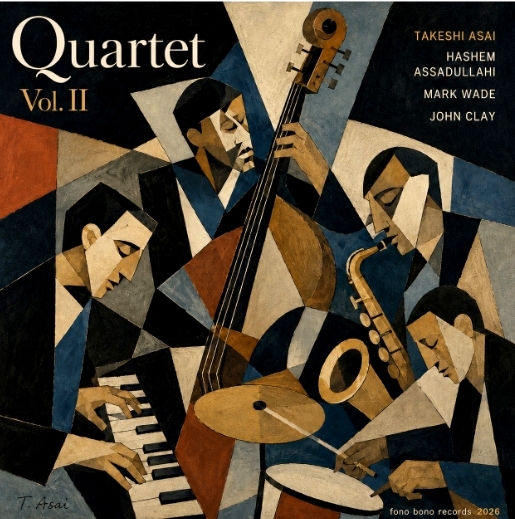
What impresses most is how closely they listen to each other. This is an album where phrases are picked up, answered and transformed: on “Discrepancy”, for example, Asai begins his solo from the last phrase of the saxophonist’s improvisation, as if the conversation simply continued. The cover artwork, with four musicians whose figures break into cubist planes and whose instruments seem to grow out of their bodies, is a perfect visual image of this: each part keeps its own shape, yet none could exist without the others.
Asai wrote six of the eight pieces, and Assadullahi contributed two, “Eve’s Door” and “Mr. Bones”, placing them in different parts of the programme so that the second composing voice is present throughout. The sequencing is thoughtful: the album gathers energy, then leaves space to breathe, then builds again, rather than staying at one level of intensity.
It opens with “C Blues”, a title that points to the very roots of jazz, even though the melody is anything but simple. Assadullahi floats over Asai’s rumbling low-register piano, and the piece sets the tone: past and future side by side. “Discrepancy”, dedicated to Thelonious Monk, has a lively, angular character that is a loving nod to the master without turning into imitation, and Asai’s chord voicings are personal and quite delightful.
“Eve’s Door” begins with restraint and gradually grows in weight and momentum, with a piano solo that starts out bluesy and becomes more and more adventurous. “Fictious” is one of the quietest, most economical moments, a slow, brooding ballad that stays close to its melody and leaves a lot of room between the notes. “Fillet Mignon” then emerges from this stillness: it starts with a haunting, introspective theme and slowly turns into a forward-moving strut that gains momentum until the final minutes have a very different energy from the first. (The title, with its mix of elegance and humour, is wonderfully typical of Asai). “Mr. Bones” is more straight-ahead, with fine solos from the alto, the piano and the bass, and “O’new”, which Asai had already recorded on an earlier trio album and later in a solo version, receives a new life here, with a particularly joyful piano spot. It is lovely to hear a piece come back after so many years, played by a pianist who has gathered more experience, more encounters and new partners: like reopening a book you thought you knew by heart and finding sentences you had never noticed.
Finally, the album closes with its longest piece, over twelve minutes: “The White Daisy Loves You More”. This jazz waltz has a soothing, picturesque, almost poetic melody, and it gives all four musicians the space to unfold at their own pace, with inspired statements from each. After the preceding tracks, it is a perfectly chosen finale, a long exhale.
What makes this album “a must”? First, the writing. Asai’s melodies are warm yet unpredictable, tied to the jazz tradition but looking forward, and he sounds like no one else. Second, the playing: the solos are colourful and always serve the music, and the group sound is appealing, swinging and relaxed, whatever the tempo. Third, the sense of narrative: the album has a clear emotional arc, with room for lightness and for reflection. And finally, the sheer pleasure it gives. Fans of creative, swinging modern jazz will find in it an immediate joy, and people who are new to the pianist will find a perfect way in.
Takeshi Asai once said that before you become a pianist, you have to be a musician, and before that, an artist. Quartet Vol.II shows exactly what he meant: an artist’s record, full of curiosity and beauty, and above all of listening. A great album, and a must.
Frankie Pfeiffer
Editor in chief – PARIS-MOVE
PARIS-MOVE, October 29th, 2026
Follow PARIS-MOVE on X
:::::::::::::::::::::
Preorder the album
(unfortunately, only available in digital format)
Tracklisting:
- C Blues 7:59
- Discrepancy (dedicated to Thelonious Monk) 5:39
- Eve’s Door 8:09
- Fictious 5:59
- Fillet Mignon 7:16
- Mr. Bones 8:36
- O’new 8:23
- The White Daisy Loves You More 12:13
All songs composed by Takeshi Asai (BMI), except tracks 3 and 6 by Hashem Assadullahi (ASCAP).
Musicians:
Takeshi Asai – piano (Yamaha C7)
Hashem Assadullahi – alto saxophone
Mark Wade – bass
John Clay – drums
Credits:
Recorded on July 8 & 9, 2026 at DTC Recording Studio, New York
Mixed and mastered in September at DTC Recording Studio, New York
Artwork designed at DTC Design Lab