| Contemporary music |
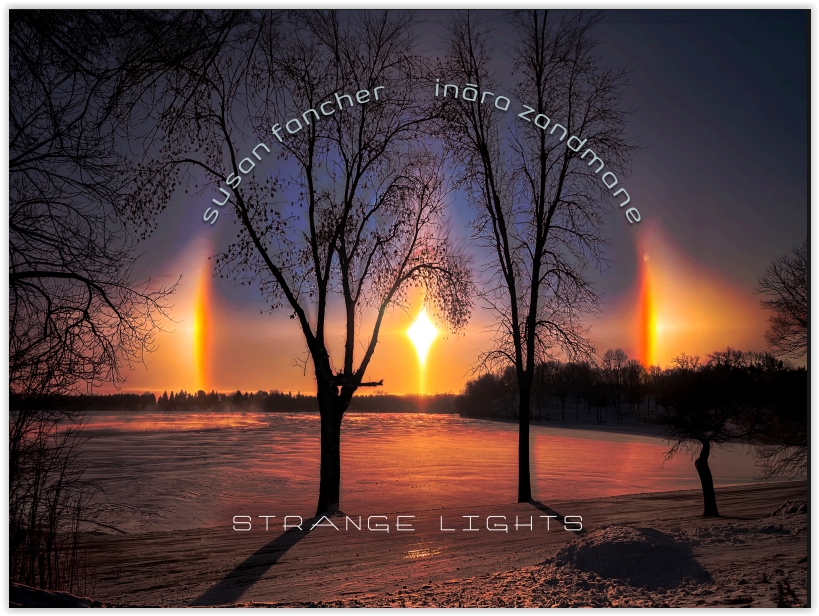
Susan Fancher & Ināra Zandmane – Strange Lights: Where Sound Becomes Light
Auroras, sundogs, coronas, eclipses: strange lights are phenomena that stop you in your tracks, that make you look up and wonder. It is a quietly perfect metaphor for what Susan Fancher and Ināra Zandmane have achieved with this album: music that astonishes not through spectacle alone, but through the kind of sustained, luminous beauty that keeps pulling you back in. Strange Lights is a record that rewards attention and then rewards it again.
The foundation of everything here is the duo itself. Fancher and Zandmane met in Greensboro, North Carolina, in 2003 and have been friends and collaborators ever since. That two-decade relationship is audible in every bar of this recording, not as comfortable familiarity, but as something rarer: a deep mutual attentiveness, a shared expressive sensibility that allows each musician to breathe freely within the ensemble without ever losing the other. Chamber music at its best is a conversation between equals, and that is precisely what Strange Lights offers across its nine tracks and three substantial works. Strange Lights presents a true artistic dialogue, one in which saxophone and piano function as equal storytellers.
Harriet Steinke – Strange Lights (2019)
The album opens with the title work by Detroit-based composer Harriet Steinke, and it announces the record’s aesthetic beautifully. Strange Lights for alto saxophone and piano is, at its heart, a study in timbral exploration, an inquiry into the saxophone’s unique capacity to balance warmth and richness with a brassy, almost metallic brilliance, and to shift between those qualities with the fluidity of changing light.
The opening movement, marked Freely (7:13), is a warm, lyrical meditation that gives Fancher’s tone room to unfold at its own pace. Her sound here is immediately striking — luminous, rounded, and possessed of a poetic inflection that transforms even simple melodic gestures into something genuinely expressive. Zandmane’s piano provides a subtly shifting harmonic landscape beneath her, supportive without being predictable, always listening.
The second movement, With movement – Slow, relaxed (7:19), introduces an oscillating rhythmic quality that lifts the music into a different kind of light, more kinetic, more varied in texture, before the final Postlude settles into quiet reflection, the saxophone’s tone softening to something almost vocal in its intimacy. Steinke’s writing is elegant and sensitively crafted, and in Fancher and Zandmane’s hands it glows.
Mark Engebretson – Sonata (2024)
The album’s centrepiece is Mark Engebretson’s Sonata for soprano saxophone and piano, written specifically for Susan Fancher and receiving its recorded premiere here. The switch from alto to soprano saxophone is immediately striking, the instrument’s narrower, more focused sound brings a different quality of intensity to the duo, and Engebretson exploits it brilliantly across three movements inspired by poetry by Brian Lampkin.
In the Pocket (5:34) opens with a light, airy energy that quickly reveals itself to be deceptively strong, buoyant on the surface, but with a bold, assertive rhythmic core underneath. Fancher navigates its demands with fluid ease, her soprano tone clear and bright, while Zandmane drives the rhythmic momentum with real precision and playfulness.
I look out on the day (4:52) is the Sonata’s emotional heart: restrained, inward, full of longing held at arm’s length by determination. It is beautifully judged, neither sentimental nor remote, and the duo plays it with a quiet intensity that is deeply affecting. Fancher’s breath control and dynamic shading here are extraordinary.
The Directions (7:32) brings the Sonata to a close with a movement that feels genuinely hard-won. Its voice is seasoned, sometimes troubled, occasionally turbulent, and its arrival at a triumphant conclusion feels earned rather than imposed. It is the kind of ending that lands differently depending on what you have brought to the listening, and that is exactly the mark of music worth returning to.
Dorothy Chang – New Stories (2013)
The album closes with Dorothy Chang’s New Stories for alto saxophone and piano, and it provides a wonderfully vivid and colourful counterweight to what has come before. Chang, Professor of Music at the University of British Columbia, has woven her identity as a second-generation Chinese American into four movements that move freely between Chinese folk songs, 1980s pop ballads, marching band music, Bach, Brahms, Stravinsky and contemporary composition, not as a collage of quotations, but as a genuinely integrated personal musical language.
Floating worlds (4:38) opens with a drifting, impressionistic quality that is immediately atmospheric, melodic fragments seeming to surface and dissolve like reflections on water. A Tall Tale Told (4:39) brings a more narrative, almost theatrical energy, Fancher’s alto saxophone finding a storyteller’s voice that is both playful and slyly dramatic. Reflection (4:18) is the sequence’s most introspective moment, spare and quietly beautiful, before Folksong (5:04) closes the album in warmth and colour, folk-inflected melodic lines woven through a piano texture that feels simultaneously ancient and entirely contemporary.
Chang’s New Stories is a work of genuine charm and substance, and Fancher and Zandmane play it with obvious affection and complete stylistic fluency. It is a deeply satisfying conclusion to an album that has taken the listener on a real journey.
Strange Lights: A Luminous Journey Through Contemporary Music for Saxophone and Piano
Strange Lights is everything a contemporary chamber music album should be: beautifully performed, intelligently programmed, and genuinely illuminating about what the saxophone and piano duo can be in the hands of artists who have spent twenty years learning how to listen to each other. Susan Fancher’s tone, technique and musical imagination are exceptional throughout, and Ināra Zandmane matches her at every turn, a collaborative pianist in the truest sense of the term, never merely accompanying, always co-creating.
Harriet Steinke, Mark Engebretson and Dorothy Chang are three composers of real distinction, and having their work championed with this level of commitment and artistry is exactly what new music deserves. Strange Lights is a record that illuminates, in every sense of the word. Warmly and unreservedly recommended.
Throughout the recording, Susan Fancher proves once again why she is regarded as one of the leading voices in the world of contemporary classical saxophone. Her playing combines technical mastery with rare emotional intelligence. She possesses that uncommon ability to make every phrase sound inevitable, every note meaningful. Equally impressive is Ināra Zandmane, whose artistry permeates every moment of the album. Her touch ranges from crystalline delicacy to orchestral power, always serving the music with impeccable sensitivity.
The recording quality deserves praise as well. Every nuance of Fancher’s saxophone and every subtle detail of Zandmane’s piano playing are captured with remarkable clarity and warmth. The sonic image is spacious and natural, allowing listeners to fully appreciate the extraordinary range of colours generated by the duo.
Like the natural phenomena that inspired its title, Strange Lights leaves listeners with a sense of wonder. Through the artistry of Susan Fancher and Ināra Zandmane, sound itself seems transformed into light-shifting, radiant and endlessly fascinating.
This is not simply an excellent saxophone-and-piano album. It is a celebration of friendship, collaboration, imagination and musical storytelling at the highest level. A luminous achievement and one of the most compelling contemporary chamber music recordings of the year. Highly recommended.
Frankie Pfeiffer
Editor in chief – PARIS-MOVE
PARIS-MOVE, July 31st, 2026
Follow PARIS-MOVE on X
::::::::::::::::::::::::
To buy the album on Neuma Records website
Musicians:
Susan Fancher, saxophone
Ināra Zandmane, piano
Tracklisting
Harriet Steinke (b. 1994)
Strange Lights (2019) for alto saxophone and piano
- Freely 7:13
- With movement – Slow, relaxed 7:19
Mark Engebretson (b. 1964)
Sonata (2024) for soprano saxophone and piano
- In the Pocket 5:34
- I look out on the day 4:52
- The Directions 7:32
Dorothy Chang (b. 1970)
New Stories (2013) for alto saxophone and piano
- floating worlds 4:38
- A Tall Tale Told 4:39
- Reflection 4:18
- Folksong 5:04
Recorded in Tew Recital Hall, Greensboro, North Carolina, June – December, 2025
Produced by Susan Fancher and Mark Engebretson
Recorded and edited by Mark Engebretson
Mixed and mastered by Bernd Gottinger
Photos: Sandy Emmons, Ashe Engebretson, Natalie van Gelder
Design: Philip Blackburn
This project was made possible thanks to the generous support of the Arts and Sciences Council Committee on Faculty Research at Duke University.