| Jazz |
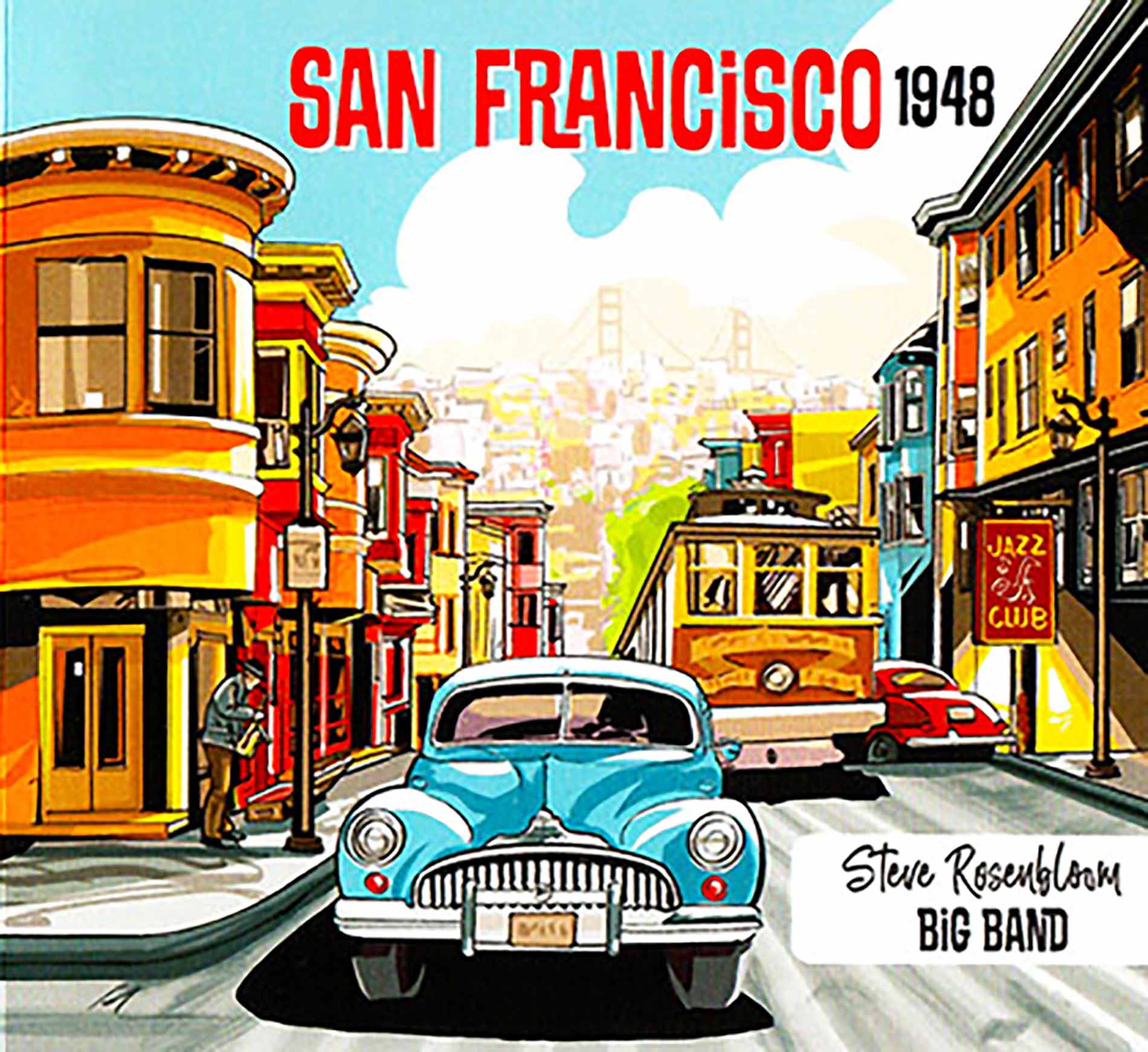
A Date, a City, a Sound: Steve Rosenbloom Reimagines San Francisco, 1948.
Finding reliable information about Steve Rosenbloom is no easy task. He remains, by design or by temperament, a profoundly discreet figure. And yet, this album is so richly evocative that it demands attention, inviting the listener, and the critic, to dig deeper. We took the time to search, to follow faint digital trails, and to piece together what little is publicly known. What emerges is fragmentary but revealing: Rosenbloom has been active on music stages since the 1980s. It is likely there, in the lived exchange between musicians and audiences, that he learned how to transmit joy through sound. That impulse is immediately evident from the album’s opening moments.
Rosenbloom is also a practicing psychoanalyst, a fact that inevitably invites interpretation. But rather than offering a clinical dissection of history, the music suggests something more generous and perhaps more necessary: joy as an act of escape. There is no sense here of an artist attempting to analyze an era he never lived through. Instead, he seems to reach toward it intuitively, guided by the emotional residues left behind in literature, cinema, and collective memory. The influence of mid-century culture is unmistakable, absorbed and reimagined rather than quoted or reconstructed.
Listening to the album creates an irresistible sensation of moving from scene to scene, as if passing through a series of carefully lit film sets. One can almost feel the spectral presence of Humphrey Bogart or Lauren Bacall; those intense gazes poised somewhere between mystery and irony. Is this a form of reverence? Almost certainly. And perhaps also a tribute to San Francisco itself, frozen at a precise historical moment. In 1948, the city was more alive than ever, reshaped by postwar momentum and cultural ferment. That sense of motion, urban, social, artistic, runs quietly but insistently through the music.
For a European listener like myself, the instinct is often to contextualize: to analyze, cross-reference, and verify. But music ultimately resists over-explanation. It asks to be felt before it is understood. And once allowed to settle, images inevitably surface. I find myself recalling countless visits to cinematheque’s, driven by an early fascination with American and Italian cinema, later expanded to the Spanish films of Luis Buñuel. Those screenings were accompanied by obsessive reading, film dictionaries consumed page by page, and by a realization that has only grown clearer with time: every era carries its own color in art, its own sonic identity, sometimes even its own unspoken soundtrack. By that measure, Steve Rosenbloom has aimed, and landed, squarely on his target.
Pause for a moment and recall American documentaries from the period. In 1948, dance was everywhere. Marathon dance contests pushed bodies to exhaustion, collective rituals of endurance and transcendence in a society still shaking off the trauma of war. That same impulse, to push forward, to surpass oneself, animates this album. It is present in the strength of the compositions, the intelligence of the arrangements, and the remarkable musicianship throughout. The record radiates the spirit of a world our parents once knew: the postwar years, marked by an almost urgent pursuit of lasting happiness. Rosenbloom captures not just the sound of that era, but its emotional undertow.
Has Steve Rosenbloom, then, succeeded in psychoanalyzing San Francisco in 1948, mapping a historical state of mind through music? The idea is far from implausible. For any intellectual, whether musician, writer, actor, filmmaker, or visual artist, the deepest creative material is always rooted in reflection. There are countless paths toward that core. For Rosenbloom, it seems to have required only a date, a city, and a culture, along with books, films, and perhaps a handful of time-worn photographs, to produce a work of striking originality.
By transcending the musical conventions of the period, he evokes; while maintaining a resolutely contemporary vision, Rosenbloom paints a portrait of a city in all its complexity and cultural diversity. The listener is drawn in almost effortlessly, because each of us shares a layered relationship with history: the stories we inherit, the ones we study, and those we live ourselves. This is a beautiful album that deserves far more than a cursory review, and one that rewards deep, attentive listening.
Thierry De Clemensat
Member at Jazz Journalists Association
USA correspondent for Paris-Move and ABS magazine
Editor in chief – Bayou Blue Radio, Bayou Blue News
PARIS-MOVE, December 19th 2025
Follow PARIS-MOVE on X

::::::::::::::::::::::::
MUSICIANS:
Band Members:
Steve Rosenbloom, leader-composer, Alto Sax
Jules Payette, Lead Alto + Flute
Allison Burik, Alto + Bass Clarinet
Michael Johancsik, Tenor Sax + Clarinet
Alex Francoeur Tenor, Sax + Clarinet
Benjamin Deschamps Baritone Sax + Clarinet
Lex French, Trumpet
Andy King, Trumpet
Benjamin Cordeau, Trumpet
Cameron Milligan, Trumpet
Mathieu Van Vilet, Trombone
Thomas Morelli-Bernard, Trombone
Taylor Donaldson, Trombone
Chris Smith, Trombone
Eric Harding, Piano
Mike De Mas, Bass
Jim Doxas, Drums
Track Listing :
Samba for Esther
In a Boppish Sort of Way
Mosley
Call From The Orient
Light and Easy
Fiesta for Paquito
San Francisco 1948
Mexican Holliday
Asher’s Song