| World |
Guellal Montréal: Sidi Bémol finds kinship between two distant homelands
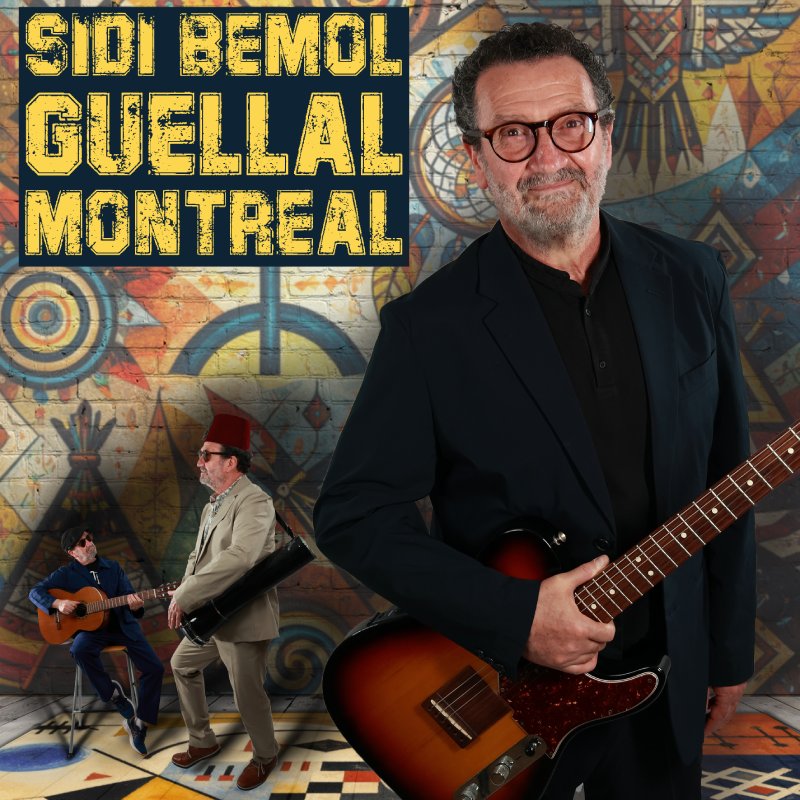
Thirty years and thirteen albums into a career built almost entirely on cultural collision, and Hocine Boukella, better known to audiences as Sidi Bémol, has never been shy about following an instinct across borders. Guellal Montréal, his latest and arguably most conceptually ambitious record yet, follows that instinct further than ever: all the way from the cafés and marketplaces of Oran to the poetry of Indigenous Quebec, and finds, against long odds, that the two traditions have more to say to each other than distance would suggest.
The album’s starting point is the guellal, the deep-voiced, sharply struck hand drum at the heart of Oran’s popular music and a foundational instrument of melhoun, the centuries-old sung poetry, performed by wandering singer-poets in cafés and marketplaces, widely considered a direct ancestor of raï. Boukella fell under its spell young, through masters like Cheikh Hamada, and as a lifelong blues and rock devotee, he quickly sensed something familiar in it: the same raw emotional charge, the same trick of turning plain poetry into pure vibration.
That instinct might have stayed a purely Algerian preoccupation were it not for a series of trips to Quebec, where Boukella encountered Indigenous music and, more than anything, Indigenous poetry, particularly the writing of Joséphine Bacon and Natasha Kanapé Fontaine. What struck him wasn’t surface similarity but something deeper: a shared reverence for nature, memory and the living world that echoed everything he’d absorbed from Berber poetic tradition despite the two cultures having no historical connection whatsoever. Guellal Montréal is the record built from that unlikely recognition, an album less interested in juxtaposing two traditions than in getting them to actually talk to each other.
That conversation runs deeper than lyrics alone. In Montréal, Boukella connected with Tacfarinas Kichou, a Quebec-based percussionist and instrument maker of Algerian descent, and together they’ve developed a genuinely original approach to the guellal itself, building custom instruments that fold contemporary and native American influences directly into the drum’s construction, rather than simply layering different sounds on top of one another in the mix. It’s a detail that matters: the fusion here happens at the level of the instrument, not just the arrangement, which gives the whole record a sense of genuine synthesis rather than a stylistic mash-up.
Boukella, joined by his band, bassist Youssef Boukella, guitarist Abdenour Djemaï, drummer Maamoun Dehane, all contributing backing vocals, with Mehdi Askeur guesting on guellal, sings across twelve tracks in Arabic, Kabyle, French and English, drawing lyrically on both melhoun tradition and Indigenous texts, both classic and contemporary. It’s a genuinely rare thing for a single album to hold that many languages and traditions without feeling scattered, and credit for that cohesion goes as much to the band’s tight, blues-and-rock-inflected playing as to Boukella’s own songwriting.
Among the twelve tracks, one stands out clearly as the album’s centrepiece: “Enfer,” a slow-burning, nearly seven-minute blues built on aching, beautifully unhurried guitar work that gives the record’s cross-cultural premise its most purely visceral moment. It’s the track where Boukella’s blues instincts and his Berber roots feel most completely fused rather than merely adjacent, and it alone is worth the price of admission. Elsewhere, the album moves confidingly between moods and tempos, from rockier, more driving numbers to more reflective, folk-tinged passages, never settling into a single register for too long, which suits a record so explicitly built around dialogue rather than resolution.
This is, of course, entirely in keeping with a career that’s rarely stood still. Since his 1998 debut and through albums exploring Kabyle sea shanties, Celtic-Maghrebi fusion, and Rajasthani-inflected jazz, Boukella has built a reputation as an artist who treats tradition as something to be carried forward and reshaped rather than preserved behind glass, a trained geneticist turned cartoonist turned musician whose restless curiosity has never really had an off switch. Guellal Montréal feels like a natural and genuinely moving culmination of that thirty-year exploration.
Guellal Montréal is an ambitious, warm-hearted record, a rich, rewarding listen from an artist still finding new ground to explore three decades in.
Frankie Pfeiffer
Editor in chief – PARIS-MOVE
PARIS-MOVE, September 16th, 2026
Follow PARIS-MOVE on X
::::::::::::::::::::::::
Guellal Montréal est le nouveau projet de Sidi Bémol, alias Hocine Boukella. Ce n’est pas simplement un nouvel album de musique algérienne. Le 13ème album de Sidi Bémol est né à Montréal autour de la rencontre entre les traditions musicales de l’Ouest et du nord-ouest algérien et les cultures autochtones du Québec (son premier album date de 1998…). Le point de départ est le guellal, percussion traditionnelle très présente dans les musiques populaires oranaises et dans l’univers du melhoun. Sidi Bémol fait dialoguer cet instrument avec la guitare, le blues, le rock et des influences contemporaines. Ce qui est particulièrement original, c’est le travail autour de la poésie autochtone québécoise, notamment l’univers de poètes comme Joséphine Bacon et Natasha Kanapé Fontaine et d’autres artistes «autochtones» qui ont inspiré cet album. Les chansons, au nombre de 12, sont chantées en arabe, kabyle, français et anglais. Montréal a véritablement été le laboratoire du projet. Sidi Bémol explique avoir découvert, lors de ses voyages au Québec, une poésie autochtone qui lui a rappelé certains aspects de la poésie berbère: rapport à la nature, mémoire, territoire et relation au vivant. Il a ensuite cherché à faire dialoguer ces deux univers plutôt qu’à simplement les juxtaposer. Il a notamment travaillé avec Takfarinas/Tacfarinas Kichou, percussionniste et luthier québécois d’origine algérienne, qui a développé une approche personnelle du guellal et conçu ses propres instruments.
Le disque semble assez fidèle à ce que Sidi Bémol fait depuis près de 30 ans: prendre une tradition algérienne et la faire voyager. On retrouve: guellal et rythmiques maghrébines, blues, rock et guitares électriques, melhoun et poésie chantée, influences folk et contemporaines, textes en plusieurs langues, références aux traditions et aux poésies autochtones d’Amérique du Nord.
Le groupe réunit notamment Hocine Boukella au chant et à la guitare, Youssef Boukella à la basse, Abdenour Djemaï à la guitare, Maamoun Dehane à la batterie et Mehdi Askeur au guellal.
Album d’un artiste hors du commun, car Sidi Bémol, Hocine Boukella, n’est pas seulement musicien: il est également dessinateur, auteur et producteur. Il a commencé à la fin des années 1990 et a développé une musique souvent décrite autour du gourbi-rock, mélangeant traditions algériennes, blues et rock. Ce n’est pas un projet sorti de nulle part: Sidi Bémol en parlait déjà en 2023-2024, lorsqu’il expliquait travailler sur cet album après ses voyages au Canada. Le projet porté à maturité est simplement magnifique.
Dominique Boulay
Paris-Move & Blues Magazine (Fr)
PARIS-MOVE, September 16th, 2026
Follow PARIS-MOVE on X
::::::::::::::::::::::::
En concert à Paris au Cabaret Sauvage le 25/09/2026
Tracklisting :
1 TROP DE BOULOT 3:28
2 MALHEUR EST BON 3:33
3 CHICOUTIMIYA 3:11
4 LES MENOTTES 2:59
5 OH MY DARLING 3:32
6 ENFER 6:49
7 BUS ENNAR 4:05
8 YA GAMRA DAWI 2:45
9 LA-HAUT 3:25
10 TAMANRASSET 4:19
11 YUS-AD 3:35
12 MONTREAL 3:14
Musicians:
Hocine BOUKELLA: vocals and guitar
Youssef BOUKELLA: bass and backing vocals
Abdenour DJEMAÏ: guitar and backing vocals
Maamoun DEHANE: drums and backing vocals
Guest:
Mehdi ASKEUR: guellal and backing vocals
Songwriter: Hocine BOUKELLA
Recorded & mixed by Pierre DACHERY at studio Prado