
| World Jazz |
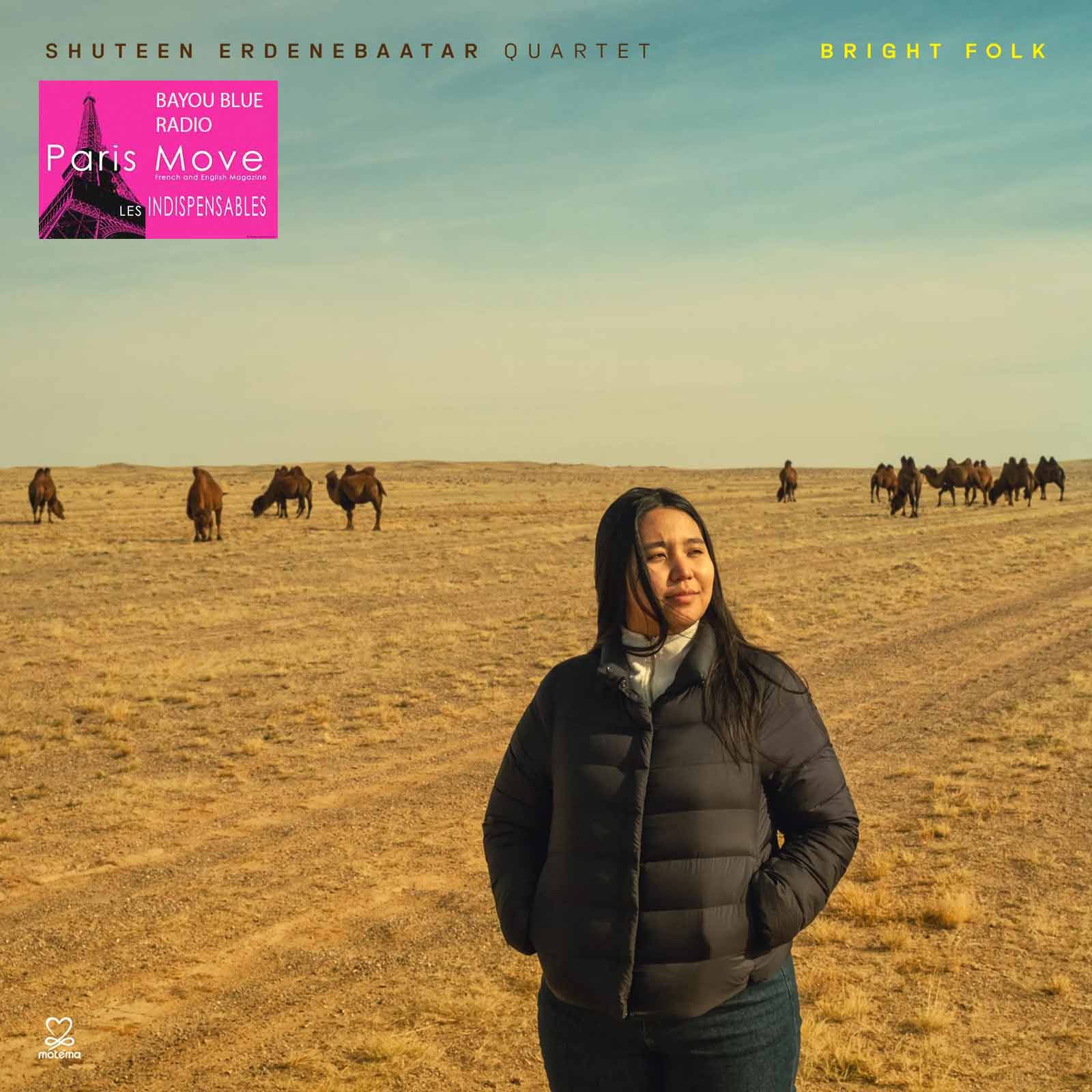
Shuteen Erdenebaatar, “Bright Folk”: A Return to Her Roots and the Intimate Geography of a Life
For several days, a blanket of gray skies has settled over Austin. Rain glistens on roads that have already endured the punishing heat of summer, sometimes followed by sudden and equally unforgiving cold spells. On a quiet morning that seems to stretch on indefinitely, I put on “Bright Folk,” the new album by pianist and composer Shuteen Erdenebaatar. From the opening notes of “Do You See the Stars I See?,” something immediately feels right. The music seems perfectly attuned to the atmosphere of the moment, yet it brings a sense of grandeur and luminosity that stands in striking contrast to the landscape outside. Something rather remarkable happens: the music alters our perception of an otherwise ordinary moment, giving it an entirely different dimension without taking anything away from its original character. There is a quiet poetry in this opening, one that neither reaches for easy sentiment nor attempts to dictate an emotional response. It unfolds with an almost effortless elegance, as though those first notes were gradually revealing a landscape we have always known but never quite taken the time to see. Erdenebaatar’s music possesses that rare ability to make the familiar seem new again, offering a different way of looking at the world without ever distancing us from the realities of everyday life. Her musical language opens onto something larger, a space in which memories, places and human experiences intersect. Listening becomes less a matter of moving from one composition to another than an invitation to embark on a journey of one’s own.
Born in Mongolia and now based in Berlin, Erdenebaatar belongs to a generation of musicians for whom identity can no longer be defined simply by geography. It is shaped by movement, encounters and experience, without the country of one’s birth ever losing its place in the imagination. With “Bright Folk,” her third album, she explores a question that is at once deeply personal and universally recognizable: What does it mean to return to a place you left long ago? What remains of our sense of belonging after years spent elsewhere have fundamentally changed the way we see the world? And, perhaps most importantly, how do we reconnect with our roots without trying to become the person we once were?
The defining moment in the creation of this album came when the Concerto 21 Foundation invited her quartet to perform in Mongolia in October 2024. It was the group’s first visit. For Erdenebaatar, returning to her homeland meant considerably more than revisiting familiar places. After spending years building a life and career in Europe, going back to Mongolia offered an opportunity to confront her own memories while discovering her country anew through the eyes of her fellow musicians. Their presence introduced a different perspective, one that inevitably shifted the familiar frame of reference. Places we believe we have known since childhood can suddenly reveal unexpected dimensions when someone accompanies us in seeing them again. What was once taken for granted becomes an object of renewed attention, and what seemed familiar begins to acquire a different meaning.
Among the places that left the deepest impression on her was the Gobi Desert, her father’s homeland. Its immense horizons, profound silence and particular relationship with time appear to have played an essential role in shaping “Bright Folk.” Yet it would be too easy to regard the desert merely as a source of visual inspiration. It is also a landscape of memory, a link between generations and a way of reconnecting with family history through geography itself. The Gobi becomes an inner landscape, an expanse that informs the compositions as much through what it evokes as through what it leaves to the imagination.
These wide-open spaces are among the album’s defining characteristics. They seem to shape its breathing room, its melodic development and the sense of freedom that runs through all eight compositions. But this openness is never simply about contemplating beautiful scenery. Beneath the landscapes lies a deeper inquiry into inheritance, time and the ways in which life transforms us. Returning to a familiar place can reveal just how profoundly we ourselves have changed. Somewhere we once regarded as home may become a mirror reflecting everything that has happened in the intervening years: the experiences accumulated elsewhere, the people encountered along the way, the memories that have stayed with us and, ultimately, the person we have become. It is precisely within that delicate space, somewhere between memory and transformation, belonging and nostalgia, that Erdenebaatar locates her new work.
What makes “Bright Folk” particularly compelling is the way this personal reflection finds expression in a musical language that never becomes inward-looking or self-absorbed. Erdenebaatar has no interest in simply illustrating her own story, much less constructing a nostalgic narrative around her origins. Instead, she uses that experience as a starting point for music that is open, generous and profoundly collective. Her quartet features bassist Nils Kugelmann, Belgian saxophonist Simon Comté on tenor and soprano saxophones, and Israeli drummer Amir Bresler. Saxophonist Jakob Manz also joins the group as a guest, playing recorder on “Bright Folk” and alto saxophone on “Page #7671.” These musicians bring different backgrounds and experiences to the ensemble, but they are not brought together to manufacture some artificial sense of cultural identity. What emerges is a genuine musical conversation, one in which every instrument has room to speak and the freedom to contribute to the character of the whole.
Given Erdenebaatar’s dual role as pianist and composer, one might naturally expect the piano to occupy a central and dominant position. Yet one of the most impressive qualities of her writing is precisely her refusal to make her instrument the group’s permanent center of gravity. The piano often serves as a connecting force, introducing ideas and creating opportunities for the other musicians to develop their own melodic lines. A theme may emerge from the saxophone, find a new direction through the double bass or be transformed by the drummer’s response. The piano supports, encourages, sets things in motion and occasionally gives an entirely new direction to ideas that seem to arise spontaneously within the group.
This approach reveals a genuine artistic maturity. It requires not only a thorough understanding of one’s instrument but also the confidence to step aside at exactly the right moment. Virtuosity is never treated as a display of power or technical superiority. It serves the ensemble, whose cohesion depends on the musicians’ ability to listen to one another. They do not seem interested in claiming the available space so much as sharing it. That distinction matters, particularly in contemporary jazz, where technical sophistication and increasingly complex arrangements can sometimes overshadow the importance of melody. Here, the compositions remain immediately accessible without sacrificing harmonic richness, structural intelligence or the potential for musical exploration. There is complexity beneath the surface, but never at the expense of clarity.
One of the album’s greatest attractions lies in the meeting of folk sensibilities, echoes of musical traditions from around the world and a thoroughly contemporary jazz vocabulary. These elements are not simply placed side by side to produce an appealing cultural contrast. The melodies have an identity and an internal logic of their own. They may sound deceptively simple on first hearing, but as they develop, their careful construction becomes increasingly apparent. Subtle variations, harmonic shifts and the individual contributions of the musicians gradually reveal additional layers of depth. The theme is not merely a starting point, something to be abandoned once the improvisation begins. It remains the living heart of each composition, a point of reference to which the musicians can return even after exploring unexpected musical territory.
That ability to develop and sustain a melodic idea is, to my ears, one of the album’s most distinctive qualities. Each musician seems capable of extending a musical thought without losing sight of its original intention. Improvisation does not interrupt the narrative; it becomes another way of continuing the conversation. The compositions breathe, take their time, open up new possibilities and sometimes return to where they began after traveling through unexpected territory. The result is music whose sophistication never becomes burdensome and whose freedom never feels directionless. There is a natural sense of movement throughout, as though the musicians were discovering the possibilities of each composition together rather than simply executing a predetermined plan.
“Do You See the Stars I See?” offers a particularly moving illustration of this approach. The title grew out of the composer’s memories, especially the long summer nights she spent in Mongolia looking at the stars with her father. Now separated from him by thousands of miles, she holds on to that image and to a deceptively simple question: Are we still looking at the same stars? The question could hardly be more straightforward, yet it contains much of the emotional depth of the entire project. It speaks of distance, family ties, the persistence of memory and the peculiar sense of closeness that can survive even when two people’s lives unfold in different places.
The stars become something more than a poetic image. They represent a point of connection that transcends borders and physical distance. Two people can live far apart, inhabit different realities and follow paths that no longer cross in their everyday lives, yet still share a common experience of the world. The music gives this idea an especially moving expression. The notes never attempt to describe separation or nostalgia in literal terms. Instead, they suggest their contours, leaving listeners free to discover their own memories within them. That openness is precisely what gives the composition its universal reach. Its emotional power comes not from telling us what to feel but from making room for feelings we may already have carried within us.
“Home Is You” takes the reflection further, turning to the meaning of home itself. Home is no longer simply an address, a territory or a country. It can exist in another person, a relationship, a memory or a succession of moments that continue to accompany us. For anyone who has lived far from the country in which they were born, the question carries particular weight. A sense of belonging does not necessarily disappear when we leave. It changes, sometimes in ways we cannot fully understand until much later. It may even become plural, divided among several places that gradually combine to form a new sense of identity.
Erdenebaatar’s own journey makes this idea especially tangible. Mongolia remains an essential part of her story, while Berlin has become another place to live, create and express herself. There is no need to choose between these two worlds. Her music suggests, instead, that we can belong to more than one place without having to erase the differences between them. This open understanding of identity is one of the album’s most interesting dimensions. It avoids fixed definitions of culture and the restrictive categories so often imposed on artists according to their origins. Rather than treating identity as something inherited and permanently established, Erdenebaatar presents it as a living process, continually shaped by experience.
It would also be a mistake to reduce “Bright Folk” to a meeting between European jazz and Mongolian musical tradition. Such a reading would miss the composer’s real ambition. Her work belongs squarely within contemporary jazz, with its harmonic possibilities, rhythmic freedom and ongoing search for new forms of expression. Cultural references are not decorative touches intended to make the compositions seem more distinctive or exotic. They are part of her personal history and naturally inform her musical language. That is an important distinction: Erdenebaatar is not trying to represent a culture. She is creating music from the experiences, memories and influences that have shaped who she is. The result feels entirely personal without ever becoming exclusive.
This approach becomes even more meaningful when “Bright Folk” is considered within the broader arc of her recording career. With “Rising Sun,” released in 2023, the pianist had already established a distinctive artistic personality, combining rigorous musical training with a melodic sensibility that allowed her to move beyond the conventional boundaries of contemporary jazz. The album brought her significant recognition, including the German Jazz Award for Ensemble of the Year. “Under the Same Stars,” released in 2025, subsequently revealed another side of her musical world, a more intimate one, in a dialogue with Nils Kugelmann involving double bass and contrabass clarinet. I was particularly moved by that earlier album’s economy of means, its delicacy and its ability to create an almost cinematic musical space. I would not take back a word of what I wrote about it at the time: “Under the Same Stars” is an album destined to accompany your dreams and illuminate your heart, with all the grace, intelligence and emotional resonance it carries. Those words could just as easily apply to the experience of discovering “Bright Folk.” The two projects differ in instrumentation and expression, but they share the same attention to melody, the same commitment to composition and, above all, the rare ability to move us without ever forcing an emotional response.
With “Bright Folk,” the return to the quartet brings a broader dimension to this artistic exploration. The experience accumulated onstage through more than a hundred concerts since “Rising Sun” seems to have strengthened the trust among the musicians. That familiarity translates into an effortless exchange of ideas and an ability to let the compositions evolve without losing their coherence. The music has a collective sense of breathing room, allowing it to move from quiet contemplation to more energetic passages while maintaining a remarkable aesthetic unity. There is a sense that the musicians understand not only what each composition requires but also when to let it unfold on its own. That balance between structure and spontaneity is one of the album’s quiet strengths.
The titles of the album’s eight compositions also contribute to the world they create: “Do You See the Stars I See?,” “Becoming,” “After All This Time,” “Bright Folk,” “Home Is You,” “Page #7671,” “In Praise of Light” and “River Sound.” Together, they suggest a vocabulary shaped by time, transformation, memory and the natural world. Light, stars, rivers and home are not simply poetic images. They seem to belong to a larger reflection on how we are shaped by the places we pass through and the relationships we build along the way. The album does not tell a linear story. Rather, it offers a succession of inner landscapes whose connections gradually reveal themselves as we listen. Each composition adds another perspective, another fragment of a personal history that gradually becomes something listeners can recognize as their own.
The title “Bright Folk” itself carries a particularly appealing meaning. It is a tribute to people whose kindness, generosity, creativity and faith in others help make the world a brighter place. The idea might sound almost naïve in an era marked by division, conflict and an increasingly defensive retreat into national and cultural identities. Yet it takes on a deeper meaning when viewed through the lens of what one generation passes on to the next. The album also speaks to those who came before the composer, to the people who opened doors, made new experiences possible and helped others build a future of their own. There is something quietly moving about this acknowledgment of the people whose influence may not always be visible but whose presence continues to shape the lives of others.
This humanistic dimension may be one of the project’s most valuable qualities. It is not expressed through an overt political statement or an attempt to deliver a message. It emerges naturally from the way the music brings people together. Different backgrounds become a source of richness, individual voices find their place within a larger whole, and personal experience becomes a language that can be shared. At a time when borders are increasingly invoked as reasons to keep people apart, this approach reminds us that cultural exchange can also create spaces for understanding and artistic discovery. Music does not erase differences. It gives them a chance to speak to one another. And perhaps that is a more meaningful achievement than any attempt to make them disappear.
That does not mean a jazz album should be expected to resolve the contradictions of the contemporary world. That would be asking it to do something it was never intended to do. But it is entirely reasonable to recognize the significance of a work that sets openness against isolation, sharing against fragmentation and an evolving sense of identity against the idea that belonging must remain fixed. Erdenebaatar’s journey demonstrates that it is possible to live between cultures without being forced to choose one at the expense of another. Her music does not offer a definitive synthesis or pretend that the tensions inherent in such a journey can simply be resolved. It presents an ongoing conversation, one that continues to grow richer with experience.
Perhaps that is where the real achievement of “Bright Folk” lies. Behind the beauty of the compositions and the quality of the performances is a reflection on what connects us to others, what we carry with us from the past and what we become through new experiences. Returning to Mongolia did more than allow Erdenebaatar to rediscover familiar landscapes. It gave her an opportunity to measure the distance she had traveled and to understand that our origins are never a territory we can simply claim once and for all. They evolve with us, change over time and sometimes acquire an entirely new meaning when viewed from somewhere else. We may leave a place, build a life elsewhere and discover that the connection we thought we had left behind has never really disappeared. It has simply taken on a different form.
As the final composition comes to an end, the rain is still falling over Austin. The roads continue to glisten, the sky remains overcast and the morning has not really changed. And yet something in the way I experience the moment has shifted. That, perhaps, is what I value most in an album: the ability not merely to accompany a day but to give it a deeper dimension. “Bright Folk” has that rare quality. It does not try to transport us to some idealized elsewhere or impose a particular vision of the world. It simply invites us to look differently at what surrounds us, to rediscover in our own memories the connections we share with others and to recognize the beauty of experiences that remain with us, sometimes long after the people and places that gave rise to them have moved beyond our immediate reach.
Here, I find much of what moved me so deeply about “Under the Same Stars,” but with a new sense of breadth and a more collective expression. Shuteen Erdenebaatar continues to develop an artistic identity that is increasingly her own, bringing together demanding compositional ideas, considerable instrumental freedom and a melodic sensibility that remains deeply accessible. Her piano does not need to dominate to make its presence felt. Her origins do not need to be constantly emphasized to find their way into her music. And her international journey never represents a break with her personal history. Everything finds its place within a musical language that is coherent, distinctive and generous. It is the work of an artist who understands that musical identity is not something to be declared. It is something that emerges, naturally and unmistakably, through the music itself.
“Bright Folk” is a deeply human album: luminous without being naïve, contemplative without standing still, sophisticated without ever losing its emotional power. It reminds us that belonging is not determined solely by where we live, but also by the people we carry within us, the memories we share and the paths we have traveled. And if the stars Shuteen Erdenebaatar thinks about are still the same for those who remained in Mongolia and those now living thousands of miles away, perhaps music offers an answer to the question she asks: distance does not necessarily mean separation. It can become a space for memory, inheritance and creation. That is the beauty of “Bright Folk,” an album that, well beyond its title, lives up to its name in every sense.
Thierry De Clemensat
Member at Jazz Journalists Association
USA correspondent for Paris-Move and ABS magazine
Editor in chief – Bayou Blue Radio, Bayou Blue News
PARIS-MOVE, November 9th, 2026
Follow PARIS-MOVE on X
::::::::::::::::::::::::
Musicians :
Shuteen Erdenebaatar, piano and compositions
Nils Kugekman, bass acoustic
Jacob Manz, saxophone
Simon Conte, saxophone
Amir Bresler, drums
Track Listing :
Do You See The Stars I See?
Becoming
After All This Time
Bright Folk
Home Is You
Page #7671
In Praise Of Light
River Sound
On The road in Germany:
Nov 14 – Stadttheater Ingolstadt, Ingolstadt
Nov 25 – Jazz at Berliner Philharmonic, Berlin
Nov 27 – KOMM Pleußmühle, Düren
Nov 28 – Altes E-Werk, Göppingen
Nov 29 – Theater Gütersloh, Gütersloh
Dec 1 – Theaterstübchen, Kassel
Dec 4 – Schloss Kapfenburg, Lauchheim
Dec 5 – Schloss Seefeld, Seefeld
Jan 14, 2027 – Centralstation, Darmstadt
Jan 15, 2027 – BIX Jazzclub & Lounge, Stuttgart
Jan 16, 2027 – Kultur hinterm Feld, Dötlingen
Jan 19, 2027 – Laeiszhalle Kleiner Saal, Hamburg
Feb 13, 2027 – Schloss Tiengen, Waldshut-Tiengen
Mar 19, 2027 – Schloss Köngen, Köngen
Mar 20, 2027 – Leerer Beutel, Regensburg
Apr 5, 2027 – Ella & Louis, Holzhausenschloßchen
Apr 9, 2027 – Forum Merzhausen, Merzhausen
Apr 10, 2027 – Jazz im PZN, Wiesloch
Apr 11, 2027 – Jazz im Rathaus, Sonneberg
Apr 16, 2027 – Kurhaus Bad Ham, Hamm
May 28, 2027 – Jazztage Idar-Oberstein
Aug 15, 2027 – Jazz and Joy Festival, Worms
Oct 27, 2027 – Stadttheater Landsberg
Nov 23, 2027 – Schloss Landestrost, Neustadt am Ruberberge
Dec 3, 2027 – Kallmann-Museum, Ismaning
Dec 4, 2027 – Burg Vischering, Lüdinghausen