| Piano |

Shannon Wettstein, Con Grazia: A Century of Italian Piano Music — An Absolute Must-Have!
Con Grazia: A Century of Italian Piano Music, the Neuma Records release from American pianist Shannon Wettstein is ambitious in scope, flawless in execution, and so quietly thrilling from first note to last that it demands to be heard in full, in one sitting, with nothing else competing for your attention. This is an unreserved must-have for anyone who loves piano music, modernist composition, or simply the sound of an artist operating at the absolute height of her powers.
Con Grazia takes its title, “with grace”, from the opening work, a short piece by Giacinto Scelsi, and the phrase could just as easily describe Wettstein’s own playing throughout. Across twenty-one tracks, she moves through nine works by nine different Italian composers, spanning a full century: from Scelsi’s elusive 1930s miniature to Sonia Bo’s 2018 tone-poem on Virginia Woolf. In between come titans of Italian modernism – Luigi Dallapiccola, Luciano Berio, Franco Donatoni, Salvatore Sciarrino – alongside composers who are still actively shaping the present moment: Ivan Fedele, Silvia Bianchera, Sonia Bo and Giuliano Bracci. It’s a staggeringly complete portrait of a musical tradition that, as the liner notes point out, has spent a hundred years innovating without ever feeling the need to sever its ties to the past.
That tension between the ‘avant-garde’ impulse to break new ground and a deep, almost filial reverence for musical history, is the thread that runs through this entire record, and Wettstein makes it explicit. In her own words, she was drawn to works that are simultaneously “unapologetically new” and yet deeply “indebted to music of the past”. You hear that duality everywhere: in Berio’s Wasserklavier, which openly quotes Schubert and Brahms while sounding unmistakably like nobody but Berio, in Dallapiccola’s Quaderno, built from twelve-tone rows yet saturated with the ghost of Bach, in Sciarrino’s Anamorfosi, which distorts Ravel through a lens borrowed from seventeenth-century visual art. Wettstein doesn’t just play these connections, she makes you feel them, phrase by phrase.
Wettstein’s credentials as an interpreter of “the most daring new music”, as her own artist statement puts it, are formidable. With more than 450 world premieres to her name, she has performed at Lincoln Center, the Los Angeles Philharmonic’s Green Umbrella Series, Boston’s Isabella Stewart Gardner Museum, the Fort Worth Modern Art Museum and Chicago’s Constellation, and in recent seasons has taken her programs as far afield as Hong Kong’s City Hall, Bogotá’s Matik Matik and the Camerata of Cremona in Italy itself. The New York Times critic Steve Smith once wrote of a performance at The Stone that it was “full of subtleties no recording could catch”, high praise that makes this particular recording something of a paradox worth seeking out, since Wettstein’s gift for subtlety turns out to translate onto record remarkably well.
She has held piano faculty positions at Michigan State University, St. Cloud State University, Augsburg University and Bemidji State University, previously served as pianist for Boston’s Auros Group for New Music and Minnesota’s Zeitgeist New Music Ensemble, and continues to collaborate with artists including flutist Elizabeth McNutt, saxophonist Kyle Hutchins, and ensembles such as the Mivos Quartet and Fonema Consort. She studied with Sequeira Costa at the University of Kansas, Stephen Drury at the New England Conservatory, and Aleck Karis at UC San Diego, with further guidance from Claude Frank and Ben Zander, a pedigree that reads like a map of American new-music performance over the last several decades. She is also the host of Dr. Avant-Garde, a podcast devoted to pushing the art of music forward, which tells you everything you need to know about where her curiosity lives.
What makes Con Grazia especially satisfying is how deliberately it was constructed. Wettstein has explained that the whole project began with Donatoni’s Rima, after which she added works by two of Donatoni’s own students, Sonia Bo’s D’onde and Ivan Fedele’s Antipodes, before branching outward to the wider canon of Italian avant-garde writing: Scelsi, Berio, Dallapiccola and Sciarrino. That teacher-to-student lineage gives the album a genuine intellectual backbone beneath its gorgeous surfaces. This isn’t a random anthology of “Italian piano pieces”, but a carefully mapped family tree of ideas, passed from one generation of composers to the next.
The album opens with Scelsi’s “Con Grazia” from his Fifth Suite for Piano (1:44), a work by a composer who was, by any measure, one of music’s true outsiders, a member of the Italian nobility who studied privately rather than at conservatory, travelled extensively through India, Egypt and possibly Tibet, and came to think of himself less as a composer than as a “receiver” of music arriving from elsewhere. Written sometime in the 1930s, this is a lilting, slightly intoxicated dance, harmonically ambiguous and laced with a dry, cosmopolitan wit, the perfect curtain-raiser, setting the album’s governing mood of sophistication shot through with mischief.
Sciarrino’s “Anamorfosi” (2:10) follows, a miniature by arguably the most frequently performed Italian composer alive today. Largely self-taught as a musician after beginning as a visual artist, Sciarrino here mashes together fragments of Ravel’s piano writing, most recognisably Jeux d’eau, with echoes of the 1952 film musical Singin’ in the Rain, under a title borrowed from the 17th-century art technique in which an image resolves into coherence only from one single, precise vantage point. It’s a disorienting, beautiful piece, and Wettstein navigates its shifting perspective with total assurance.
Sonia Bo’s “D’onde” (7:33) is the album’s longest single movement and one of its emotional high points. Inspired directly by Virginia Woolf’s experimental novel The Waves, with its six characters’ soliloquies representing fragments of a single collective consciousness, Bo’s piece lets the sound of water, sometimes lapping gently, sometimes crashing with real violence, frame a sequence of interior monologues. Shannon’s control of dynamic shading here is extraordinary, you can practically watch the tide come in.
Then comes the album’s great centrepiece: Dallapiccola’s “Quaderno Musicale di Annalibera” (1952), unfolding across eleven tightly compressed movements — Simbolo, Accenti, Contrapunctus Primus, Linee, Contrapunctus Secundus, Fregi, Andantino Amoroso e Contrapunctus Tertius, Ritmi, Colore, Ombre and Quartina — in a combined span of barely fifteen minutes. Written as a birthday gift for the composer’s eight-year-old daughter, and titled in homage to the keyboard notebooks Bach once compiled for his own family, the Quaderno folds a literal B-A-C-H motif and structural references to the Art of Fugue into a rigorously twelve-tone framework, canon at the unison, canon in inversion, even a “crab” canon in retrograde, all built from a single shared tone row. It’s a dazzling demonstration of how serial technique and genuine tenderness can coexist, and Wettstein handles its constant shifts of character, by turns playful, stark, amorous and shadowed, with the instincts of a natural storyteller rather than a technician ticking off movements.
Donatoni’s “Rima” (1983), the work that started the whole project, arrives next in two large movements (6:08 and 6:34), and it’s a joy from beginning to end. Donatoni, who abandoned composition altogether for years following a period of depression before being coaxed back by the death of his close friend Bruno Maderna, wrote his late works under the loose, liberating influence of jazz’s spirit, if not its actual syntax. The title means “rhyme” and true to that idea, Donatoni’s phrases begin in wildly different places but keep arriving at the same kind of cadential “rhyme”, a structural wit that Wettstein plays up with real relish, bringing out every ounce of the music’s effervescence.
Giuliano Bracci’s “Canto Notturno” (5:56), the most recent work on the programme alongside Bo’s, is prefaced in the score by a quotation from Giacomo Leopardi’s night-sky meditation and pays homage to Schubert’s haunting Der Doppelgänger. Bracci builds the piece almost entirely from resonance rather than attack, the written notes function as a kind of negative space, with the music’s true substance emerging only once the fingers lift and the overtones are left to ring. It’s a piece about absence as much as presence, and an extraordinary showcase for the kind of pianissimo control that very few performers can sustain convincingly for nearly six minutes.
Ivan Fedele’s “Antipodes” (2005, 4:16) pushes that same idea even further. Conceived as a pedagogical work to introduce young pianists to twenty-first-century musical language, it contains remarkably few actual notes. The real challenge lies in counting through long stretches of precise silence, an underrated skill that separates the merely accurate pianist from the truly musical one. Wettstein’s reading is riveting proof of the latter.
Berio’s “Wasserklavier” (1965, 2:06) offers a moment of pure, suspended beauty at the heart of the album’s back half, the first-composed, third-published entry in Berio’s Six Encores, openly referencing Schubert’s Op. 142 and Brahms’s Op. 117 while dissolving them into something unmistakably Berio’s own: liquid, resonant, and quietly radical in its restraint.
The album closes with Silvia Bianchera’s “D’eco” (1992), in two movements, Preludio (3:37) and Toccata (2:21), a work the composer herself describes as a nostalgic love letter to that thrilling turn-of-the-century moment when late Romanticism was giving way to Expressionism. It’s a fittingly passionate finale: by turns fiery and tender, percussive and lyrical, impulsive and deeply contemplative, and Shannon brings the whole hundred-year arc of the album to a close with playing that feels both triumphant and intimate at once.
Con Grazia succeeds on every level an album like this can succeed: as scholarship, as curation, as a loving historical survey, and, above all, as sheer, spellbinding pianism. Shannon Wettstein doesn’t merely perform this century of Italian music, she illuminates it, connecting Scelsi’s 1930s mysticism to Sonia Bo’s 2018 meditation on Virginia Woolf as though no time had passed at all. It is a generous, intelligent, beautifully recorded album, and quite simply one of the finest piano releases of the decade.
Frankie Pfeiffer
Editor in chief – PARIS-MOVE
PARIS-MOVE, October 1st, 2026
Follow PARIS-MOVE on X
:::::::::::::::::::::
Tracklisting:
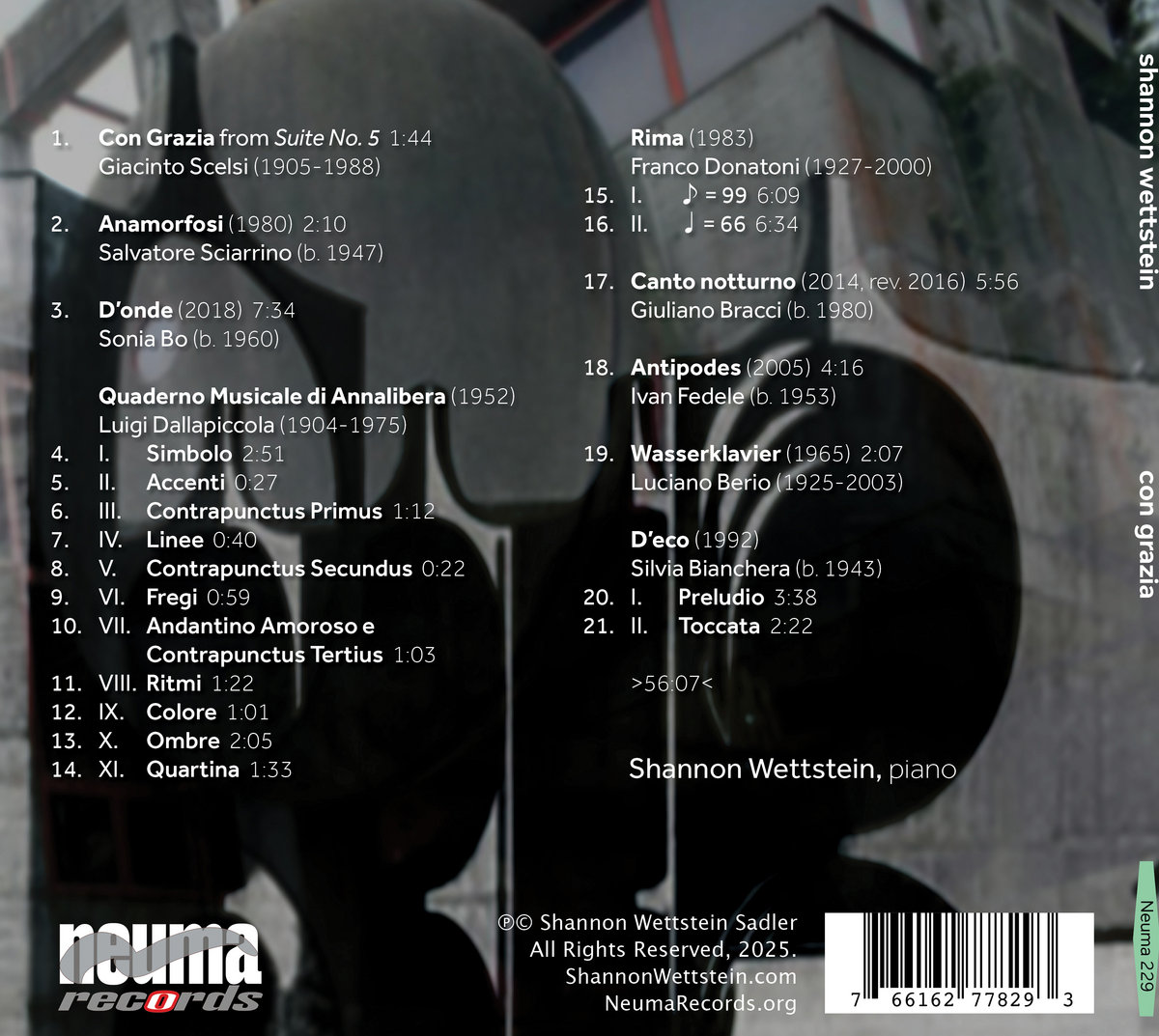
- Giacinto Scelsi: Con Grazia from Suite No. 5 – 01:44
- Salvatore Sciarrino: Anamorfosi – 02:10
- Sonia Bo: D’onde – 07:33
- Luigi Dallapiccola: Quaderno Musicale di Annalibera: I. Simbolo – 02:51
- Luigi Dallapiccola: Quaderno Musicale di Annalibera: II. Accenti – 00:27
- Luigi Dallapiccola: Quaderno Musicale di Annalibera: III. Contrapunctus Primus – 01:11
- Luigi Dallapiccola: Quaderno Musicale di Annalibera: IV. Linee – 00:39
- Luigi Dallapiccola: Quaderno Musicale di Annalibera: V. Contrapunctus Secundus – 00:22
- Luigi Dallapiccola: Quaderno Musicale di Annalibera: VI. Fregi – 00:59
- Luigi Dallapiccola: Quaderno Musicale di Annalibera: VII. Andantino Amoroso e Contrapunctus Tertius – 01:02
- Luigi Dallapiccola: Quaderno Musicale di Annalibera: VIII. Ritmi – 01:22
- Luigi Dallapiccola: Quaderno Musicale di Annalibera: IX. Colore – 01:01
- Luigi Dallapiccola: Quaderno Musicale di Annalibera: X. Ombre – 02:04
- Luigi Dallapiccola: Quaderno Musicale di Annalibera: XI. Quartina – 01:32
- Franco Donatoni: Rima: I. ♪ = 99 – 06:08
- Franco Donatoni: Rima: II. ♩ = 66 – 06:34
- Giuliano Bracci: Canto notturno – 05:56
- Ivan Fedele: Antipodes – 04:16
- Luciano Berio: Wasserklavier – 02:06
- Silvia Bianchera: D’eco: I. Preludio – 03:37
- Silvia Bianchera: D’eco: II. Toccata – 02:21
Total running time: 56:07
Musician:
Shannon Wettstein: piano
Credits
Recorded at Schmitt Music Auditorium, Bloomington, MN, January 2024.
Recording engineers: Steve Wiese and Scott Malchow.
Mastered by Erdem Helvacıoğlu.
Producer: Randall Davidson.
Released on Neuma Records (Neuma 229)