| Jazz |
Summary: Shai Jaschek’s Portrait blends lyrical melodies, modern jazz and intimate trio interplay, revealing a guitarist and composer with a distinctive voice.
Shai Jaschek’s Portrait: A Jazz Guitarist Finding His Voice in New York
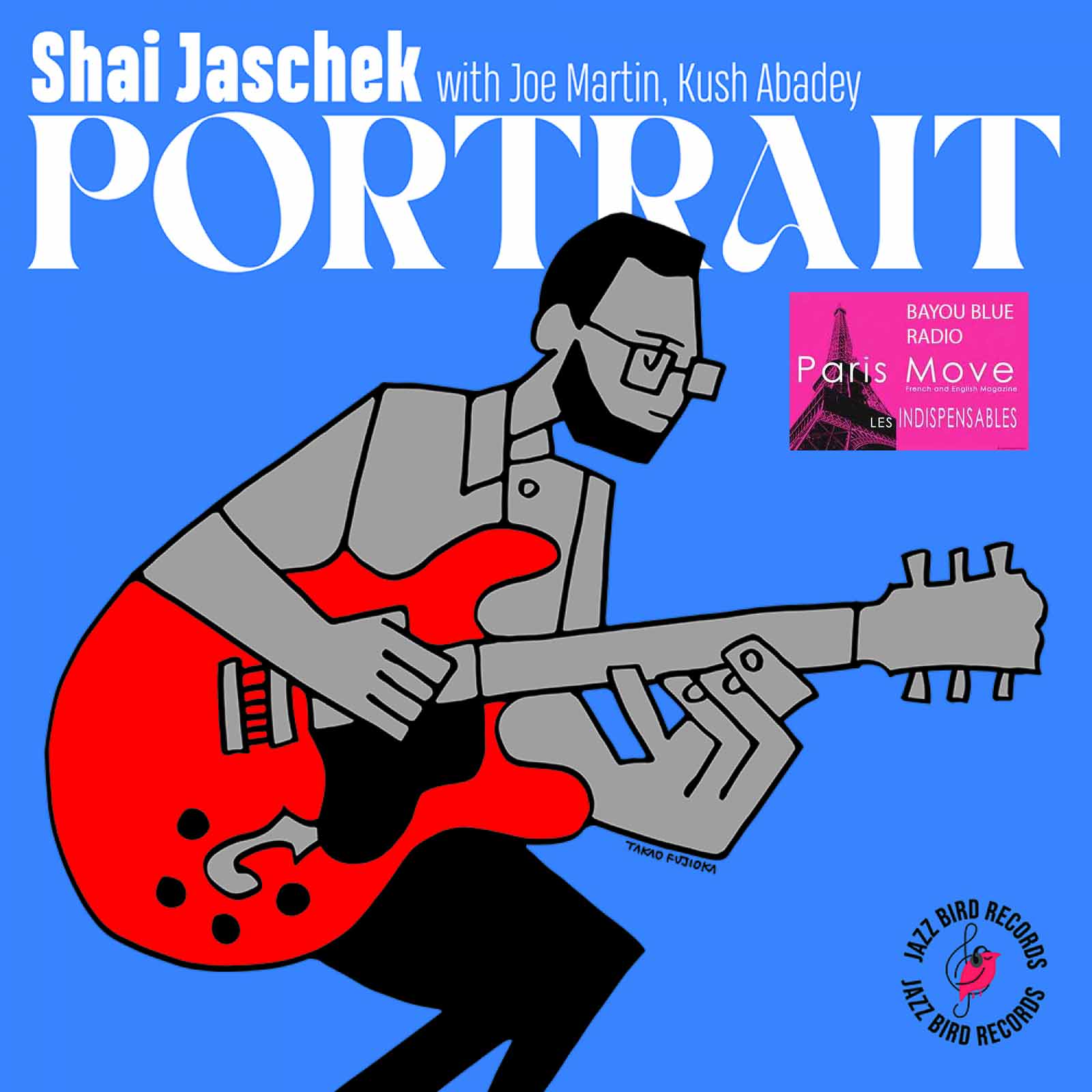
The day broke after a night of rain, with that suffocating heat that wraps itself around you from the earliest hours and gives the morning a strange sense of slowness. I headed to the studio with a few records to listen to and that particular curiosity that always comes with discovering a new album. I put on Portrait, by Shai Jaschek, without any particular expectations beyond seeing where the music might take me. My first thought was simple: beautiful atmosphere. And yet, I have to admit that this is not usually the kind of album that immediately draws me in. I need something more to hold my attention: a note that lands exactly right, a rhythm that catches the ear, a melody that does not immediately demand to be admired but settles in quietly and eventually refuses to leave. That is precisely what happens here. There is a composer in Shai Jaschek who awakens all my instincts as a listener looking for good notes and beautiful rhythms. And when the melodies follow, I settle in and let the music do its work. Portrait belongs to that relatively rare category of records that seem immediately accessible while gradually revealing a much greater richness than the first listen suggests. I listen once, then again, and with each pass something else comes into focus: a turn in the guitar, a response from the bass, a movement in the drums, an arrangement that initially seemed incidental and suddenly becomes essential. Nearly everything works with a kind of inevitability that is not spectacular, but is often the real difficulty in music. The compositions are engaging, Jaschek’s playing is precise and assured, the arrangements never try to overwhelm the themes, and above all, the chemistry among the musicians gives the record room to breathe. You can hear that these pieces were conceived, worked through, played and then given enough freedom to continue evolving once they were recorded. That is where Portrait becomes interesting. This is not simply a guitarist’s record. It is a composer’s record, and that distinction changes quite a lot. Jaschek does not seem interested in convincing us that he knows how to play guitar, even though there is little doubt about his technical ability. What he wants to show is what he can do with a melody, a rhythm and three musicians who understand one another without needing to step on one another. His decision to build the album entirely around original compositions is consistent with that approach. He could have relied on standards, on instantly recognizable themes, on the collective memory of jazz that can sometimes provide a shortcut. Instead, he takes the risk of presenting his own music. And that risk is precisely what gives Portrait its identity.
Often, the opening track of an album tells you something about what is to come. Here, “Birmingham After Dark” takes you by the hand and immediately points the way. There is something nocturnal about the piece, something urban, almost cinematic, as if the music had begun walking through a city after nightfall. Nothing is forced, nothing is underlined. Jaschek establishes his world with enough confidence to let the listener do the rest. The guitar draws the outlines, the bass provides the depth that allows the piece to breathe, and the drums organize the movement without ever trapping the music inside it. Then the tracks follow one another like different worlds waiting to be discovered, with the feeling that you are moving through different neighborhoods of the same city, different hours of the same night, different states of mind. That is probably what I like most about this album: it has a genuine atmosphere without becoming an “atmospheric” record in the reductive sense of the word. The music tells you something, but it never tells you exactly what to think. It leaves spaces, and those spaces matter. Shai Jaschek is now based in New York, after building his path between Israel and the United States, and that journey seems to have nourished a music that does not try to choose between different influences but allows them to speak to one another. New York is obviously there, with its immense tradition, its clubs, its musicians and its history weighing on every guitarist who comes looking for a place in the city. But this is not an exercise in reverence toward a mythical New York. Jaschek seems to have understood that in New York, the only way to survive musically is to listen constantly, play constantly, meet other musicians and, sooner or later, find your own voice. Even before settling in the city, he already knew the work of Joe Martin and Kush Abadey, particularly through recordings by musicians he admired. He hoped that one day he might play with them. Then the encounters did what encounters in music tend to do, in clubs, over concerts and through the New York musical life that is built less through declarations than through exchanges between musicians. When the three of them come together around Jaschek’s compositions, something becomes immediately clear: these pieces need these two partners to reach their full dimension.
Joe Martin and Kush Abadey are therefore not here simply to accompany a guitarist who has arrived to display his technique. They are part of the project from the beginning. Martin brings considerable experience in modern jazz, with collaborations involving Mark Turner, Chris Potter, Kurt Rosenwinkel and Gilad Hekselman, while Abadey has worked with Wallace Roney, Melissa Aldana and Hekselman, among others. They have been playing together for many years, and you can hear that familiarity. The bass and drums form a genuine rhythmic organism around the guitar, capable of supporting an idea but also of shifting it, gently challenging it, opening another door. That is precisely the kind of interaction I look for in a trio. The music has to be able to breathe between the instruments. The guitarist does not necessarily have to be the one doing the most talking. Sometimes the best idea is the one you leave to someone else to finish. Jaschek seems to understand that perfectly. His playing is nevertheless remarkable. He controls his instrument with a precision that could easily lead toward virtuoso display. But that is not the road he chooses. There is a real discipline of melody in his playing. He knows where a phrase begins, where it can go, when it needs to develop and, most importantly, when it needs to stop. That may sound simple, but it is probably one of the hardest things to do in music. Playing a lot is relatively easy when you possess the technique; knowing what to play, and especially what not to play, requires another kind of maturity. Portrait is full of those small decisions that make the difference: a short phrase instead of a long flight, a silence instead of one more note, a change of rhythm at the moment you do not expect it. Nothing is particularly spectacular on its own, but together these choices create a genuine personality. They also explain why the album can speak equally well to a seasoned jazz listener and to someone who does not possess all the genre’s codes. The music does not require a diploma for admission. It simply leaves the door open.
That question of accessibility matters because Jaschek seems to have thought carefully about how jazz can communicate with an audience that may not necessarily be familiar with its more complex forms. He recognizes that jazz can sometimes give the impression of being a music reserved for people who already know how to listen to it. His answer is to favor lyrical, memorable melodies capable of establishing an immediate relationship with the listener. I find that approach particularly interesting because it does not mean simplifying the music to make it more commercial. Quite the opposite. It takes far more control to write a melody that sounds inevitable than it does to pile up sophisticated ideas. A good melody has to survive its context. It has to remain recognizable once you forget the arrangement, once you stop thinking about the guitarist’s virtuosity or the quality of the recording. It has to continue living somewhere in your head. Portrait has several such moments. That is probably why I keep returning to the record. Certain musical phrases remain after the listening is over. They come back while I am doing something else. That is the telltale sign. The music has left the speakers and entered memory. In a musical landscape where complexity is sometimes confused with depth, Jaschek reminds us that a work can be immediately accessible and still be deeply crafted. There is no contradiction between the two. The real difficulty is precisely to make the work required to achieve that apparent simplicity disappear.
A succession of good ideas, then, from the choice of musicians to the way the sound itself is conceived. I am always struck by the difference between albums where electrical effects seem to arrive before the musical ideas and those that take the time to let the instruments speak. Portrait clearly belongs to the second category. The acoustic format of the trio is completely assured and, to my ears, works better than many productions in which electricity eventually becomes an end in itself. Here, the sound remains at the service of the composition. The guitar does not need to be buried under effects to acquire a personality. It can simply sound like a guitar. And when three musicians have enough experience to make a piece come alive without artificially adding layers of sound, the result can be surprisingly rich. Jaschek clearly enjoys playing with sound and rhythm, but he never confuses playing with sound with simply accumulating sound. That distinction impresses me far more than many other things. There is something deeply satisfying about taking the time to establish a theme, letting it develop, and then allowing the musicians to look at it from another angle. At moments, the post-bop atmosphere recalls certain albums from the 1950s and 1960s, but without ever feeling like imitation. The references are obviously there, and it would be foolish to pretend otherwise. But they function as a language rather than as decoration. Jaschek does not seem interested in recreating the jazz of another era. He is trying to understand what that tradition can still produce today. And that is where the record becomes more interesting than a simple demonstration of good taste. The question is not merely where this music comes from, but what can still be done with it.
“May Flowers” is certainly the track that stayed with me most because of its poetic quality. It sounds almost like the opening theme of a late-night jazz program, beginning after the city has quieted down and a few lights are still glowing behind apartment windows. There is something gentle about the piece, but never sentimental. The melody seems to float before gradually finding its way again, and the guitar has an almost vocal quality that allows you to follow every phrase. It is exactly the kind of track I like to hear several times because it does not give everything away in the first minute. It leaves traces. In its own way, “May Flowers” sums up one of Portrait’s strengths: its ability to create images without imposing them. You might hear a city, a season, a street, a memory or simply a beautiful melodic line. In the end, it does not really matter. The music works because it suggests. And when the album moves on to more rhythmic pieces, the contrast reinforces that sense of travel. “Stomping with Pitzi,” for example, brings a much lighter, almost mischievous energy. The piece grew out of a request from Jaschek’s wife and pays a humorous tribute to the world of “Stompin’ at the Savoy.” I like that detail because it reminds us that behind the sophistication of jazz, behind the references and the technique, there are always simple stories. A musician also writes for the people he loves, for the situations he encounters, for the memories that belong to him. That personal dimension keeps Portrait from becoming an academic exercise. You can feel that these pieces had a life before they ever reached the record. And that changes the way you listen to them.
Other compositions give the album a different kind of gravity. “How Much Longer” and “Hymn for Peace,” in particular, open a door onto something darker, with questions that extend far beyond music itself. Jaschek addresses violence, despair and the idea of a peace that is more than simply a phrase. Yet it would be too easy to turn these pieces into political statements and reduce the record to what they are ostensibly about. That would miss their real interest. Music does not explain; it makes us feel. It solves nothing, but it can give shape to anxiety, anticipation or a desire for peace. And that is probably the best way to allow the outside world into a jazz album: not by illustrating it, but by allowing it to resonate. This dimension adds something to the portrait of the musician. Behind the guitarist attentive to rhythm and melody is a composer who is also watching what is happening around him. Yet even when the subject becomes more serious, Jaschek never loses his sense of music. The themes remain carefully constructed, the exchanges within the trio remain essential, and the album never turns into a speech. That restraint strikes me as exactly right. There is enough noise in the world already for music to have no need to add more. Sometimes it can do something else: create a space where we can simply listen, think and breathe.
What also strikes me, as I listen again and again, is this determination never to let virtuosity take over from composition. Shai Jaschek plays remarkably well, but that is never the main subject. The subject is the music. It sounds obvious, and yet it is not particularly common. Many guitarists today possess astonishing technique, but technique alone does not automatically produce a personality. You still have to know how to tell a story. Jaschek seems to have chosen that path. He is not trying to play faster than everyone else, louder than everyone else or more complicated than everyone else. He is looking for his own balance. And that balance runs through melody. That is probably where I find myself most closely connected to his work. As a listener, I can appreciate a brilliant solo, a harmonic feat or a complicated meter, but those are rarely the things that make me want to put a record on again. What brings me back is a musical phrase. An atmosphere. A rhythm. An emotion that is difficult to define but present enough to make you want to start over. Portrait has that quality. It does not give itself entirely to you on the first listen, but neither does it require any special effort to enter its world. You simply have to let it happen. Then the details begin to arrive.
I could obviously go on about the influences, the structures, the technical qualities of the trio and the particular role of the guitar in this music. But at some point, you have to return to the essential question: Do I want to listen to this album again? The answer is yes. And in the end, that is the only answer that really matters to me when I am faced with a record. Everything else can be analyzed, compared, discussed, taken apart track by track, but if the music does not make you want to come back, something is missing. Portrait makes you want to come back. It has the quality of those albums that accompany you rather than impose themselves on you. You can listen closely, trying to understand every interaction, or you can simply let it play while the day moves forward. Either way, it works. And that double reading is valuable. The specialist can hear the construction, the references and the compositional choices; the less familiar listener can simply enjoy the melodies and the sound of the trio. No one is shut out. That is probably what Jaschek is getting at when he talks about jazz as a music capable of reaching people who do not already know its codes. He does not abandon complexity. He simply makes it less intimidating.
And so I think back to that morning after the rain, to the heat that was already beginning to settle in, to the studio and to that first listen I started almost without thinking. “Beautiful atmosphere,” I thought. A few listens later, the phrase obviously seems too small. Portrait is a richer album than that first impression suggested. There is the guitar, of course, but above all there is genuine writing, a remarkably sure sense of melody, a thoughtful approach to rhythm and a striking confidence in the power of the trio. There is also New York, present almost in the background, that city where so many musicians come looking for their voice and where you have to learn to listen before you can expect to be heard. And finally there is Jaschek’s determination to make jazz a music that can welcome people without surrendering either its history or its standards. For me, that is probably what makes Portrait particularly compelling. The record is not trying to revolutionize jazz. It is attempting something more difficult: to give the music new life through personal compositions, musicians who know one another and a constant attention to sound. And then there is that hint of nostalgia, that almost smiling desire to conquer jazz clubs with his own compositions, without arrogance, simply with the desire to play. It is a fine ambition. After all, jazz has always moved forward this way, through musicians who know what came before them but still want to add a few lines to the story. Shai Jaschek has added his here. And when “May Flowers” returns to my mind after the record has ended, when certain phrases from “Birmingham After Dark” continue to circle in my head, I realize that Portrait has ultimately accomplished what good albums always accomplish: it did not merely pass through my ears; it left a trace. The rest belongs to time, to future listens, to future concerts and to that strange capacity jazz has to keep inventing its present while still speaking with its past.
Thierry De Clemensat
Member at Jazz Journalists Association
USA correspondent for Paris-Move and ABS magazine
Editor in chief – Bayou Blue Radio, Bayou Blue News

PARIS-MOVE, September 24th, 2026
Follow PARIS-MOVE on X
::::::::::::::::::::::::
To Buy this album (October 9, 2026)
Musicians :
Shai Jaschek, guitar
Joe Martin, bass
Kush Abadey, drums
Track Listing :
Birmingham After Dark
When the Sun Came Out
June 27th
How Much Longer
Two Chords Song
May Flowers
Stomping with Pitzi
Hymn for Peace
Poem