| Jazz |
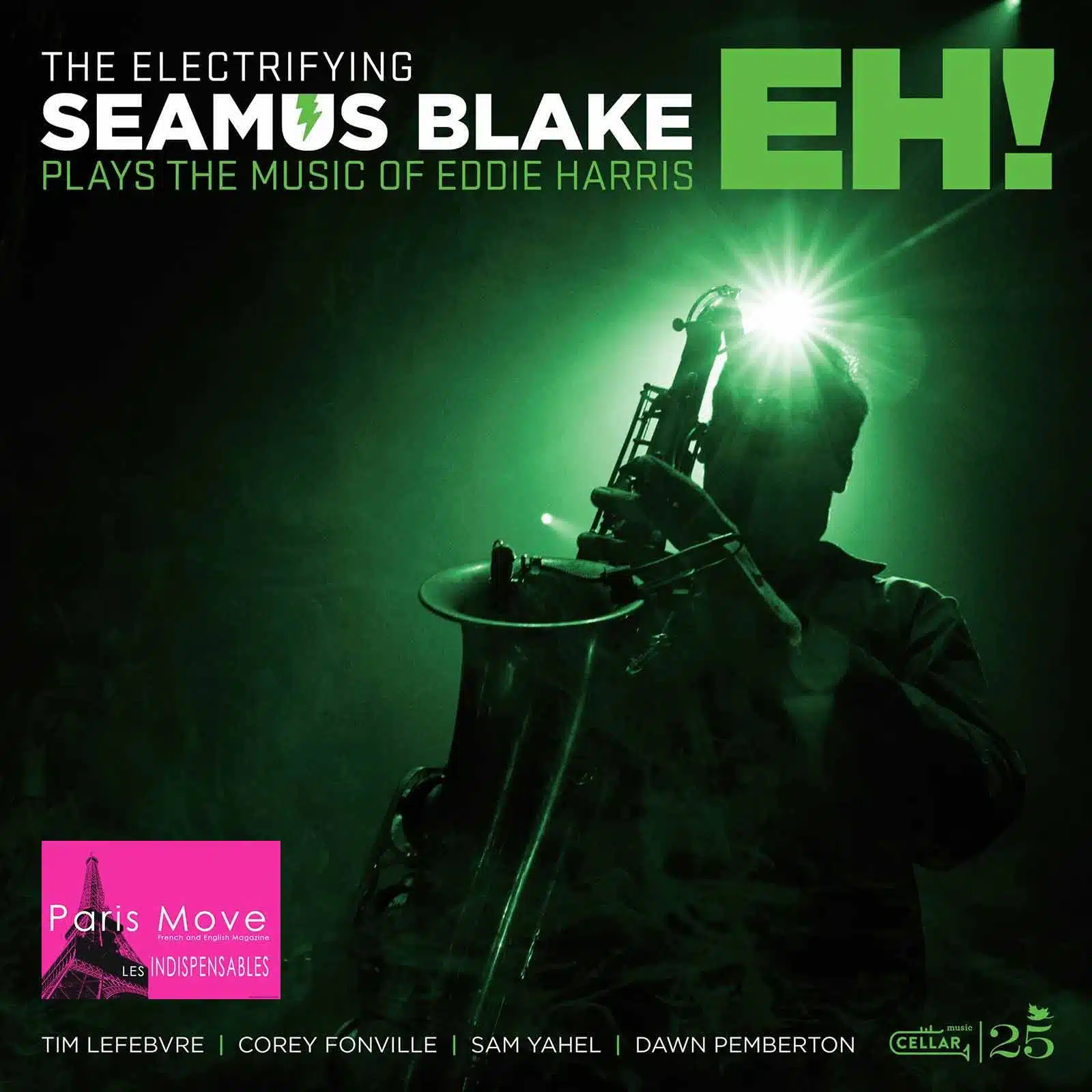
Summary: With stellar contributions from Tim Lefebvre, Corey Fonville, Sam Yahel and Dawn Pemberton, Seamus Blake’s tribute to Eddie Harris transforms classic material into a contemporary jazz statement that bridges funk, soul and modern improvisation with remarkable energy and vision.
Seamus Blake Reimagines Eddie Harris for the 21st Century in a Vibrant and Groove-Filled Tribute
There are album covers that seem to arrive at exactly the right moment. On a week when rain is forecast day after day and gray skies feel determined to settle in for the long haul, the warm green tones of this cover offer a welcome burst of sunlight before a single note has been played. Then your eyes move to the names gathered around the project, and anticipation quickly turns into excitement. With Seamus Blake, Tim Lefebvre, Corey Fonville and Sam Yahel on board, expectations naturally rise.
The album wastes no time delivering. It opens with a blazing version of “Compared to What,” a performance that combines instrumental precision, vocal authority and an irresistible funk groove. The energy established in those opening minutes never truly lets up, carrying the listener through a record that feels both celebratory and deeply purposeful.
For listeners unfamiliar with Eddie Harris, a brief reminder is in order. The Chicago-born tenor saxophonist and composer was one of the most innovative figures to emerge from jazz in the late 1960s. Harris built a career by embracing elements that many jazz purists initially viewed with suspicion: groove-oriented rhythms, electronics and stylistic crossover. His recording of “Exodus” became the first jazz record to earn a gold certification while also breaking into the national charts. His collaboration with Les McCann on the landmark live album Swiss Movement, recorded at the Montreux Jazz Festival in 1969 without prior rehearsal, produced the enduring anthem “Compared to What,” written by Gene McDaniels. Meanwhile, his composition “Freedom Jazz Dance,” later recorded by Miles Davis and countless others, evolved into one of modern jazz’s most frequently interpreted standards.
What makes this tribute particularly compelling is that it never feels trapped by nostalgia. Rather than treating Harris’ music as a museum piece, Blake and his collaborators approach it as living material. The result is an album that possesses all the qualities of a future reference recording in its own right. Beyond its thematic focus, it offers a strikingly contemporary vision of Harris’ legacy, translating his musical language into the twenty-first century through modern rhythmic concepts, sophisticated arrangements and an inventive use of brass and electronic textures.
Harris himself was a pioneer in this regard. Among the first jazz musicians to electrify his instrument through the Varitone system, he helped establish a lineage that connected the fusion era to many contemporary approaches to electronic wind instruments. His influence extended far beyond jazz circles. Across decades, his recordings have been sampled by hip-hop artists ranging from Eric B. & Rakim and Gang Starr to De La Soul, Cypress Hill, Digable Planets, Pete Rock & CL Smooth and Busta Rhymes, ensuring that his sound continued to resonate with entirely new generations of listeners.
The album functions as a bridge between past and present. There is tenderness throughout these performances, but also imagination and poetic restraint. Asked what initially attracted him to Harris’ music, Blake offered a simple answer: “I remember hearing Eddie Harris for the first time and being blown away. It was funky, melodic, and unlike anything I’d ever heard before.”
Blake’s own résumé helps explain why he is uniquely suited to this material. Over the years he has performed and recorded with Wayne Shorter, Herbie Hancock, Kurt Rosenwinkel, Gonzalo Rubalcaba and John Scofield, who famously described him as both an extraordinary musician and a complete saxophonist. While still studying at Berklee College of Music, Blake was already recording with drummer Victor Lewis before relocating to New York, where he would become a longstanding member of the Mingus Big Band. In 2002, he won the prestigious Thelonious Monk International Jazz Saxophone Competition, cementing his reputation as one of the leading voices of his generation.
One of the album’s greatest achievements is the way it conceals the complexity of its construction. The arrangements are sophisticated, the harmonic architecture often intricate, yet the performances remain effortlessly accessible. Everything feels natural, propelled by musicians whose technical mastery never overshadows the music itself.
A large part of that success can be attributed to the remarkable chemistry of the ensemble. Tim Lefebvre’s bass playing is a constant source of momentum, anchoring the music with deep, elastic grooves while adding subtle layers of color and texture. His ability to move seamlessly between jazz, funk and modern improvisational music gives the record much of its contemporary pulse. Equally essential is Corey Fonville, whose drumming combines precision and imagination. Fonville’s rhythmic approach draws from a broad modern vocabulary that includes jazz, fusion, hip-hop and neo-soul, creating a dynamic foundation that keeps the music in perpetual motion without ever overwhelming it. Together, Lefebvre and Fonville provide the engine that allows the music to sound both grounded and adventurous.
That opening track, however, remains the key to understanding the entire project. “Compared to What” begins with the voice of Dawn Pemberton, a decision that immediately reframes a familiar classic. Blake explained that he wanted to explore a different arrangement and bring Pemberton’s voice to the forefront. More importantly, he noted that the lyrics, although written in the 1960s, still resonate with remarkable force today. The song’s questions about society, justice and political reality feel no less urgent in the present moment.
The album then moves into “Listen Here,” one of Harris’ signature compositions and a cornerstone of his live repertoire. Blake describes it as quintessential Eddie Harris: direct, blues-infused, funky and touched by a subtle strain of psychedelia. The performance captures exactly that balance between accessibility and adventurousness that defined Harris at his best.
Listening to this record, one is reminded of Miles Davis’ famous observation that everything ultimately begins with Louis Armstrong. In a similar spirit, it becomes difficult to ignore the elegant presence of Miles Davis throughout this project. His influence lingers here not as imitation, but as a distant shadow, a reminder of how jazz continually renews itself by reinterpreting its own history. Harris absorbed that lesson, and Seamus Blake clearly understands it as well.
More than a tribute album, this is a conversation across generations. It honors Eddie Harris not by recreating his music exactly as it was, but by embracing the restless curiosity that made him such an important artist in the first place. That may be the most faithful tribute of all.
Few tribute albums manage to sound this alive. By treating Eddie Harris’ music as a source of inspiration rather than a historical artifact, Seamus Blake and his collaborators have created a record that feels both timeless and urgently contemporary. It is a celebration of innovation, groove and imagination, one that introduces Harris’ enduring legacy to new listeners while offering longtime jazz fans a fresh perspective on a body of work that continues to reveal new possibilities.
Thierry De Clemensat
Member at Jazz Journalists Association
USA correspondent for Paris-Move and ABS magazine
Editor in chief – Bayou Blue Radio, Bayou Blue News
PARIS-MOVE, June 16th, 2026
Follow PARIS-MOVE on X
::::::::::::::::::::::::
Musicians :
Seamus Blake – tenor saxophone, EWI and effects, vocals
Sam Yahel – Hammond B3 organ, piano, clavinet, Fender Rhodes
Tim Lefebvre – electric bass
Corey Fonville – drums
Dawn Pemberton – vocals
Seamus Blake, Sam Yahel, Tim Lefebvre, Corey Fonville, Dawn Pemberton and Scott Morin – Group Vocals on Illusionary Dreams
Track Listing :
Compared To What
Listen Here
Mean Greens
EH Medley
Come Dance With Me
Funkorama
Illusionary Dreams
Produced by: Scott Morin, Seamus Blake and Cory Weeds
Executive Producer: Cory Weeds
Recorded at Afterlife Studios in Vancouver, BC, Canada on November 3rd and 4th, 2025
Engineered by John Raham
Additional Vocal Engineering by Dave Sikula
Mixed and Mastered by Sheldon Zaharko
Production Managers: Dominic Duchamp and Scott Morin
Photography by Kate Izor
Additional Photography by Ken Burke