| Contemporary music |
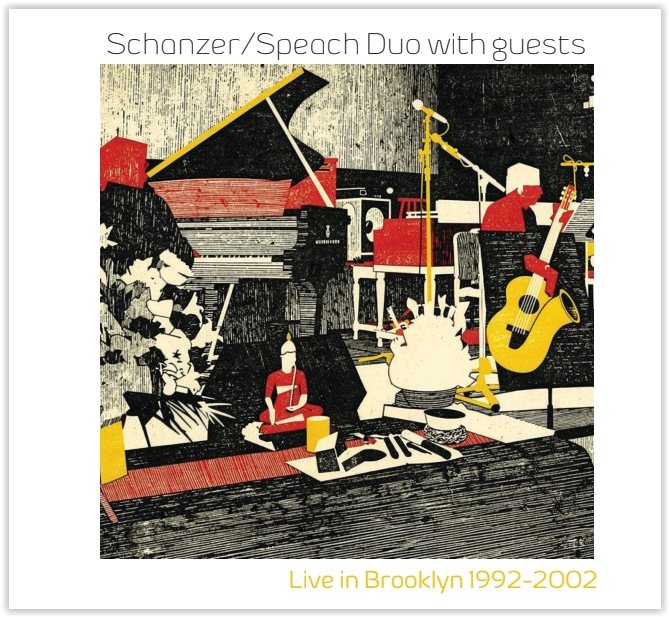
Schanzer/Speach Duo with Guests – Live in Brooklyn 1992–2002: When Brooklyn Was a Laboratory of Sound
Some albums are conceived as artistic statements. Others emerge as historical documents almost by accident, only revealing their true significance years later. Live in Brooklyn 1992–2002, the extraordinary archival release by the Schanzer/Speach Duo with Guests, belongs firmly to the second category. More than a live album, this two-disc collection is a time capsule, preserving a vibrant decade of creative music-making that flourished in Brooklyn long before the borough became synonymous with contemporary artistic cool.
Listening today, more than twenty years after the most recent recording was made, one quickly realizes that this is not merely a collection of great performances. It is a portrait of a community, a philosophy, and a moment in American musical history when experimentation thrived through collaboration, mutual support, and a belief that artists should control the presentation of their own work.
At the center of this story stand phenomenal guitarist Jeffrey Schanzer and exceptional pianist-composer Bernadette Speach, whose partnership began in Buffalo in 1982. Their musical backgrounds could hardly have been more different. Schanzer immersed himself in free jazz, world traditions, and improvisation, while Speach emerged from the contemporary classical world, studying composition with the legendary Morton Feldman. Yet as critic and composer Kyle Gann observed, their sensibilities proved remarkably complementary. One hears this throughout the album: Schanzer’s exploratory guitar language and Speach’s structural awareness combine to create a musical space where composition and improvisation coexist naturally.
Their move to Brooklyn in 1984 placed them at the heart of a remarkable artistic ecosystem. Through the Musicians of Brooklyn Initiative (MOBI) founded by towering figures such as Lester Bowie, Oliver Lake, and Cecil Taylor, and later through their own organization, MusicVistas, Schanzer and Speach helped create performance opportunities for some of the most adventurous musicians of the era.
The result is the treasure preserved here: recordings made between 1992 and 2002 at Lafayette Avenue Presbyterian Church and the Brooklyn Society for Ethical Culture. Together, they form an audio documentary of a creative renaissance that remains insufficiently recognized outside specialist circles.
What immediately strikes the listener is the quality of the guests. This is not simply an impressive lineup; it is a gathering of some of the most important voices in avant-garde jazz and creative music.
The album opens with an exhilarating improvisation featuring Oliver Lake, one of the founding members of the influential World Saxophone Quartet. His alto saxophone cuts through the texture with characteristic authority, balancing lyricism and abstraction in equal measure. The interaction with Schanzer and Speach feels conversational rather than demonstrative, setting the tone for everything that follows.
The appearance of Lester Bowie on The Villager is particularly moving today. Bowie, one of the most beloved and innovative trumpeters of his generation and a founding member of Art Ensemble of Chicago, brings both warmth and unpredictability to the performance. His trumpet seems capable of moving from humor to profundity within a single phrase. There is a generosity in his playing that perfectly reflects the community spirit underlying the entire project.
Another highlight arrives with percussionist and multi-instrumentalist David Pleasant, whose contribution transforms improvisation into something approaching ritual. Known for his deep engagement with African diasporic traditions, Pleasant brings a sense of ancestral memory and rhythmic depth that expands the music beyond conventional jazz frameworks.
Yet perhaps the most remarkable performance on the first disc is Wadada Leo Smith’s monumental Rain Flowers, Vertical Spears and Diamond Sunrays. Spanning more than twenty-four minutes, it unfolds like a spiritual journey. Smith, one of the great visionaries of contemporary music, moves effortlessly between trumpet, koto, mbira, harmonica, and flute. The piece exemplifies his lifelong pursuit of music as a form of meditation and philosophical inquiry. Speach’s delicate toy piano contributions add unexpected colors, creating a sonic landscape that feels simultaneously ancient and futuristic.
The first disc concludes with bassist Mark Dresser, whose extraordinary technical command and imaginative approach have made him one of the most respected figures in contemporary improvised music. His performance demonstrates why he remains such a pivotal voice in creative music circles: every note feels considered, yet entirely spontaneous.
If the first disc establishes the richness of Brooklyn’s creative scene, the second broadens the perspective even further.
The reunion of Lester Bowie with cellist Fred Lonberg-Holm produces one of the album’s most dynamic moments. Lonberg-Holm, who would later become a central figure in Chicago’s experimental music community, brings a restless energy that meshes beautifully with Bowie’s irrepressible creativity.
A striking contrast follows with Alva Rogers’ Foreign Affair. Rogers, known not only as a vocalist but also as an acclaimed actress, writer, and multidisciplinary artist, introduces a theatrical and narrative dimension. Her voice transforms the album momentarily into something akin to musical storytelling, reminding listeners how porous the boundaries between artistic disciplines were within this community.
The performance featuring violinist Leroy Jenkins is another treasure. As a founding member of the legendary Association for the Advancement of Creative Musicians and one of the pioneers of modern improvised string playing, Jenkins possessed an instantly recognizable voice. His improvisation here feels both deeply rooted in jazz history and entirely untethered from convention.
The electronic explorations of Holland Hopson and John J.A. Jannone demonstrate the scene’s openness to new technologies and emerging forms of expression. Their contribution may be among the most forward-looking performances on the album, anticipating directions that experimental music would increasingly explore in the decades to come.
The set concludes magnificently with Joseph Jarman’s Hollows Five: II – Sincere Words. Can’t Compromise or Overpower. Like Bowie and Jenkins, Jarman was a key member of the Art Ensemble of Chicago and one of the most profound artistic voices to emerge from the AACM tradition. His performance here combines saxophone, flute, percussion, and an unmistakable spiritual presence. The twenty-two-minute piece serves as a fitting culmination of the entire collection: expansive, searching, uncompromising, and deeply human.
Throughout both discs, one constant remains the remarkable chemistry between Schanzer and Speach. They never behave like mere accompanists, nor do they seek to dominate. Instead, they create environments in which every guest can flourish. Schanzer’s guitar work moves fluidly between jazz, contemporary classical music, folk traditions, and pure abstraction. Speach’s piano playing combines compositional intelligence with genuine improvisational freedom. Together, they provide continuity across a decade of recordings and a remarkable diversity of collaborators.
The sound quality, considering the archival nature of the material, is impressive. More importantly, the recordings preserve the atmosphere of the venues themselves. One can almost feel the intimacy of Lafayette Avenue Presbyterian Church, a place whose history as an Underground Railroad station adds a symbolic resonance to music so deeply concerned with freedom and self-determination.
What makes Live in Brooklyn 1992–2002 particularly valuable is that it documents a scene rather than simply individual artists. These performances reveal a network of musicians united not by style but by curiosity, mutual respect, and a willingness to take risks. The album reminds us that artistic movements are built not only by famous names but by communities, organizers, venues, and collaborations.
Today, as many of the musicians featured here have become legendary figures, or, in the cases of Bowie, Jenkins, and Jarman, cherished memories, these recordings acquire an additional deep emotional dimension. They are historical documents, certainly, but they are also living music. Nothing here feels dated. The performances remain vibrant, challenging, and surprisingly contemporary.
As Morton Feldman famously remarked, “It was in the air.” Listening to Live in Brooklyn 1992–2002, one understands exactly what he meant. This is not merely an excellent archival release. It is a vivid testament to a remarkable artistic community, a celebration of creative freedom, and an essential document of one of the most fertile periods in Brooklyn’s musical history.
A fascinating, generous, and historically invaluable release that deserves the attention of jazz listeners, improvisation enthusiasts, and anyone interested in the hidden histories of American creative music.
Frankie Pfeiffer
Editor in chief – PARIS-MOVE
PARIS-MOVE, August 4th, 2026
Follow PARIS-MOVE on X
::::::::::::::::::::::::
Order the album (2CDs) on the Neuma Records website
Digital audio available from ALL DIGITAL STREAMING SERVICES (from October 16, 2026) and from BANDCAMP (from Oct 1, 2026).
Schanzer/Speach Duo (on all tracks):
Jeffrey Schanzer: classical and/or electric guitar
Bernadette Speach: piano
Tracklisting:
CD 1 (56:48)
- Improvisation (Lake/Schanzer/Speach) 7:21
- Guest: Oliver Lake – alto saxophone
- The Villager (Bowie) 9:02
- Guest: Lester Bowie – trumpet
- Improvisation (Pleasant/Schanzer/Speach) 10:47
- Guest: David Pleasant, Drumfolk Riddim Specialist – percussion, flute
- Rain Flowers, Vertical Spears and Diamond Sunrays (Smith) 24:13
- Guest: Wadada Leo Smith – koto, trumpet, mbira, harmonica, wooden flute
- Guest: Bernadette Speach – toy piano
- Improvisation (Dresser/Schanzer/Speach) 5:23
- Guest: Mark Dresser – bass
CD 2 (61:31)
- Improvisation (Bowie/Lonberg-Holm/Schanzer/Speach) 9:30
- Guest: Lester Bowie – trumpet
- Guest: Fred Lonberg-Holm – cello
- Foreign Affair (Rogers: composer, lyricist) 10:18
- Guest: Alva Rogers – vocalist
- Improvisation (Jenkins/Schanzer/Speach) 9:23
- Guest: Leroy Jenkins – violin
- Glove Quartet (Hopson/Jannone/Schanzer/Speach) 10:07
- Guest: Holland Hopson – soprano saxophone, electronics
- Guest: John J.A. Jannone – electronics
- Hollows Five: II – Sincere Words – Can’t Compromise or Overpower (Jarman) 22:12
- Guest: Joseph Jarman- alto saxophone, flute, percussion
Recording dates:
CD1
- Oliver Lake: June 11, 1993
- Lester Bowie: May 7, 1994
- David Pleasant: June 14, 1997
- Wadada Leo Smith: June 6, 1992
- Mark Dresser: June 9, 2001
CD2
- Lester Bowie, Fred Longberg-Holm: May 7, (year?)
- Alva Rogers: June 1, 1996
- Leroy Jenkins: March 7, 1997
- Holland Hopson, John J.A. Jannone: February 8, 2002
- Joseph Jarman: May 30, 1998
All tracks recorded live at Lafayette Avenue Presbyterian Church, Brooklyn, NY
exceptfor Jenkins (CD2-3) and Hopson/Jannone (CD2-4) at Brooklyn Society for Ethical Culture, Brooklyn, NY
Producers: Jeffrey Schanzer and Bernadette Speach
Edited, mixed and mastered by Jeanne Velonis
Except CD1-4, edited and mixed by Greg DiCrosta and Jeanne Velonis
Recording Engineers:
Alen Hadži-Stefanov (CD1-1, 2, 3, 4; CD2-1, 2, 5)
Charles Golden (CD1-5)
James McLean (CD2-3)
Jody Elf (CD2-4)