| Jazz |
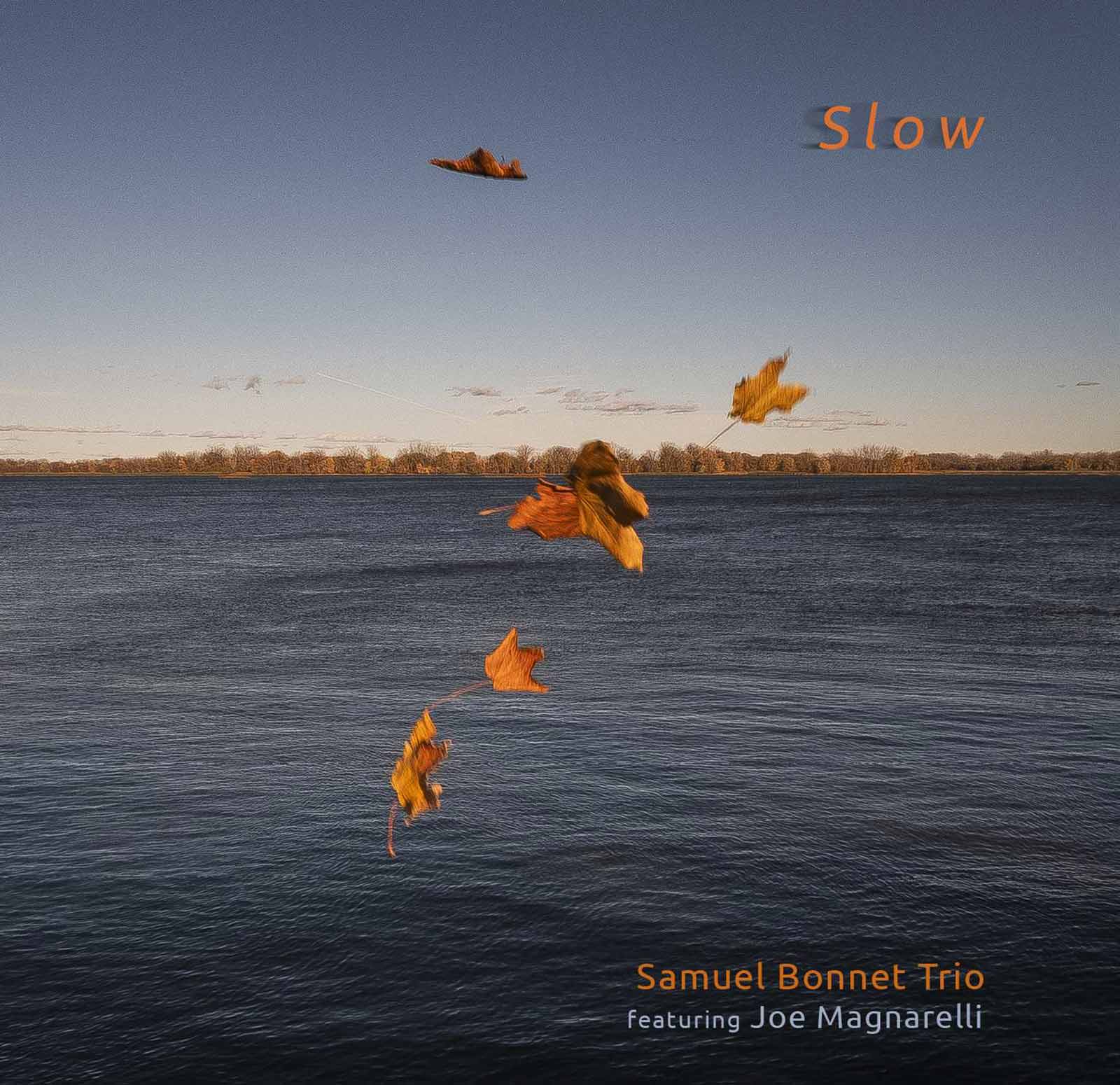
Summary: Samuel Bonnet’s Slow is an intimate jazz album about listening, silence, space and reclaiming our relationship with time.
Samuel Bonnet’s Slow: Learning to Inhabit Time Through Music
Slow, the new album by Samuel Bonnet, may have taken a little longer than expected to reach our turntables, but it is a record that rewards patience, and there is something almost amusingly appropriate about that delay for an album that takes slowness as its point of departure. Bonnet comes from Paris, not the forgotten corner of Texas called Paris and immortalized by Wim Wenders in Paris, Texas, but Paris, France, the city he left in 2009 to settle in Montreal, in French-speaking Canada. Since then, he has built a musical path that has resisted easy classification. His playing is rooted in a serious knowledge of classical guitar, yet it has gradually opened itself to the freedoms of jazz, improvisation and a particular conception of the trio in which every instrument is capable of becoming a voice. Slow comes after that strange period when the pandemic abruptly interrupted routines, travel, concerts and even our sense of time itself. For Bonnet, that interruption seems to have led to a more fundamental question: What do we actually do with our time once we are no longer required to spend it rushing from one obligation to the next? It is an apparently simple question, but it carries unusual weight in a culture that has made speed a measure of achievement. We are expected to answer quickly, produce quickly, think quickly and, increasingly, even entertain ourselves quickly. The “hustle culture” Bonnet refers to is precisely this machinery of perpetual acceleration, a system that eventually makes anything without an immediate measurable result seem almost suspicious.
His travels, particularly his encounter with the Italian idea of the “slow life” and with the Indian Ayurvedic tradition, encouraged him to rethink his relationship with time. In that sense, he enters a conversation explored more than two decades ago by Canadian journalist Carl Honoré in In Praise of Slowness: slowing down does not necessarily mean doing less; it can mean recovering a more appropriate sense of proportion, especially for things that require concentration, thought and attentive listening. Music belongs unmistakably to that category. It cannot be entirely reduced to immediate consumption. It asks us to remain, to follow a phrase until it has finished speaking, to accept the silence that separates one intervention from the next. That is precisely what Samuel Bonnet seems to be putting into practice on Slow. The title should therefore not be mistaken for a general instruction about tempo. This is not a uniformly slow record, nor is it contemplative in the conventional sense. There is swing, movement, acceleration and a palpable collective energy. The slowness is found somewhere else: in the musicians’ willingness to let ideas unfold, in their refusal to crowd every available space, and in the confidence, they place in melody. It is a slowness of listening rather than a slowness of the metronome. That distinction is essential to understanding Bonnet’s music. His trio, formed with bassist Jonathan-Guillaume Boudreau and drummer Simon Bergeron, operates less like a structure designed to support a guitarist than like a living organism in which each player is responsible for the whole. The bass gives the music harmonic depth while retaining its melodic function, while the drums do far more than mark the beat: they participate in the group’s breathing. Within that framework, the guitar can afford not to say everything. That restraint matters because Bonnet’s jazz is not built on the accumulation of notes but on their placement, their weight and the space around them. His acoustic guitar, with the particular resonance of nylon strings, gives the music an immediately recognizable character. Its sound is rounder, woodier and less confrontational than that of an electric guitar, and that difference inevitably shapes the construction of his phrases. Bonnet seems to understand instinctively what the instrument offers him, emphasizing articulation, nuance and the lingering life of a note. A note is not simply played and discarded; it remains suspended in the air for a moment longer, becoming part of the surrounding acoustic space. His playing consequently has an almost tactile quality. We listen not only to the phrase itself but to everything that continues to resonate after it has been played.
That is the space in which Joe Magnarelli finds his place so naturally. The American trumpeter appears on several tracks rather than throughout the entire program, and he is never treated as a guest star brought in to alter the trio’s identity from the outside. His presence works instead as a revelation, opening another dimension within music that is already fully formed. His trumpet brings a different attack, another kind of breath and another way of drawing a melodic line. Where Bonnet’s guitar can allow a note to bloom through the resonance of its strings, Magnarelli’s trumpet works through breath, articulation and projection. The contrast between the two instruments therefore becomes part of the composition itself. Bonnet does not attempt to conceal the difference; he makes it productive. It is one of the album’s most convincing achievements.
From “Nylon Swing,” which opens the record, Bonnet makes his intentions clear: he wants the acoustic guitar to be heard on its own terms without ever removing it from the pulse and language of jazz. The title itself contains the idea — nylon, a material traditionally associated with classical guitar, meeting swing, a rhythmic language that demands movement, flexibility and constant forward motion. The apparent contradiction is an ideal way into the album. The guitar retains its natural voice, but it is placed inside a dynamic environment in which rhythm becomes the driving force. What matters, then, is not simply what Bonnet plays but the way his instrument behaves inside the ensemble. He makes no attempt to reproduce the sound or gestures of an electric jazz guitarist. Instead, he accepts the strengths and limitations of the acoustic guitar and turns them into part of his identity. That approach continues in “Liberation,” where the music seems to open outward. The piece is particularly revealing in the way it balances composition and improvisation. Bonnet writes themes with enough structure to give the music a clear direction, but with enough openness to ensure that improvisation never feels like a compulsory detour between two statements of the melody. This is one of the distinctions between a piece designed around a solo and a genuine jazz composition: in the first, the theme can become little more than a launching pad; in the second, it continues to shape the improvisation even after it has disappeared from the surface. Bonnet maintains that continuity. The melody remains, almost invisibly, the spine of the music. That quality becomes even clearer in “Complices,” one of the album’s key pieces because it reveals the inner mechanics of the trio. The music is not organized around a soloist with an accompanying rhythm section; it moves from player to player. The bass can pick up an idea, the drums can shift an accent, the guitar can leave an opening that another musician immediately fills. Such playing demands an unusually high level of attention. The musicians have to know not only what they are playing but where the others may be going next. This is where the larger philosophy of Slow comes into focus: listen before you answer.
Jazz has always been built on that kind of exchange, but Bonnet turns it into an aesthetic principle. His music seems less concerned with individual display than with the quality of the conversation. Magnarelli deepens that sense of dialogue whenever he enters. His phrasing has an unmistakable authority, but he never seems interested in dominating the room. The trumpet becomes a second voice, sometimes extending the guitar’s line, sometimes answering it, sometimes setting it against a different register and a different timbral color. The relationship is particularly compelling because Bonnet’s guitar speaks with a certain intimacy, while the trumpet naturally projects outward. It would be easy for the balance to tilt. It never does. That restraint says a great deal about the care with which the music has been written and arranged. “Daryl’s Blues” then shifts the record’s center of gravity. Here the blues is less a decorative stylistic reference than a reminder of where much of jazz’s language comes from. The music becomes earthier, more directly connected to tradition, but Bonnet never disappears inside that tradition. This is one of the strengths of his writing: he knows the vocabulary without feeling obliged to reproduce it mechanically. The blues becomes raw material, something he can reshape according to the demands of his own musical language.
“Momentum” makes the album’s central paradox even more apparent. How can a record devoted to slowness contain a piece whose very title suggests acceleration, forward drive and the accumulation of energy? Because Slow is not an argument against movement. It is an argument for experiencing movement differently. Momentum is not the same thing as running without purpose; it is the sensation of energy gathering and the ability to direct it. In an acoustic trio, that process depends heavily on the relationship between bass and drums. The drummer must do more than keep time; he has to sense the group’s changing dynamics, knowing when to push, when to support and when to step aside. The bass gives the movement depth and continuity, allowing the guitar to play with tension and release. These tiny negotiations are what make the music feel alive. There is nothing static about this notion of slowness. The album breathes, contracts, expands and moves forward.
“Laetitia” brings the music toward a quieter territory, but its calm should never be confused with a lack of tension. In a piece this exposed, silence becomes part of the composition. The more stripped-down the music, the more vulnerable every gesture becomes. A wrong note, an overly heavy attack or a phrase that goes on too long would immediately reveal itself. Bonnet instead seems willing to embrace the fragility of the acoustic material. The guitar is never entirely detached from the air around it; its resonance creates a space into which the bass can enter, while the drums intervene with an economy that strengthens rather than diminishes the tension. When Magnarelli appears, the contrast becomes especially striking. The breath of the trumpet introduces a vertical dimension into the guitar’s more horizontal fabric. The result is not merely a meeting of contrasting timbres but a different way of making the composition breathe. That attention to breath is fundamental to Bonnet’s music, and it helps explain why comparisons with other jazz guitarists are ultimately less useful than they might first appear. His playing has its own identity because it exists at the intersection of several traditions. Classical technique has given him a precise touch and an acute awareness of resonance; jazz has given him harmonic and rhythmic freedom; the trio has given him a setting in which collective listening becomes part of the music itself. None of these elements overwhelms the others. They coexist, and the result is the work of a musician thinking not merely as a guitarist but as a composer.
Bonnet does not seem to write pieces simply to create opportunities for solos. He thinks in terms of color, register, density and circulation. That becomes particularly apparent in “Asturias,” which closes the album in two parts. Choosing Albéniz to end a jazz record about slowness is not an incidental gesture. Classical guitar returns here as a musical territory that belongs naturally to Bonnet, but it is refracted through everything he has learned as a jazz musician. The first part recovers the melodic and almost narrative character of the work, while the second opens more decisively toward the language of jazz. Magnarelli’s arrival in that final section introduces another layer of tension, bringing together the Spanish inheritance of the piece, the intimate resonance of the nylon-string guitar and the more projected voice of the trumpet. It is exactly this kind of encounter that gives Slow its richness.
Bonnet does not appear interested in choosing between classical music and jazz, as if one of those worlds had to be declared the authentic one. He lets them coexist. That coexistence may be the clearest musical expression of his own journey: Paris and Montreal, classical guitar and jazz, travel and encounters form less a series of separate stages than a single continuous movement. Music becomes a way of connecting experiences that might once have seemed to belong to different worlds. This is also why Magnarelli matters so much to the album. His presence is not ornamental. It changes the perspective. By placing an American jazz trumpeter inside his acoustic guitar universe, Bonnet brings his own language into contact with another conception of phrasing, swing and sonic projection. The record gains depth without becoming a stylistic exercise. Magnarelli understands how to make tradition present without sounding trapped by it, while Bonnet knows how to absorb that tradition without surrendering his own voice. What exists between them goes beyond musical efficiency. There is an understanding of proportion, of when to speak and when to leave room for the other. The guitar does not try to become a trumpet, and the trumpet does not try to become a guitar. Each voice remains itself, and that difference is precisely what makes the conversation possible.
What ultimately makes Slow so compelling is therefore not simply the idea behind it but the way that idea becomes audible in the very texture of the album. Slowness lives in the breathing, in the silences, in the space left for other musicians, in the refusal to turn every track into an exhibition of individual skill. It is also present in the architecture of the compositions, which consistently seem more interested in development than in instant gratification. Slow can certainly be heard simply as an acoustic jazz record, and there is plenty to admire on that level: Bonnet’s touch, the work of the rhythm section, Magnarelli’s appearances, the references to the blues and to classical guitar. But it can also be heard as a musical response to a larger and increasingly urgent question: What happens to our relationship with time when we stop trying to fill every available moment? That question now runs through discussions of work, productivity and the way we live, but Bonnet is too perceptive to turn his album into a manifesto. He does not lecture us about slowing down. He plays.
And perhaps that is why the music is more persuasive than an argument could be. Music has a rare ability to make an idea physical. We can spend pages explaining why we should slow down; sometimes a handful of notes, allowed to resonate for just a little longer, can make the meaning immediately tangible. Slow does not ask us to live at half speed. It asks us to recover the ability to choose our own pace. That distinction matters. Slowness can become as oppressive as speed when it becomes another obligation, another lifestyle rule to follow. What Bonnet is proposing is subtler: the possibility of recovering a personal sense of rhythm and breathing room. In jazz, that idea acquires a particular force because time is constantly negotiated among musicians. Tempo is never merely a mechanical measurement. It depends on placement, on listening, on the way a phrase settles against the pulse. A group can play fast and create a feeling of calm; it can play slowly and generate extraordinary tension. What matters is the quality of the time the musicians share. Slow is built around precisely that quality. Bonnet’s trio seems to understand that music never belongs entirely to the person playing the melody. It also belongs to the musician accompanying it, to the one answering it, and to the one who chooses, at a crucial moment, not to play. That democratic conception of the ensemble is one of the album’s most important qualities because it gives the music a depth that may not reveal itself immediately. The record rewards returning to it, allowing the tracks to unfold in sequence and noticing how “Nylon Swing” establishes its acoustic language, how “Liberation” opens the space, how “Complices” deepens the conversation, how “Daryl’s Blues” brings the music back to something more grounded, how “Momentum” places movement at the center again, and how “Laetitia” lowers the light before “Asturias” leads the guitar back toward its classical origins.
The album is therefore a journey, but one that refuses to hurry. That may be where Samuel Bonnet makes his case most convincingly. He does not simply give us music that talks about slowness from a distance; he creates music that almost requires us to slow down in order to hear it properly. In a world where listening has become increasingly fragmented, where we move from one song to another before the first has even had time to reveal its shape, that demand can seem almost old-fashioned. Yet it is deeply contemporary. Taking time to look, to breathe, to walk, to listen carefully to an entire record: these ordinary gestures have begun to feel almost like acts of resistance. Slow does not pretend to change the way we live, but it can change, for the better part of an hour, the way we listen. That is no small thing. Samuel Bonnet has made an album in which technique never tries to obscure the music, in which the acoustic guitar retains both its fragility and its richness, in which bass and drums create a genuine space for conversation, and in which Joe Magnarelli, through the warmth of his tone and the precision of his interventions, adds the dimension that transforms a fine trio recording into a genuine musical encounter. Slow is ultimately less an album about slowing down than an album about attention: attention to other people, attention to sound, attention to silence, attention to everything that happens between two notes. Perhaps that is where its deepest achievement lies, in the recovery of a relationship with time. Samuel Bonnet is not trying to stop time, which would be impossible. He is offering something more modest and, in the end, more valuable: a way of learning how to inhabit it.
Thierry De Clemensat
Member at Jazz Journalists Association
USA correspondent for Paris-Move and ABS magazine
Editor in chief – Bayou Blue Radio, Bayou Blue News

PARIS-MOVE, October 7th, 2026
Follow PARIS-MOVE on X
::::::::::::::::::::::::
Musicians :
Joe Magnarelli – Trumpet, Flugelhorn (1, 2, 6, 8)
Samuel Bonnet – Guitar
Jonathan-Guillaume Boudreau – Double Bass
Simon Bergeron – Drums
Track Listing :
Nylon Swing
Liberation
Complices
Daryl’s Blues
Momentum
Laetitia
Asturias – Part 1
Asturias – Part 2
All music by Samuel Bonnet except Asturias by Isaac Albéniz
Recorded January 31 and February 1, 2026
Studio Pierre Marchand, Montréal
Engineer: Paul Johnston
Mastering: Guy Hébert
Cover photo: Luc Mercure
Back photos: Marginal Studio
Design: Pierre Fortier
Produced by Samuel Bonnet
This album was made possible with support from the Canada Council for the Arts.
Thanks to the Creator, to my wife Laetitia for her constant support and encouragement, my family, the musicians for playing so beautifully, Paul Johnston for his beautiful engineering, and Alain Mercier for his support.