| Jazz |
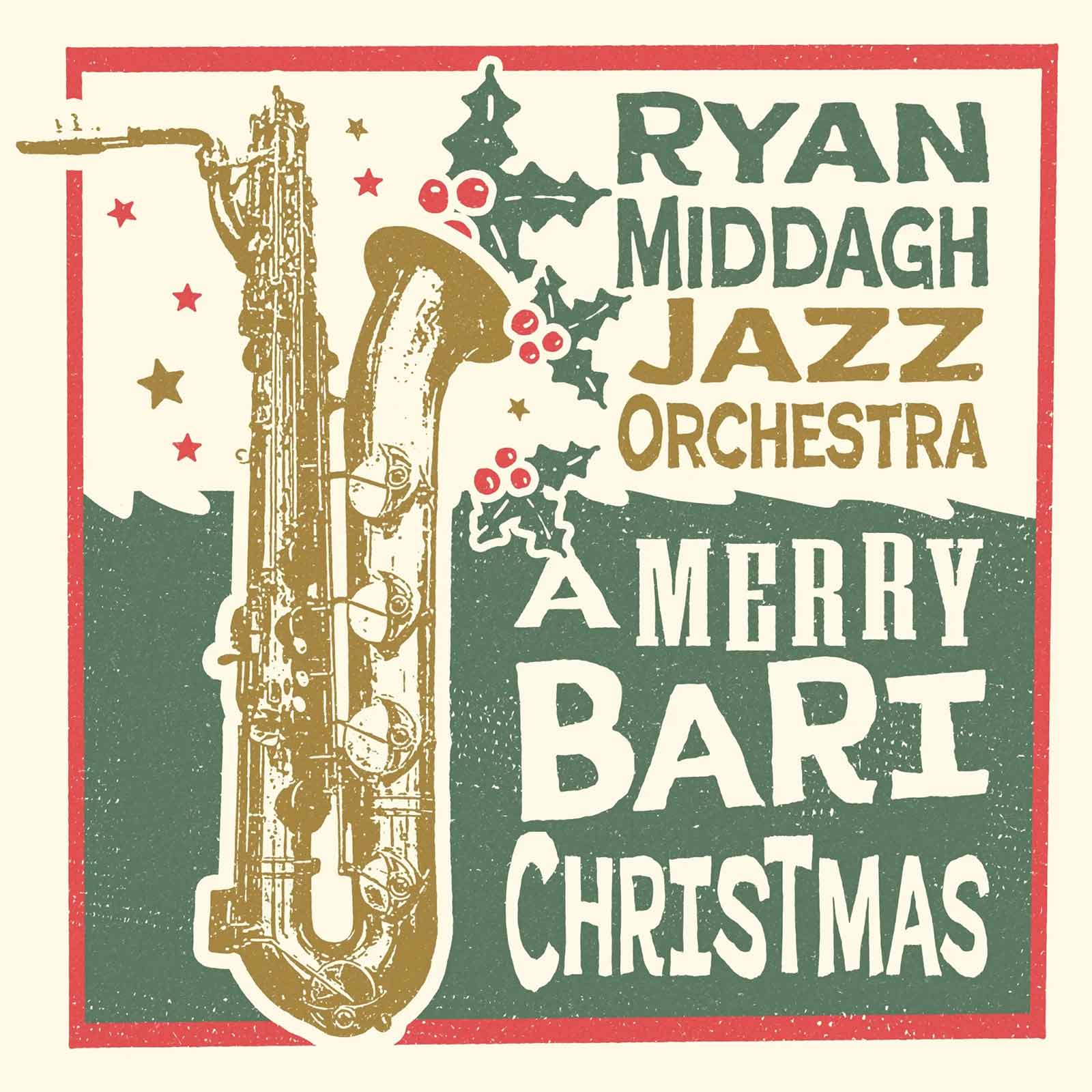
Ryan Middagh Brings the Baritone Saxophone to Center Stage on A Merry Bari Christmas
In the long history of albums devoted to the holiday season, one conviction is beginning to take hold: in 2026, Christmas will swing—or it won’t be Christmas at all. Jazz has a rare ability to transform traditions without betraying them, uncovering possibilities in familiar melodies that repetition and habit have gradually obscured. Of course, that requires musicians with the imagination and technical command to make it happen. With A Merry Bari Christmas, composer, arranger, bandleader and saxophonist Ryan Middagh brings all those elements together.
I have to admit that I have a particular weakness for the baritone saxophone. Its deep, generous, occasionally almost insolent sound has a remarkable ability to give an entirely different dimension to an orchestral ensemble. Like Eyal Vilner, approaching big-band swing from a different perspective, Middagh understands the mechanics of this collective musical language: the power of the sections, the balance between instrumental voices, the circulation of ideas and the ability to generate infectious energy through carefully structured arrangements. The result is delightful, often spectacular, but above all musically assured. Rather than simply revisiting familiar Christmas standards with predictable arrangements, Middagh offers a genuine exploration of the possibilities of the big band and of an instrument that still receives far less attention than it deserves. Eight tracks are enough to create a coherent musical world in which tradition becomes living material, open to invention, humor and a freedom that never slips into musical convenience.
From the opening bars of “(If I Were Giant) Jingle Bells,” the album makes its intentions clear. This is hardly another decorative rendition of a holiday standard everyone knows by heart. Middagh imagines a meeting between “Jingle Bells,” John Coltrane’s “Giant Steps” and “If I Were a Bell,” three musical worlds whose combination might easily have amounted to little more than an exercise in cleverness. Instead, he creates a compelling musical construction, full of unexpected turns, harmonic detours and rhythmic shifts that keep the listener engaged. Pat Coil’s piano and Jeff Coffin’s baritone saxophone each find room to shine, while the ensemble provides an exceptionally effective rhythmic foundation. What stands out is the way the arrangement preserves the melody’s immediate familiarity while drawing it into a considerably more demanding musical vocabulary. The tune is almost unrecognizable at times, yet retains enough of its original identity to establish an instant connection with the listener. Most importantly, it makes you want to move. This is the kind of “Jingle Bells” that could easily soundtrack the final hours of a holiday gathering, when conversations grow louder and the dance floor begins to take precedence over good manners. One could hardly ask for a more entertaining opening.
That first track also introduces the project’s guiding principle: making the baritone saxophone not merely a supporting instrument in a large ensemble, but its true center of gravity. Middagh has assembled five musicians whose individual approaches reveal the instrument’s remarkable range: Jeff Coffin, Michael Dease, Mark Douthit, Jimmy Bowland and Middagh himself. This is not simply a matter of gathering impressive soloists or creating opportunities for virtuoso display. The real interest lies in the different roles assigned to the baritone. It takes the lead, blends into the sections, engages in conversations with other instrumental voices, develops counterlines and contributes to the ensemble’s collective textures. Middagh explores its full range, from natural power to more understated expressive possibilities, making effective use of contrasting registers, tonal colors and articulation. The result gives the album an unmistakable identity. The baritone is no longer relegated to the occasional role of providing the saxophone section’s bass line. It becomes a protagonist in its own right, capable of carrying a melody, supporting an orchestral structure and engaging in dialogue with instruments that are sometimes its complete sonic opposite. There is genuine intelligence in this approach to arranging, but also something of a tribute to an instrument that unquestionably deserves a brighter spotlight.
The choice of repertoire reflects the same spirit of freedom. With “The (Cute) Little Drummer Boy,” Middagh takes another holiday favorite and places it in a setting that gives particular prominence to Jimmy Bowland’s baritone saxophone and Marc Widenhofer’s drums. Rather than constantly reaching for grand orchestral gestures, the arrangement draws on the composition’s rhythmic, almost processional character to shift its musical balance. Elsewhere, “Christmas Time Is Here (Killer Joe)” brings together the melodic world of Vince Guaraldi and that of Benny Golson, creating a particularly stimulating encounter between two jazz figures whose musical sensibilities are not as far apart as one might initially imagine. Mark Douthit’s baritone saxophone contributes to the exchange, while Vinéecia Buchanan’s vocals introduce another dimension. Throughout the album, Middagh refuses to leave these songs imprisoned by their status as seasonal entertainment. Each arrangement seems to begin with a simple question: What can we still discover in a melody we believe we have known forever? His answer does not lie in piling on effects, but in reworking the material with enough imagination to give every track a personality of its own.
One of the album’s most delightful surprises comes from a much less expected direction. With “Un Flambeau, Jeannette, Isabelle,” Middagh reaches into the French musical heritage for an old Christmas carol associated with the Provençal tradition, whose origins date back to the 17th century and whose melody is attributed to Marc-Antoine Charpentier. This takes us a considerable distance from the familiar territory of American jazz. I must admit that this particular detour sent me looking for some historical background, since such a reference is hardly commonplace on a big-band Christmas album. But that is precisely what makes the project so interesting. The challenge was considerable: how do you transform a melody rooted in an ancient popular and religious tradition without distorting it or reducing it to an exotic curiosity? Middagh comes up with a convincing answer. His arrangement relies on contrapuntal interplay, shifts in phrasing and orchestral interventions that gradually unsettle the listener’s expectations. Vinéecia Buchanan’s voice and Jeff Coffin’s tenor saxophone contribute to the construction, while Jordan Perlson’s drums accompany the composition through its successive transformations. The result has an appealingly unusual quality, bringing together two musical traditions that, at first glance, have little obvious reason to meet. Admittedly, the sung lyrics are not always easy to make out, but I would consider that a minor detail that does little to diminish the listening experience. What matters is the success of the adaptation, the richness of the writing and the ability to bring an old Provençal melody into a contemporary orchestral language. As a historical footnote, the lyrics commonly associated with the song today are also linked to an adaptation by Émile Belmont, created in the mid-20th century from the Provençal tradition. An intriguing detail that adds another layer to this unexpected musical encounter.
“I’ve Got My Love to Keep Me Warm (In Havana)” continues this stylistic exploration, shifting the colors toward a Latin and Caribbean sound. The title itself announces the intention: to take Irving Berlin’s composition outside its familiar setting and give it a different kind of breathing room without sacrificing its original charm. The trumpets of José Sibaja and Emmanuel Echem, Mark Douthit’s alto saxophone and Glenn Caruba’s congas considerably expand the orchestra’s sonic palette. That diversity matters. It prevents the album from becoming a succession of demonstrations built around a single instrument. The baritone saxophone remains its guiding voice, but the big band is very much a living organism, with each section given room to express itself and respond to the others. Middagh clearly understands that the richness of a large ensemble lies not simply in its power, but in its ability to bring together different personalities and musical traditions. The arrangement does not merely paste a Latin flavor onto an American song. It reflects a broader understanding of how rhythms and influences can circulate and interact. That is also what allows the album to maintain its freshness despite the familiarity of its repertoire.
Another particularly successful moment comes with “(Not So) Silent Night,” which provides a welcome contrast to the more exuberant passages. Pat Coil’s piano introduction establishes a meditative, almost contemplative atmosphere before the orchestra gradually takes over. The arrangement unfolds through a carefully calibrated series of contrasts. Emmanuel Echem’s trumpet introduces a more intimate dimension, while Michael Dease and Jonathan Salcedo exchange ideas on trombone, gradually leading the music toward a more jubilant expression. This is more than a simple opposition between contemplation and power. The piece captures the range of emotions associated with the holiday season: anticipation, nostalgia, the happiness of reunions and the collective excitement that eventually takes over. Here, Middagh’s writing reveals one of its essential strengths. He knows when to leave room for breathing, when to let soloists develop their ideas and when to give the orchestra the time it needs to transform the musical material. The big band is not merely filling the sonic space. It is telling a story.
With “Santa Digs Me,” the album returns to a more openly playful mood. The only original composition in the program, written by Jeff Coffin and Chris Walters and arranged by Middagh, is a particularly entertaining change of pace. Chris Walters’ vocals bring a welcome lightness, while the interplay among three baritone saxophones—those of Jeff Coffin, Michael Dease and Ryan Middagh—gives the track an immediately recognizable identity. Bringing together three instruments of such imposing proportions might easily have produced something cumbersome. Nothing of the sort happens. Instead, their exchanges become an opportunity to play with tone, register and the musicians’ ability to respond to one another. Humor does not come at the expense of precision, any more than virtuosity gets in the way of collective enjoyment. Here we encounter one of the album’s most appealing qualities: the sense that the musicians are having just as much fun playing together as the listener is having listening to them. The music never seems determined to impress at all costs. It would rather share its energy, and that makes all the difference.
Still, it would be a mistake to regard A Merry Bari Christmas as little more than an orchestral diversion designed to accompany December festivities. Behind the project’s enthusiasm lies a personal story that gives its musical intentions a deeper meaning. For Ryan Middagh, Christmas is above all a time of anticipation, reunions and shared memories. He explains that the Christmas tree goes up at his house as early as Nov. 1, marking the beginning of the preparations. That almost childlike anticipation, that desire to stretch out a season that always seems too short, provided the starting point for the album. His choice of the big band also carries a particular significance. Middagh sees the ensemble as a kind of musical family, built around rehearsals, shared experiences, challenges overcome and the pleasures of performing together. This is no incidental sentiment. It is reflected in the way he assembled the orchestra, selecting musicians for their individual personalities and their ability to bring arrangements conceived with them in mind to life. The strength of the collective rests on a genuine understanding of its individual members. Every contribution has its place within a larger architecture, without depriving the musicians of their freedom of expression. There is something profoundly human about this approach to jazz, a reminder that the big band, beyond its sonic power and technical demands, remains above all a collective adventure.
The album’s closing track deserves particular attention. “Have Yourself a Merry (Bari) Christmas” might initially seem like little more than another playful variation on the album’s title. In fact, it is the most personal piece in the program. The summer before the recording sessions, Middagh faced embouchure dystonia, a neurological disorder that causes involuntary muscle contractions and can seriously interfere with the ability to play an instrument. For a saxophonist, this is an especially formidable challenge, since it directly affects the physical relationship between musician and instrument. With adjustments to his equipment, guidance from specialists and the support of his professional circle, Middagh was gradually able to resume playing and bring the project to completion. That experience gives the final track a particular resonance. Unlike the collective energy that dominates much of the album, it begins with a solitary statement on the baritone saxophone. Middagh chooses to close on a note of simplicity and openly acknowledged vulnerability, a striking contrast with the orchestral abundance of the preceding tracks. This is not a dramatic flourish inserted to manufacture emotion. On the contrary, it is a return to the essentials: a man, his instrument and the determination to keep making music. After celebrating reunions, conviviality and the pleasure of playing together, Middagh brings the album to a close with an intimate musical statement. That choice lends the entire project a deeper meaning in retrospect.
By the time the final notes fade, A Merry Bari Christmas has established itself as a thoroughly satisfying achievement. I find little to criticize in a project that strikes such a convincing balance between musical sophistication, orchestral imagination and immediate appeal. The arrangements demonstrate a deep understanding of the big-band tradition, the soloists are given exceptional opportunities to shine, and the baritone saxophone is finally afforded enough room to reveal the full extent of its expressive possibilities. But what matters most, in my view, is something else: Middagh has succeeded in making a Christmas album that is more than a seasonal product. He is not trying to compete with the countless recordings of these familiar songs, nor is he imposing a superficial notion of modernity upon them. He simply restores their capacity to surprise, filtering them through his own imagination and his attachment to jazz. It is a generous, intelligent and entirely convincing approach.
For those who attach particular meaning to the holiday season, whether celebrating with family or friends, there is plenty here to enjoy: the pleasure of recognizing a familiar melody, the excitement of discovering an unexpected arrangement, the energy of a big band and the warmth of music conceived to be shared. Baritone saxophone enthusiasts will obviously be delighted, but everyone else has just as much reason to join in. This is an album that requires neither specialized knowledge nor any particular occasion to be appreciated. All it asks is that you let the music carry you along. And if the 2026 holiday season needs a soundtrack, Ryan Middagh’s album deserves a prominent place on the list.
Thierry De Clemensat
Member at Jazz Journalists Association
USA correspondent for Paris-Move and ABS magazine
Editor in chief – Bayou Blue Radio, Bayou Blue News
PARIS-MOVE, October 31st, 2026
Follow PARIS-MOVE on X
::::::::::::::::::::::::
Musicians:
Vocals
Vinéecia Buchanan
Chris Walters
Saxophones (featuring the Baritone Saxophone)
Ryan Middagh (bandleader, baritone saxophone)
Jeff Coffin
Michael Dease
Mark Douthit
Jimmy Bowland
Jovan Quallo
Trumpets
Steve Patrick
Tyler Jaeger
Jeff Bailey
Emmanuel Echem
Jose Sibaja
Olivia Achcet
Trombones
Jonathan Salcedo
Michael Dease
Barry Green
Matt Jefferson
Piano
Pat Coil
Steve Kummer
Bass
Brian Allen
Drums & Percussion
Jordan Perlson (drums)
Marc Widenhofer (drums)
Glenn Caruba (congas)
Track Listing:
(If I Were Giant) Jingle Bells
The (Cute) Little Drummer Boy
Un Flambeau – Jeannette Isabelle
Christmas Time Is Here (Killer Joe)
I’ve Got My Love To Keep Me Warm (In Havana)
(Not So) Silentnight
Santa Digs Me
Have Yourself A Merry (Bari) Christmas