| Jazz |
Summary : Roni Eytan’s Melody People blends jazz, Middle Eastern traditions and microtonal harmonica, revealing a distinctive new voice in contemporary jazz.
Roni Eytan’s Melody People: Redefining the Harmonica in Modern Jazz
Some instruments seem condemned to reclaim their place in jazz, generation after generation, as if they were still trapped inside a history that assigned them a role and made it difficult to escape. The harmonica is one of those paradoxical instruments. A quintessentially popular instrument, associated with the blues, folk traditions, street songs and a particular sonic memory of the 20th century, it has nevertheless produced some of the most distinctive voices in jazz. From Larry Adler to Toots Thielemans, the harmonica gradually moved from the margins into the language of modern improvisation without entirely losing the fragile quality that brings it close to the human voice. With Roni Eytan, however, the story seems to be moving in another direction.
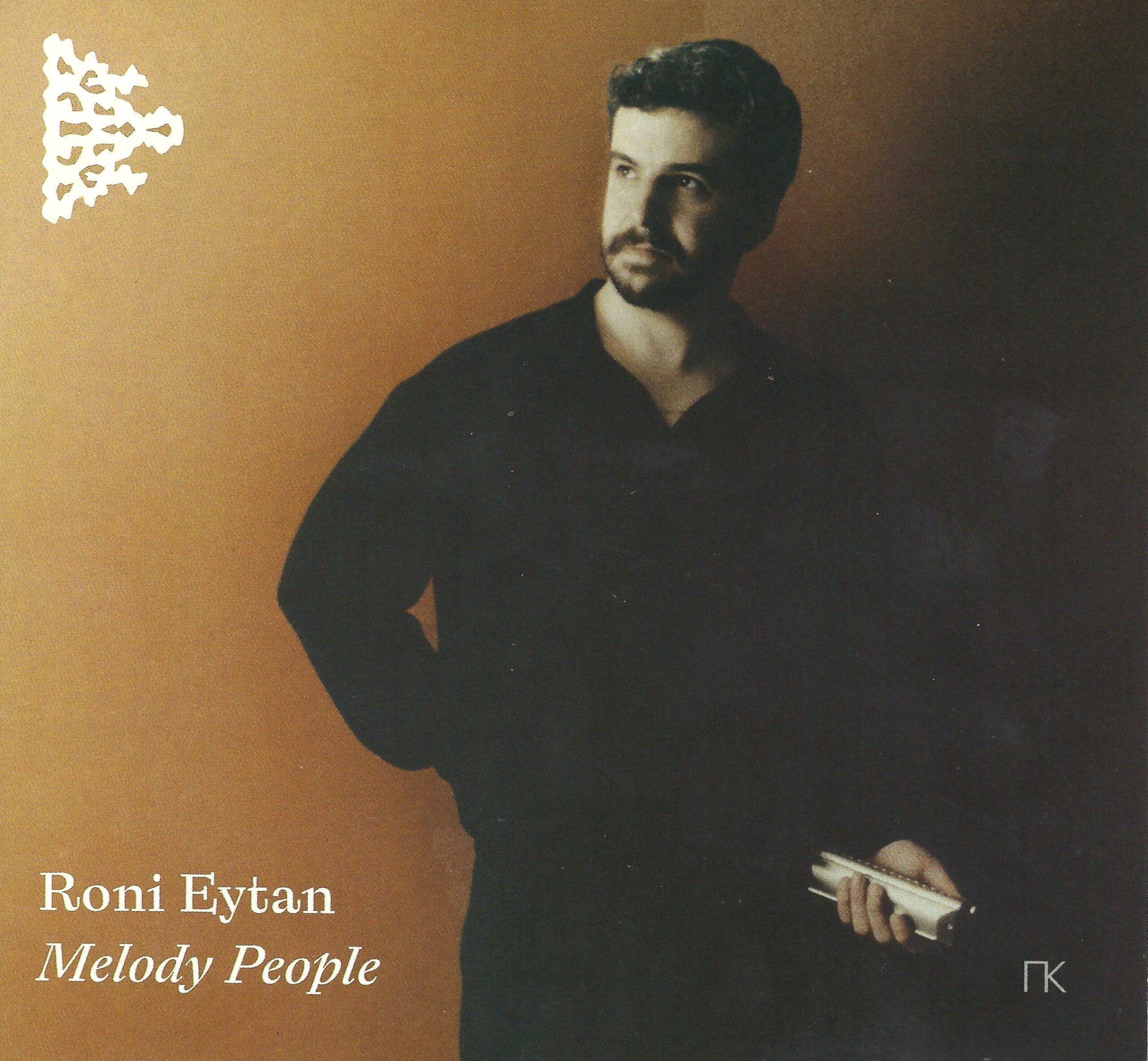
The question is no longer whether the harmonica can stand alongside the saxophone, trumpet or piano. Eytan is interested in what the instrument can become inside an ensemble. He does not constantly reach for the spotlight. His playing often disappears into a larger architecture, becoming one voice among several, almost vanishing behind the compositions before returning when the music needs it. That instinct makes Melody People, his first album as a leader, particularly revealing. Due out Oct. 30, 2026, on PKmusik, the record is not simply a showcase for virtuosity or an attempt to make the harmonica more respectable in contemporary jazz. It is the product of a musical life in which several worlds have gradually collided and learned to coexist. Jazz meets the traditions of the Middle East and North Africa, including Andalusian music, alongside elements of Jewish cultural heritage. But calling this “world music” would be too easy, and ultimately too limiting. The phrase has become a convenient way of packaging cultural encounters, as if a few rhythms, instruments or melodic turns were enough to explain an identity.
Eytan’s music suggests something more complicated. These traditions are not simply added to jazz for color; they shape the music from within, influencing the way melody, rhythm and musical space are imagined. His microtonal harmonica, drawing on the modes and inflections of Middle Eastern music, opens intervals and tensions that may sound unfamiliar to ears trained on conventional jazz. Eytan was born and raised in Jerusalem, where the musical traditions of the region formed part of his cultural landscape, before jazz became another way of understanding music and eventually the world. His path later took him to the United States, where he studied at Berklee on a full scholarship and built a career as a sideman with Danilo Pérez, John Patitucci, Eddie Gómez, Brian Blade, Kevin Hays, Kris Davis and Shai Maestro. That experience matters because it taught him something beyond instrumental technique: how to listen to a band, understand the relationship between musicians and recognize when a sound needs to enter the conversation — or stay out of it. The harmonica can therefore function as a melodic line, a texture, a punctuation mark or an inner voice rather than simply the instrument waiting for its solo.
A debut as a leader is a different kind of test. The musician can no longer hide behind another composer’s personality or the supporting role of a sideman. He is responsible for the entire picture: the writing, the arrangements, the musicians, the balance and the decisions about what should be heard and what should remain in the background. The challenge is greater still when the instrumentalist is also the composer. Playing is no longer enough; the musician has to understand what each note serves. Eytan seems to have taken that responsibility seriously. As a teenager, he discovered the harmonica and quickly fell in love with jazz, but instead of building his vocabulary exclusively from harmonica players, he studied trumpeters, saxophonists and pianists. He wanted to understand the language before deciding what his instrument could contribute to it. At the same time, he explored the folk traditions surrounding him and began looking more deliberately toward his own roots. Jazz and regional music were initially two separate roads. Gradually, they converged.
The chamber-like character of Melody People reinforces that convergence. The album brings together an acoustic ensemble featuring Shai Maestro on piano, Nitzan Bar on guitar, Barak Mori on bass and Daniel Dor on drums, with Mayu Shviro on cello. The lineup prevents the record from becoming a prolonged argument for the harmonica. The music moves from player to player; timbres answer one another, lines overlap, and Eytan’s instrument can move between foreground and background. Shai Maestro’s role as producer is important here. His own career has been shaped by a dialogue among jazz, tradition and contemporary composition, and he appears to have understood that the project would be stronger if the microtonal harmonica were allowed to breathe within an ensemble rather than carry the entire burden of the concept. Each musician retains an individual voice, and that makes Eytan’s voice more convincing, not less.
It would be easy to approach Melody People as a harmonica record. It is more revealing to hear it as the work of a composer still discovering the ideal proportions for his ideas. The sound catches the ear, the technique surprises, and certain inflections suggest an accordion or the human voice. But beneath that novelty is an abundance of material: colors, rhythmic ideas, melodic memories and a clear desire to connect several traditions. At times, that abundance becomes a burden. Some pieces would benefit from more air and a greater willingness to let one idea stand alone. This is less a verdict than a question for the future. Eytan already has plenty to say; the next stage may be learning which ideas become stronger when he says less. Silence is not what remains when the music stops. It is part of the music.
The encounters that shaped Eytan’s career help explain how he arrived at this point. His move to the United States exposed him to a broader musical environment and new ways of thinking about his instrument. His meeting with Grégoire Maret, one of the leading harmonica players of his generation, was significant, as Maret recognized Eytan’s ability to bring elements of his own culture into dialogue with the roots of jazz. Benny Golson also recognized the distinctiveness of his talent. Such endorsements are worth noting, but they should not become substitutes for listening. A musician is not defined by the people who recognize him. Eventually, he has to decide what to do with that recognition.
For Eytan, the answer increasingly lay in composition. In 2018, he became the first harmonica player selected for the prestigious Herbie Hancock Institute of Jazz, then known as the Thelonious Monk Institute. He studied under the artistic direction of Herbie Hancock and Wayne Shorter and also worked with Tigran Hamasyan, who encouraged him to find his own voice as a composer. That advice goes to the heart of Eytan’s project. The challenge is not to produce a recognizable sound but to transform a range of influences into something that can no longer be separated into neat categories. “Jazz plus the Middle East plus North Africa” would be an inventory, not an identity. The more difficult achievement is to make those elements inseparable, so that jazz and melodic memory, tradition and improvisation begin to sound as though they belong to the same musical thought. Some of Melody People’s strongest passages point toward that possibility.
The microtonal harmonica is crucial because it gives Eytan a way to make that meeting audible. Its intervals can move between pitches with a flexibility that brings the instrument close to the human voice, creating phrases that seem to hesitate before settling. The effect is subtle but important: melody becomes less like a fixed line and more like something remembered, carried and reshaped in the act of being played. That idea reaches beyond technique and into the album’s title. Melody People is about melodies, but also about the people who carry them across generations. At its center is Eytan’s grandfather, described as a storyteller who passed down melodies inherited from earlier generations. A melody, in this context, becomes a form of testimony. It carries something of the person who once sang or played it, travels with people, crosses borders and changes with each new voice. What happens to a tradition when it leaves the place where it was born? What happens to a melody when it moves from one generation to another and then from one continent to another? At what point does tradition become creation? Those questions give Melody People a reach beyond that of a debut built around an unusual instrument.
They also place Eytan within a much larger story about music and identity. Musicians move, recordings circulate, languages overlap and traditions are reinterpreted far from the places where they began. Globalization can flatten musical differences, but it can also give artists new tools with which to revisit their own histories. Eytan does not appear interested in preserving his roots behind glass. He wants to transform them. There is little nostalgia in that process, and no attempt to reconstruct an idealized past. The traditions he draws upon encounter improvisation, jazz harmony and contemporary textures and emerge altered without becoming unrecognizable. In that respect, his approach mirrors the history of jazz itself: a music built through movement, encounter, borrowing, conflict and transformation. Jazz has never existed in a finished form. It absorbs, breaks apart and rebuilds. Eytan enters that history without trying to reproduce it.
That is also why the harmonica matters less as an exotic object than as a vehicle for changing the way the music is heard. It can suggest a voice, a folk instrument, a regional memory or simply a new color inside an ensemble. The instrument remains recognizable, but its function is no longer predetermined. That shift is perhaps Eytan’s most interesting achievement so far. He is not trying to prove that the harmonica belongs in jazz; he is asking what jazz might allow the harmonica to become.
A little critical distance is nevertheless necessary. When a young musician arrives with an unusual background and the support of respected figures, there is a temptation to declare the debut of a fully formed artist. That would be premature. Melody People is a foundation, not a conclusion. It reveals a composer with genuine personality, but not one who has necessarily found every form capable of holding the ideas he wants to express. Some compositions are strikingly ambitious, occasionally to the point of crowding too much information into the same space. The arrangements are carefully constructed, the textures are rich and the references plentiful. At times, the music might have been stronger had it stepped back and allowed a melody to breathe on its own. Eytan’s challenge now is not to acquire more material but to learn what to leave out.
That is not a small challenge. The best improvisation is rarely the one that says everything; it is the one that leaves room for something else to happen. Composition works the same way. And because the harmonica sits so close to the voice, it may be particularly well suited to that economy. A short phrase can carry more emotional weight than a complicated arrangement. A breath can say more than another sequence of notes. Eytan does not need to resolve these questions on a first album. What Melody People needs to demonstrate is simpler: that its maker has enough personality to make us want to hear what comes next. On that measure, the album succeeds. His years as a sideman have taught him the value of the collective; his encounters with major figures in contemporary jazz have deepened his understanding of the tradition; his engagement with the musical cultures of the Middle East and North Africa has brought him back toward a cultural memory; and his work at the Herbie Hancock Institute placed composition at the center of his artistic development. Melody People is where those paths meet.
There are hesitations here, moments of excess and arrangements that could breathe more freely. But there is something more important: direction. In music, as in any serious creative work, direction often matters more than immediate perfection. Roni Eytan is worth following not simply because he plays an unusual instrument, but because he seems to understand that individuality does not reside in the object held in one’s hands. It resides in the way a musician listens to the world before transforming it into sound. The harmonica is ultimately only the means. Behind it lies a larger meditation on melody, memory and transmission.
The melodies passed down by a grandfather become the melodies of a musician living between worlds. Traditions become contemporary material. Jazz becomes a language capable of welcoming what comes from elsewhere without reducing it. That is where Melody People becomes more than the curiosity of an unusual debut. It does not tell us everything about Roni Eytan, and that may be its greatest strength. It leaves doors open. The next stage of his career will show whether he can turn this initial abundance into a more spare, spacious and deeply personal form of writing. For now, it is enough to recognize that a new harmonica player has entered a territory that no longer belongs entirely to the harmonica. He arrives carrying his own melodies, his own memories and a conception of music that refuses the comfort of easy borders. And it is precisely when a musician begins to move the boundaries of his own instrument that we can begin, in the fullest sense, to hear a voice.
Thierry De Clemensat
Member at Jazz Journalists Association
USA correspondent for Paris-Move and ABS magazine
Editor in chief – Bayou Blue Radio, Bayou Blue News
PARIS-MOVE, October 7th, 2026
Follow PARIS-MOVE on X
::::::::::::::::::::::::
Musicians:
Roni Eytan: harmonica and microtonal harmonica
Shai Maestro: piano
Nitzan Bar: guitar
Barak Mori: bass
Daniel Dor: drums
Special guest:
Mayu Shviro: cello
Tracklisting:
- Winter Dance [2:19]
- Hopeful [3:31]
- Melody People [8:31]
- Tears (A Mother’s Lament) [6:34]
- A Modern Folk Tale [7:38]
- Before It Begins [1:13]
- Like A River [4:43]
- Harmonica Song (For Dave) [3:24]
- Elegy for Saba [8:30]
- Melody People (Holding | Letting Go) [1:26]
- Hayalda Hachi Yafa Bagan [3:34]
- Ne Me Quitte Pas [6:10]
Total time: 57:36
All music composed and arranged by Roni Eytan except:’Before It Begins’ by Mayu Shviro, ‘Hayalda Hachi Yafa BaGan’ by Yoni Rechter (lyrics by Yehonatan Geffen), ‘Ne Me Quitte Pas’ by Jacques Brel, arranged by Roni Eytan.
Recorded at La Buissonne, Pernes-les-Fontaine, France.
Recorded and mixed by Gérard de Haro, assisted by Matteo Fontaine.
Mastered by Nicolas Baillard at La Buissonne Mastering Studio.
Additional recording at Big Orange Sheep, Brooklyn, NY, by Alon Benjamini.
Additional recording at Pluto Studios, Tel Aviv, Israel, by Asaf Shai and Daniel Anglister.
Roni Eytan plays Suzuki Harmonicas. The microtonal harmonica was developed with Brendan Power.
Produced by Shai Maestro