| Jazz |
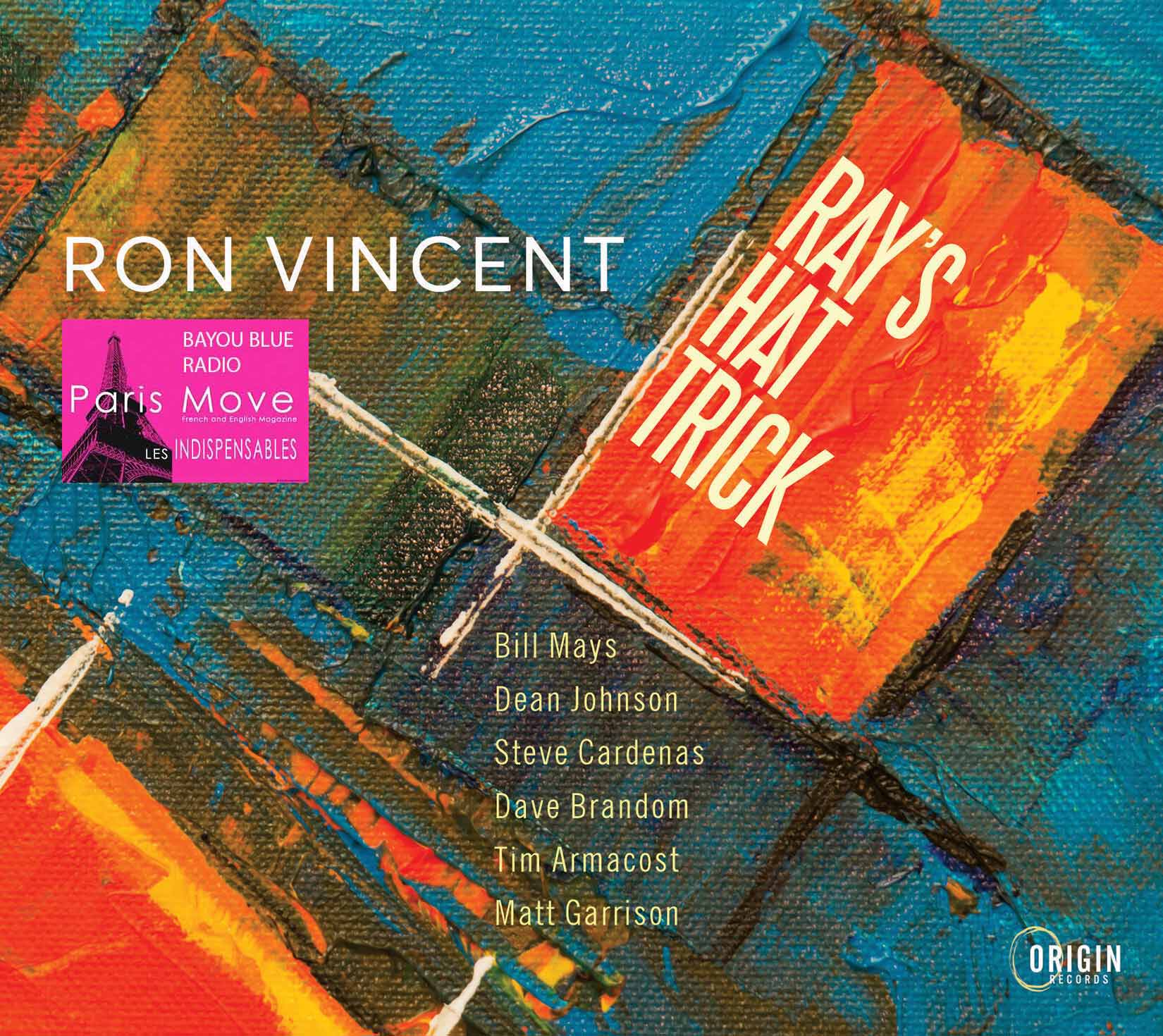
Summary: Ron Vincent’s Ray’s Hat Trick connects his Gerry Mulligan years with a deeply personal vision of modern jazz, featuring Bill Mays, Dean Johnson and an exceptional ensemble.
Ron Vincent’s Ray’s Hat Trick: Jazz, Legacy and the Art of Listening
Sometimes it takes only a few measures to recognize a musical world. Ron Vincent’s Ray’s Hat Trick does exactly that, bringing us almost immediately into a kind of jazz that listeners familiar with Gerry Mulligan will recognize: supple, precise and quietly swinging, with an unusual sensitivity to the balance between voices. The swing is there, but it never announces itself. Nothing is pushed forward for effect. Yet the familiarity of this sound has little to do with nostalgia or reconstruction. Vincent is not trying to recreate another era, nor is he attempting to revive a style simply because it has a distinguished history. The connection is more direct and more personal. This is the sound of musicians who have known one another for decades and who shared an important chapter of their lives with Mulligan. In 1989, Bill Mays, Dean Johnson and Vincent became Mulligan’s rhythm section, and Vincent remained with him, first in the quartet and later in the Re-Birth of the Cool Tentet, until the saxophonist’s death in 1996. That history can be heard in the remarkable ease of the trio. Mays at the piano, Johnson on bass and Vincent at the drums do not have to establish a common language; they already have one. Ray’s Hat Trick grows naturally from that relationship, but with an important change in perspective: this time, Vincent is the one choosing the repertoire, shaping the ensemble and putting his own compositions into the conversation.
The project began as a quartet with Mays, Johnson, guitarist Steve Cardenas and Vincent, then expanded to include Dave Brandom, Tim Armacost and Matt Garrison. That expansion matters. It gives Vincent a broader palette without sacrificing the intimacy of the original group. The saxophones, flute and clarinets allow him to move between different combinations of voices, while Cardenas brings a distinctive color to what might otherwise have remained a more traditional piano-bass-drums setting. Much of the album’s character comes from that circulation of timbres. A piece may begin with the transparency of the trio and then gradually open to a saxophone line, a clarinet or another instrumental color that changes the atmosphere without disturbing its center. Nothing feels ornamental. The additional voices are not there simply to make the arrangements bigger. Each has a purpose, and Vincent uses them with the instinct of a musician who understands that an arrangement becomes richer not when it contains more information, but when every sound has a reason to be there.
The repertoire follows the same principle. Vincent’s compositions sit alongside pieces by Bill Mays and Steve Cardenas, as well as music associated with Duke Ellington, Duke Pearson, Denzil Best, Jerome Kern and Alan Broadbent. Dear Old Stockholm is particularly revealing. The traditional Swedish melody, long absorbed into the jazz repertoire, is instantly recognizable, yet the performance refuses to turn recognition into nostalgia. The tune becomes a meeting point for the musicians, a place where melody, rhythm and space can interact naturally. Vincent’s drumming remains closely tied to the movement of the ensemble, while the arrangements allow the instruments to breathe rather than compete for attention. This is one reason the album can evoke Mulligan without sounding like a tribute record. Vincent understands the value of restraint, but he is not trying to reproduce Mulligan’s sound. He is drawing on an experience that has become part of his musical instinct and using it to shape something that belongs entirely to him.
That becomes even clearer in Vincent’s own pieces, including Ray’s Hat Trick and Restitution. They are not drummer’s showcases disguised as compositions. Vincent writes from the perspective of an accompanist who has spent decades learning how an ensemble works from within. The drums contribute to the architecture of the music, but they never demand that the architecture revolve around them. There is a quiet authority in that choice. Vincent knows what a soloist needs, but he also knows when to step aside and let a phrase exist without commentary. His arrangements reflect the same understanding. The horns are not simply layered on top of one another; they appear in changing configurations, sometimes extending the quartet, sometimes functioning as independent voices. With several saxophonists in the lineup, the music could easily have become crowded. Instead, the additional players give it dimension, allowing Vincent to change the emotional temperature of a piece without changing the fundamental character of the group.
Vincent’s long career as a sideman is crucial to understanding why this works. Over the years he has played with musicians as different as Phil Woods, Lee Konitz, Randy Brecker, Bob Brookmeyer, Bill Charlap, John Lewis and Slide Hampton, as well as Art Farmer, Bill Crow, Rob McConnell, Rufus Reid and Billy Taylor. On paper, the list is impressive; in the music, its importance is subtler. Vincent has spent his career moving between very different musical personalities, and Ray’s Hat Trick does not sound as if it belongs exclusively to any one of them. There is swing, bebop and post-bop, along with the spaciousness associated with certain cool-jazz traditions, but these elements are never presented as stylistic quotations. They have been absorbed. What remains is a language that feels lived-in rather than assembled.
Bill Mays is central to that sense of continuity. Their relationship began during the Mulligan years and continued through later collaborations, including the Bill Mays Trio. Mays is not here as a celebrated guest whose presence gives the project added weight. He is part of the album’s DNA. His compositions Still Life and Mike sit naturally alongside Vincent’s material, linking different periods of a musical friendship without calling attention to the connection. Dean Johnson plays an equally important role. His bass provides movement without ever becoming intrusive, keeping the pulse alive while leaving room for the piano, guitar and horns to breathe. Cardenas brings another dimension. His guitar does not merely fill in harmony; it changes the way the listener perceives the space between the instruments. That quality is especially apparent on New Moon, his contribution to the album, where the guitar becomes part of the ensemble’s texture rather than simply its harmonic foundation.
What is striking is how little friction there is between all these different sources. Ellington does not need to be invoked as a monument, nor do Pearson or Best function as historical credentials. They are simply composers whose music belongs naturally in the company Vincent has assembled. The same is true of Mays and Cardenas. Vincent does not appear interested in proving that he knows the history of jazz. After a career like his, such a demonstration would be beside the point. He chooses music that can speak to the particular musicians in the room, and the arrangements allow those musicians to alter the character of the ensemble without breaking its identity. That is how the album manages to remain coherent without becoming predictable.
Gerry Mulligan remains an unavoidable presence, of course, but his influence is heard less in specific musical references than in Vincent’s understanding of how a group should breathe. There is a lightness to the accompaniment, an awareness that the drummer does not have to underline every harmonic turn or rhythmic accent. Vincent is interested in sustaining motion rather than constantly marking it. That quality can bring Mulligan to mind, but imitation is never the objective. Vincent spent enough years inside Mulligan’s music to absorb its principles, and enough time afterward working with other musicians to test those principles against different ideas of jazz. The result is not a return to the past but a continuation of experience.
The album becomes most rewarding when attention shifts away from the question of influence and toward the musicians’ exchanges. That is where Ray’s Hat Trick truly comes alive. A piano phrase opens a door for the guitar. A saxophone enters without interrupting the flow. Johnson keeps the bass moving while Vincent subtly changes the dynamics beneath the group. These are small gestures, but they accumulate. The pleasure of the record comes less from dramatic statements than from the accuracy of these responses. It is music that reveals more of itself with repeated listening because its details are not all placed on the surface. What initially sounds effortless turns out to be carefully constructed, with an almost conversational logic running underneath it.
That may be why the album can speak so naturally to listeners who love Gerry Mulligan without becoming a record about Gerry Mulligan. The connection is unmistakable: in the musicians, in the arrangements, in the preference for clarity and in a conception of swing that never becomes heavy-handed. But Vincent is no longer the drummer he was in 1989. Everything that happened afterward is present here. The work with Lee Konitz, Phil Woods, John Lewis, Bob Brookmeyer, Randy Brecker and many others has expanded his musical vocabulary and complicated his relationship to the traditions he inherited. Ray’s Hat Trick does not look backward so much as it takes stock of what those years have left behind.
That is perhaps what makes the album particularly meaningful within Vincent’s career. After spending so much time helping other musicians define their sound, he does not use his turn as a leader to make a grand declaration of independence. Instead, he does something more revealing: he assembles musicians he trusts and allows them to remain themselves. His leadership is expressed not through dominance but through the creation of a musical environment in which every player has room to speak. The album carries his name, yet it never feels like a vehicle designed to keep the spotlight on him. In a sense, that is the most convincing expression of Vincent’s identity as a musician. He leads in the same way he has accompanied others: by listening, by knowing when to intervene and by understanding that the strongest musical statement is sometimes the one that leaves another musician enough room to make it.
In the end, Ray’s Hat Trick is a record built from several decades of musical relationships, but it never feels imprisoned by its history. Its appeal is not based on the promise of reinventing jazz or on the weight of the names attached to its repertoire. It lies in something more durable: the intelligence with which Ron Vincent brings musicians, compositions and experiences together and allows them to interact without forcing them into a single mold. The album recalls Mulligan without attempting to recreate him; it places Ellington, Pearson and Best in a contemporary conversation without turning them into museum pieces; and it finally gives Vincent’s own writing the space it deserves after so many years spent in the background. Most of all, it sounds like a band that knows how to listen. Bill Mays, Dean Johnson, Steve Cardenas, Dave Brandom, Tim Armacost, Matt Garrison and Ron Vincent play with the confidence of musicians who have nothing to prove. The music moves through changes of color, shifts in dynamics, exchanges and silences, always maintaining its sense of proportion. After decades spent helping tell other musicians’ stories, Ron Vincent finally tells his own. The remarkable thing is that he does so without abandoning the quality that has defined his career from the beginning: he tells it by listening to the people around him.
Thierry De Clemensat
Member at Jazz Journalists Association
USA correspondent for Paris-Move and ABS magazine
Editor in chief – Bayou Blue Radio, Bayou Blue News

PARIS-MOVE, September 25th, 2026
Follow PARIS-MOVE on X
::::::::::::::::::::::::
Musicians :
Bill Mays – piano
Steve Cardenas – guitar
Dean Johnson – bass
Ron Vincent – drums
Dave Brandom – alto/bari saxes, flute, clarinet
Tim Armacost – tenor sax, alto flute, flute, bass clar.
Matt Garrison – soprano/alto/tenor saxes, flute
Track Listing:
1 Angelica 6:38 Duke Ellington
2 Dear Old Stockholm 7:21 Swedish folk song
3 Ray’s Hat Trick 6:10 Vincent
4 Pick Yourself Up 4:38 Jerome Kern
5 Still Life 7:04 Mays
6 Is That So 5:54 Duke Pearson
7 New Moon 5:22 Cardenas
8 Restitution 7:18 Vincent
9 I Hear You 7:21 Alan Broadbent
10 Mike 6:26 Mays
11 Wee 4:55 Denzil Best
Arrangements by:
(1-4,6,8,9,11) Vincent
(5,10) Mays
Produced by Ron Vincent
Recorded & mixed by Chris Sulit at Trading 8s, Paramus N.J.
Recorded on January 28, 2026
Mastered by Michael MacDonald at AlgoRhythms Mastering, Santa Fe, NM
Cover art by Steve Johnson
Ron photo by Kevin Luker
Band photos by Tim Armacost
Cover design & layout by John Bishop