| Contemporary music |
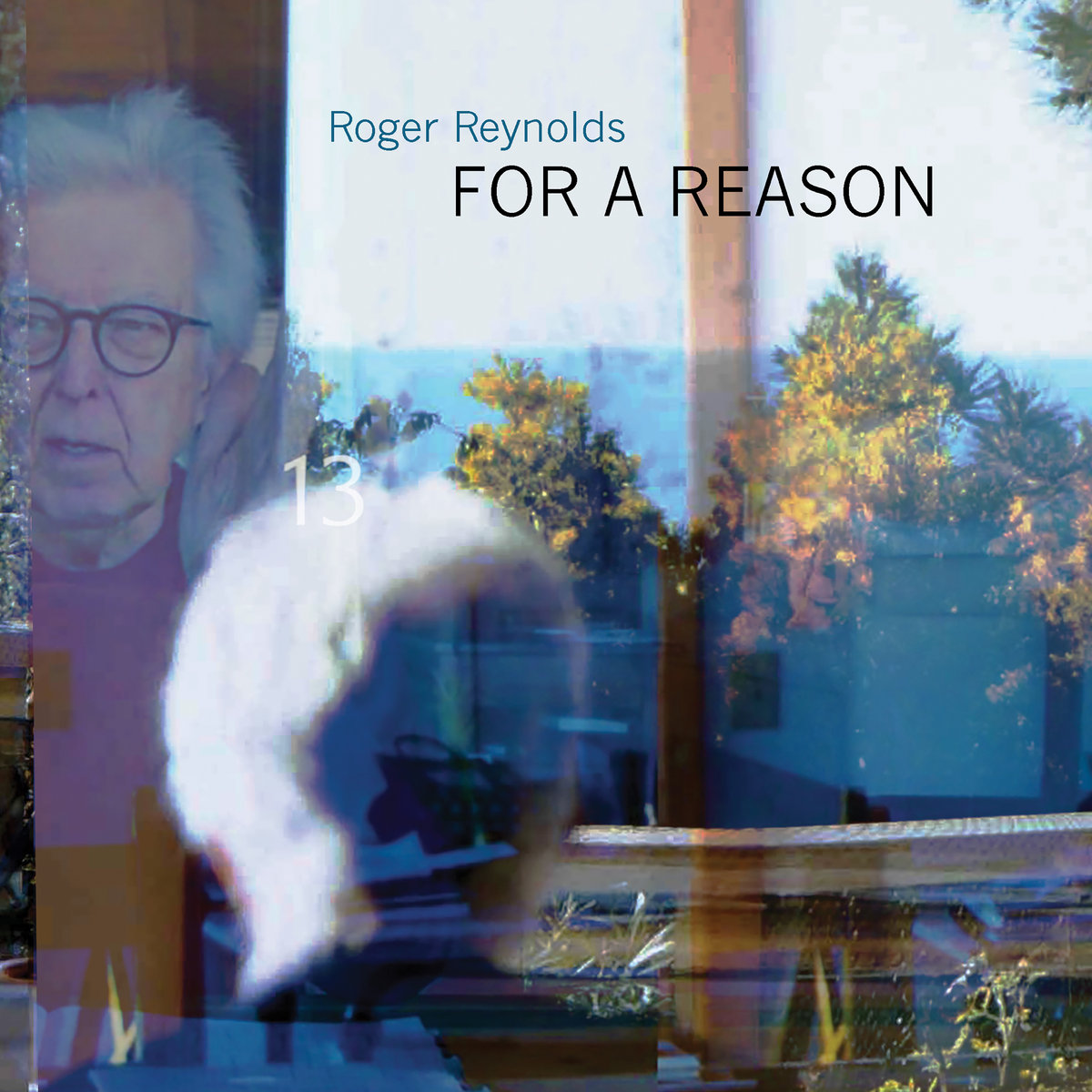
For A Reason: Four Portraits in Sound and a Booklet You Can Fall Into.
Roger Reynolds’ For A Reason: a composer at 92, and a package that arrives late but not a day too soon. It was released in 2023, and the package only reached my desk last month. Listening to it now, in October 2026, I find that it has lost none of its power, quite the opposite, in fact.
Roger Reynolds was born on July 18, 1934, and he was 88 when the set appeared and turned 90 in 2024. Today he is 92, still the Pulitzer Prize-winning composer who has taught at UC San Diego since 1969. The set is better described as the work of a man in full possession of his powers than as a late-career tribute. It is a double album that sounds like a beginning.
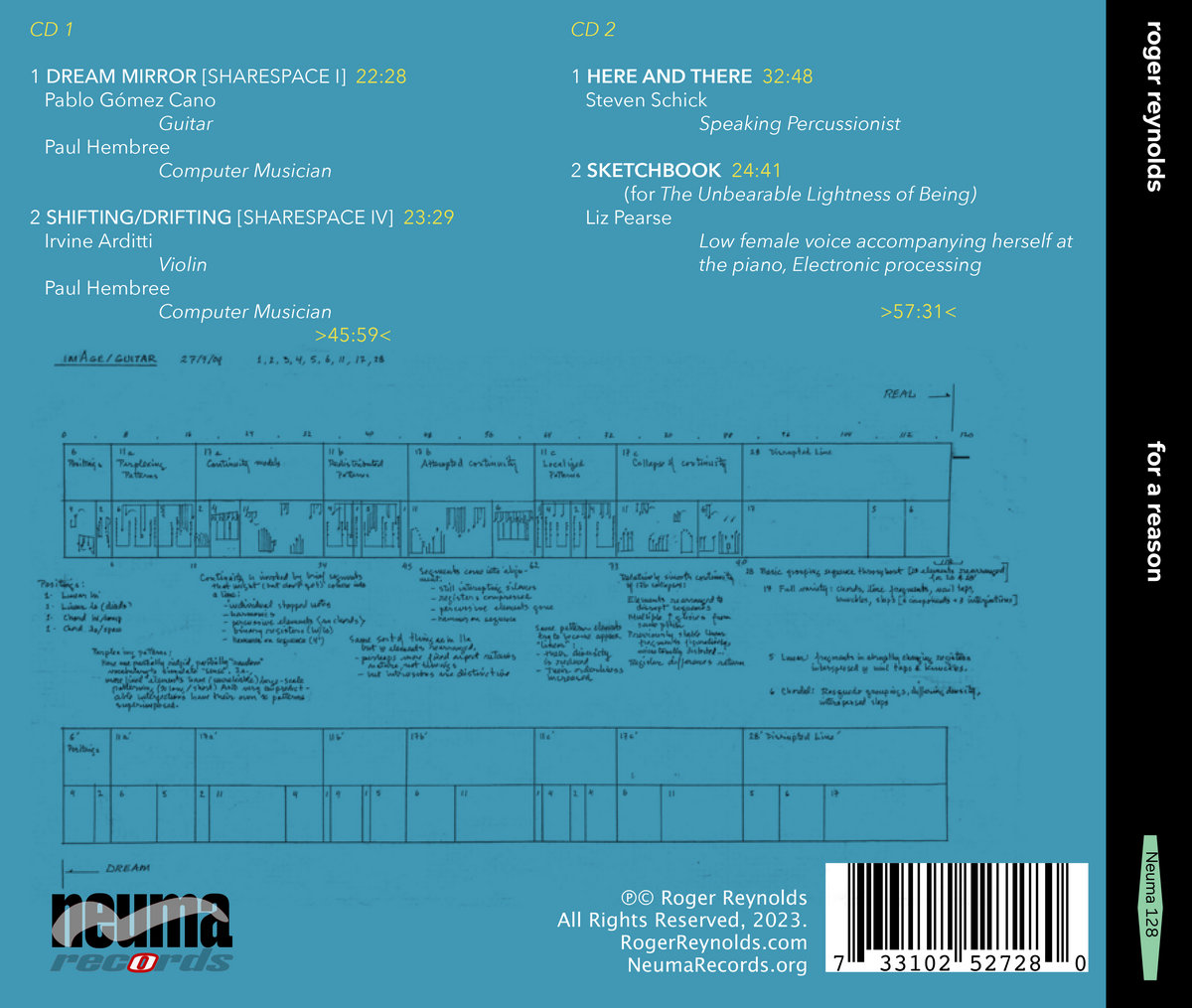
What For A Reason is: four works, four friendships.
The album gathers four pieces spanning more than three decades. Each grew out of a close collaboration between the composer and a performer who is also a friend: Pablo Gómez Cano (guitar), Irvine Arditti (violin), Steven Schick (percussion), Liz Pearse (voice).
In three of the four works, the soloist is extended by live computer processing, realized by the artist Paul Hembree. It is not a gimmick. The soloist plays, the computer listens, transforms and answers, and the whole thing breathes.
The album’s own words, borrowed from Reynolds, say what drives him: “I’m interested in the whole world of how music speaks — not just what it’s saying, but how it’s saying it”. The four works are four ways of putting that sentence into practice.
CD 1: the Sharespace duets
Dream Mirror (Sharespace I), 22:27
The Sharespace series reimagines the instrumental duo as one acoustic player and one computer musician sharing the same performance space. Dream Mirror (2010) is the first of them, written for the Mexican guitarist Pablo Gómez Cano. It lasts over twenty minutes and still has the intimacy of chamber music.
Gómez Cano moves from rasgueado, flamenco-flavoured outbursts, staggered, prickly and frenzied, to passages so quiet and sparse that they become meditative. Around him Hembree’s electronics rumble, shimmer and fold the guitar’s own sounds back on themselves. The title could not be more apt: you hear the guitar and its reflection, and the reflection has ideas of its own.
It is also the most immediate way into the set, a door left open for the curious listener. Several reviewers have pointed out that it is the most accessible of the four, and the guitar’s warmth helps. But “accessible” here does not mean easy. It means that the ear is welcomed before it is challenged.
Shifting/Drifting (Sharespace IV), 23:29
Then comes the great Irvine Arditti, for whom the 2015 piece was written. It is luxury casting in the true sense. Violinist and composer corresponded closely during its creation, and the work is a portrait of Arditti’s artistry. The two words of the title name two sides of his playing: the assertive, when he shifts from one position to another with sudden decision, and the ruminative, when the music drifts.
The writing has plenty of surprises: hailstorms of pizzicati layered over bowed slides, flurries multiplied by the computer until snowstorms of notes become showers of sonic icicles. It is Bach’s solo violin writing taken to an infinite degree, one player becoming an ensemble of himself. And yet the virtuosity is never the point. It serves a soliloquy, sometimes lonely, sometimes in dialogue with the strange scenery Hembree builds around it.
CD 2: speech, silence and song
Here and There, 32:48
The longest and most recent work (2018) is for solo speaking percussionist, a rarer species than the speaking pianist. Steven Schick, a UCSD colleague of Reynolds, plays and speaks at the same time, delivering texts by Samuel Beckett while moving among instruments: guiro, tam-tam, bass drum, vibraphone, a low gong.
Reynolds does not illustrate Beckett. His stated aim is to be informed by what the writer is seeking and by how he builds it. The words are non-narrative and function more as music than as drama or lecture. Schick’s sense of timing is extraordinary. Sounds hang in the air, and silence itself speaks without the thread ever dissolving. It is, by every account, a beast to perform, yet remarkably engaging to hear. Schick sets a bar here for any percussionist who follows.
Sketchbook (for The Unbearable Lightness of Being), 24:41
The oldest work on the album closes it, and it has the most curious history. Sketchbook dates from 1985. It was written for Joan La Barbara and never performed, and it stayed in a drawer for over thirty years. When the singer Liz Pearse, then pursuing doctoral studies, came upon the score, she worked with Reynolds to bring it to life, much as Arditti’s scholarship had once helped complete a Cage work.
The texts are by Milan Kundera. Pearse, a low female voice who accompanies herself at the piano, with Hembree’s electronics once again in the loop, finds a Webernian lyricism in the music. Just as Kundera’s narrating voice shifts throughout his famous novel, she varies her ways of delivering the text: sung, spoken, whispered, transformed. The emphasis is on beauty, delicacy, even ecstasy. It is not an opera or a monodrama, but a piece that lives on collaboration, like everything else here.
The booklet: an object worth the price on its own!
I have to dwell on the 44-page booklet, because it deserves it. Reynolds keeps a fresh sketchbook for every composition, a habit that goes back to his Detroit childhood and the intricate architectural drawings of his father. He uses each notebook to imagine, plan, push further and finally give the piece its logic. The album’s physical form pays tribute to these intimate artifacts, with sketchbook pages reproduced among the photographs of the musicians.
Add the essay by the critic Thomas May, who opens by saying that Reynolds’s music “invites complete submergence” rather than merely asking to be listened to. It is detailed, intelligent and generous. The layout, by Karen Reynolds, Stacie Birky Greene and producer Philip Blackburn, is a pleasure to hold and turn. The digipak is sturdy, the printing lavish. You sense that a collector’s item was made on purpose, and with love.
Reading the essay while the music plays is a particular joy: you follow a score through its author’s own notes, and the “reasons” of the title start to come into view.
A word on the title and the film:
For A Reason is also the title of a documentary portrait of the composer by the filmmaker Kyle Johnson, and this double album presents the works featured in it. The title is a quiet joke and a quiet answer. Nothing here is arbitrary: every sound, every collaboration, every sketchbook page exists for a reason.
Is this music easy? No. It asks for attention, repeated listening, and a willingness to be taken somewhere. But it rewards that attention generously. Reynolds is by turns romantic, expressionist, experimental and classical, and always curious. Over four large-scale works he proves that technology, literature and virtuoso performance can be woven into something that feels profoundly human.
The performances, by Gómez Cano, Arditti, Schick and Pearse with Hembree at the computer, are beyond criticism. The recording has an immediacy that carries through the four pieces. The booklet is superb. Together they make a set that documents a major voice of our time and will undoubtedly be sought after for years to come.
At 92, Roger Reynolds has given us a body of work that still looks forward. If you care about contemporary music, you need this set.
Our mark: a must. Absolutely.
Frankie Pfeiffer
Editor in chief – PARIS-MOVE
PARIS-MOVE, October 6th, 2026
Follow PARIS-MOVE on X
:::::::::::::::::::::
To buy the album on Neuma Records’ website
To buy the album on Roger Reynolds’ Bandcamp
Tracklisting:
CD 1
- Dream Mirror (Sharespace I) – 22:27
- Shifting/Drifting (Sharespace IV) – 23:29
CD 2
- Here and There – 32:48
- Sketchbook (for The Unbearable Lightness of Being) – 24:41
Musicians:
- Pablo Gómez Cano: guitar (Dream Mirror)
- Irvine Arditti: violin (Shifting/Drifting)
- Steven Schick: speaking percussionist (Here and There)
- Liz Pearse: low female voice, accompanying herself at the piano (Sketchbook)
- Paul Hembree: computer musician (Dream Mirror, Shifting/Drifting, Sketchbook)
Credits:
Booklet essay by Thomas May
Booklet design by Karen Reynolds, Stacie Birky Greene and Philip Blackburn