| World Jazz |
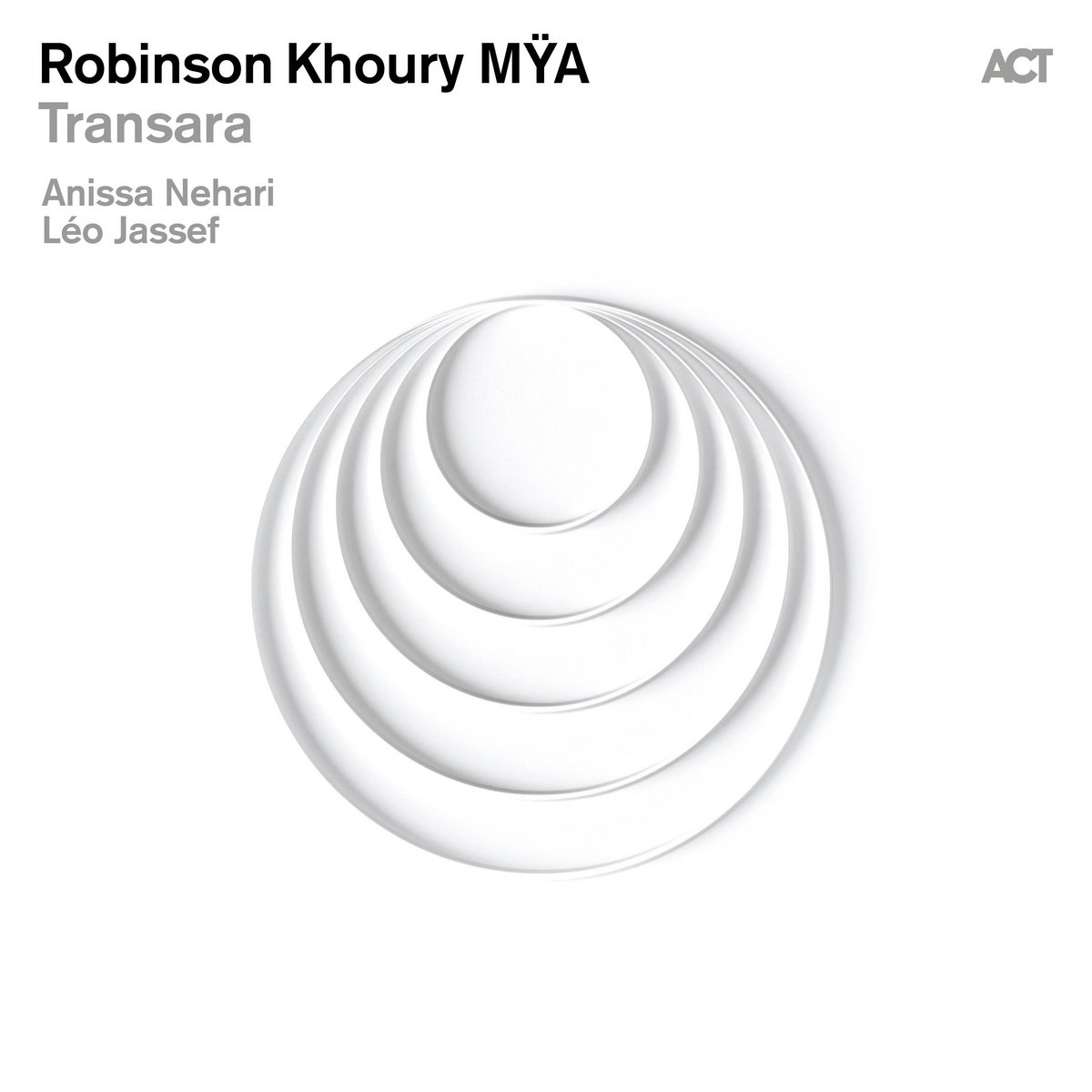
With Transara, Robinson Khoury confirms that he now belongs to the circle of the most inventive jazz musicians on the current European scene. After impressing us with his orchestral work, his many collaborations, and his taste for crossings between jazz, oriental music and contemporary composition, Khoury presents here an 11-track work that is deeply inhabited, intimate and luminous.
The title of this opus, first of all. Transara: a neologism invented by Robinson Khoury to denote a transition between worlds, a connection between spaces and states. The music is also a deeply felt commentary on our times, constantly oscillating between melancholy and warmth. “Given the state of the world around us, one cannot help but be pensive and melancholic,” he acknowledges.
With Transara, Khoury explores new territories with rare conviction, reminding us that jazz remains capable of reinventing itself when entrusted to musicians willing to push its boundaries without ever sacrificing its emotional depth. His influences make themselves felt, but veiled, filtered through such a dense network of multicoloured stars that it becomes difficult to isolate them.
From the very first minutes, Transara establishes a captivating atmosphere: an airy music that oscillates between meditation and movement, rooted in multiple traditions.
What strikes you immediately is the complicity and total mutual respect between the three artists. Nothing is demonstrative and none of them seeks to privilege their own playing. Everything is dialogue, circulation, breathing, sharing. The record possesses that undeniable fluidity of albums where musicians are not trying to shine individually, but to create a collective language.
As is so often the case with important works, the music exists in a permanent in-between, caught between tradition and experimentation.
Robinson Khoury impresses throughout all eleven tracks with the expressive richness of his trombone. His playing combines power and fragility with remarkable mastery. Khoury never plays “against” the music: he shapes it from within, with rare harmonic sensitivity and emotional intensity.
Anissa Nehari’s voice brings a particular light to the whole album, softly diffused or incandescent when needed. She sings with delicacy, and her timbre possesses something both aerial and earthy at once. With Anissa, Transara is no longer content to be a contemporary jazz album — it becomes a work of transmission and sharing.
With his piano, Léo Jassef is the album’s quietly noticed and remarkable backbone. He creates spaces, offers them to his two partners, suggests climates, colours atmospheres, and accompanies with discretion and a subtly authoritative presence when required, without ever imposing. Jassef belongs to that increasingly rare category of musicians: virtuosos capable of making you forget their virtuosity. His playing never imposes. It draws you in. It invites the listener into the music with an almost conversational gentleness.
Among the eleven tracks, several stand out as the album’s highest points:
The title track, Transara, perfectly encapsulates the trio’s aesthetic: a gradual, almost hypnotic build in which the trombone lines and the voice seem to search for one another before merging into a shared emotion. The composition unfolds a slow, never laboured beauty, carried by the subtle harmonies of Jassef’s piano.
On Luna, the trio reaches a degree of intimacy that is almost overwhelming. Anissa Nehari sings with remarkable expressive purity while Robinson Khoury develops a solo of immense tenderness. The piece gives the impression of a nocturnal conversation suspended outside of time. As for the solo, it is in no way a display of technical virtuosity — it is a genuine emotional turning point within a narrative.
On Alma de Luz, the trio reveals its ability to integrate Mediterranean and oriental influences without ever falling into mere sonic décor. The rhythm breathes naturally, and the three musicians seem to move forward in the same organic flow. Léo Jassef’s harmonic work here is particularly remarkable.
Souffles constitutes another summit of the album. More stripped-back, almost contemplative, the piece highlights the art of silence that runs throughout the entire album. Khoury makes his trombone sing with magnificent restraint, while Nehari’s voice acts as a floating, almost spiritual presence. She offers here a remarkable lyrical delicacy. Voice and instruments unfold slowly, patiently, allowing the silences to carry as much emotion as the notes themselves. There is in this track something almost cinematic in the way the trio pans across space, and sky.
Finally, Éclats d’ombre brings a compelling dramatic tension. The trio dares to embrace greater contrasts and density, without ever losing the clarity of its musical intention. At moments, the musicians seem to anticipate each other’s ideas before they have even taken shape. The way the three artists progressively build the intensity of the piece speaks to an impressive collective maturity.
What makes Transara so precious is its capacity to touch deeply, without ever forcing emotion. Robinson Khoury, Anissa Nehari and Léo Jassef have created an album of rare elegance, in which virtuosity, spirituality and poetry flow with a natural ease.
With this record, the trio achieves far more than a beautiful musical encounter: they create a genuine sensitive space, a music of sharing and light that continues to resonate long after the final note. And what makes this recording so remarkable lies precisely in that balance between refinement and freedom, between rigour and emotional spontaneity.
Transara is not simply an excellent world jazz album — it is a musical act of resistance, an invitation to bring light into a world that has grown increasingly complex. To achieve this, Robinson Khoury MŸA has found its language, and that language is charismatic, universal.
Frankie Pfeiffer
Editor in chief – PARIS-MOVE
PARIS-MOVE, May 27th, 2026
Follow PARIS-MOVE on X
::::::::::::::::::::::::
Tracklisting :
Coquillage
Alaoui Club
Poussière
Hope
Taxi Brousse
Pensées Irréelles
Cyclone
Sumud
Matriarchy
Prophétie Part I
Prophétie Part II
Recorded in October 2025, Gil Evans’ Studios, Amiens