| Jazz |
Summary: A polished but unfocused jazz album that showcases skill without taking enough risks.
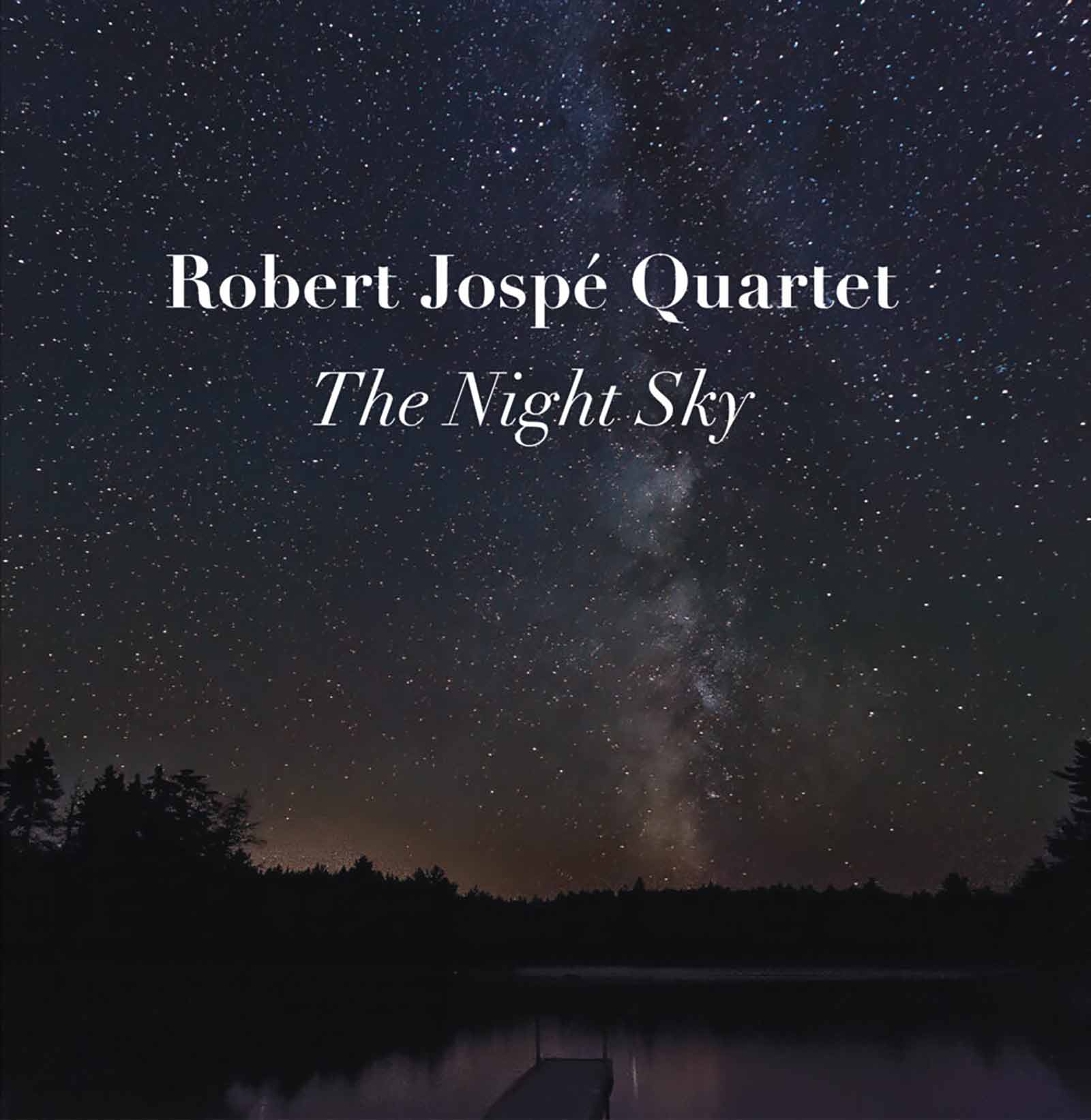
Robert Jospé Quartet – The Night Sky Review: Polished Jazz That Plays It Too Safe
There is a fine line between refinement and reticence, and on The Night Sky, the Robert Jospé Quartet lands just on the wrong side of it. The album is polished, undeniably professional, and often pleasant, but too often it feels content to drift rather than declare, to suggest rather than commit.
At the center is drummer Robert Jospé, whose résumé includes collaborations with figures like Michael Brecker, Dave Liebman, John Scofield, Pat Metheny, and Bobby McFerrin. That pedigree suggests a musician capable of bold statements. Instead, Jospé opts for restraint, sometimes to a fault. His drumming is tasteful, controlled, and technically assured, but rarely commanding. For a bandleader, he often feels like a supporting player in his own project, and one cannot help but imagine how a more assertive, rhythmically distinctive approach, one that leans into complex grooves or signature patterns, might give the music a clearer identity.
The quartet itself, Daniel Clarke on piano and keyboards, Chris Whiteman on guitar, and Paul Langosch on bass, performs with precision and cohesion. There is no shortage of skill here; in fact, that may be part of the problem. The playing is so consistently polished that it leaves little room for friction, surprise, or risk. Clarke’s harmonic palette is warm but predictable, Whiteman’s guitar work slides comfortably between jazz and fusion without ever truly digging into either, and Langosch holds everything together with quiet efficiency. It is all impeccably done, and too often forgettable, in part because the arrangements rarely push beyond their comfort zone or allow the individual personalities within the group to fully emerge.
Stylistically, The Night Sky casts a wide net: Latin grooves (“Samba Sunrise”), atmospheric world jazz (“Desert Dream”), light funk inflections, a standard (“Take the ‘A’ Train”), and even hints of smooth jazz polish. The title track, appearing twice, attempts to tie these strands together but instead underscores the album’s central issue: a lack of focus. Rather than building a cohesive identity, the record feels like a sampler, a well-produced portfolio designed to demonstrate versatility rather than vision. A more deliberate commitment to a specific direction, particularly the sharper, more engaging fusion elements heard in flashes, might have resulted in a stronger, more memorable statement.
This “calling card” approach is familiar, particularly among artists aiming to position themselves on the international festival circuit. And to be fair, the album succeeds on those terms. It is accessible, well-recorded, and easy to imagine in a live setting where its grooves and textures could resonate more immediately. But as a listening experience, it rarely rises above competence, in part because it favors smooth continuity over tension, contrast, or structural surprise. One is left wishing for bolder compositional choices, more pronounced dynamic shifts, and a willingness to disrupt the prevailing sense of ease.
Where the album briefly sparks to life is in its fusion-oriented moments. Here, the quartet shows signs of urgency: the rhythms tighten, the interplay sharpens, and the music hints at a stronger identity. These passages suggest a more compelling direction, one that the album frustratingly never fully commits to. Expanding these moments through longer, more exploratory improvisations, or allowing the band to stretch beyond concise, controlled formats, could have brought greater depth and unpredictability to the record.
Even the album’s structural decisions occasionally feel underdeveloped. The reprise of the title track, for instance, offers limited variation, missing an opportunity for a more radical reinterpretation that could have reinforced the album’s conceptual thread. Similarly, the sequencing lacks a clear narrative arc; the tracks unfold with a certain uniformity, rather than building momentum or creating a sense of progression. Greater attention to pacing, balancing intensity with restraint, density with space, would have made for a more engaging listening experience.
More broadly, The Night Sky often prioritizes mood over memorability. While its textures are consistently appealing, stronger melodic hooks or more distinctive thematic material might have given listeners clearer points of entry. The same can be said of its stylistic blending: rather than smoothing genre boundaries, a more decisive contrast between influences, leaning fully into Latin, fusion, or funk elements at specific moments, could have created more striking and memorable musical statements.
In the end, The Night Sky is not without appeal. It is listenable, well-crafted, and occasionally evocative. But it rarely challenges the listener or stakes out a distinct artistic territory. For all its technical strengths, it feels more like a résumé than a revelation, a record that proves competence without quite achieving necessity.
Thierry De Clemensat
Member at Jazz Journalists Association
USA correspondent for Paris-Move and ABS magazine
Editor in chief – Bayou Blue Radio, Bayou Blue News
PARIS-MOVE, April 3rd 2026
Follow PARIS-MOVE on X

::::::::::::::::::::::::
Musicians:
Robert Jospé: drums/percussion
Daniel Clarke: piano/keyboards/composer
Chris Whiteman: guitar
Paul Langosch: acoustic bass
Track Listing :
The Night Sky
Samba Sunrise
Pyramids
Desert Dream
Flashback
The Night Sky
The Golden Hour
Some Other Time
Take The “A” Train
Southern Doodle Dandy
Silver Lining