| Jazz |
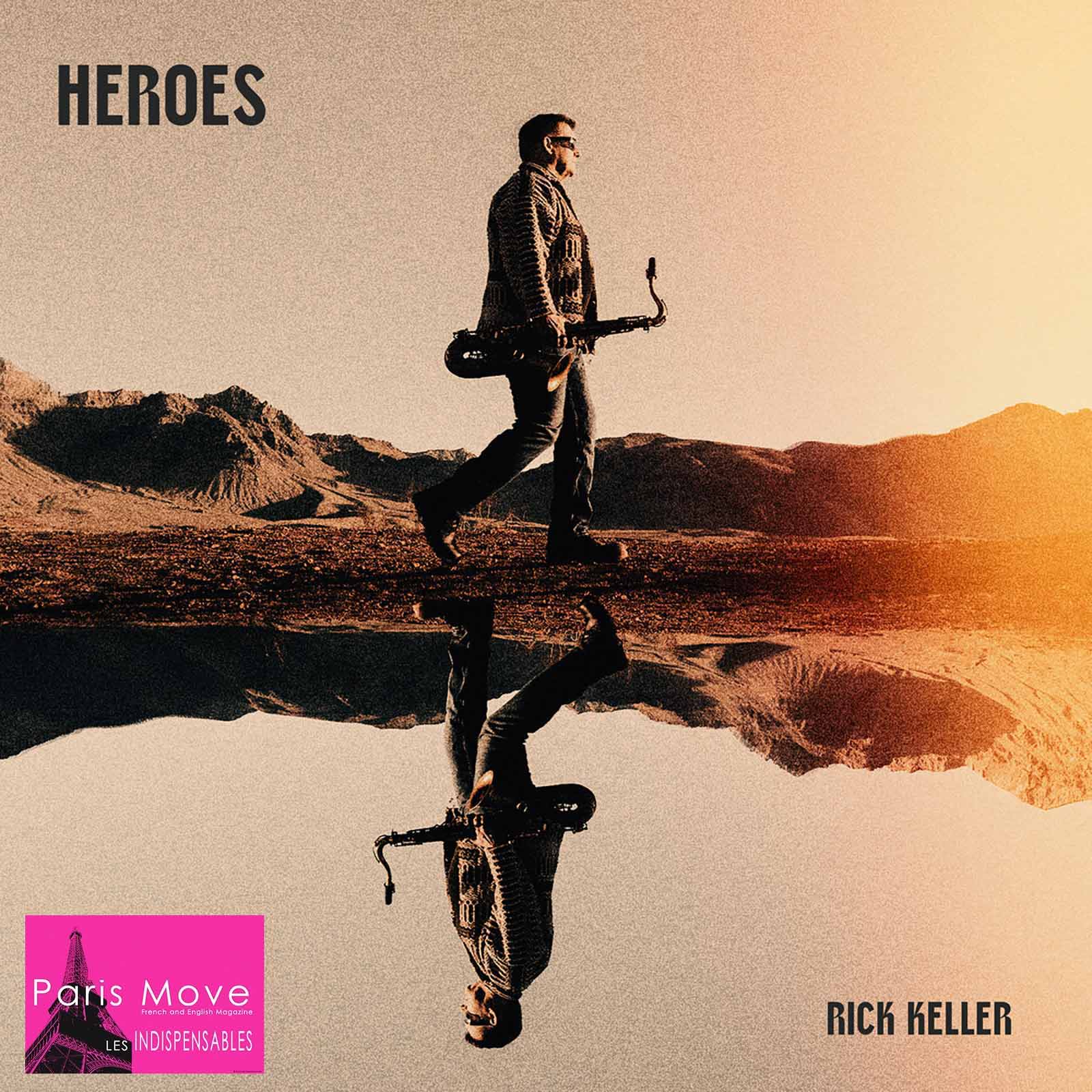
You do not immediately listen to Heroes by Rick Keller with a checklist of influences in mind. Instead, the sensation arrives first: that uncanny feeling of recognizing familiar ghosts moving through the music, shapes, colors, and gestures that feel known without being named. Only later, reading Keller’s own words, does the picture come into focus. Miles Davis. Weather Report. Wayne Shorter. Joe Zawinul. Herbie Hancock. Marcus Miller. The Brecker Brothers. Ralph Towner. Allan Holdsworth. Bill Bruford. Seeing the list written out produces a strange moment of recognition, almost autobiographical in nature. It feels less like a declaration of taste than a quiet confession, as though Keller were mapping the musical territory that shaped him.
Yet Heroes is not an album built on quotation or mimicry. Keller does not chase the sound of his predecessors; he absorbs them. These influences function less as references than as inheritance, musical DNA embedded deep within the compositions. Far from diluting his voice, they allow him to descend more fully into his own universe. From the outset, two elements assert themselves with clarity: a tone that is instantly recognizable, and a body of compositions that feel genuinely singular, resistant to nostalgia and uninterested in imitation.
The rhythmic foundation is precisely what one hopes for from a mature jazz-fusion record, fluid, intelligent, and elastic. Above it, Keller’s saxophone assumes the role of storyteller. His phrasing unfolds like lived narrative, suggesting years of stage experience distilled into sound. This is hardly surprising. Over time, Keller has become an essential presence on the Los Angeles music scene, performing and recording with artists as varied and respected as Christopher Cross, Bill Holman, Johnny Mandel, and Vinnie Colaiuta. His versatility has made him a trusted horn arranger and a sought-after touring musician, from Danny Seraphine’s CTA and Groove Junkies to Frankie Valli’s tours. Add to these shared stages with Barry Manilow, Natalie Cole, Jon Secada, The Temptations, The Four Tops, and even the London Symphony Orchestra, and one begins to understand Keller not merely as a sideman, but as a connective force, an artist fluent in multiple musical languages.
That same adaptability defines his work as an educator at the University of Nevada. One can easily imagine the privilege of studying under a musician capable of moving seamlessly across genres without losing his center. Teaching, in Keller’s case, feels less like the transmission of fixed knowledge than an ongoing exchange. It keeps him in dialogue with younger generations whose musical references are broader, faster-moving, and shaped by a different cultural moment. In return, his own work remains alert, porous, and alive.
Heroes unfold like a carefully constructed film or a well-paced novel, moving from scene to scene with a sense of space and progression. At times, the music feels pastoral, even gently bucolic—poetic in its restraint. Then, without warning, the listener is pulled forward into new terrain, urged into motion. It took repeated listens, nearly a dozen, to fully absorb the album’s architecture. The compositions are complex, yet they are framed by discreet, highly effective arrangements that never call attention to themselves. Each musician’s voice is clearly audible, a testament to Keller’s attentiveness as a bandleader: he holds the course of his vision while leaving ample room for collective invention. This generosity is precisely what gives the album its lasting appeal.
Emotionally, certain moments evoke the spirit of Joe Zawinul, most notably on “Subterraneous.” But here again, there is no imitation at work. Listen closely and you will also hear traces of Miles Davis, not as echo, but as presence. The result is music that is both elegant and deeply felt. Heroes remind us that the most compelling artists are those who carry their past not as a weight, but as a source of momentum. Keller’s heroes are no longer behind him. They live inside the music, transformed, quietly, confidently, into something unmistakably his own.
Thierry De Clemensat
Member at Jazz Journalists Association
USA correspondent for Paris-Move and ABS magazine
Editor in chief – Bayou Blue Radio, Bayou Blue News
PARIS-MOVE, December 19th 2025
Follow PARIS-MOVE on X

::::::::::::::::::::::::
Track Listing :
For Pat
Ahead of the Curve
Hope
Subterraneous
Slow it Down
Tell Me Now
Us Against the World
Distant Passage
Heartbeat
Playing
Ackward Adolescence
Fearless
Complexity
Hymn
All music composed by Richard H Keller Jr ©2025 Saxsonic Music
Except Us Against The World Co composed by Richard H Keller Jr ©2025 Saxsonic Music and Carmen A Grillo ©2025 Big Surprise Music
Musicians:
Rick Keller: Saxes Flute Composition, Mixing, Keyboard and perc. programming
Trumpet: Ramiro Nasello, Danny Falcone, Gil Kaupp, Evan Taylor
Vocals: Joseph Ott, Gary Fowler, Alli Starr, Matt Seward, Carmen Grillo (Co Composer UAW)
Keyboards: Dave Siegel, Bill Zappia
Guitars: Camilo Velandia, Sean Carbone, Steven Lee, Carmen Grillo
Vibraphone: Nick Mancini
Bass: John Belzaguy, Alex Bailey, Eric England, Alfredo Lopez, Dan Lutz, Dave Ostrem
Percussion: Tim Sellars featured percussionist on Cycle of Life, James Whiting (and vibraphone)
Drums: Andy Sanesi, Alex Bailey, Jakubu Griffin
Audio Engineers:
Chuck Foley, GIl Kaupp, Sam Friend, Carmen Grillo
Recorded at UNLV recording studios Las Vegas, Nevada Nov 2024 -May 2025
Additional tech staff: Arthur Chivas and Logan Barrow
All songs written by Richard Keller ©Saxsonic Music 2025 ASCAP except Us Against the World co written by Carmen Grillo ©Big Surprise Music BMI
Executive Producer Mark Dobronski
Additional co producers: Steve Arnold and Frank Dileonardo