| Jazz |
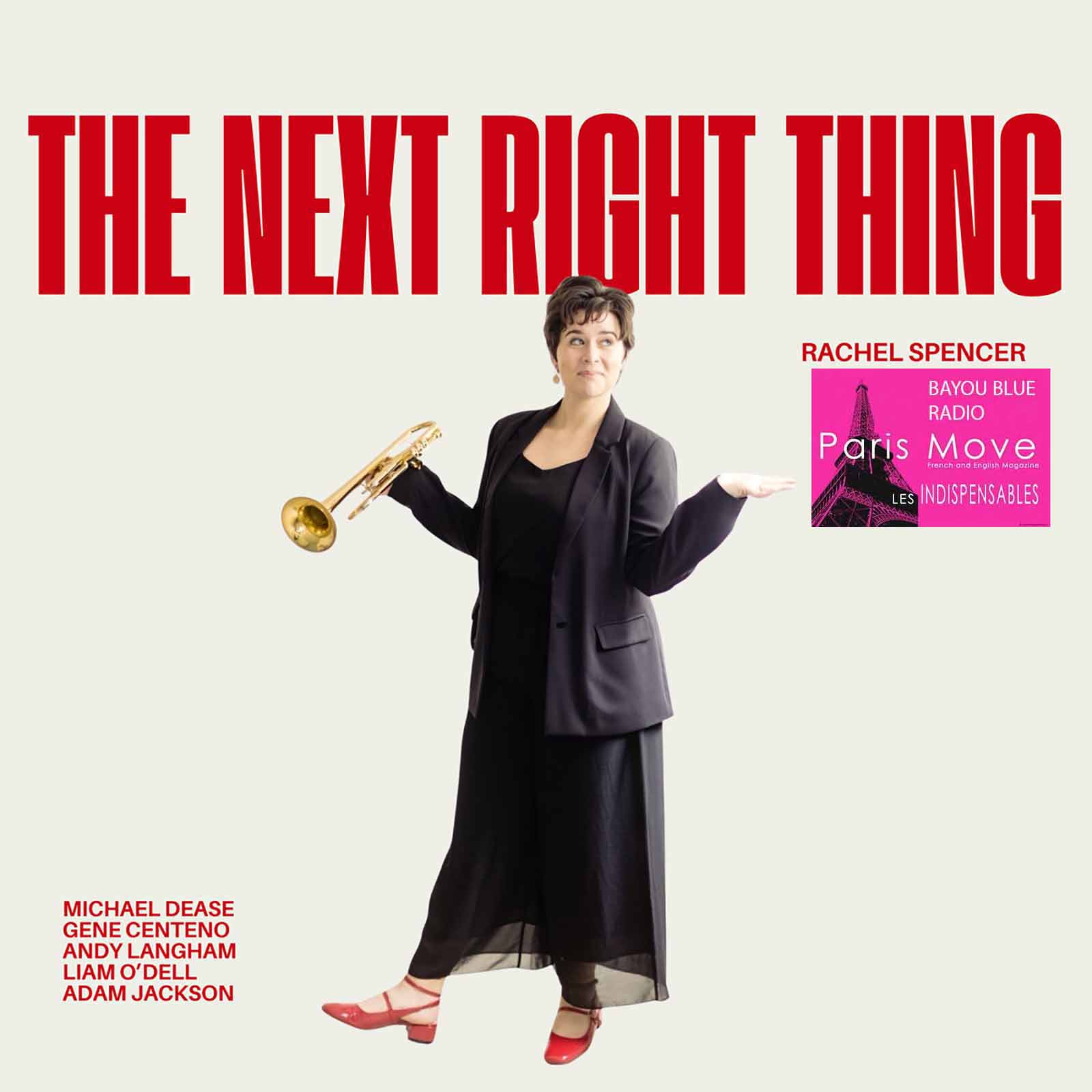
RACHEL SPENCER — THE NEXT RIGHT THING: TALENT DOESN’T WAIT FOR RECOGNITION
There is something both revealing and slightly unsettling about discovering an artist whose music has been developing practically under your nose, yet whose work has somehow escaped your attention. I live in Austin, Texas, a city with a lively musical identity and a reputation that extends well beyond its borders. I also spend a good deal of time following jazz musicians, recordings and conversations that reach far beyond the local scene. Many of my contacts are elsewhere in the United States, or abroad. And yet, despite being part of the same musical environment, I very nearly missed Rachel Spencer and her debut album, The Next Right Thing.
That discovery says something about the way we listen, of course. But it also says something about the way musical recognition works. An artist can be active, committed and artistically accomplished without necessarily becoming visible. Local jazz calendars tend to circulate familiar names. The same musicians appear repeatedly, the same networks sustain themselves, and familiarity can gradually be mistaken for a measure of importance. None of this is necessarily deliberate. It is simply how musical scenes function. But it can leave a surprisingly wide gap between artistic merit and public recognition. Rachel Spencer deserves to be heard beyond that gap. The Next Right Thing is a remarkably assured first statement. It has the energy and openness of a musician who enjoys playing, who understands the language of jazz from the inside and who has no particular need to announce her seriousness at every turn. There is a festive quality to the album, a sense of forward movement that places it comfortably within a post-bop tradition without making it sound like an exercise in historical imitation. The music is inviting, but never superficial; sophisticated, but never weighed down by its own intentions.
That balance is harder to achieve than it may seem. Jazz musicians are often encouraged to demonstrate their command of the language through complexity, speed or an almost compulsory display of technical authority. Yet technique, however impressive, is only one part of musical identity. What matters is what a musician does with it: the choices made, the phrases left unfinished, the silences respected, the way an idea is developed rather than merely exhibited. Spencer understands this distinction. Her playing is precise and articulate, but it also has character. There is a recognizable personality behind the notes. I am particularly drawn to the way she combines control with freedom of expression. Her sound does not depend on exaggerated gestures or on the desire to dominate every musical moment. Instead, she builds her statements with care, allowing a phrase to breathe and giving the music room to develop. There is confidence here, but not the kind that needs to make itself conspicuous. It is a quieter assurance, and perhaps for that very reason a more convincing one.
At moments, I find myself thinking of Céline Bonacina, a saxophonist whose musical temperament I have long appreciated. I am not suggesting that the two musicians sound alike, or that they belong to the same artistic trajectory. The connection I hear is more personal than stylistic: a combination of individuality, discipline and an instinct for making technical command serve musical expression. It is the difference between playing well and having something to say.
The compositions are central to what makes this album so compelling. Spencer is not simply using the recording as a platform for instrumental performance. Her original material gives the project its identity and reveals an imagination that deserves as much attention as her playing. The writing has harmonic depth and melodic intelligence, but it never feels constructed merely to impress a specialist audience. The ideas remain connected to the larger emotional movement of the music. “Liminal Spaces” is particularly revealing. Even its title suggests a territory between defined states, and the composition develops that sense of movement and transition with considerable subtlety. Its interest lies not in a single dramatic effect, but in the way the musical material opens up, shifts and finds new possibilities. There is an architectural quality to the writing, yet the piece never loses its sense of life. The structure supports the performance rather than restricting it.
“Bias” offers another perspective on Spencer’s compositional thinking. It reinforces the impression that she is attentive to the relationship between musical ideas, their development and the spaces between them. These are not compositions that simply provide a sequence of changes over which musicians can demonstrate their abilities. They have an internal logic, a point of view. They ask something of the performers while leaving them enough freedom to respond.
That freedom is essential to the album. Spencer leads without turning leadership into a form of control. She gives the other musicians room to contribute, and the result is an ensemble sound rather than a collection of individual performances placed next to one another. The distinction matters. Good jazz is not merely a matter of assembling accomplished players. It depends on listening, on the willingness to adapt, and on the ability to recognize when another musician has something worth following.
The presence of trombonist Michael Dease adds an especially interesting dimension. His musical approach provides a contrasting voice, and the relationship between the two players gives the recording much of its character. Their differences are productive. Rather than competing for attention, they create a space in which each can sharpen the other’s ideas. There is a sense of mutual respect in that exchange, and it contributes to the album’s ease and coherence. This is one of the pleasures of The Next Right Thing: it sounds like music made by people who are genuinely engaged with one another. The performances have energy, but they are not restless. The musicians can stretch out without losing sight of the compositions, and the arrangements leave room for individual expression without sacrificing the overall shape. The recording and mix also deserve recognition. The sound is clear and well balanced, allowing the details of the ensemble to emerge without making the production itself the main attraction. Everything serves the music. It would be easy to describe this as a promising debut and leave it there. But I think that would underestimate what is happening. A first album can be a calling card, a demonstration of potential, or an attempt to establish a place within a crowded field. This one does more. It presents a musician with a developing artistic language, a composer’s instinct and a clear understanding of the collaborative nature of jazz. It does not pretend to have answered every question. It makes the more interesting choice of showing us why the questions are worth asking.
There is, of course, a larger context to consider. American jazz remains extraordinarily rich in musicianship, ideas and creative energy. Yet the mechanisms through which artists become known have not always kept pace with that vitality. Visibility is unevenly distributed. Geography, professional networks, access to recording opportunities, media attention and the ability to tour all play a role. A musician may be respected by colleagues and valued by audiences who know the work, while remaining largely absent from the broader conversation.
This is particularly relevant when considering women instrumentalists and composers. The situation has evolved, and the presence of women across the jazz world is increasingly evident. But visibility should not be confused with equality of opportunity, and recognition should not be mistaken for a problem that has already been solved. The question is not whether women can play, compose, lead ensembles or sustain demanding artistic careers. They have been doing so for generations. The question is why the music industry’s habits of attention and recognition can still be so selective.
There is a tendency to treat the achievements of women in jazz as a separate subject, as though their work required a special category before it could be taken seriously. That approach can become limiting in its own way. Rachel Spencer should certainly be heard in the context of the continuing contribution of women to jazz, but she should also be judged on the music she has made. Her compositions, her instrumental voice and her work as a bandleader are the strongest arguments in her favor. They do not need to be softened or qualified. The same applies to the independent musicians who sustain so much of the American jazz landscape. Their work often depends on a combination of artistic commitment, teaching, performance, collaboration and the practical business of keeping a career alive. The public may see the recording, the concert or the finished project. It does not always see the years of preparation, the professional relationships, the rehearsals, the teaching and the persistence required to bring that work into existence. Too often, the absence of widespread recognition is treated as evidence of limited importance. It is a mistake. Artistic value and market visibility are not interchangeable currencies.
Austin is an interesting place from which to consider these questions. The city has a powerful musical identity, but jazz occupies a particular position within it. Its musicians work in an environment where musical activity is abundant, while attention is divided among genres, venues and established circuits. The presence of a strong local scene does not automatically guarantee that every musician working within it will receive the attention deserved. Nor does a city’s reputation as a music destination tell us everything about the depth or diversity of its musical life.
My own near-miss with Rachel Spencer is a reminder of that. I would rather acknowledge it than pretend that every important artist automatically comes to my attention. Listening is also an act of discovery, and discovery sometimes requires us to look beyond the names already circulating in our familiar networks. There is no reason a musician’s importance should be measured by how frequently that musician appears in a local calendar, a festival announcement or a review. What matters is the work. And The Next Right Thing is work of genuine substance.
I am left especially curious about what Spencer will do next as a composer. Her writing suggests that she has more to explore, and that her musical identity is still unfolding. The combination of melodic instinct, harmonic awareness and an understanding of ensemble interaction gives her a strong foundation. Just as importantly, she seems to know that a bandleader’s responsibility is not simply to place herself at the center of the music. It is to create the conditions in which the music can become larger than any one individual. That is a quality I value enormously. It is also one of the reasons this album stays with me. The more I listen, the more I hear in the compositions and in the relationships between the musicians. The record does not exhaust itself after the first impression. It invites another listen, then another. Its pleasures are immediate, but its details continue to reveal themselves.
I do not know how quickly Rachel Spencer will receive the wider recognition her work deserves. The jazz world has never been particularly predictable in that regard. But I am convinced that she is a musician worth following closely, and that The Next Right Thing should travel well beyond the boundaries of the Austin scene. It is an accomplished debut, certainly, but more than that, it is an introduction to an artist with the potential to become an important instrumental voice and a distinctive composer.
Sometimes an album arrives with a great deal of publicity and very little to say. Sometimes the music makes its case quietly, leaving the listener to do the work of passing it along. This is one of those records. I am glad I finally found it, even if I should have found it sooner.
A remarkable debut, a musician worth following closely and, above all, an album that is hard to stop listening to. Yes, The Next Right Thing is downright addictive.
Thierry De Clemensat
Member at Jazz Journalists Association
USA correspondent for Paris-Move and ABS magazine
Editor in chief – Bayou Blue Radio, Bayou Blue News
PARIS-MOVE, November 3rd, 2026
Follow PARIS-MOVE on X
::::::::::::::::::::::::
Musicians :
Rachel Spencer Composer (1,3,5,6,7) trumpet
Gene Centeno, alto saxophone
Michael Dease, composer (2,4) , trombone (2,4)
Andy Langham, piano
Adam Jackson Drums
Track Listing :
The Next Right Thing
Steamrollin’
Liminal Spaces
Queen Of Cups
Bias
I Can Almost Remember
Essential Company