| Jazz |
Summary:
Composer and saxophonist Quinsin Nachoff unveils Patterns from Nature, an ambitious large-ensemble work performed by an exceptional group of musicians including pianist Matt Mitchell, percussionist Satoshi Takeishi, bassist Carlo De Rosa, clarinetist François Houle, trombonist Ryan Keberle, and the Molinari String Quartet. Through four movements, “Branches,” “Flow,” “Cracks,” and “Ripples”, Nachoff explores natural processes through intricate orchestration, improvisation, and a deeply conceptual musical language that bridges contemporary classical composition and exploratory jazz.
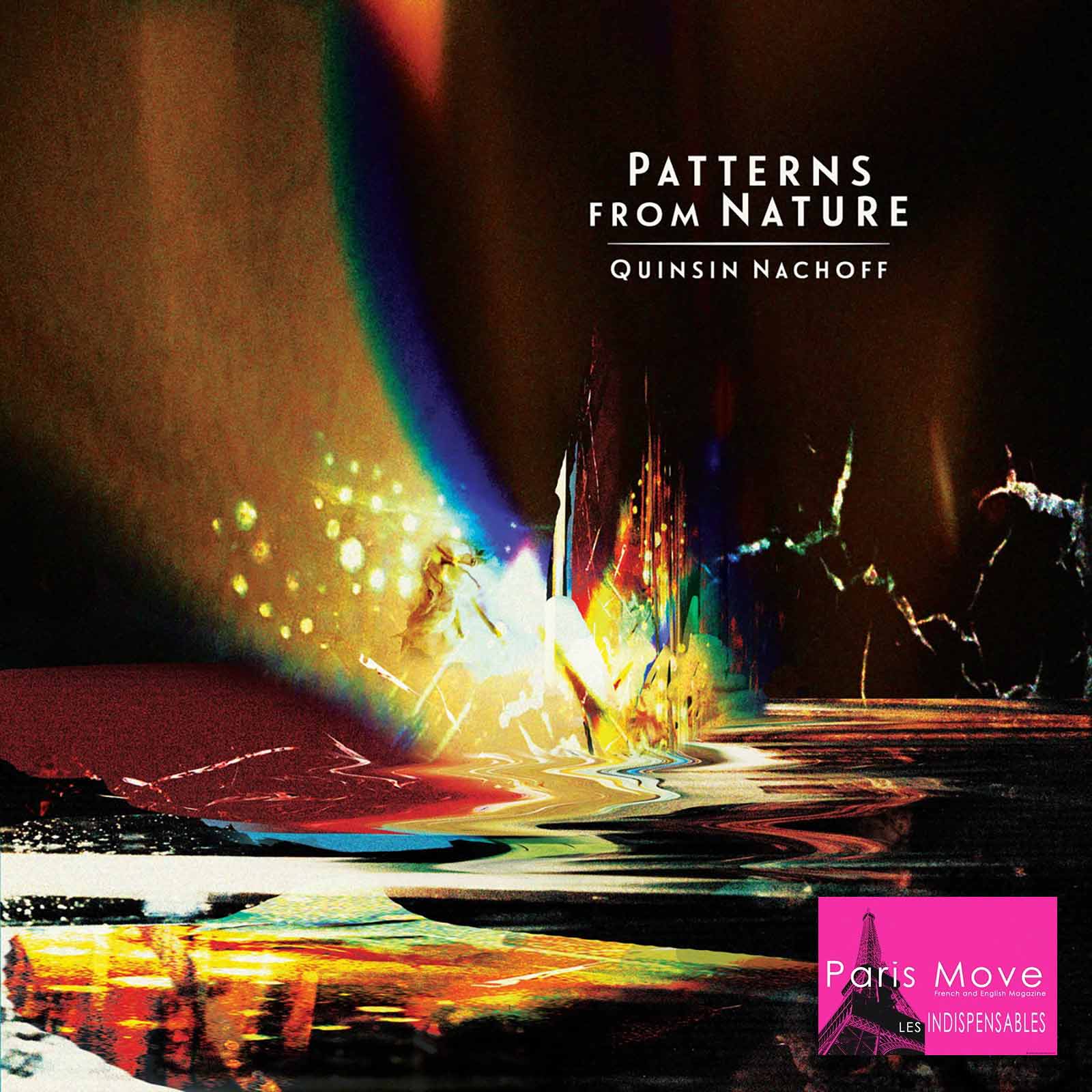
Quinsin Nachoff’s Patterns from Nature: Where Sound Mirrors the Architecture of the Natural World
With certain artists, the question of genre quickly becomes irrelevant. The music refuses such tidy categorization, slipping easily across stylistic borders and challenging the listener to abandon familiar labels. The work of Quinsin Nachoff belongs firmly in that rare territory. His album Patterns from Nature does not merely traverse genres; it dissolves them, privileging the physical presence of sound itself over the orderly logic of notes on a page.
Nachoff approaches composition with the sensibility of both architect and naturalist. As a composer, he crafted the dense, meticulously detailed scores for two large-ensemble works. As a conductor, he guided their realization with a carefully selected group of musicians drawn from different musical worlds. The ensemble includes pianist Matt Mitchell, percussionist Satoshi Takeishi, bassist Carlo De Rosa, clarinetist François Houle, trombonist Ryan Keberle, and the Molinari String Quartet,an ensemble renowned for its commitment to contemporary repertoire. Each musician brings a distinct vocabulary, yet together they inhabit the elaborate sonic ecosystem imagined by the composer.
Patterns from Nature unfolds in four movements, each inspired by natural processes and structures. The opening piece, “Branches,” interprets the patterns of arboreal growth. Here, Mitchell’s piano lines stretch outward like limbs reaching for light, unfurling across orchestral textures that evolve continuously. The music expands organically, its internal logic recalling the quiet geometry of a forest canopy.
“Flow,” the second movement, captures the complexity of fluid motion. Takeishi’s distinctive percussion setup provides an immense dynamic palette, while the Molinari String Quartet contributes a remarkable range of textures. The result is music that feels almost cinematic in its detail,an impressionistic study of currents and eddies, translating the physics of movement into sound.
On “Cracks,” the score becomes a stage for dialogue. The written orchestral framework interacts with the improvisations of De Rosa’s bass and Houle’s clarinet, producing a cascade of branching possibilities. Their exchanges seem to fracture and reassemble the music in real time, echoing the unpredictable patterns found in geological formations or shifting landscapes.
The closing movement, “Ripples,” unfolds as a tense and captivating conversation between Nachoff’s own saxophone and Keberle’s trombone. Waves of sound expand outward, gradually dissolving into silence, an effect inspired by the slow formation of stalactites, where time, gravity and mineral traces collaborate in patient creation.
Listening to Patterns from Nature is less an act of passive consumption than a form of attentive observation. The listener becomes a spectator, invited to “look with the ears,” absorbing the intricate interplay of textures and structures. These musical proposals are both alluring and formidable: their complexity stands in sharp contrast to the conventions of most contemporary recordings.
One might imagine the choreography not on a stage but in a landscape, the rustling of leaves stirred by the wind, the subtle rhythms imposed by unseen forces. To fully engage with the work requires a certain surrender: close the eyes, let the sounds carry you, and allow the experience to blur the boundary between listener and environment.
In literature, Marguerite Yourcenar famously used the image of the wind in her novel The Abyss as a symbol of freedom, detachment and wandering through time and place. Nachoff’s music evokes a similar sense of motion, an artistic current that moves across landscapes both physical and intellectual.
To describe this music simply as jazz would be misleading. Its architecture belongs more to the domain of contemporary classical composition, where dramaturgy and long-form narrative guide the listener’s perception. In that sense, Nachoff’s work operates in a sphere far removed from traditional improvisational frameworks. The composer constructs a musical argument of considerable intellectual depth, one that asks listeners to bring a measure of curiosity, and perhaps erudition, to the encounter.
Yet beneath the complexity lies a striking emotional core. Nachoff, himself a saxophonist, channels a sensitivity that often feels ecological in spirit, as though the music were advocating for a renewed awareness of the natural world. In today’s tense geopolitical climate, such artistic gestures can resonate as subtle affirmations of freedom, the quiet assertion that human creativity still has the power to imagine different futures.
For that reason, Patterns from Nature will not appeal to every audience. Its ambitions place it closer to the most challenging works displayed in major contemporary art galleries than to the immediacy of mainstream music culture. Appreciating it requires space, both mental and temporal. It asks the listener to set aside distractions, to devote a private moment of concentrated listening.
Those willing to grant that time may discover a work that unfolds slowly but with remarkable depth: a musical landscape where sound mirrors the hidden architecture of the natural world.
Thierry De Clemensat
Member at Jazz Journalists Association
USA correspondent for Paris-Move and ABS magazine
Editor in chief – Bayou Blue Radio, Bayou Blue News
PARIS-MOVE, March 8th 2026
Follow PARIS-MOVE on X

::::::::::::::::::::::::
Track Listing :
Patterns From Nature I. Branches
Patterns From Nature II. Flow
Patterns From Nature III. Cracks
Patterns From Nature IV. Ripples
Winding Tessellations I. Winding Paths
Winding Tessellations II. Convergence
Winding Tessellations III. Tessellations
Musicians :
Quinsin Nachoff – tenor saxophone, composer
JC Sanford – conductor
Roberta Michel – flute, piccolo, alto flute, bass flute
François Houle – clarinet
Sara Schoenbeck – bassoon
Tony Kadleck – trumpet
John Clark – french horn
Ryan Keberle – trombone
Aaron Edgcomb – percussion
Gene Hardy – musical saw (Patterns from Nature: II. Branches)
Matt Mitchell – piano
Carlo De Rosa – bass
Satoshi Takeishi – percussion (Patterns from Nature)
Molinari String Quartet (Quatuor Molinari):
Olga Ranzenhofer – violin I
Antoine Bareil – violin II
Frédéric Lambert – viola
Pierre-Alain Bouvrette – cello
ALBUM CREDITS:
Recorded at Oktaven Audio, New York
Engineered by Ryan Streber, Charles Mueller, Owen Mulholland
Mixed and Mastered by David Travers-Smith
Produced by David Travers-Smith, Quinsin Nachoff
Executive Producer – Michael Janisch
Layout and design for CD and LP – Lee Hutzulak
Liner notes – Philip Ball
Every new release from Quinsin Nachoff is a headline event, a radical combining and recombining of sonic and conceptual innovations, ever-evolving textures, powerful melodies and rhythms, that always open up new vistas for exploration while clearly marking the way back to what has come before. The album Patterns from Nature is an unashamedly ambitious showcase for his remarkable abilities as a composer and orchestrator, working within the space where the heartfelt collaborative improvisation of jazz meets the adventurous rigor of contemporary music and the depth and complexity of conceptual art.