| Jazz moderne |
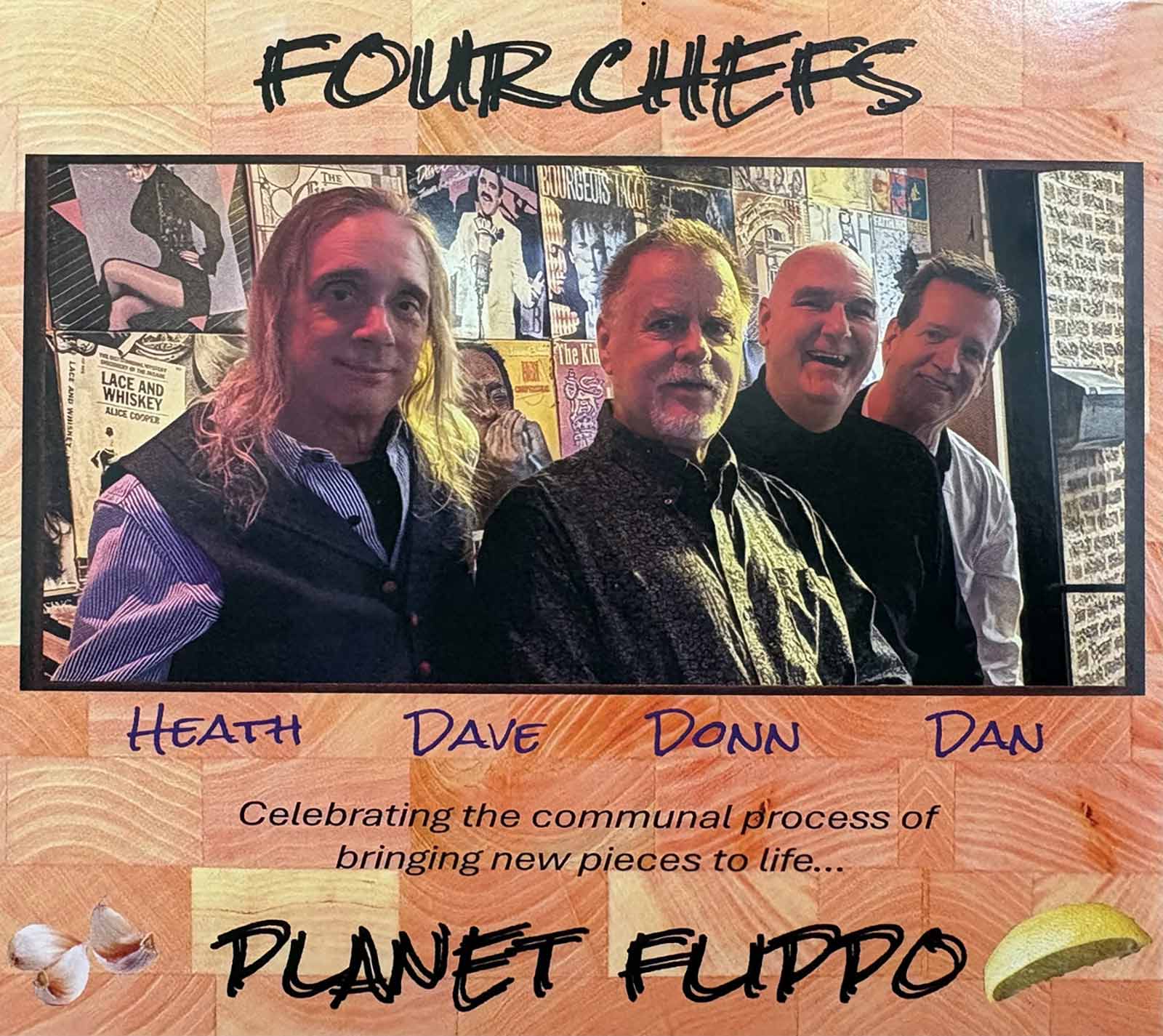
Some album covers make you want to walk away before you have heard a single note. Four Chefs, by Planet Flippo, is one of them. The cover is so awkward, both in concept and execution, that it seems almost designed to test the listener’s patience before the music gets a chance to defend itself. But covers lie. Occasionally, a terrible one is wrapped around a terrific record. So I put Four Chefs on with a certain amount of skepticism, but also with the willingness to be proved wrong. Planet Flippo is the project of Dr. Dave Flippo, a pianist, composer and arranger whose work occupies the intersection of jazz, contemporary composition and world music. He is joined here by saxophonist and flutist Dan Hesler, bassist Donn De Santo and drummer Heath Chappell, with additional musicians appearing on several tracks. The album draws from both older and newer Flippo compositions and sets out to build a repertoire capable of moving across several traditions of jazz. From the opening measures, one thing is immediately clear: these musicians know what they are doing. They know the vocabulary, they know the history, and they have absorbed the grammar of modern jazz thoroughly enough that they never need to announce their credentials. And that, as it turns out, is both the record’s strength and its central problem.
The opening pieces settle into familiar post-bop territory, with carefully shaped themes, precise harmonies and a rhythm section flexible enough to accommodate changes in direction without losing its balance. There is something reassuring about the sound. It reaches back toward the jazz of the 1950s and ’60s, when composition, improvisation and harmonic exploration were constantly testing the limits of the form. Planet Flippo knows that territory intimately. Nothing feels clumsy, underdeveloped or technically uncertain. If anything, the opposite is true. The musicians are so consistently in control that the music rarely seems willing to lose control. Every instrument has a purpose. Every arrangement has been considered. Every corner has been neatly sanded down. The warm, rounded production reinforces the impression, sometimes evoking the polished atmosphere of an older jazz recording. None of this is objectionable. But after a while, I began to wonder whether the record was being careful not to make a mistake rather than trying to make a discovery. Jazz, after all, has never depended entirely on getting everything right. Some of its most memorable moments come from the instant when something threatens to go wrong and the musicians decide to follow it anyway. Four Chefs rarely takes that gamble.
As the album unfolds, Flippo begins to move the furniture around. “Blue Eleven” introduces a stronger soul influence, while other compositions bring in elements of fusion, shifting meters and structures that appear intent on stretching beyond conventional jazz forms. The impulse is perfectly reasonable. In fact, it is one of the album’s most interesting ambitions. The problem is that the further Four Chefs travels, the more difficult it becomes to identify where it actually wants to live. One reference gives way to another, one historical period to another, one musical color to another. The album never collapses into chaos, but neither do all these changes produce a compelling sense of direction. It is restless without always being adventurous. You can follow Flippo’s logic, but you do not always feel the necessity behind it. This is an important distinction. Musical eclecticism can create electricity when disparate influences collide and force something new into existence. But accumulation, by itself, is not transformation. Four Chefs sometimes sounds less like a conversation among traditions than like a well-organized room in which everyone has been invited to speak and nobody has been asked to say anything particularly dangerous.
Flippo’s background helps explain why the album is built this way. Early in his career, he became interested in Third Stream, the effort to bring together concert music, jazz sonorities and improvisation. He later worked with chamber ensembles and developed music for small jazz groups, eventually associating his approach with the broader idea of “global-jazz,” a conception of the music open to influences from different traditions rather than treating jazz as a sealed historical language. That history matters because it makes clear that Four Chefs is not simply another exercise in retro jazz. Flippo is trying to extend the tradition, to make room for other musical vocabularies and to see what happens when they are placed alongside one another. The ambition is genuine. So is the craftsmanship. But ambition and execution are not the same thing, and at a certain point the album forces a question that it never quite answers: how much can a record absorb before its own identity begins to dissolve?
That question is where Four Chefs becomes most interesting, and most frustrating. There is a great deal here to hear. There is even more to study. For musicians, composers and students of jazz, the record offers a useful map of compositional decisions: harmonic movement, orchestration, rhythmic organization, ensemble interaction and different approaches to balancing written material with improvisation. You could hand the album to a serious jazz student and reasonably say, listen carefully and pay attention to how this is put together. There is value in that. But a record can be instructive without being deeply affecting, and Four Chefs repeatedly exposes that gap. I often found myself listening to the construction of the music more intently than to the music itself. I heard the decisions. I heard the references. I heard the craft. What I heard less often was the feeling that something was at stake.
That becomes especially apparent in the improvisation. The musicians are plainly capable, and nobody here needs to be rescued by a critic pretending otherwise. Yet technical fluency can become its own kind of enclosure. You know that these players could push further. You can hear the available possibilities sitting just beyond the arrangements: a rougher edge, a more unexpected turn, a moment of genuine imbalance, a phrase that refuses to resolve neatly. Instead, the performances tend to return to the safety of the structure. The result is not sterile, exactly. It is simply controlled to the point of diminishing surprise. The record keeps showing you the machinery without quite giving you the explosion. And after a while, that can make even sophisticated music feel strangely predictable.
It would be unfair, though, to conclude that Planet Flippo has no personality. It does. The personality simply resides more in Flippo’s ideas about composition than in a sound that is instantly identifiable. He is clearly interested in building a kind of musical laboratory, a place where jazz can interact with contemporary composition, soul, world music and the many traditions that have shaped the genre since the middle of the 20th century. There is something admirable about that intellectual curiosity. What is less convincing is the emotional result. I understand what Flippo is trying to construct. I am less certain that I feel compelled to inhabit it. The album’s intellectual coherence is easier to perceive than its emotional coherence, and that imbalance becomes more pronounced with each successive track.
Which brings us back to the title. Four Chefs is, in its way, an almost perfect metaphor for the record. Several cooks have gathered around the same meal, each bringing ingredients, experience and specialized knowledge. It is a clever image for a group interested in combining traditions and techniques. But cooking has an inconvenient lesson that applies just as well to music: more ingredients do not necessarily make a better dish. At some point, the question is no longer how much you have put into the pot, but whether the finished meal has a flavor of its own. Four Chefs contains plenty of ingredients. There is craftsmanship, historical knowledge, compositional ambition, technical ability and a genuine desire to connect different musical worlds. What it lacks is the one ingredient that cannot be added after the fact: a distinctive taste. Something that makes you recognize the record before you check the label. Something that makes you want to return not to figure out how the meal was prepared, but because you still remember how it tasted.
That is why my response to Four Chefs ultimately remains more analytical than emotional. This is not a bad record. It is not an amateur record. It is not even an unsuccessful record in any straightforward sense. The musicians are accomplished, the writing is serious, the arrangements are carefully considered, and the project behind the album reflects a sincere engagement with the history and future possibilities of jazz. But competence has its limits as an artistic argument. Four Chefs gives you plenty to admire and plenty to discuss, but relatively little that demands to be remembered. As the album progresses, the listening experience becomes increasingly intellectual rather than visceral. You listen, analyze, recognize, understand. What you rarely do is stop and think, wait, what was that? There are no musical disasters here, but there are also remarkably few moments that escape the gravitational pull of the respectable. In the end, Four Chefs strikes me as a fairly average record, and that may be its most difficult quality to overcome. Its natural audience will probably be musicians, students, composers and jazz listeners interested in the architecture of the music, where there is enough substance to reward close attention. But for listeners looking for personality, urgency or the kind of musical surprise that makes a record feel necessary rather than merely accomplished, the album leaves less behind. The four chefs clearly know their way around the kitchen. They know the ingredients, they understand the techniques, and they have prepared the meal with considerable care. But when the plates are cleared, what stays with you is not the flavor. It is the recipe.
Thierry De Clemensat
Member at Jazz Journalists Association
USA correspondent for Paris-Move and ABS magazine
Editor in chief – Bayou Blue Radio, Bayou Blue News
PARIS-MOVE, October 1st, 2026
Follow PARIS-MOVE on X
::::::::::::::::::::::::
Musicians / Four Chefs:
Dave Flippo: keys/piano/melodica
Dan Hesler: saxophones/flute
Heath Chappell: drum set
Donn De Santo: acoustic and electric bass
Special guest:
Aras Biskis: guest percussionist
Produced by Dave Flippo and Donn De Santo
Engineered by Donn De Santo