| Jazz |
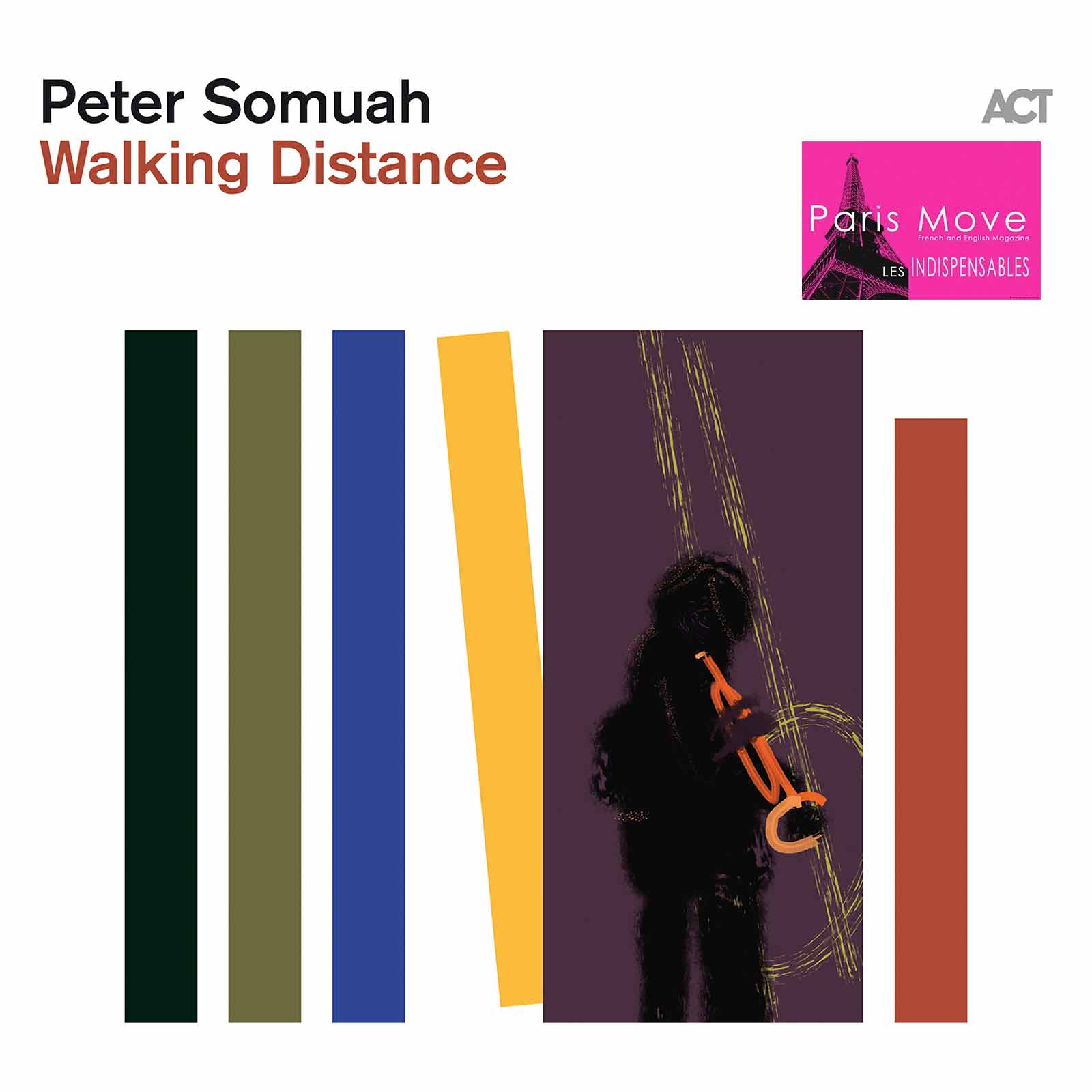
The first note arrives almost cautiously, a burnished trumpet tone suspended in space, neither in a hurry nor eager to impress. It hangs there, warm and deliberate, before the rhythm section eases in beneath it. In that instant, it becomes clear that Peter Somuah is not merely opening an album; he is inviting the listener into a conversation about distance, memory and belonging.
It is striking to realize that Walking Distance is already Somuah’s third release on the German label ACT Music. The speed of his ascent might surprise those only now discovering him, but the consistency of his artistic vision explains it. Each album has felt less like a follow-up and more like a reintroduction, a new chapter in an unfolding narrative. Somuah does not repeat himself; he refines, expands and repositions.
From the opening track, one hears echoes of the bebop language once sharpened by Miles Davis, particularly the restless phrasing and luminous restraint that marked Davis’s late-1940s recordings. Yet Somuah’s music resists nostalgia. If there is lineage here, it is spiritual rather than imitative. He shapes clear melodic arcs over harmonies that feel both intimate and expansive, balancing lyricism with rhythmic subtlety.
The album’s architecture is carefully constructed. One track leans into post-bop sophistication, with harmonies unfolding in patient layers; another introduces Arabic-inflected modal colors, the trumpet bending gently toward microtonal inflections. Latin rhythmic undercurrents ripple beneath a blues-infused melody elsewhere, while a funk-driven groove injects momentum without ever overwhelming the ensemble dynamic. Throughout, Ghanaian rhythmic sensibilities, especially in the percussion patterns and bass interplay, provide an unmistakable foundation.
The title, Walking Distance, serves as both metaphor and manifesto. The album becomes an exploration of proximity: between genres, between continents, between inherited tradition and personal innovation. Cultural boundaries, Somuah suggests, are closer than we imagine. They are, in fact, within walking distance.
For some listeners, the project may evoke the spirit, if not the sound, of Sketches of Spain. Like Davis, Somuah approaches global influences with curiosity and seriousness. But where Davis often abstracted and reframed his inspirations through orchestral grandeur, Somuah immerses himself more intimately within them. His engagement feels less like transformation at a distance and more like participation from within. The difference is not generational alone; it reflects a distinct cultural positioning and a 21st-century sensibility shaped by migration, dialogue and hybridity.
Born in Ghana and shaped by experiences across Europe, Somuah belongs to a generation for whom transnational identity is not a concept but a lived reality. That biography matters. It informs the album’s emotional core: a constant negotiation between rootedness and movement. His trumpet tone, rounded, unforced, occasionally tinged with a grainy edge, conveys both introspection and quiet confidence.
There is, notably, an accessibility to the music. The melodies are memorable, the grooves inviting. But beneath that surface lies sophisticated craftsmanship. The arrangements often shift subtly: a harmonic pivot here, a rhythmic displacement there, a sudden thinning of texture before a collective swell. These are not decorative choices; they create tension and release, intimacy and breadth.
If there is a risk in such stylistic breadth, it lies in potential diffusion, the danger that global fusion becomes aesthetic tourism. Yet Walking Distance largely avoids that trap. The coherence of the ensemble playing, the recurring thematic motifs and Somuah’s distinct trumpet voice hold the project together. The diversity feels integrated rather than assembled.
The album also arrives in a cultural moment when multiculturalism is, in certain corners, viewed with suspicion or alarm. Yet the lived reality of the contemporary world, economically, socially, artistically, is one of entanglement. Since at least the late 20th century, cultures have intertwined at accelerating speed. Somuah’s music does not argue this point polemically; it demonstrates it musically. The blending is not theoretical. It is audible.
Beyond stylistic conversation, the record carries narrative weight. Several compositions unfold like short stories: the quiet anticipation of departure, the kinetic swirl of urban life, the tenderness of reunion. Somuah has a gift for suggesting movement, not only geographic, but emotional. His solos rarely dominate; they converse. Space is used as eloquently as sound.
For a Ghanaian artist working in a historically African American art form while navigating European production contexts, this balance is significant. His African identity is most palpable in rhythmic grounding, but it permeates more subtly in phrasing, in call-and-response gestures, in tonal inflections that resist strict Western symmetry. At the same time, he captures the atmospheres of other musical worlds with attentiveness rather than appropriation, translating them into his own vocabulary.
It would be easy, perhaps tempting, to predict that this album will secure Somuah’s place among the defining jazz artists of the 21st century. Such declarations, however, belong to time. What can be said now is simpler and perhaps more meaningful: Walking Distance expands the conversation of contemporary jazz without raising its voice. It suggests that innovation need not shout, that complexity can remain welcoming, and that distance, cultural or musical, may be shorter than we think.
As the final track fades, the trumpet once again lingers in open air, neither fully resolved nor unfinished. It feels less like a conclusion than a horizon line, an invitation to keep walking.
Thierry De Clemensat
Member at Jazz Journalists Association
USA correspondent for Paris-Move and ABS magazine
Editor in chief – Bayou Blue Radio, Bayou Blue News
PARIS-MOVE, February 13th 2026
Follow PARIS-MOVE on X

::::::::::::::::::::::::
To buy this album (March 13, 2026)
Musicians :
Peter Somuah: trumpet, flugelhorn
Anton de Bruin: Rhodes, organ, keys
Jens Meijer: drums
Marijn van de Ven: bass
Danny Rombout: percussion
Heleen Vellekoop: flute on #2
Nia Ralinova: cello on #2, 3
Track Listing :
01 Crossroad (03:25)
02 300 Meters (04:20)
03 Around the Corner (05:11)
04 Intersection (04:46)
05 Roundabout (03:26)
06 Junction (03:47)
07 A Turn (05:05)
08 Chef Groove (03:41)
09 Nearby (02:57)
10 Right Lane (02:39)
11 Voyage (03:30)
All music composed by Peter Somuah
Produced by Peter Somuah, Anton de Bruin
Recorded between 25 and 27 August 2025 at The Womb Studios, The Hague, Netherlands
Recorded by Tijmen van Wageningen
Mixed by Anton de Bruin
Mastered by Stuart Hawkes