
| Jazz |
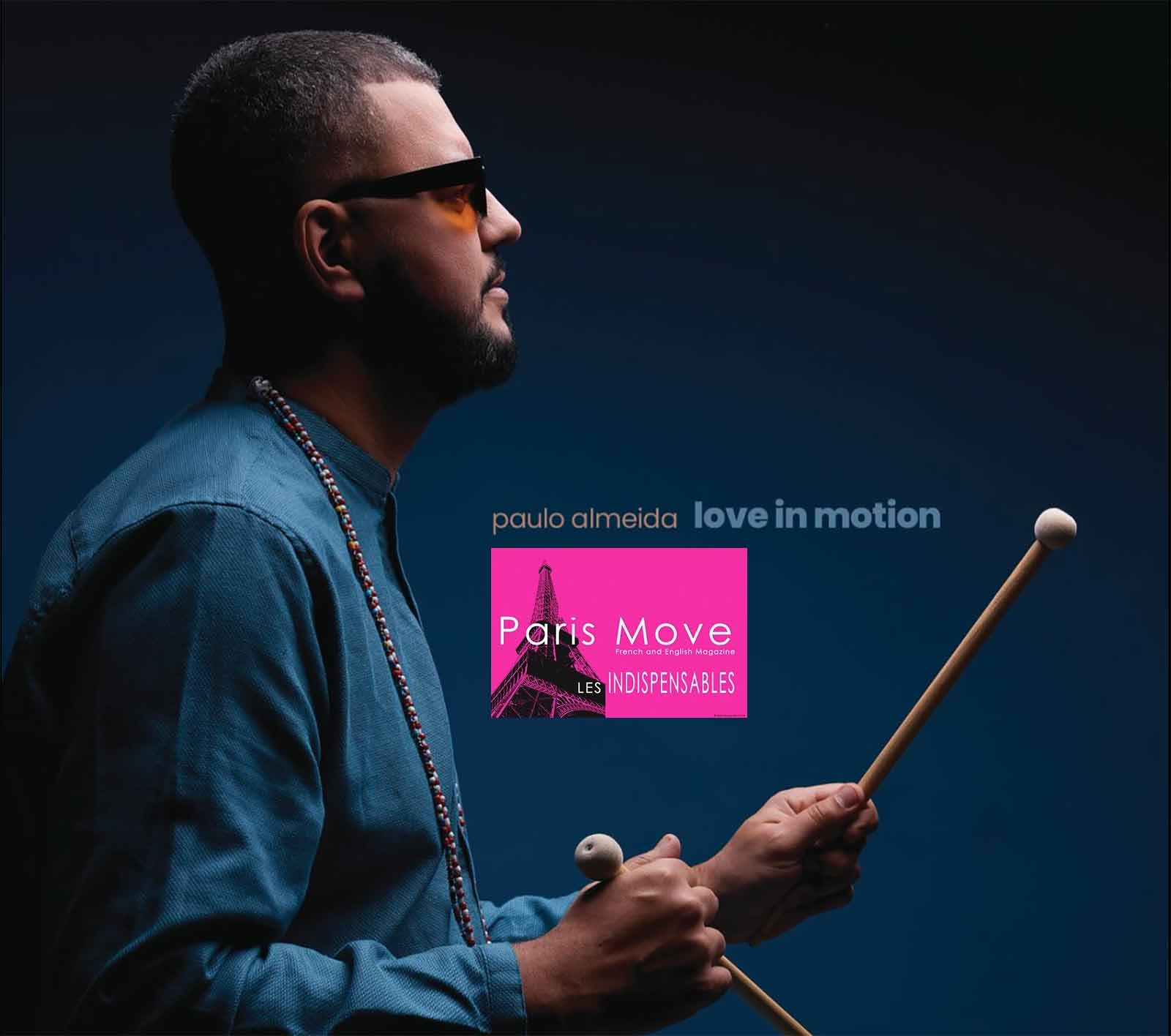
Summary: Love in Motion showcases Paulo Almeida’s unique fusion of rhythm, voice, and global jazz influences.
Paulo Almeida – Love in Motion: A Rhythm-Driven, Contemporary Jazz Exploration
Having already had the opportunity to hear this Brazilian drummer, percussionist, and composer, I approached Love in Motion with anticipation, and it delivers, though not without asking something of its listener. Situated within a contemporary jazz landscape increasingly defined by hybridity and global dialogue, Paulo Almeida’s latest release stands as both a continuation and a refinement of his artistic voice.
The album confirms the impression of a musician whose work is rhythmically driven yet richly textured, blending jazz language with deep cultural resonances. Its melodies are luminous, often disarmingly so, but they unfold within structures that favor density over immediacy, rewarding attentive, repeated listening.
The record was born from an intensive period at the piano, during which Almeida sang his ideas before translating them to the drum set and sharing them with his ensemble. This process is not anecdotal; it is central to the architecture of the music. The voice here functions as a compositional tool rather than an embellishment, shaping phrasing and direction before rhythm takes form. That approach is audible throughout the album, where movement becomes the unifying principle. Whether in the restless propulsion of “Burning Skin” or the suspended lyricism of “Saudade,” motion persists, not always forward, but always present.
Several pieces provide particularly effective entry points. “Winter Morning” captures the album’s urban sensibility with striking clarity, evoking the layered textures of a waking city, its subdued tension, its quiet momentum. “Resilience,” by contrast, leans into structural interplay, where rhythmic elasticity and harmonic framing converge with notable precision. Even the more concise moments distill the project’s emotional core into compact, introspective statements.
Listening across the album, one is reminded of the choreographic sensibility of Volmir Cordeiro, whose work draws from the rhythms and frictions of urban life. Almeida’s music carries a comparable sense of kinetic observation: the suggestion of bodies in motion, of intersecting trajectories, of a sonic environment shaped as much by tension as by flow. This is particularly evident in the way rhythmic patterns seem to emerge and dissolve rather than simply repeat.
An inspired composer, Almeida places elements of classical thinking at the center of his jazz vocabulary. This grounding allows him to construct harmonic spaces with a strong sense of design, where timbre and texture take on architectural roles. In this framework, percussion is no longer confined to timekeeping. It becomes narrative, an active presence moving through layered environments, not unlike the shifting realities depicted in Les Murailles de Samaris by François Schuiten and Benoît Peeters. The comparison is not merely aesthetic; it points to a shared concern with perception, illusion, and the multiplicity of forms.
Still, the album’s strengths are inseparable from its challenges. Its density—rhythmic, harmonic, conceptual, can at times verge on opacity. This is not music that yields itself easily; its intricacies may feel elusive on a first listen, particularly for those expecting more direct melodic resolution. Yet it is precisely this resistance that gives the work its staying power. Each return reveals new internal connections; new details embedded within the interplay of voice and percussion.
Song has accompanied Almeida since childhood, and that background remains deeply embedded in his musical language. His integration of voice and drums is seamless, extending the expressive range of both. Rather than treating the drum set as a purely rhythmic engine, he approaches it as a source of color and contour, capable of melodic suggestion and tonal nuance.
It is perhaps no coincidence that Almeida is now based in Basel, a city whose broader European context emphasizes rigorous, classically grounded training. Like many Brazilian musicians navigating international careers, he moves fluidly between traditions, absorbing and reconfiguring them without diluting their specificity.
That capacity for synthesis defines the album’s originality. Almeida’s work reflects a plural integrity, one that respects genre while refusing to be contained by it. For listeners new to his music, Love in Motion may require patience, but it ultimately justifies the investment. It also clarifies why artists such as Hermeto Pascoal, Dhafer Youssef, Guillermo Klein, Lionel Loueke, Wolfgang Muthspiel, Jorge Rossy, Anat Cohen, Ralph Alessi, Filó Machado, and Leny Andrade have sought collaboration with him across diverse projects.
In the end, the album’s message is less declarative than experiential. It does not instruct so much as immerse. And if it insists on anything, it is this: to listen actively, to remain present, and, above all, to stay in motion.
Thierry De Clemensat
Member at Jazz Journalists Association
USA correspondent for Paris-Move and ABS magazine
Editor in chief – Bayou Blue Radio, Bayou Blue News
PARIS-MOVE, April 1st 2026
Follow PARIS-MOVE on X

::::::::::::::::::::::::
To buy this album (April 24, 2026)
Musicians :
Lorenzo Vitoli: piano and synths
Josh Schofield: alto and soprano saxophone
Joan Codina: acoustic bass
Paulo Almeida: drums, vocals, percussion
Jorge Rossi: vibes in Ipe
Lisette Spinnler: vocal in Nenhum Talvez
Track Listing :
- Burning Skin 4.37
- Um Sopro 6.46
- Lembranças do Boi 5.23
- Nenhum Talvez 5.50
- Winter Morning 5.15
- Resilience 4.19
- Saudade 2.12
- Ipê 5.52
- Saci 5.12
All compositions by Paulo Almeida, except “Nenhum Talvez” from Hermeto Pascoal and “Winter Morning” in partnership with Lorenzo Vitolo
Produced by Paulo Almeida
Recorded by Guillem Salles at Jazz Campus in Basel in April 2025
Mixed and mastered by Thiago Monteir