| Jazz |
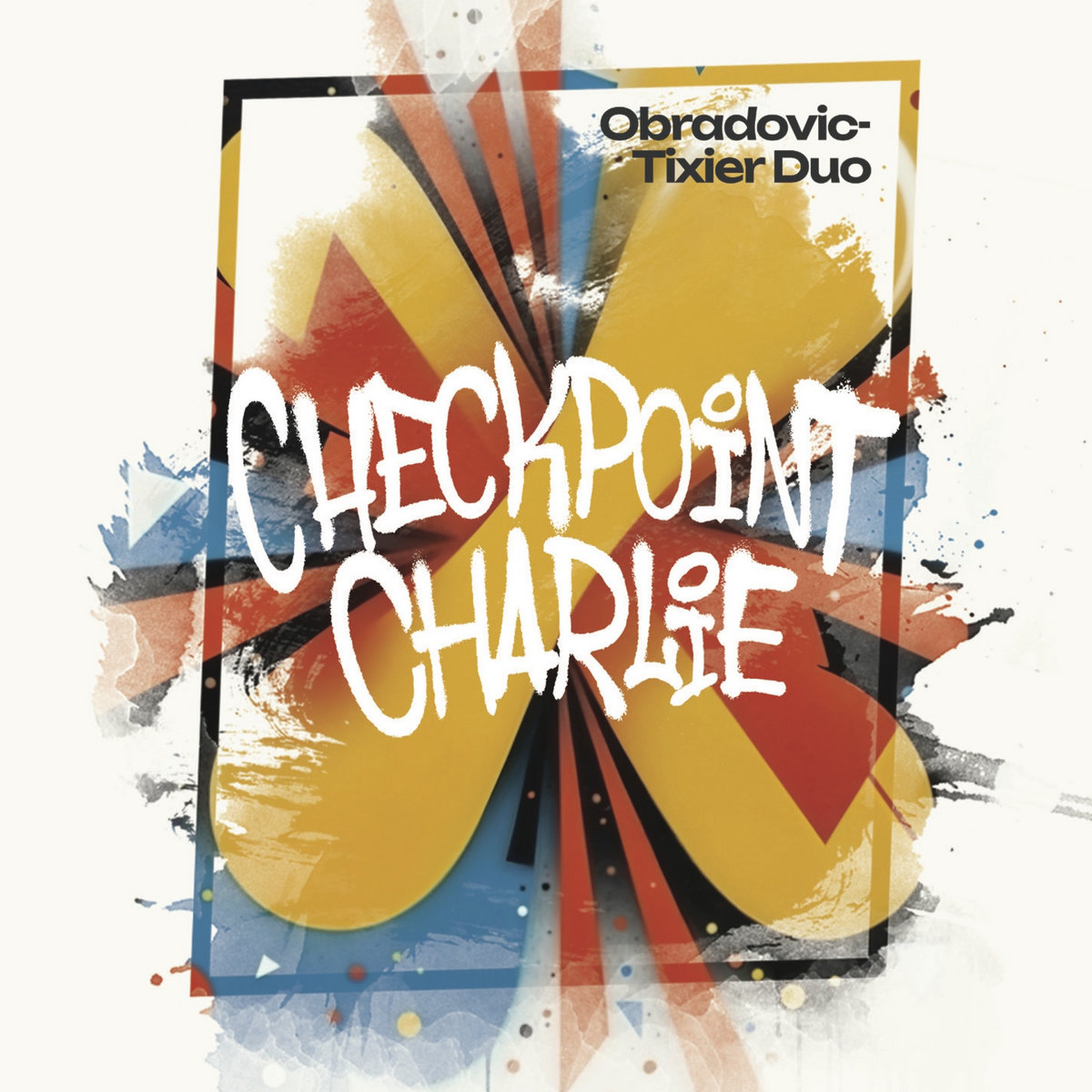
Obradovic-Tixier Duo’s Checkpoint Charlie: Ten Years On, a Piano-Drums Duo at the Crossroads of Worlds
Ten years after they first joined forces, Croatian drummer Lada Obradović and French pianist David Tixier mark their anniversary in the best possible way, with a new record that asks big questions. Checkpoint Charlie is the follow-up to TOLD, and it shows a duo that has found its voice and is still looking for new places to use it.
A piano-and-drums duo has no hiding place. There is no bassist to anchor the groove and no guitar of bass to carry the tune, so everything depends on the two players and on what they imagine. This pair imagine a great deal. Tixier reaches beyond the acoustic piano to keyboards and electronics, Obradović reaches beyond the drum kit to percussion and sound, and together they sound like a much larger band without losing the intimacy of two people listening to each other.
Why the title Checkpoint Charlie? I perceive it as the symbol of a fragile era. It comes from the famous crossing point between East and West Berlin during the Cold War, a crossing point that I, personally, passed through several times, each time with a very strong sense of emotion. The booklet explains why they chose it. First, the rhythm of the two words repeated is music in itself. Second, the place once stood for division and now stands for reunification and the end of an era, so it carries both restlessness and hope. In a world the duo describes as fragile in many respects, they present the album as an invitation to reflect on that history. As the booklet puts it, what could be more precious today than freedom?
That idea of artistic freedom runs through the whole album. The notes talk about the need to preserve one’s identity as a creator in the face of outside pressure, and about our age of instant opinions, where everyone feels they must have a view on everything.
The duo says it has returned to its acoustic foundations here, balancing recording and mix so that drums and piano stand on equal footing. The result is music that is thoughtful and spontaneous, experimental in structure, and still easy to enter thanks to a strong sense of groove and a commitment to formal clarity. The nine pieces are short and concise, like abstract, highly sensory short films: scenes of life captured in the moment, satirical tales, philosophical reflections and deeply personal memories. That is a very good description of what it feels like to listen to the record from start to finish.
David Tixier is much more than a pianist. His writing mixes classical elegance with modern jazz harmony, and his keyboards and processing never feel like a gimmick. They are another expressive voice. On this album he composed three of the pieces, “No One Cares”, “The Unfallen” and “S.A.F.E.”, which tend to be the more reflective and conceptual ones.
Lada Obradović treats the drums as a small orchestra. She moves from driving grooves to delicate textures and ritual-like patterns without ever playing for effect, and every gesture serves the music. She wrote most of the others: “Checkpoint Charlie”, “Times Square Ballerina”, “Invisible Child” and “Lucky in Liège” are hers, and she shares the writing of “If You Say So” and “Smiley” with Tixier. She was named Best Instrumentalist at the La Défense Jazz Festival in 2019, and you can hear why.
“Checkpoint Charlie” is the opening statement and the title track. It sets out the album’s themes of division and reunion, restlessness and freedom, and gets the listener ready for what follows. “No One Cares” is the album’s great contrast. It is serene on purpose, built on a repetitive, constant rhythm, and the calm reflects detachment, from the world and from other people. The notes ask who today truly cares about protecting others, and the music’s cool surface makes the question sharper. “Times Square Ballerina” is one of the most touching pieces. It was inspired by a young girl of about thirteen whom Lada saw almost every day in a small park in front of her local city hall, jumping around with headphones and a music player, trying to be a ballerina. She had no classical training, but her movements had infinite grace. The piece is a tribute to a girl with an iron will, and to the pure freedom of simply being yourself and following your dreams. It is a quiet gem.
“If You Say So” is a sarcastic response to the wave of hatred and judgment in modern society, and to people who claim to know better than the artist what their work means. The musical mix of styles is part of the joke, and it is delivered with real wit. “The Unfallen” is the first half of a diptych with the next track. It rests on the purity of the duo’s acoustic instruments, drums and piano, with a text by David Tixier recited by an AI-generated voice taken from the world of relaxation mantras, set against the sound of rain. The poem lists beautiful things destined to fall, an emerald sky, an iron shield, a red moon, and ends with the line that only the unfallen remain. It is an intriguing and very contemporary idea, a deliberate and conceptual use of AI, not a trick. “S.A.F.E.” (Simply Affected by the Fatality Effect) is the second half of the diptych and looks at those who fall. It speaks of two kinds of people, those who dream and those who no longer dream, and warns that a safe haven can be a place where humanity stops growing. Tixier reminds us that artists have a duty to stay vigilant, because it is impossible to feel secure and creative at the same time.
“Invisible Child” is the most moving piece. It evokes the war in Croatia and is built on the story of a mother who saved her daughter by cutting her hair and wrapping her in rags to make her invisible to the enemy. The notes insist it is not a tribute to war but to survival and love, a pacifist ode to human cruelty overcome by the will and love of a mother. It is personal, painful music, and it is handled with great dignity. “Lucky in Liège” brings welcome humour. It is a satire of artists’ lives and journeys, inspired by a tour stop where the band, exhausted, booked accommodation in Liège instead of Bruges. Beneath the joke is a serious thought about the effort behind an hour on stage, like the hidden part of an iceberg. A satirical poem about a rainy day in Liège became a piece of music. “Smiley” closes the cycle. Lada tells how, at the end of each concert, she looks for one unhappy face in the audience, “Smiley”, before playing the encore, and how that person usually comes to say thank you afterwards. The piece is an invitation to make every Smiley smile and a thank-you to the audience. It is a warm, generous way to end. A track that evokes an emotion as powerful as that which emanates from Charlie Chaplin’s famous “Smile”, based on the theme song used in the soundtrack for Charlie Chaplin’s 1936 film Modern Times.
Bonus point: Checkpoint Charlie is also a complete “object”. The 20-page bilingual booklet is more than liner notes. It is an artistic companion to the music, which is what makes the CD worth owning.
Checkpoint Charlie is a mature, humane and beautifully made record, the work of two musicians who have spent ten years building a world that is entirely their own. It belongs to contemporary jazz, chamber music, electronic experiment and modern composition at once, and it stays accessible through its lyricism and honesty. A must!
Frankie Pfeiffer
Editor in chief – PARIS-MOVE
PARIS-MOVE, November 2nd, 2026
Follow PARIS-MOVE on X
:::::::::::::::::::::
Format: CD with a 20-page booklet in English and French, plus digital
Our review of their last album is here: TOLD on Paris-Move.
Tracklisting:
- Checkpoint Charlie
- No One Cares
- Times Square Ballerina
- If You Say So
- The Unfallen
- S.A.F.E. (Simply Affected by the Fatality Effect)
- Invisible Child
- Lucky in Liege
- Smiley
Musicians:
David Tixier: piano, keyboards
Lada Obradović: drums, percussion
Credits:
Tracks 1, 3, 7 and 8 composed by Lada Obradović
Tracks 2, 5 and 6 composed by David Tixier
Tracks 4 and 9 composed by Lada Obradović & David Tixier
Artwork: Črcke
Photo: Vincent Bartoli