
| Jazz |
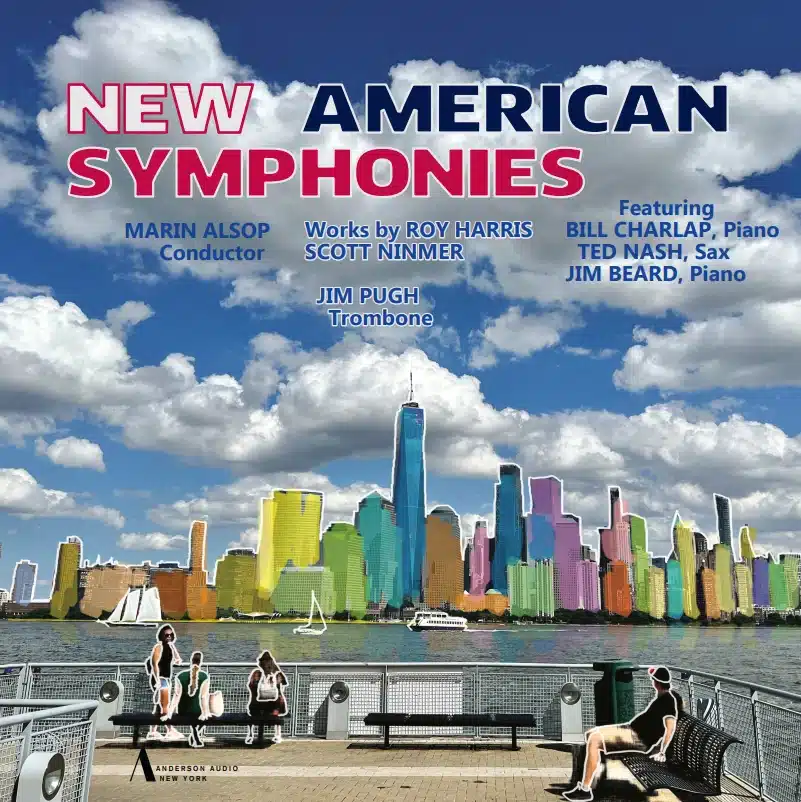
Jim Pugh: New American Symphonies – Roy Harris’s Lost 1938 Trombone Symphony Finally Comes to Life
New American Symphonies, by the great trombonist Jim Pugh, is even more thrilling than the story. A symphony written in 1938 for the most famous trombonist of the Swing Era, abandoned after a single failed rehearsal, lost in boxes of archives for almost ninety years, and now recorded for the first time by a star-studded ensemble under Marin Alsop and, as a companion, a brand-new suite written for Pugh by his former student. It is brilliant, joyful, deeply American and gloriously played. The mark is the highest one on Paris-Move: a must.
The story starts with a good idea from a pianist. Johana Harris, a classical pianist and a big jazz fan, suggested to her husband, the composer Roy Harris, that he write a symphonic work for Tommy Dorsey, then the most celebrated trombonist and bandleader in the country, famous for his smooth, singing tone. Harris, born in Oklahoma in 1898, raised in California and helped on his way to Paris, to the classroom of Nadia Boulanger, by Aaron Copland, was by then one of the leading voices of American symphonic music, best known for his Symphony No.3. His language was tonal, open, optimistic, and he took the suggestion seriously: in 1938 he wrote a work for trombone and large ensemble.
Then it went wrong. When Dorsey’s orchestra tried to read the first movement, the fast, virtuosic phrasing proved too difficult, the players gave up, and the music was put aside. It was never performed in public and never recorded. For decades it was just a rumour in the trombone world.
Jim Pugh decided to find it. After years of research on Harris and his estate, his search led him to the Roy Harris Papers at the Library of Congress, where the handwritten score was scattered through several boxes of unsorted material. He pieced it back together and found, on the first trombone staff, the name of the player it was written for, still there on the page: “Tommy”. What he heard when he looked at the score made him sure it had to be played: “If you close your eyes and listen to the first movement”, he says, “you can hear where jazz would eventually arrive some 35 or 40 years later”, and toward the end you can hear the roots of minimalism. A “time capsule” that slipped through the cracks of history.
The album calls the work American Symphony 1938, it is also known as the Trombone Symphony. It has two movements, and they could hardly be more different.
American Symphony 1938: two movements, two worlds:
The first movement, marked “Vigorously” (6:55), lives up to its name from the very first bars. It is fast, bright and full of surprises, a whirlwind of woodwinds, brass and piano in which tunes appear and vanish, and the colours of the orchestra change from one phrase to the next. There is a fiddle tune in there too, the kind of American folk melody that would soon be at the heart of Copland’s own music. You can understand why it frightened Dorsey’s band: it asks for precision, stamina and a sense of swing that no 1930s orchestra was used to finding in a symphonic score. And yet the music sounds anything but dated. It could be the overture to a Broadway show that has not yet been written, or the work of a living composer; in it, classical form, jazz energy and the optimism of the Depression-era American spirit all meet.
The second movement (10:21) offers a complete change of mood: slow, languid, with deep, rich, low-register sonorities. Here the trombone is the voice, and Pugh’s tone, warm, burnished and full of nuance, is a joy. The music unfolds in a stately way, with long lines that breathe, and gentle repetitions that point forward to later music. After the whirlwind of the opening, it is like walking into a calm, sunlit room.
Marin Alsop, who conducts the Harris, leads a band of sixteen musicians with a perfect sense of balance between rigour and swing. She has the weight of a symphonic conductor and the lightness of someone who loves jazz, which this score demands.
If the Harris is a message from the past, Night Suite is a message from the present. Composer Scott Ninmer, today Chief Arranger of the United States Marine Band (“The President’s Own”) in Washington, D.C., studied with Pugh. He wrote the opening section as a thank-you gift to his teacher, and Pugh, who says he probably learned more from his student than the other way round, loved it so much that he urged Ninmer to take it further. The suite, in three movements and almost 25 minutes, was first played in 2014 at the International Trombone Festival at the Eastman School in Rochester; this album is its first studio recording, with Ninmer himself conducting the eighteen musicians.
The writing is that of a big jazz band, with the harmonic richness and the freedom that implies, and room for improvisation and spotlight solos. “Eventide” (9:03) is a long dusk, in which Pugh gets a lot of space to sing and to solo, and the band answers him in lively call and response. “Gliding Through Darkness” (7:24) starts with a rippling guitar figure, doubled by other instruments, before brass and woodwinds join in with lush punctuations; it asks the soloist for a mix of precise reading and improvising agility, and Pugh meets it with ease. “Too Late” (8:20), the finale, is lighter and airier, with weaving melodies and plenty of jazz spirit; and when I read in the credits that the guitarist is Jon Herington, known from Steely Dan, the pieces fell into place: this is a music that fans of that band’s sophisticated groove will love.
The pairing is inspired. Because Harris’s symphony has only two movements, the ear expects a third, and Night Suite comes in just at that moment without trying to imitate it. The two works are not alike, and that is the point: one is a 1938 time capsule, the other a 21st-century suite, and together they draw a line of nearly a century through American music, from the symphonic ambitions of the 1930s to the jazz voices of today. It is also a fine example of the old concerto grosso idea, a solo voice facing an ensemble, brought up to date.
The man at the centre of it all, Jim Pugh, is one of the most respected trombonists on the planet. A veteran of more than 4,000 recording sessions, he has played with Steely Dan, Yo-Yo Ma, Paul Simon, Barbra Streisand, Michael Jackson, Pink Floyd, Tony Bennett and Frank Sinatra, and he came up through Eastman and the band of Woody Herman to become one of the busiest players in New York. Yet this is a personal project, a long-held mission, and you can hear it: the sound is round and generous, the phrasing is that of a singer, and the technique is at the service of the music at every moment.
Jim is surrounded by an extraordinary cast, drawn from the worlds of jazz, classical music, Broadway and the studios. Bill Charlap and Jim Beard share the piano chair, Ted Nash is the featured soprano saxophone soloist, also on alto sax and clarinet, Elizabeth Mann plays flute, David Tofani, Lawrence Feldman, Dennis Anderson and Roger Rosenberg complete the reeds, the trumpets are Bob Millikan, Chris Gekker and Tony Kadleck, the trombone section is completed by Joseph Alessi, Keith O’Quinn and David Taylor, and Jay Leonhart on bass and Jim Saporito on drums and percussion give the rhythm section a supple, swinging foundation. There is not a weak link, and the interplay between the piano, the reeds and the brass in the Harris is a delight.
The recording is a reunion within the reunion. Jim Anderson, who produced and engineered the album with Ulrike Schwarz, first met Pugh in a Pennsylvania school band more than sixty years ago, and went on to become one of the world’s leading recording engineers, with more than thirty Grammy nominations. They recorded the ensemble live at the Power Station at BerkleeNYC, in Digital eXtreme Definition (DXD), and the album exists in stereo and immersive audio.
The philosophy is clear: if the technology and the engineers can be made to disappear, the listener is left alone with the music. That is exactly what happens. The soundstage is wide and deep, the balance is impeccable, each instrument has its own space and its own colour even when the writing gets dense, and there is real weight, presence and dynamic range. You do not feel you are listening to a recording; you feel you are sitting in the middle of the band, while the musicians play just for you. On a good system, it is a reminder of why we care about sound at all.
There is a lot to love here: there is the thrill of discovery, the first sounds of a masterpiece that waited since 1938, the joy of a great big band playing a brilliant new suite, the warmth of a teacher and a student, a producer and a soloist who have been friends for decades, and, above all, the sheer beauty of the music-making. At 42 minutes, it is the perfect length: you finish it and want to start again, and again, and again…
It also does something important. It restores a missing page of American music, and shows that Roy Harris, the symphonist, and Tommy Dorsey, the king of swing, could have met on the same stage, if only the world had been ready. Now it is. New American Symphonies is a triumph for Jim Pugh, for Marin Alsop and for every musician involved, and a record I recommend with all my heart. An absolute must.
Frankie Pfeiffer
Editor in chief – PARIS-MOVE
PARIS-MOVE, October 19th, 2026
Follow PARIS-MOVE on X
:::::::::::::::::::::
Tracklisting:
American Symphony 1938 (Roy Harris)
- 1st Movement – Vigorously 6:55
- 2nd Movement 10:21
Night Suite (Scott Ninmer, written for Jim Pugh)
- I. Eventide 9:03
- II. Gliding Through Darkness 7:24
- III. Too Late 8:20
Total running time: 42:03
Musicians:
Jim Pugh – solo trombone
Marin Alsop – conductor (American Symphony 1938)
Scott Ninmer – conductor (Night Suite)
Woodwinds and reeds: Ted Nash (alto sax, soprano sax, clarinet; featured soprano soloist), Elizabeth Mann (flute), David Tofani (clarinet), Lawrence Feldman (alto sax, clarinet), Dennis Anderson (tenor sax, clarinet), Roger Rosenberg (tenor sax, bass clarinet)
Trumpets: Bob Millikan, Chris Gekker, Tony Kadleck
Trombones: Joseph Alessi, Keith O’Quinn, David Taylor
Rhythm section and percussion: Bill Charlap (piano), Jim Beard (piano), Jay Leonhart (bass), Jim Saporito (drums, percussion), with Jon Herington (guitar) on Night Suite
16 musicians on the Roy Harris work and 18 on the Scott Ninmer work.
Credits:
Produced and engineered by Jim Anderson and Ulrike Schwarz
Recorded in DXD and immersive audio at the Power Station at BerkleeNYC
Released on August 14, 2026