
| Jazz |
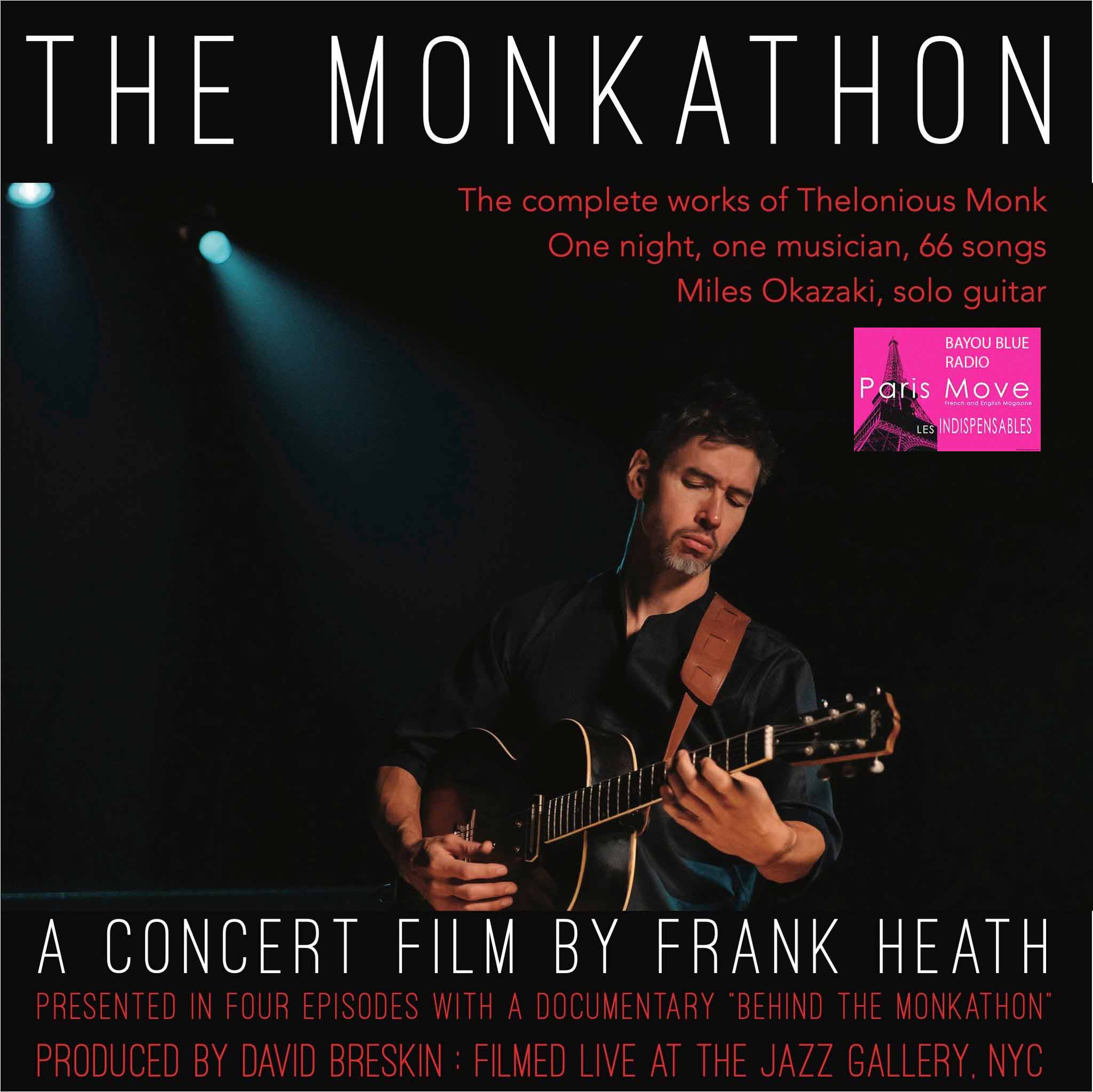
The reissue of the six-CD set “Work: The Complete Compositions of Thelonious Monk” coincides with the October 10, 2026, release of The Monkathon, Frank Heath’s film about Miles Okazaki and his extraordinary decision to perform all sixty-six of Thelonious Monk’s compositions on solo guitar.
MONKATHON
There are projects that, when described on paper, seem so excessive that the description itself almost gets in the way. Sixty-six compositions, one guitarist, one instrument, several hours, one evening. The numbers immediately suggest endurance, even spectacle, and yet what stayed with me after watching The Monkathon was not the feat itself. It was the strange intimacy of spending so much time with a musician who has decided to enter an entire body of work and remain there long enough for it to stop looking like a repertoire and start feeling like a world. Okazaki began the project in 2017, the centennial of Monk’s birth, by recording his complete compositional output, a monumental undertaking that eventually became Work, a six-album cycle released in 2018. But the recordings were not the end of it. Okazaki later took the project one step further, turning the complete sixty-six compositions into a single-evening performance. That decision could easily have produced a film about endurance, virtuosity or obsession. Frank Heath chooses something more interesting. The Monkathon is not another biography of Thelonious Monk, and it is not really a film about a musician trying to prove that he can accomplish something almost impossible. It is a film about what happens when a musician lives inside another musician’s work for hours at a time, when memory, concentration, fatigue, physical effort and improvisation begin to overlap, and when the passage of time itself becomes part of the music.
The world premiere took place September 22 at Roulette in Brooklyn, where one of the four episodes of The Monkathon, as well as a short documentary “Behind the Monkhaton,” was screened, followed by a conversation and Q&A with Miles Okazaki and Frank Heath. I am grateful to Ann Brathwaitre for allowing me to see the film beforehand. I should also admit that, before this project, I did not really know Miles Okazaki’s work. That matters to me because I tend to prefer encountering a musician through the music itself before reading the biographies, the criticism and all the explanations that inevitably tell us what we are supposed to hear. I like that first encounter when it is still unprotected, when the music has not yet been surrounded by someone else’s interpretation. So I arrived at Roulette without a particularly fixed idea of what I was about to see.
At 7 p.m, the first set began, but before Okazaki played a note, there was New York. There were the sounds coming from the street, the movement outside, the feeling of the city continuing at full speed just beyond the room. Okazaki walked in wearing a leather jacket, guitar in hand, and for a brief moment I thought of Léo Ferré. Not because Okazaki sounds like Ferré, obviously, but because I recognized something in the image of a solitary musician entering a room with an entire world apparently sitting on his shoulders. Then the atmosphere changed. The lights turned red. A grand piano stood behind him, almost like a silent reminder of the instrument for which Monk wrote so much of this music, while everything else remained stripped down. Okazaki was alone in the middle of the stage. The first set moved through Little Rootie Tootie, We See and Brakes Sake, among other compositions, and I remember thinking that there was something reassuring in the absence of any attempt to make the undertaking look heroic. There was simply the guitarist, the guitar and Monk. Yet as the set continued, I began to understand that the scale of the project was going to reveal itself precisely through that simplicity. The compositions did not feel like separate items being checked off a list. They began to form a continuous landscape. By the end of the first set, Okazaki was standing with his guitar, and that small physical gesture suddenly made the hours ahead feel much more real. This was not going to be a conventional seated recital. The music was going to have to be carried by the body as much as by the memory.
At 8:20 p.m., the second set began, and with Bolivar Blues I felt the evening changing character. The initial curiosity had begun to disappear, replaced by a more concentrated form of listening. We now knew what Okazaki had committed himself to, and we also knew that the real work was only beginning. What fascinated me was the way the music seemed to exist simultaneously in memory and in the present moment. Okazaki knows Monk’s compositions deeply, but he does not handle them as if they were fragile historical objects that must be protected from interpretation. He moves inside them. He knows their architecture well enough to bend it, test it and discover what the guitar can reveal that the piano cannot. This is where I began to lose interest in the question of whether he could actually make it through all sixty-six compositions. The more I watched, the less the number mattered. What mattered was the relationship developing between Okazaki and the music. These were compositions he had spent years absorbing, recording, performing and reconsidering, and now he had to summon them one after another while remaining completely present. There is a difference between remembering music and physically carrying it, and by the second set that difference was beginning to show. I could see the accumulated concentration, the subtle changes in posture, the effort involved in staying attentive. Heath does not manufacture a crisis to make the film more dramatic. He does not need to. Fatigue is already there, slowly entering the frame and becoming part of what we hear. For me, this is where the film began to reveal its real subject. Time was no longer simply the thing measured between 8:20 and the next set. Time had become something audible.
By 9:40 p.m., the third set began, and this was the moment when I found myself needing to step back for a while, almost to take a breath from the intensity of what I was watching. That reaction became part of my experience of the film because, by then, I was no longer observing Okazaki from a distance. I had spent enough time with him that his concentration had begun to affect my own. After the applause, he smiled, and there was something wonderfully human in that smile, a small acknowledgment between the musician and the people in the room who were now sharing the same strange experiment. Jackie-In came next, and then the light shifted toward blue, changing the atmosphere without any need for explanation. San Francisco Holiday followed, and once again I found myself listening less for the accomplishment than for the spaces opening inside Monk’s compositions. The longer the evening continued, the more clearly I could hear Okazaki negotiating between what Monk had written and what he himself was hearing in that particular moment. By the end of the set, he was standing again, finishing with 52nd Street Theme. I was increasingly aware of the physical cost of what I was watching. Fingers, shoulders, breathing, posture, memory, attention, all of these things were becoming part of the music. This is one of the reasons The Monkathon works for me: Heath does not exploit the body in order to create drama, but neither does he pretend that the body is irrelevant. He lets us remain with the musician long enough to notice what happens when concentration is sustained hour after hour. At that point, even as a viewer, I could feel the duration of the evening.
At 11 p.m., the fourth set began under blue and red light, and by then Okazaki was giving everything he had left. The room looked different to me, although very little had actually changed. Four hours of listening had changed the way I was seeing it. There is a story about Monk and Steve Lacy in 1960 that has always stayed with me because it says so much about Monk’s relationship to music. When Lacy was playing too many unusual notes, Monk told him, “Stop playing all those weird notes, play the melody!” Okazaki actually played with Lacy in 1994, and he has spoken about a similar understanding of Monk’s music, the idea that the notes already contained in the composition are enough, and that the challenge is to discover what is already there rather than constantly trying to add something. I heard that idea differently now, after watching Okazaki move through so much of the repertoire. He did not seem to be playing against Monk. He seemed to be playing with him. That distinction is important because it takes the performance away from the language of virtuoso conquest and brings it back to conversation. By the time Boo Boo’s Birthday arrived, I could feel the accumulated hours in the room. Then came Round Midnight. There was something almost inevitable about that choice, but after everything that had come before, it did not feel like a conventional finale. It felt as though the entire evening had gathered itself into those final moments. The audience listened, the applause came, and eventually Okazaki left the stage. What happened next affected me almost as much as the final notes. There was no theatrical gesture, no grand announcement that the challenge had been completed. The room simply began to empty, and outside, New York was still there. Cars, voices, footsteps, distant traffic, the ordinary sounds of a city moving through the night came back almost immediately. After several hours of Monk, those sounds felt strangely loud and strangely beautiful. Nothing outside had stopped while we were inside. The city had simply continued. And yet something had happened in that room. I had watched one musician move through the complete compositional world of another, and the return of the city made the experience feel less like a monument than like a brief, intense passage through another world.
It would be easy to describe what Okazaki has done with the vocabulary that naturally surrounds an undertaking of this kind: monumental devotion, heroic undertaking, a guitar equivalent of a solitary ascent. I understand why those descriptions appear, but they are not what I want to remember about the project. If we reduce it to the number sixty-six, to the hours, to the physical endurance, we risk missing the more mysterious thing happening underneath. What interested me was watching the challenge slowly disappear behind the music. The longer the performance lasted, the less I thought about whether Okazaki would finish and the more I listened to what the music was doing to him, and to what his playing was doing to the music. The film makes duration visible without turning it into a gimmick. Heath allows concentration to deepen, fatigue to appear, memory to become physical and improvisation to emerge as a way of remaining inside Monk rather than escaping him. I appreciate that restraint because it respects the intelligence of the audience. There is no need to manufacture a plot when the passage of four sets, from 7 p.m. through 8:20, 9:40 and finally 11:00 p.m., already contains its own narrative. I was there with my own attention, my own fatigue, my own need at one point to pause, and that became part of the experience of watching the film. The hours belong to Okazaki, but they also begin to belong, in a smaller way, to anyone willing to stay and listen.
That restraint is one of the things I value most in Frank Heath’s approach. Musical cinema can easily become too eager to explain itself, as though every performance must be accompanied by a biography, an argument, a historical lesson or a dramatic revelation. The Monkathon does not seem interested in telling me what I should think about Monk or Okazaki. The camera observes, waits and lets the music occupy its own space. Sometimes it comes close enough to make Okazaki’s hands and the guitar feel almost architectural; at other moments it pulls back and reminds me of how solitary the figure onstage actually is. The changing light, from the red atmosphere of the first set to the blue tones that emerge later, becomes part of my memory of the evening without turning into an obvious symbol. I appreciate that kind of filmmaking because it leaves room for the viewer. It trusts us enough to notice. It trusts us enough to become bored for a moment, to become tired, to lose concentration and then find it again. In a strange way, that makes the film more faithful to the experience of live music than a more aggressively constructed documentary might have been.
There is another aspect of the project that kept returning to me, and that is the question of translation. Monk wrote primarily for the piano, an instrument with a very particular physical logic, a particular range, attack, resonance and ability to make several voices coexist. Okazaki takes those compositions onto the guitar, where the possibilities are different and the limitations are much more exposed. The guitar cannot simply reproduce the piano. It has to translate. Notes have to be reorganized, voicings reconsidered, rhythms physically redistributed. But Okazaki is not trying to manufacture a substitute Monk piano. He is asking what Monk becomes when the compositions pass through another instrument, another body and another musician’s imagination. That question interests me much more than the idea of faithful reproduction. The guitar does not imitate the piano. It becomes another voice in the conversation. And because the entire repertoire is being traversed over several hours, I can hear that translation happening again and again, each composition offering another problem, another possibility, another way into Monk.
That is also why Monk never feels like a relic in The Monkathon. His presence is everywhere, but he is not trapped inside a historical photograph or a canon that must simply be admired from a distance. His compositions remain alive because musicians continue to touch them, reshape them, breathe through them and bring them into the present. For me, that is what tradition should mean at its best. It is not simply the preservation of the past. It is the willingness to make the past live again. Okazaki has spent years with Monk’s compositions, first recording the complete body of work, then performing it and finally taking all sixty-six pieces through a single evening. Yet none of this feels like an attempt to close the book on Monk. It feels like the opposite. The deeper Okazaki goes into the repertoire, the more open it seems to become. He is not trying to replace Monk, explain Monk or conquer Monk. He is listening to him, and asking us to listen along with him.
The title Work carries another meaning for me. It is, of course, the work of Thelonious Monk, the work Okazaki has undertaken as a musician, and finally the work that the music itself performs on the listener. Listening for several hours is not passive. It requires something from us. It requires attention, patience and a willingness to remain with something that does not immediately reveal everything it has to say. That feels increasingly unusual in a culture built around acceleration, interruption and the constant arrival of something new. The Monkathon asks for another kind of time. It asks me to stay, to listen, to watch and to allow the music to take as long as it takes. I found that request almost radical in its simplicity. Nothing is optimized for convenience. Nothing is compressed into a quick conclusion. The four sets become a kind of slow architecture, and somewhere between 7 p.m. and 11:10 p.m., I stopped thinking about how much time had passed and simply found myself inside it.
Perhaps that is what makes the film speak so clearly to the present moment. We are surrounded by images that arrive already edited, already explained and already reduced to whatever meaning can be understood most quickly. The Monkathon does something almost unfashionable: it allows uncertainty, duration and attention to remain part of the experience. It does not tell me what Monk means. It does not tell me what Okazaki’s undertaking is supposed to prove. It gives me the time to watch a musician work through a body of music and to decide what I hear in that encounter. I value that openness because Monk’s compositions do not seem to me to need a final explanation. They need musicians willing to return to them, listeners willing to hear them again and artists willing to discover something new without pretending that the past has disappeared. The film is therefore less a conclusion than an open door. Okazaki’s performance does not conclude Monk’s music, just as Heath’s film does not conclude Okazaki’s project. Both simply give us another reason to enter it.
When the evening finally ends, what stays with me is that the number sixty-six has somehow ceased to be the point. I began the evening thinking about the extraordinary scale of the challenge, and I ended it thinking about the conversation. Between Monk and Okazaki, between piano and guitar, between composition and interpretation, between memory and invention, between the musician alone onstage and those of us sitting in the dark listening. At 7 p.m., before the first notes, I was still hearing New York outside Roulette and wondering what I was about to encounter. By 11:10 p.m., after the fourth set and Round Midnight, I was hearing those same city sounds again, but I was hearing them differently. The city had not changed. I had spent several hours listening. That was enough. Miles Okazaki had crossed an entire body of work with a single guitar, Frank Heath had given us the time to stay with him, and Thelonious Monk remained present throughout, not as a monument but as a living voice. The challenge was extraordinary, certainly, but somewhere along the way it disappeared behind the music. What remained was the conversation, and for me, that is where The Monkathon truly begins.
Thierry De Clemensat
Member at Jazz Journalists Association
USA correspondent for Paris-Move and ABS magazine
Editor in chief – Bayou Blue Radio, Bayou Blue News
PARIS-MOVE, September 27th, 2026
Follow PARIS-MOVE on X
::::::::::::::::::::::::
The Monkathon will be free and available to all at https://monkathon.com/ on October 10, 2026 (Monk’s 109th birthday)
::::::::::::::::::::::::
About the Compositions
A few words about each track, along with acknowledgements to various players who have influenced this project:
.
Volume 1
Locomotive (1954)[4]. Rhythm. The feeling of the train seemed like the right way to get things moving. (3:49)
Brilliant Corners (1956). Monk was credited with the quote, “All musicians are subconsciously mathematicians,” , and the form of this composition is like a fractal. The improvisation has Max Roach inmind. (3:22)
Gallop’s Gallop (1955). A challenging tune on the guitar, twists and tight corners. Although it would beeasier with fingers, it’s played here with the pick in order to make the contours of the melodies pop. (4:00)
Light Blue (1957). A question and answer type of tune, where the second question is slightly different thanthe first, perhaps not satisfied with the first answer. Played with fingers. (2:19)
Evidence (1948). Justice, Evidence. Two crucial words for people of color in America. Played here with aheavy picking style adapted from my mentor Rodney Jones. Pedal point vibe influenced by Bobby Broom’sversion of this tune. (4:20)
Crepuscule with Nellie (1957). Played straight, no improvisation. For Bill Frisell, whose version of thiswith Paul Motian and Joe Lovano is a milestone. (2:43)
San Francisco Holiday (1960). It seemed like this tune should have a lighthearted treatment, but thetechnical problems with the counterpoint are pretty daunting. So in the end maybe it is a kind of compromise, something like the alternate title, “Worry Later.” (3:33)
Monk’s Point (1964). The bends, for Albert King. (2:47)
Shuffle Boil (1955). According to Robin Kelley, this song is “Monk’s tribute to the black hoofer tradition” The guitar trades with itself here, using a rhythmic “tap dancing” technique. I was thinking often of a recent performance I saw of drummer Marcus Gilmore and dancer Savion Glover. (3:56)
Jackie-ing (1959). The pedal point combined with the melody reminded me of an Indian raga called “Yaman.” The meditative nature of an alap (the introduction of a performance) is hinted at here, combined with the regular changes and form of the tune. Low E is tuned down a tritone to Bb. For the sonic adventurer Nels Cline, who played this tune in a Monk concert last year. (3:18)
Criss Cross (1951). The original 8 bar bridge is used here (as opposed to the 6 bar bridge in the 1963version). A sharp and aggressive style of picking seemed appropriate for this melody, which is jagged andinsistent. (3:10)
Introspection (1947). Leading to D major, we find one of those mysterious Monk sound objects: A, E, Bb, F – Two fifths separated by a minor 9th (or two minor 9ths separated by a 5th). This chord is used as kind ofpivot to change tempos. It never seemed necessary to leave the melody on this one, as it keeps revealingmore of itself each time around without unnecessary embellishment. (5:19)
Functional (1957). Ending the set with a blues for the writer Barry Gifford, a dear friend who encouragedme to go ahead with this project after hearing a few of the first recordings. Always know, improvisation = storytelling. (3:25)
Volume 2
We See (1954). Innocence, curiosity, energy – qualities of children. This was in mind, as well as the bouncing, light touch of Mr. Kenny Barron, a master Monk interpreter who generously sharedmany of his insights with me onstage and off. (2:59)
Sixteen (1952). A seldom played tune. The little two note tag at the end of the melody decided to take over the improvisation. Straight time feel, for Pat Martino, who gave me encouragement at animportant time. (2:45)
Misterioso (1948). Rhythmic variations on the melody. Despite the way it sounds, the performance is in common time the whole way through. (2:01)
Humph (1947). Rhythm changes with the classic dominant cycle starting on F#7. I follow some other less direct pathways in the improvisation, as well as a few tempo changes. Chord work inspired by Bruce Johnson, who gave me one mind-altering lesson in the late 90s. (2:32)
Teo (1964). Triple feel, Africa, and rhythmic illusions. Continuing the vibe from “Misterioso.” For David Gilmore, one of the modern rhythmic masters of the guitar. (3:45)
Hornin’ In (1952). A puzzle to transcribe for guitar because of the abundance of close intervals. Without those crunches, the tune won’t sound right. This is one possible solution. (4:05)
Raise Four (1968). This minimalist melody seemed to call for an abstract treatment. (1:37)
Skippy (1952). A notoriously thorny tune. The improvisation makes extensive use of Steve Coleman’s “alternate pathways” concept of dominant progression. Someone playing the regular changes along with this recording might hear the improvisation weaving in and out of the direct path. (4:03)
Pannonica (1956). Thinking of Monk’s playing on the celeste, this version uses natural harmonics on the guitar whenever possible. No real improvisation, as this approach proved to be so difficult that I could really only make it through one chorus. For the genius pioneer Lennie Breau. (3:24)
Think of One (1953). Medium swing – the tempo of choice for so many of Monk’s performances.An arrangement that requires constant switching between the pick and the fingers. (5:34)
Well You Needn’t (1947). Medium swing again. An early tune in Monk’s catalogue, but the main theme for improvisation is taken from the 1957 version on Monk’s Music, with the rising andfalling counterline and the deceptive 8 bar intro. Like so many of these compositions, the thingsthat seem simple can be treacherous. (8:44)
Bolivar Blues (1956). For Steve Lacy and Roswell Rudd, and the essential album School Days. (6:12)
Volume 3
Monk’s Dream (1952). Dream logic – Monk teaches us that a solo doesn’t have to adhere to be “soloistic.” Here it’s just chords, comping for no one. I played this after listening to Elvin Jones’ great solo on this tune on Larry Young’s Unity. (4:09)
Little Rootie Tootie (1952). Built around that confounding opening chord, the train whistle that sounds three times but cannot be played on the guitar in any satisfying way. The solution here is todivide it up into different registers and inversions and see if the composite effect can approach the right vibration. For the uncompromising improvisor Derek Bailey. (3:49)
Eronel (1951). With the thumb, for Wes Montgomery. (3:31)
Thelonious (1947). In the groove, for Grant Green. (2:36)
Ruby, My Dear (1957). Weaving through the harmonic labyrinth, for Johnny Smith. (5:10)
Four in One (1951). Single note lines for Steve Cardenas, who showed me how easily the first line could be played in 8th position. Relaxed tempo. (5:35)
Blue Hawk (1959). A short meditation on the cluster (G, Ab, A) that can be heard on Monk’s original recording. (2:17)
Stuffy Turkey (1964). A version of the ornamented melody that Coleman Hawkins plays on the original “Stuffy,” with a couple of playful angles. For Mary Osborne, an overlooked master who recorded with Hawk in the mid 1940s. (2:13)
A Merrier Christmas (1959). A tune that Monk never recorded, but I’ve always been a fan of Mal Waldron’s unadorned style, and this is based on the version that he played on with Steve Lacy. (2:07)
Played Twice (1959). The phasing five beat figure halfway through the form is what gives this song its character. In this case, it expands into the whole song. (2:42)
Bemsha Swing (1952). A perpetual motion tune, turnarounds inside of turnarounds. Using some melodic concepts from Steve Coleman, I try here to put some more turnbacks inside of those, which turns into an extended improvisation. (7:09)
Blues Five Spot (1958). Thinking of the relentlessly swinging Five Spot recordings and especially the slippery style of Johnny Griffin. (3:58)
Volume 4
Bye-Ya (1952). Tropical vibe. Using a right hand “pandeiro” technique I learned in some lessons with Nelson Faria in Brazil years ago. Also thinking of one of my favorite guitarists of all time, the great João Bosco. (4:08)
Who Knows (1947). An obscure tune, and not a walk in the park. Played with an elastic tempo. (3:36)
Green Chimneys (1966). Playing around with E flats. Ideas about rhythmic figures to span long periods of static harmony. Mostly choked guitar. (5:12)
Blue Sphere (1971). Following Monk’s version, where the melody only emerges at the end of the improvisation. The improvisation sounds loose, but is actually in strict time. For Jean-Paul Bourelly.(4:54)
Ugly Beauty (1967). The only song not in common time. The wonderful opening chord is so crucial to the character of the song that the low E is tuned to D to get the full voicing. (2:56)
Oska T (1963). Another song with an impossible chord for the guitar that must be played somehow. In this case, the bottom five strings are tuned to the first chord of the song (Eb, Ab, Bb,F, C). The rest of the improvisation explores this strange sound-world. For grounded experimentalist Jerome Harris. (4:55)
Hackensack (1954). Fast tempo, with a few twists. For the heavyweight champion, George Benson. (2:35)
Ask Me Now (1951). Playing this on solo guitar begs the question of what to do in all of the spaces. Taking a cue from the title, an echoing question and answer seemed to be a good way togo. For Pat Metheny, whose album Question and Answer is a crucial step in the history of guitar. (5:16)
I Mean You (1946). Trying for a rolling rhythm, full of triples. For Emily Remler, who forever influenced the way that I play with some lessons in the late 1980s. (5:12)
52nd Street Theme (1944). As Monk never recorded this tune, the main reference for this version is Bud Powell’s version from 1951 [7]. Powell’s transposition of the melody by minor thirds isthe idea behind the improvisation, which modulates between four keys. (4:24)
Something in Blue (1971). Ending the set again with a blues. For B.B. King, who I saw play in my formative years on a double bill with Miles Davis in 1991, and seemed to be speaking throughthe guitar. (4:21)
Volume 5
Nutty (1954). Duke Ellington called Monk “the baddest left hand in the history of jazz” [8]. It’s challenging on the guitar to solo while grabbing notes with the thumb, somewhat imitating a stride style. For Joseph Spence. (4:26)
Off Minor (1947). First recorded by Bud Powell, and his version is the one I’ve listened to the most. Hints of his solo come out here, especially on the bridge. (3:55)
Two Timer (late 1950s). A tune never recorded by Monk. Taking a cue from the title, I tried some ideas with two different tempos at the same time. (4:33)
In Walked Bud (1947). Beating the drum for Charlie Christian, the reason that I play guitar. (4:08)
Monk’s Mood (1947). The intro takes an idea from John Coltrane’s entrance on the 1957 Carnegie Hall concert. Anyone interested in the possibilities of human creativity should check outthat recording. (6:04)
Let’s Call This (1953). Something like “reading between the lines,” maybe “playing between the notes.” For Brazilian guitarist and composer Garôto. (4:34)
Let’s Cool One (1952). Quarter notes, for Freddie Green (6:03).
Children’s Song (1964). This old man comes rolling home. Wandering off and then finding the way back to a simple melody. (3:30)
Boo Boo’s Birthday (1967). Children enjoy the danger of leaping and possibly crashing. (2:21)
Rhythm-a-ning (1957). Thinking of Monk’s flat-fingered technique led to this rough, percussive picking style. In order to avoid the beaten paths, the solo goes into some “negative harmony” territory. (3:25)
North of the Sunset (1964). Ending the set with a blues, continuing in the style of the previous tune. (4:08)
Volume 6
Epistrophy (1948). An attempt to get at the duple/triple tension of the 1957 version with Art Blakey on Monk’s Music. At some point it becomes too difficult to keep the two parts going and thetrain falls off the rails. (2:26)
Coming on the Hudson (1958). One of those tunes that will not work unless you know the melody cold. Putting one of these very specific figures in the wrong spot can create the feeling, asJohn Coltrane described, “as if you’d stepped into an empty elevator shaft.”
Bright Mississippi (1961). Pee Wee Ellis has described how “Cold Sweat” had its origins in “So What.” This tune to me also sounded like it could have been a Jimmy Nolen guitar part, so I triedto give it a little of that flavor.
Trinkle, Tinkle (1952). Finger twister, for the virtuoso Joe Pass. (2:54)
Reflections (1952). A ballad for the legend Jim Hall. (5:47)
Brake’s Sake (1955). Interpreted as another train song. Still rolling, but almost time to hit the brakes. (4:19)
Straight, No Chaser (1951). Doesn’t always go down easy. Monk teaches us that we can appreciate the beauty of the rough, course, and dissonant. For Sonny Sharrock. (2:51)
Friday the 13th (1953). Counterpoint at a lazy tempo. Appropos to the title, I had bad luck with construction noise next door, but I liked the performance so just left the noise in there. (4:42)
‘Round Midnight (1947). What to do with this warhorse that hasn’t been done on the thousandsof existing recordings? I decided to use Bud Powell’s solo from 1950 [10] as an alternate melody,mixing it with the original and improvising off of both of them. People familiar with Powell’s one chorus masterpiece will hear pieces of it appearing throughout. People who don’t know the solo can just assume that the hippest lines are Powell’s and not mine. For my mentor Rodney Jones, who plays a beautiful version of this song on solo guitar. (5:08)
Work (1954). Deconstruction – Monk’s music holds up under the microscope – each phrase can expand into a world of its own. At full speed, the sounds pass by in a continuous flow, but slowingdown for a closer look never fails to reveal even more about the mastery and attention to detailinvolved in the architecture of Monk’s creations. (8:55)