| Jazz |
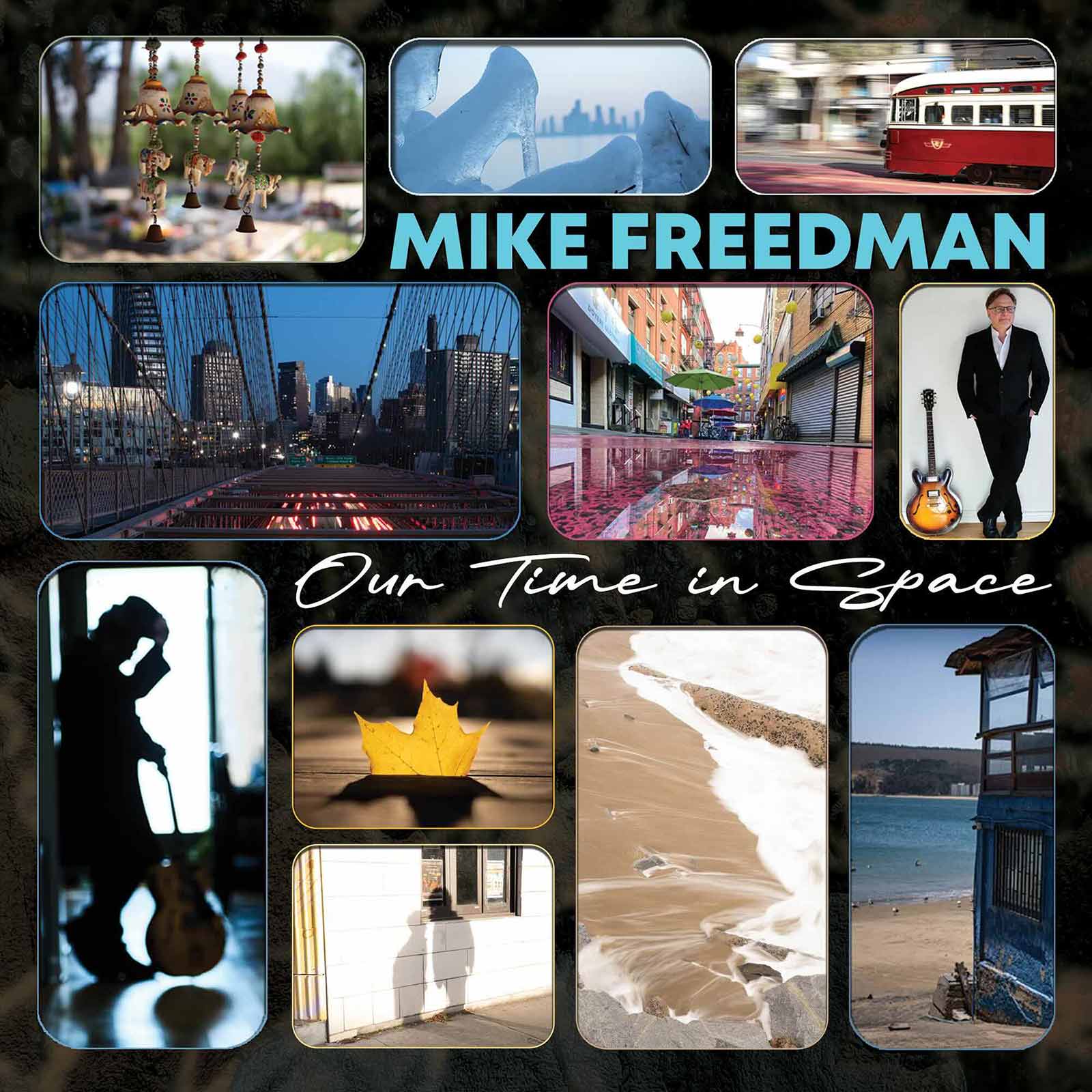
Mike Freedman – Our Time In Space: The Art of Finding a Collective Voice.
There is something genuinely refreshing about Our Time In Space, the new album from Toronto-based guitarist and composer Mike Freedman. Across eleven original compositions, Freedman creates a musical world that is carefully shaped yet remarkably open, unfolding almost like a film without images, with shifting atmospheres, unexpected turns and a subtle sense of narrative. Rather than imposing a storyline, he allows the music to suggest its own landscapes, leaving listeners free to find their way through them. His melodic writing is inviting, often buoyant, but never superficial. Beneath its apparent ease lies a sophisticated understanding of harmony, rhythm and structure. What makes the album immediately appealing is the way it reconciles compositional discipline with a genuine sense of freedom. The music feels carefully considered without sounding overworked, and its accessibility never comes at the expense of musical substance. Yet Freedman’s preference for fluidity and balance has its limitations. Some passages settle into an agreeable continuity when a sharper contrast or a more unexpected development might have given them greater expressive force.
Freedman’s strength as a composer lies in his ability to create melodies with a distinct identity while leaving room for his collaborators to reshape them. His themes are not merely springboards for improvisation; they provide a meaningful framework within which the musicians can develop their own ideas. The rhythmic writing is particularly engaging, with shifting accents, intricate patterns and subtle changes in momentum adding depth without making the music feel unnecessarily cerebral. Freedman clearly understands that complexity means little unless it serves the larger musical argument. There is no gratuitous technical display here, no attempt to impress through difficulty alone. Instead, the compositions rely on an intelligent interplay between melodic clarity and rhythmic sophistication. Still, the writing occasionally feels more cautious than its underlying ideas suggest. Some harmonic possibilities are introduced but not fully explored, and a few arrangements might have benefited from greater tension or a willingness to move beyond their established patterns. The result is consistently accomplished, though not always as adventurous as one might hope.
The musicians surrounding Freedman are instrumental to the album’s success. Pianist Matt Newton, bassist Chris Adriaanse and drummer Max Senitt form a rhythm section that combines precision, sensitivity and a welcome sense of movement. Newton brings considerable harmonic imagination to the arrangements, often adding new dimensions to Freedman’s melodic ideas rather than simply reinforcing them. Adriaanse provides a warm, grounded foundation, but his playing is never merely supportive; he contributes significantly to the music’s forward momentum. Senitt, meanwhile, demonstrates an excellent command of dynamics, knowing when to push the ensemble and when to give the music room to breathe. His drumming supplies energy without overwhelming the compositions. Together, the three musicians create an ensemble sound that feels genuinely collaborative, with each contribution serving the music rather than individual display. There is, however, a certain polish to these exchanges that occasionally works against their spontaneity. The musicians are so attentive to maintaining the overall balance that one sometimes wishes they would challenge the compositional framework more forcefully. A little more friction might have made some of these performances even more compelling.
Flutist Anh Phung adds another dimension to the project, appearing on “A Child’s Smile,” “Reconciliation” and “Meeting of the Minds.” Her instrument introduces a welcome change in texture, opening up the arrangements and creating fresh possibilities for melodic dialogue. The flute’s lighter timbre contrasts effectively with the guitar and piano, allowing certain musical ideas to emerge from a different perspective. Phung’s contributions are judiciously placed, although one might have welcomed a more adventurous exploration of the instrument’s possibilities. Her presence enriches the album’s tonal palette, but does not always fundamentally alter the direction of the compositions. It is a relatively restrained role, consistent with Freedman’s overall approach, yet one that leaves the listener curious about what might have happened had the arrangements taken greater advantage of her expressive range.
The recording itself reinforces the album’s collective character. Captured live, with all the musicians playing simultaneously over two days in February 2026 at Toronto’s Canterbury Music Studios, Our Time In Space benefits from the immediacy of musicians responding to one another in real time. There is a natural give-and-take to the performances, a sense of listening and reacting that cannot easily be manufactured through overdubbing. Engineer Julian Decorte captures this interaction with clarity and warmth, while David Travers-Smith’s mixing and mastering provide a carefully balanced sonic image. The bass retains its depth, the drums their definition, the piano its harmonic richness, and Freedman’s guitar sits naturally within the ensemble. The production never calls attention to itself, which is precisely its virtue. If anything, its immaculate presentation occasionally feels a little too comfortable, leaving limited room for rougher textures or more pronounced dynamic contrasts. That said, the recording serves the music exceptionally well. The closure of Canterbury Music Studios is a regrettable loss for Toronto’s jazz community, particularly given the importance of such spaces in preserving the intimacy and spontaneity of small-group recording.
Perhaps the most revealing aspect of Our Time In Space is Freedman’s refusal to make himself the unquestioned center of attention. His guitar playing is assured, but he never seems compelled to dominate the proceedings. This is not simply modesty; it reflects a clear artistic philosophy. Freedman understands that a composer’s identity can emerge through the quality of the music he creates for others as much as through his own instrumental performances. His collaborators are given genuine freedom to shape the material, and their contributions feel integral to the compositions rather than inserted as opportunities for individual display. That generosity gives the album much of its warmth and coherence. Yet it also raises a legitimate critical question: In making so much room for his collaborators, does Freedman occasionally understate his own artistic personality? The compositions provide a recognizable framework, but there are moments when a stronger personal statement might have given the music greater distinction. The balance between collective expression and individual identity is difficult to achieve, and Freedman does not always resolve that tension.
Ultimately, Our Time In Space is a thoughtful, accomplished and consistently engaging album, distinguished by the intelligence of its writing and the quality of its musicianship. Freedman has a genuine gift for melody, a sophisticated rhythmic sensibility and an admirable understanding of jazz as a collective art. He avoids the familiar trap of confusing complexity with depth, and his compositions remain inviting even when their underlying structures demand close attention. But the album’s greatest virtue is also the source of its principal limitation. Its carefully maintained equilibrium, understated arrangements and preference for musical dialogue occasionally prevent it from reaching a more unpredictable or emotionally compelling place. There are few missteps, but perhaps too few moments when the music genuinely catches the listener off guard. That distinction matters. Technical accomplishment and artistic coherence are valuable, but memorable jazz often emerges when musicians are willing to disturb the very balance they have worked so hard to establish. Freedman has demonstrated that he possesses the compositional intelligence and the musical partners to take that next step. This is a rewarding album, and a persuasive statement of artistic purpose, but it also leaves the impression that its creator has more to say than he ultimately allows himself to express. The real promise of Our Time In Space lies not only in what Freedman has achieved, but in the possibilities he has yet to explore. The foundation is firmly in place. What remains is the willingness to take greater risks, embrace the unexpected and turn an already accomplished musical voice into a truly unmistakable one.
Thierry De Clemensat
Member at Jazz Journalists Association
USA correspondent for Paris-Move and ABS magazine
Editor in chief – Bayou Blue Radio, Bayou Blue News

PARIS-MOVE, October 30th, 2026
Follow PARIS-MOVE on X
::::::::::::::::::::::::
Musicians:
Mike Freedman – Guitar
Anh Phung – Flute (1, 4, 7)
Matt Newton – Piano
Chris Adriaanse – Bass
Max Senitt – Drums
Track Listing:
Meeting Of The Minds
Artful Intelligence
What I Remember
Reconciliation
Mixed Up Blues
Hidden Truths
A Child’s Smile
Waltz For Evan
Our Time In Space
Collaboration
The Dawn Of Healing