
| Jazz |
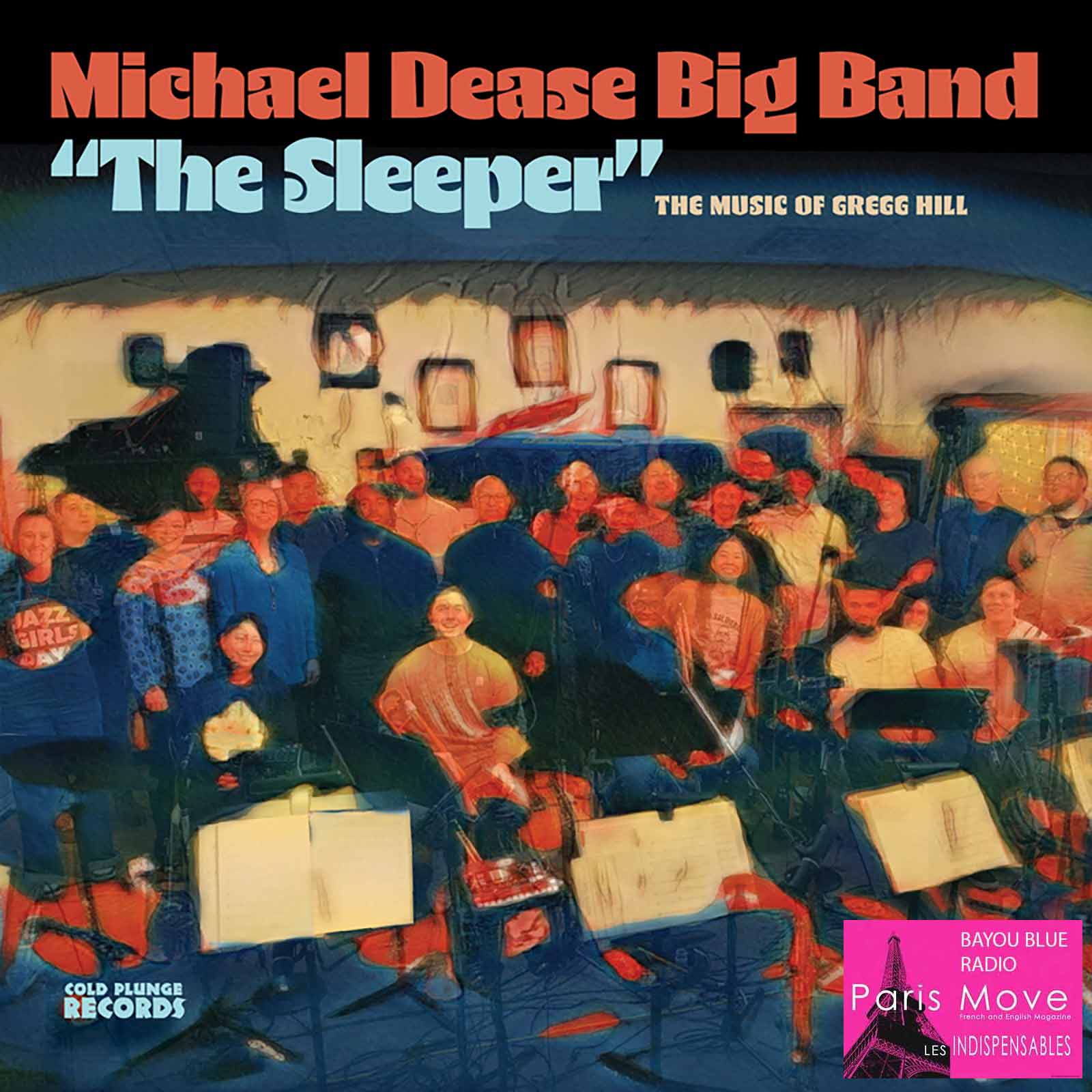
Summary: The Sleeper brings Gregg Hill’s cinematic compositions to life through Michael Dease’s dynamic big band and ten distinctive arrangements.
Michael Dease Big Band’s The Sleeper: The Cinematic Jazz of Gregg Hill
If September has become the month when some of the year’s most compelling jazz albums seem to arrive all at once, October is making a strong case for itself as a worthy continuation. Among the records worth paying attention to is The Sleeper, the new album from the Michael Dease Big Band, devoted entirely to the music of Gregg Hill. The title may suggest something quiet, perhaps even sleepy, but the music quickly makes that interpretation impossible. From the opening moments, The Sleeper feels more like an awakening than a retreat into sleep. There is movement, humor, tension and an unmistakable sense of curiosity. Hill’s writing seems to keep opening doors just as you think you have figured out where the music is going. That quality has become one of the most appealing aspects of his work. His compositions are accessible without being obvious, sophisticated without becoming academic, and often playful without ever losing their structural intelligence.
Michael Dease is an unusually well-equipped guide for this particular journey. Trombonist, baritone saxophonist, composer, bandleader and educator, he has built a career that moves comfortably between performance, composition and large ensemble leadership. His experience includes work with the Illinois Jacquet Big Band, Roy Hargrove and Christian McBride, among many others. His own recording career has also established him as a musician deeply interested in what a big band can still become. That point matters here, because The Sleeper is not simply another big band recording. It is an experiment in perspective, an opportunity to hear Gregg Hill’s compositions through a series of different musical lenses while retaining the distinctive character of the original writing.
Dease has taken ten compositions by Gregg Hill and given them to ten different arrangers. The result is not an attempt to impose a single sound on Hill’s music, but almost the opposite. Each arranger is invited to look at the same composer from a different angle. The compositions remain the foundation, but the orchestral language surrounding them changes from one piece to the next. It is a fascinating idea because Hill’s music seems almost designed for that kind of treatment. His writing has enough structure to withstand transformation, but enough openness to encourage musicians to take risks. The result is an album that feels constantly in motion without ever losing its sense of identity.
Gregg Hill inhabits a musical world that is almost always smiling, although there is often a touch of nostalgia beneath the surface. His compositions have a cinematic quality that is difficult to ignore. There are moments when they seem to belong to a film that exists somewhere just beyond the edge of the screen. Sometimes the atmosphere suggests the shadowy elegance of 1950s film noir. At other times, the music becomes brighter, stranger or unexpectedly funny. Hill can move from melancholy to mischief without making the transition feel forced. There is often humor in his writing, but never at the expense of the music. Beneath it all lies a complex and deeply satisfying architecture.
His compositions tell stories, but rarely tell you exactly what those stories are. Instead, they leave space for the musicians to become characters. A trumpet can suddenly sound like a voice entering a scene. A trombone can change the emotional temperature. A saxophone can appear almost like a narrator. The rhythm section can quietly alter the direction of the story underneath everyone else. This ability to suggest rather than dictate is one of the qualities that makes Hill’s music so rewarding, particularly when placed in the hands of a large ensemble.
That is precisely where the challenge of a big band becomes interesting. Handling a large ensemble is never easy, particularly when the material is this carefully constructed. Hill’s compositions offer multiple perspectives, and musicians approaching them have to make choices. The task is not simply to reproduce the notes on the page. It is to preserve the identity of the composition while allowing the bandleader, arrangers and musicians to leave their own fingerprints on it. Dease understands that balance. His approach is characterized by finesse rather than force. He does not seem interested in overwhelming Hill’s writing with the sheer power of a big band. Instead, he lets the arrangements reveal the layers already present in the compositions.
That sensitivity may explain why the collaboration between Dease and Hill feels so natural. Their relationship goes back several years, beginning within Michigan’s jazz community and developing more seriously when Dease encountered Hill’s writing during a recording session with Rodney Whitaker. While working through one of Hill’s melodies in a rubato duet with pianist Xavier Davis, Dease immediately noticed something unusual. The melody was simple, but the harmony underneath it was not. That contrast convinced him that Hill was a composer worth watching closely. Listening to The Sleeper, it is easy to understand why.
The new album extends a collaboration that has already produced several projects. Dease’s earlier work with Hill established a musical relationship in which the composer’s ideas could be explored through the resources of a large ensemble, but The Sleeper takes the concept considerably further. Rather than having Dease arrange every piece himself, the album brings together ten arrangers, each confronting Hill’s material from a different perspective. The result is less a single statement than a conversation between Hill’s compositions and a group of musicians who have been given the freedom to interpret them.
This distinction is important because a lesser composer might disappear under ten different arranging voices. Hill does not. His musical fingerprints remain remarkably clear. Recurring rhythmic motifs, bass ostinatos, counterpoint and unusual harmonic choices provide enough structural character for the arrangers to transform the music without erasing its identity. That is not an insignificant achievement. It says something fundamental about Hill as a composer. His music does not depend entirely on one particular interpretation. It can survive translation, and more importantly, it can benefit from it.
Dease himself seems particularly well suited to this kind of work. His experience with big bands allows him to understand both the power and the danger of the format. A large ensemble can easily become overwhelming. Volume can substitute for imagination, and historical references can turn into nostalgia for its own sake. Dease avoids that trap. His conception of the big band feels contemporary without rejecting the tradition. The music acknowledges where it comes from, but it does not appear trapped there.
That approach is especially evident in the presence of the guest soloists Dr. Eddie Henderson and Virginia MacDonald. Their participation creates another generational and stylistic dimension within the project. Henderson brings with him an extraordinary history that stretches across some of the most important developments in modern jazz, while MacDonald represents a younger generation of musicians whose musical language has evolved in a very different environment. Their presence reinforces one of the album’s central ideas: jazz remains alive when musicians inherit a language and then find new ways to speak it.
That may also be why Hill’s music continues to provide such fertile material for Dease. Hill is a prolific composer with a substantial body of work, and there is a sense that the musicians are only beginning to explore what is available to them. Rather than treating that catalogue as something to be carefully preserved, Dease and his collaborators continue to test it in different formats and through different musical perspectives. The Sleeper feels like another stage in that process rather than a conclusion.
There is also something refreshingly human about Hill’s writing. His music can be sophisticated without sounding self-important. It can be complex without making the listener feel as though he or she needs a map. It can be nostalgic without becoming sentimental. Most importantly, it seems to understand that humor has a legitimate place in serious music. That quality gives the album warmth and prevents the considerable musicianship from becoming an exercise in technical display.
This is perhaps where the film noir comparison becomes most useful. Hill’s music often seems to understand the dramatic power of what remains unsaid. A shadow can be more revealing than a spotlight, and a small harmonic shift can change the meaning of an entire passage. The musicians are not simply playing notes; they are creating atmosphere, establishing characters and suggesting events that may or may not actually be taking place. The listener is invited to complete the picture.
And then there is Jack the Shaker, the album’s closing track, which provides a welcome reminder that neither Hill nor Dease is interested in taking the whole enterprise too seriously. The title itself carries a mischievous quality, and the performance embraces it. Dease returns to the trombone, producing a performance that is both technically assured and unmistakably playful. At moments, there is something of Nils Landgren’s best qualities in the sound, that rare combination of precision, melodic instinct and sheer enjoyment of the instrument.
The humor, however, never overwhelms the music. That may be the most appealing thing about The Sleeper. For all the sophistication of Hill’s writing, for all the complexity of the arrangements and the considerable pedigree of the musicians involved, this is not an album that seems determined to impress the listener by standing above them. It wants to bring the listener inside the music and allow the stories to unfold at their own pace.
The Sleeper can be heard as ten compositions, ten arrangements and ten different ways of looking at the same composer. But it can also be heard more simply, as an invitation to spend some time inside Gregg Hill’s musical imagination. The first listen may reveal the energy and the surface of the music. A second listen begins to expose the architecture underneath. With another spin, the small jokes, unexpected turns and carefully placed details start to emerge. That is when the album becomes more rewarding, because Hill’s music seems to reveal itself gradually rather than demanding attention all at once.
Perhaps that is the real irony of The Sleeper. Despite its title, this is music that asks to be heard with your eyes open. Gregg Hill provides the architecture, Michael Dease gives it direction, and the musicians bring the characters to life. What emerges is a big band album that respects the tradition without being imprisoned by it, a sophisticated piece of musical storytelling that manages to remain warm, curious and occasionally mischievous. In a jazz season already crowded with strong releases, The Sleeper has every reason to keep listeners awake.
Thierry De Clemensat
Member at Jazz Journalists Association
USA correspondent for Paris-Move and ABS magazine
Editor in chief – Bayou Blue Radio, Bayou Blue News

PARIS-MOVE, August 28th, 2026
Follow PARIS-MOVE on X
::::::::::::::::::::::::
To buy this album (October 30, 2026)
Track Listing :
- “The Sleeper” — arr. Jason Hainsworth
- “Aftershock” — arr. Bill Cunliffe Jr.
- “La Canción” — arr. Altin Sencalar
- “Betty’s Tune” — arr. David Gibson
- “Mr. Pea is Welcomed to the Pod” — arr. Matt White
- “Go Figure!” — arr. Gina Benalcazar-Lopez
- “Common Ground” — arr. Jordyn Davis
- “Quietude” — arr. Helen Sung
- “Sloe Gin Fizz” — arr. Ben Markley
- “Jack the Shaker” — arr. Michael Philip Mossman

Musicians :
Michael Dease — trombone, baritone saxophone
Dr. Eddie Henderson — trumpet
Virginia MacDonald — clarinet
Saxophones:
Sharel Cassity — alto and soprano saxophones, flute
Rudresh Mahanthappa — alto saxophone
Jason Hainsworth — tenor saxophone, clarinet
Kirk MacDonald — tenor saxophone, clarinet
Clark Gibson — baritone saxophone, flute
Trombones:
Aidan Clark
Nanami Haruta
Ken Thompkins
Pablo Muller Santiago (bass trombone)
Trumpets:
Nathaniel Williford
Renée McGee
Matt White
David Sneider
Rhythm Section and Guests:
Miki Hayama — piano
Langston Kitchen — bass
Dr. Colleen Clark — drums
Randy Napoleon — guitar
Gwen Dease and Kevin Jones — percussion
Jalen Baker — vibraphone
Tommy Noble — additional flute/clarinet
Additional Musicians:
Zach Sommerfeld — guitar on “Betty’s Tune”
Rodney Whitaker — bass on “Aftershock”
Altin Sencalar — trombone on “La Canción”
Wycliffe Gordon — trombone on “Sloe Gin Fizz”
Jack Covert — shaker on “Jack the Shaker”
Produced by Michael Dease
Recorded May 18–19, 2025 at Troubadour Recording Studio, Lansing, Michigan
Engineered by Corey DeRuscia
Mixed by Matt White
Mastered by John McClaggan at Parachute Mastering
Cover artwork by Steve Wiest
Photography and graphic design by Lynne Brown
Liner notes by Willard Jenkins