| Blues, Jazz |
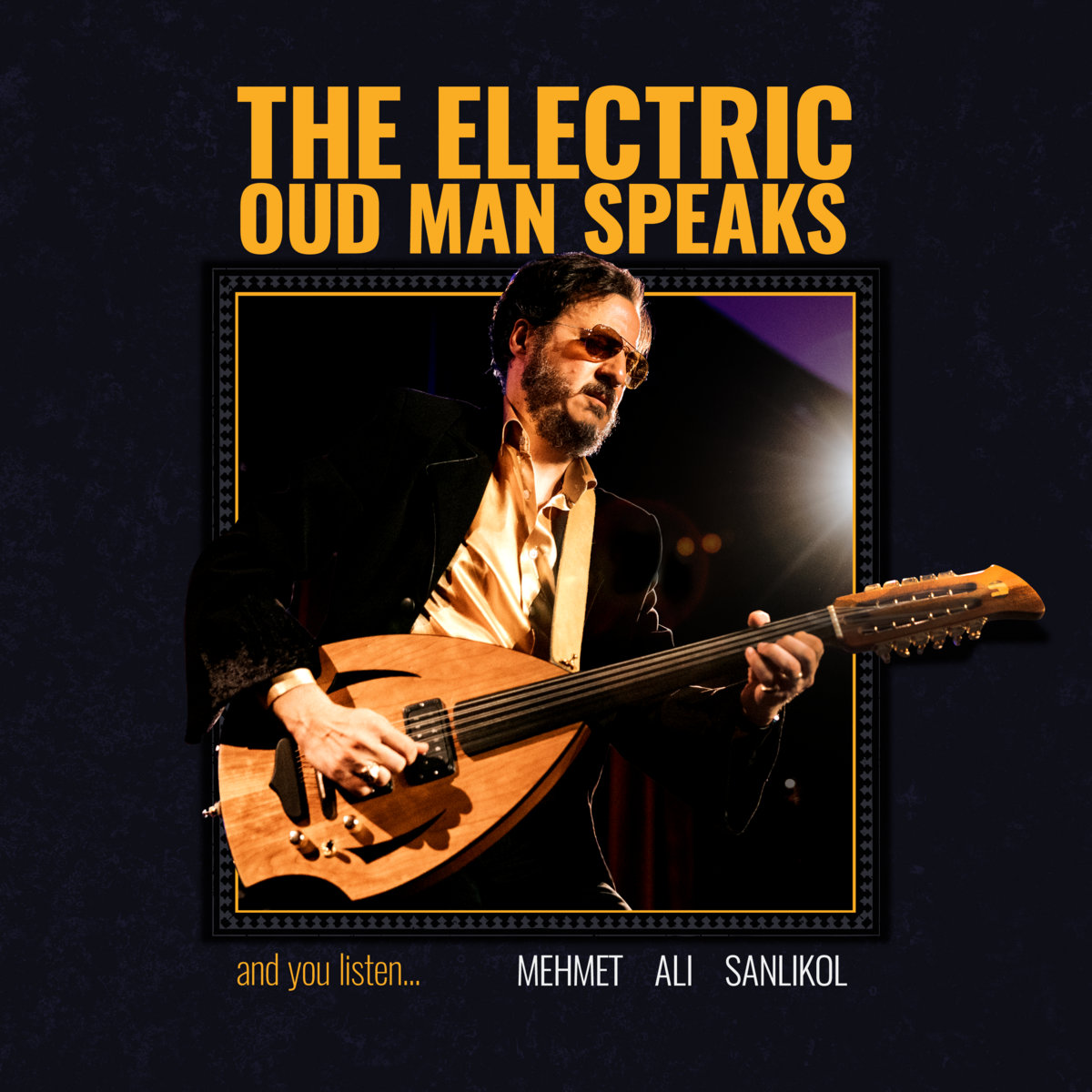
The Electric Oud Man Speaks: Mehmet Ali Sanlıkol Reinvents an Ancient Instrument for the Electric Age
Some instruments have waited centuries for someone to plug them in. The oud — the fretless, pear-shaped ancestor of the guitar, central to Middle Eastern and Turkish music for well over a thousand years — has never really been one of them, mostly because nobody had solved the physics. Turkish-American composer and multi-instrumentalist Mehmet Ali Sanlıkol spent more than twenty years wanting to solve it anyway, and The Electric Oud Man Speaks and you listen… is the exhilarating proof that the wait was worth it. Across five tracks and a lean forty-five minutes, this is one of the most genuinely original fusion records to come along in some time, not a genre experiment bolted together for novelty’s sake, but the sound of a musician finally given an instrument capable of saying everything he’s spent a lifetime learning to say.
The album’s origin story is almost as compelling as the music itself. Sanlıkol’s early attempts to bring an acoustic oud into a modern jazz rhythm section kept running into the same wall: the instrument fed back, vanished in volume, and simply couldn’t survive the moment a drum kit asserted itself. His solution was to give the oud the same transformation the guitar underwent in the early twentieth century: magnetic pickups, steel strings, a redesigned body built to handle real dynamic range. Working with American guitarist and oud enthusiast Mac Ritchey, Sanlıkol developed a custom semi-hollow electric oud that travels well, holds its tuning, and can go toe-to-toe with a full jazz-fusion band. It’s a genuine feat of instrument design, and it functions here exactly as intended: not as a gimmick, but as a fully credible lead voice, equally capable of traditional modal nuance and blistering rock-guitar-style soloing.
That dual fluency traces directly back to Sanlıkol’s own musical upbringing. Raised in Istanbul by a classical pianist mother, he grew up immersed in Beethoven, Mozart, and Chopin before discovering Chick Corea, Weather Report, and, most decisively, Charlie Parker, whose language he studied intensively before eventually enrolling at Berklee College of Music. Alongside that jazz education sat an equally serious devotion to rock guitar heroes: Led Zeppelin, Pink Floyd, Deep Purple, and Jimi Hendrix all left their mark. As an adult, he turned back to the Turkish makam and Ottoman traditions that had lived in his cultural memory since childhood, studying them with the same rigor. Now based in Boston and a full-time faculty member at the New England Conservatory, Sanlıkol treats musical styles as languages that must be learned from the inside, and the electric oud is what finally let him speak all of them at once, in the same sentence, without switching accents.
The album opens with “Pickin’ a Shuffle Alla Turca”, a driving, brass-forward statement of intent built on a bluegrass-style picking pattern Sanlıkol discovered on the oud, wedded to a fully modal Turkish melody that somehow evokes American riff traditions at the same time. It’s an immediate, propulsive opener, and a genuine attention-grabber, six minutes that make clear from the first bar this isn’t a fusion experiment layered on top of two separate traditions, but a single, already-integrated musical voice.
“Another Dream in Nihavend” is where the album reveals its full emotional range, and it’s the clear centrepiece of the record. It begins in understated, atmospheric territory – the electric oud at its most sensual and traditional – before the piece opens up into extended, distorted electric-oud soloing that would make plenty of rock and jazz guitarists envious, guitar lines with the fluid phrasing and sustain of a Jeff Beck or a Derek Trucks. Just when the track seems to have reached its peak, it gives way to a radiant, sun-drenched tenor saxophone solo from Edmar Colón that feels like the gates of heaven swinging open. At nearly eleven minutes, it’s the album’s most spellbinding track, magnificent, patient, and genuinely transporting.
“Talk About a Turkish Blues” takes a melody that reportedly came to Sanlıkol in the space between sleep and waking and stretches it into an extended thirteen-bar blues structure, reimagined entirely through Turkish modal language. The result makes the oud’s strings vibrate with a bent, singing quality that recalls Jeff Beck or Peter Green at their most expressive, a track that would make an excellent lesson for any young guitarist trying to understand what soul actually sounds like on a stringed instrument.
“A Poignant Truth” pulls back to something far more intimate: a solo home recording on fretless electric oud, built from layered arpeggios, doubled lines, vocoder textures, and contrasting distorted timbres. At under four minutes, it functions as a brief, exposed interlude before the album’s closing statement, a moment where Sanlıkol’s compositional and instrument-building instincts are laid bare with nothing to hide behind.
The closer, “No Big Deal”, sends the album off with a straight-ahead funk groove in the lineage of Jimi Hendrix and Herbie Hancock. The Hendrix influence here isn’t a passing reference, it’s genuinely uncanny, the kind of left-handed fire and phrasing that feels like it’s channeling the man directly, backed by searing brass that Hendrix himself would surely have loved. Having played Hendrix tracks myself, I must admit that here, undeniably, Hendrix’s spirit hovers over Mehmet. It’s a punchy, dazzling way to close a record that has spent forty minutes proving how much ground a single reinvented instrument can cover.
None of this would work without an ensemble equally fluent in Sanlıkol’s cross-modal vocabulary, and the band he’s assembled has the credentials to prove it. Drummer George Lernis and bassist James Heazlewood-Dale form the rhythmic core of Sanlıkol’s small-group work, and along with trumpeter Mark Tipton, both studied his comparative improvisation, tuning systems, and microtonal concepts directly at New England Conservatory and Berklee. That shared grounding in makam theory lets the group move through shifting rhythmic and modal frameworks with real naturalness rather than careful calculation. Colón, though not a former student, adapted quickly to the material’s structural demands, and his saxophone work throughout, especially that soaring turn on “Another Dream in Nihavend”, is one of the album’s genuine highlights. The quintet toured five festivals across Turkey and Cyprus the summer before recording, and that road-tested rapport is audible in every transition on this record.
Sanlıkol has said it himself, plainly: “This is my sound. This is my world. There’s no one that does what I do“. After five tracks of Turkish makam, blues structure and full-throttle rock soloing moving through each other without a single seam showing, it’s hard to argue. The Electric Oud Man Speaks and you listen… isn’t a fusion record in the usual sense, it’s the sound of traditions that, in Sanlıkol’s hands, were never really separate to begin with, finally given an instrument capable of proving it.
A stunning, original, endlessly re-listenable record, and an easy must-have for anyone drawn to jazz, blues, Anatolian psychedelia, or simply masterful, boundary-erasing musicianship.
Frankie Pfeiffer
Editor in chief – PARIS-MOVE
PARIS-MOVE, August 28th, 2026
Follow PARIS-MOVE on X
::::::::::::::::::::::::
Tracklisting:
1.Pickin’ A Shuffle Alla Turca 06:08
2.Another Dream In Nihavend 10:39
3.Talk About A Turkish Blues 07:20
4.A Poignant Truth 03:58
5.No Big Deal 04:35
All music composed by Mehmet Ali Sanlıkol (Mehteran publishing, ASCAP)
Musicians:
Mehmet Ali Sanlıkol, electric oud, vocoder, Renaissance 17
Mark Tipton, trumpet, flugelhorn
Edmar Colon, tenor saxophone
James Heazlewood-Dale, electric bass
George Lernis, drums
Produced by Mehmet Ali Sanlıkol
This album was recorded at Futura Productions (Roslindale, MA) in July 2024 and June 2025
Recorded by John Weston. Edited by Mehmet Ali Sanlıkol. Mixed and Mastered by John Weston at Futura Productions
Graphic art and design by Esteban Patiño.
Photos by Salih Üstündağ