| Jazz moderne |
Maximilian Hering may be a drummer by trade, but to engage seriously with his work is to encounter a composer of uncommon breadth, an artist whose musical thinking extends far beyond rhythm and into architecture, movement, and narrative. Deeply attuned to dance and physical motion, Hering has forged a strong reputation as a versatile musician, supported by an extensive discography as a sideman, wide-ranging collaborations across Europe, and commissions for film and interdisciplinary projects. Yet it is within his own ensembles that his artistic identity emerges most clearly and most compellingly.
The Maximilian Hering Group exemplifies this vision. Conceived as a “chordless” ensemble, built around brass instruments and a rhythm section,the group privileges collective expression over harmonic saturation. In doing so, it aligns itself with a lineage of contemporary jazz that values openness, risk, and interaction, recalling in spirit the work of figures such as Nik Bärtsch, Jim Black, or Django Bates. Here, spontaneity is not the absence of structure but its partner, and the music gains momentum precisely because each voice is allowed genuine space to assert itself.
From the opening track, the listener is drawn into a musical architecture of striking complexity that remains, somewhat unexpectedly, accessible. The album unfolds through vivid, almost cinematic imagery. At its core are rhythms, layered, shifting, and meticulously articulated, supported by percussive effects that never feel ornamental. These rhythmic foundations give way to brass-led explorations that quickly situate the music in an intellectual, urban sound world. The Gathering thrives on the tension between instinct and design, marrying improvisational freedom with clearly articulated forms.
Crucially, the album is not the product of a single compositional voice. Half of the pieces are written by members of the ensemble, a choice that broadens the album’s perspective and reinforces its collective ethos. This multiplicity of viewpoints is further enhanced by the instrumentation itself: flugelhorn, bass clarinet, flute, saxophone, and piano each contribute distinct timbral identities, ensuring that no two tracks inhabit the same emotional or sonic space. The musicians assembled for this recording are not only highly skilled improvisers but also classically trained performers, evidently comfortable navigating the demands of contemporary repertoire. Their precision allows the music’s complexity to unfold without ever becoming opaque.
That Hering is a drummer-composer shapes the album’s internal logic in profound ways. Rhythm is not merely a foundation here; it is a guiding principle. Yet the music resists easy categorization. Folk, classical, and pop influences surface throughout, woven so seamlessly into the fabric of the compositions that they are often felt more than heard. This synthesis speaks to an unusually broad cultural literacy, with contemporary jazz serving as the album’s structural backbone. When the music chooses to assert its jazz lineage explicitly, most notably through expansive saxophone solos, it does so with authority and clarity.
The chordless configuration defines the group’s aesthetic approach across the album. Melodic lines and implied harmonic structures serve as points of departure rather than destinations. Soloists are encouraged to push against these frameworks, generating a sound that is at once open, lyrical, and exploratory. The result is a musical language that feels resolutely individual—neither academic nor indulgent, but deeply considered.
This is not an album designed for casual consumption. It asks something of its listener: a willingness to engage with multiple cultural references and compositional strategies. The pieces function as narratives, drawing inspiration from themes that range from the intimate to the playful. “Moles on Her Skin,” “519 km Is Too Far for Kissing You,” and “Entre tú y yo” examine different facets of love and emotional distance. “Ojo de madera” emerges from the uncanny experience of a piece of wood whose grain seemed to stare back at the observer, while “Oliver” pays explicit homage to Olivier Messiaen, particularly his use of modes. Elsewhere, “Gleisgeflüster” captures the nocturnal whispers of freight trains, and “Route A66” imagines a symbolic meeting point between the iconic American highway and the German autobahn connecting Frankfurt and Mainz.
What ultimately defines The Gathering is its aesthetic range. The album moves fluidly between passages of striking lyricism and moments of deliberate fragmentation. This cultivated dissonance provides depth and contrast, preventing the music from settling into comfort. Over time, the record reveals an almost documentary sensibility, less concerned with telling a linear story than with observing, framing, and reflecting. In this sense, the album rewards uninterrupted listening and repeated encounters, as many of its most compelling details only fully emerge over time.
For broadcasters and curators, The Gathering is ideally suited to late-night or carefully contextualized programming, particularly within shows dedicated to contemporary jazz, rhythm-centered composition, or genre-crossing European projects. Framing the album around Hering’s identity as a drummer-composer, or situating it alongside similarly exploratory artists, offers listeners valuable points of entry. Approached with attention and openness, The Gathering reveals itself not merely as a collection of compositions, but as a fully realized artistic statement, an experience as intellectually engaging as it is quietly pleasurable.
Thierry De Clemensat
Member at Jazz Journalists Association
USA correspondent for Paris-Move and ABS magazine
Editor in chief – Bayou Blue Radio, Bayou Blue News
PARIS-MOVE, January 27th 2026
Follow PARIS-MOVE on X

::::::::::::::::::::::::
With great joy, my journey with the Maximilian Hering Group continues with The Gathering. Our second album is more versatile and contrasting: at times firmly rooted in harmonic structures, at others completely free. Lucia Fumero guests on two tracks, breaking through the band’s characteristic instrumentation like a sudden shift in a carefully measured poem. Bass clarinet and flugelhorn add further colors, as do pieces written by different members of the group.
To me, The Gathering is a convergence of joy in playing, curiosity, and depth. For the band, it’s another chapter full of discoveries and shared energy.
With love,
Max
Musicians:
Fernando Brox — flute
Edu Cabello — alto saxophone, bass clarinet
Victor Carrascosa — trumpet, flugelhorn
David Muñoz — double bass
Maximilian Hering — drums
Special guest: Lucia Fumero — piano (track 1 and 4)
Track Listing:
Moles On Her Skin
The Gat·Hering
519 KM Is Too Far For Kissing You
Oliver
Route A66
Entre Tu Y Yo
Gleisgeflüster
Summer In PT
Recorded on May 20 and 21, 2024 by Alberto Pérez at Sol de Sants Studios, Barcelona.
Mixed by Bernhard Hering at Klangraum, Mainz.
Stem mastered by Tom Krüger at ¿ no sé ? Studio B, Stuttgart. Produced by Maximilian Hering.
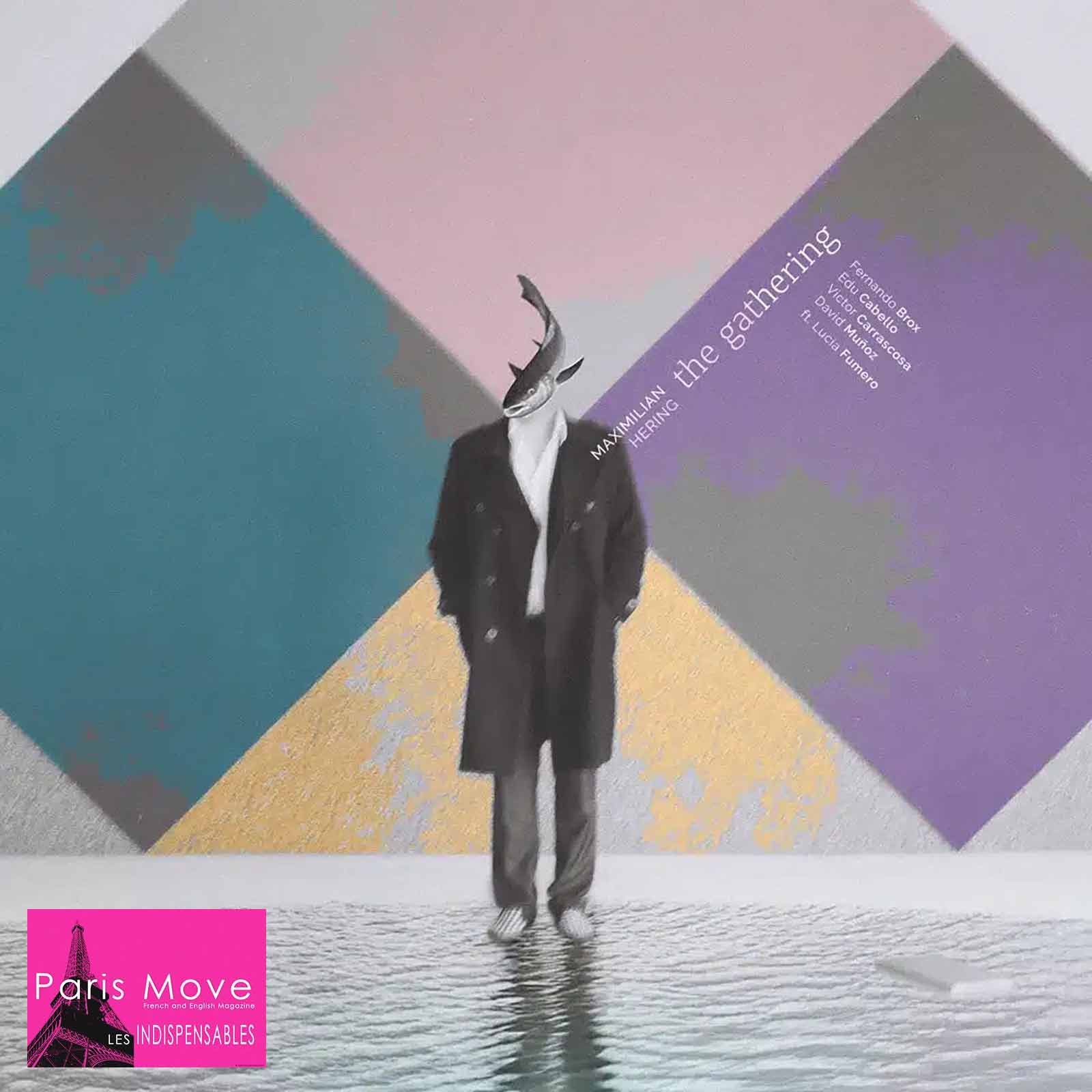
Artwork and cover photography by Sara Rojo.
Supported by Initiative Musik gGmbH with project funds from the Federal Government Commissioner for Culture and Media.