| Classique |
You are more accustomed, perhaps, to encountering Maxime Perrin in the domain of jazz rather than within the formal architecture of classical composition. Yet, like many European musicians shaped by layered traditions, his education was rooted in the discipline of the conservatory, in counterpoint and liturgical form as much as improvisation. This new project may not appear self-evident. It resists easy classification. But it arises from something deeper than genre: necessity.
Its source is loss, and history.
When the Kosovar poet Ali Podrimja died suddenly in 2012, the French poet and dramatist Marc Delouze responded with a text of homage, Ali parti (“Ali Departed”). The work imagines the final passage of a man who had devoted his life to the fragile and unfinished independence of his homeland. Delouze traveled to Kosovo to read and defend the text; from that journey emerged another prose meditation, D’une île Kosovo, born of encounter with a people still negotiating sovereignty, political, linguistic, spiritual.
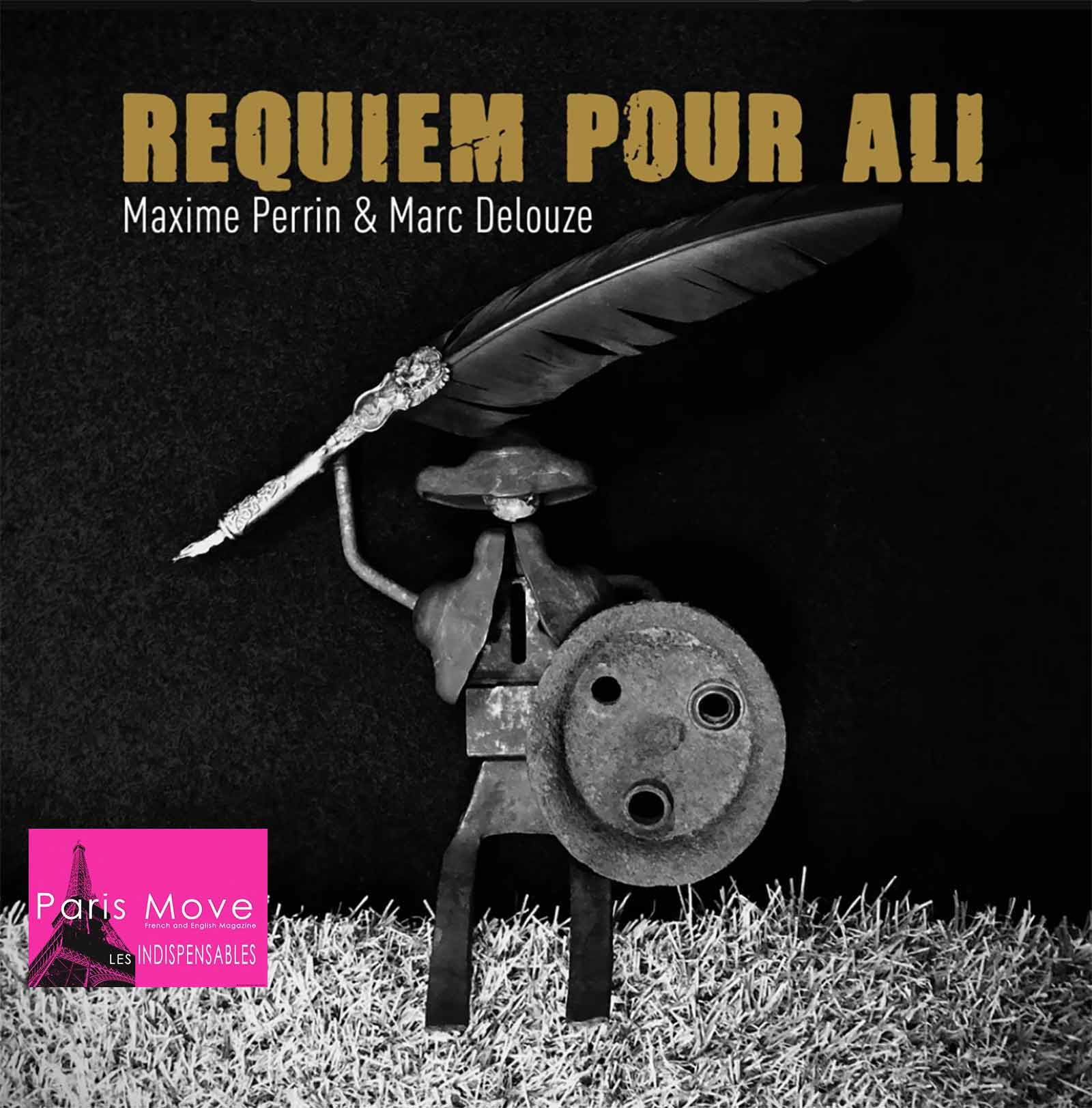
In time, Delouze joined forces with composer Maxime Perrin to create a work commensurate with Podrimja’s moral and artistic stature. The result, Requiem for Ali, is not metaphorical. It is, structurally and spiritually, a Requiem.
Supported by the Kosovar ambassador to Paris, the project took shape around a bold premise: Delouze’s contemporary text would be interwoven with the traditional Latin corpus of the Requiem Mass. Poems by Podrimja are placed in dialogue with this liturgical scaffolding, while two texts by Pier Paolo Pasolini, himself a figure of artistic resistance, create a web of political and existential resonance. The work traces a funerary arc: the wandering poet, the exiled conscience, the body borne toward mystery.
Podrimja was born in 1942 in Gjakova, then under Italian occupation, in a territory whose borders and allegiances would be violently contested for decades. Orphaned young, he endured hardship before studying Albanian language and literature at the University of Pristina. He would remain there throughout his life, shaping Kosovo’s literary landscape as critic, editor, anthologist, and public voice. His poetry, spare, defiant, often stark, became inseparable from the struggle for national self-determination. He died unexpectedly on July 18, 2012, during the Voix de la Méditerranée poetry festival in Lodève, in southern France, where Delouze was then artistic director. Art and fate, once again, crossed paths.
This context is not ancillary; it is structural. The Requiem is not simply for a poet. It is for a language under pressure, for a fragile nation, for the memory of resistance.
Musically, Perrin refuses confinement. The score retains the formal arc of the Mass, Introit, Kyrie, Dies Irae, Agnus Dei, yet destabilizes expectations through instrumentation and texture. The bass clarinet, played by Samuel Thézé, becomes a central voice: dark, breathing, almost vocal in its lament. Harmonic language shifts between modal austerity and jazz-inflected chromaticism. Choral passages evoke liturgical gravity; elsewhere, improvisatory gestures fracture symmetry. French text rises above Latin invocation. The boundaries between classical structure and jazz freedom blur deliberately, not to obscure identity but to foreground the word.
In this sense, the Requiem becomes political in form as well as subject. It resists fixed categories, just as Kosovo resisted fixed definitions imposed from without. The music churns and unsettles; it does not grant easy consolation. It asks instead what mourning means in a century where independence remains contested and memory is a battleground.
There are, too, moments of luminous suspension. The soprano line, carried by Clara Schmidtfloats between restraint and fervor, inhabiting a threshold between worlds. Her voice does not dominate; it hovers. Latin, French, Italian: languages brush against one another like borders dissolving.
One enters this album as one opens a history book, but also as one steps into a chapel at dusk. The references are numerous; the gestures layered. Delouze, long inclined to fracture theatrical conventions, finds in Perrin a collaborator equally willing to disturb inherited forms. The result is neither crossover experiment nor stylistic hybrid for its own sake. It is a meditation on transmission: how poetry survives; how music bears witness.
If one listens carefully, the opening Agnus Dei carries the simplicity of prayer. I find myself imagining Léo Ferré murmuring, “It is like a prayer,” before digressing, as poets do, into reverie. But reverie here is disciplined. Every structural rupture is earned.
To call this a review would be insufficient. Criticism, at times, must yield to testimony. There are projects that enlarge us not because they are perfect, but because they dare to hold history and vulnerability in the same breath.
So permit, in closing, a more personal note:
“Maxime, what you have done here is neither nostalgic nor ornamental. It is countercurrent. I imagine you, accordion resting against the ribs, pencil in hand, darkening staves late into the night, pursuing not fashion but fidelity. A Requiem, yes. But also an act of faith in the endurance of the word.”
For Ali.
For the poet.
For art that refuses to forget.
Thierry De Clemensat
Member at Jazz Journalists Association
USA correspondent for Paris-Move and ABS magazine
Editor in chief – Bayou Blue Radio, Bayou Blue News
PARIS-MOVE, March 4th 2026
Follow PARIS-MOVE on X

::::::::::::::::::::::::
Musicians :
Maxime Perrin – Accordionist, composer
Clara Schmidt – Vocals
Tiziana Valentini – Vocals
Quatuor à cordes : QUATUOR SEDECIM
Violons: Laura Daniel, Eloise Renard
Alto: Axel Benedetti
Violoncelle: Aurore Daniel
Sammuel Theze – bass clarinet
Stephane Mingasson – oboe
Track Listing :
Agnus Dei
Benedictus
Coda
Communio
Dies Irae
Domine
Flaka
G (Puis c’est le jour)
Inno
Introitus
Je tourne
Kenga
Kyrie
La messe
Lacrimosa
Lavez votre esprit
Le silence
Les oiseaux
Ma fatigue
Prologue
Sanctus
Tout le jour
Un Homme Ordinaire
2 (Ani More)