| Contemporary music |
Matthew Aucoin – Music for New Bodies: A Vocal Symphony for the Age of Algorithms
Music for New Bodies is an album that arrives exactly when it needs to. Matthew Aucoin asks a question that is no longer science fiction: what is left of a single, embodied human life when we are busily handing our thinking, our memories and our attention to systems we barely understand, on a planet whose oceans and air we have been poisoning for decades? He does not answer with a lecture or a manifesto. He answers with 77 minutes of music that is by turns frightening, tender, ecstatic and consoling, and that leaves you changed at the end.
The piece is hard to label, and Aucoin himself has gone back and forth over what to call it: song cycle, oratorio, vocal symphony, and finally, he decided, an opera, albeit one with no plot and no characters. Listening to this premiere recording, the label hardly matters. What matters is that this is a large, ambitious, structurally coherent journey, and that it pays off.
The texts are drawn from poems by Jorie Graham, the Pulitzer Prize-winning poet who taught Aucoin at Harvard, and were selected and adapted by the composer together with the director Peter Sellars. Graham wrote these poems under the shadow of illness, and they carry two kinds of fear at once: fear for one body, and fear for the body of the Earth. Some of the voices in them are not human at all. A poem may be spoken by the sea floor, by the machines in an operating theatre, or by the planet itself.
Aucoin’s great insight is that such a poetry cannot be sung by one person. Five soloists share the work, and they are a restless presence: sometimes five individuals, sometimes one fractured mind, sometimes a single composite voice that may not be human. The instruments behave in the same way. Strings, winds, percussion and keyboards/harp move like shoals of fish, darting and regrouping, each group a flickering collective consciousness of its own. It is a wonderfully original idea, and on disc it translates into music that feels alive and constantly in motion.
“My” journey, movement by movement:
1. Cryo (21:15). The album begins at the edge of a precipice. A diagnosis has arrived, the calendar has lost its meaning, and the lure of cryonic preservation, that frictionless escape from the body, starts to whisper. The long opening movement is a slow descent, and the sudden intrusion of a medieval mystic’s vision of suffering and dryness across the centuries gives it a haunting depth. It is a bold way to open an album, and an immediately gripping one.
2. I [know myself] (4:31). A short, unsettling interlude in which a speaker looks in the mirror and finds a stranger. The glass becomes a screen, the screen becomes a barrier, and the music stays brief and sharp, like a shock of cold water between two large panels.
3. Deep Water Trawling – Part 1 (8:47). This is the piece that began it all: a short setting of this poem so moved Sellars that he urged Aucoin to build a whole evening around it. Here the five voices become a single creature from the deep, speaking of nets, ballast, ghost fishing and slow-growing animals that cannot recover. It is the most overtly ecological moment on the album, and it is shattering.
4. Deep Water Trawling – Part 2 (10:35). The mezzo-soprano takes the role of the deep-sea presence while the other four singers become the human questioners. Their dialogue circles around loss, survival and the strangeness of living on after something has ended. It is the dramatic heart of the work, and the quieter, more intimate textures here are a welcome contrast with what came before.
5. Prying (23:40). The longest movement is also the most ambitious. We move from the ocean floor to a hospital: the ambient hum of routine, the patient’s unease, the machine that reads her out, the sweetness of anaesthesia, the bleakness of the aftermath, and finally the astonishment of waking up. One voice in the poem reads as artificial, and Aucoin gives it music that deliberately lulls and numbs, with the singers locked in rhythmic unison over an electric bass and drum kit. The effect is deliciously unsettling, and then, with extraordinary control, the composer pulls us out of the stupor again. The movement is a tour de force of pacing across nearly twenty-four minutes.
6. Poem (8:25). After everything that has come before, we are finally ready for a different kind of voice, and it is the Earth’s. Here the full ensemble and the five singers give voice to a rumbling, radiant, patient life force, and the closing plea to be remembered lands with the weight of a benediction. After so much darkness, it is a profoundly consoling ending, never sentimental, entirely earned.
The recording is a showcase for the community that created it. The American Modern Opera Company (AMOC), which Aucoin co-founded, brings the kind of lived-in ensemble chemistry that cannot be rehearsed into existence, and the superb Sandbox Percussion quartet gives the metallic and rhythmic world of the score its precision and bite. Aucoin conducts with obvious command of his own music.
The five vocal soloists are wonderful. Soprano Kathryn Lewek and soprano Meryl Dominguez provide the luminous top of the texture, mezzo-soprano Megan Moore brings warmth and humanity, tenor Paul Appleby offers bright, flexible and expressive singing, and bass-baritone Evan Hughes anchors the group with gravity and authority. What impresses most is how naturally they blend and separate: the contrapuntal weave never turns into mush, and individual voices rise and fall back into the collective without a seam. The wind, string and keyboard players, from the two flutes and oboe to the contrabassoon, harp, two cellos and double bass, are every bit as committed.
It is worth remembering that these artists had already performed the piece in public many times before they entered the studio: from its premiere in Houston in April 2024, through Aspen and then Tanglewood, to the performances at Lincoln Center in July 2025. The recording sessions took place at New York’s DiMenna Center only days before those Lincoln Center concerts, and the sense of a work that has been lived in, shaped and sharpened over time is palpable throughout.
Aucoin’s language is wide-ranging. Dense, dissonant clusters in the highest registers shimmer against high woodwinds in ways that recall the psychoacoustic magic of Ligeti; the metallic percussion writing nods to high modernism; and yet nothing floats free of the body. Pulses, tonal roots and rhythmic energy keep the music anchored, so that tension and release are always felt rather than merely noticed. Even a surprising pop-inflected groove or a splash of electronic noise, both of which could have tipped into gimmickry, arrive as part of a larger dramatic logic. The electronics and field recordings created by Kyle Joseph and Aucoin are woven into the whole with real tact.
The critical response to the live performances was enthusiastic, with one major American newspaper calling the work a significant departure not only for its composer but potentially for operatic music more widely. After hearing this album, it is not difficult to see why. Aucoin has found a sound that is new for him, darker and more austere than his earlier theatre pieces, and yet it is still unmistakably his: virtuosic, generous, and always in service of the words.
The recording, produced by Silas Brown and Aucoin and engineered by Brown, is superb: clear, spacious and detailed, with the dense polyphony and the low, rumbling extremes of the score both reproduced faithfully. In a work that depends so much on layered voices, that transparency is essential, and the production team deliver it.
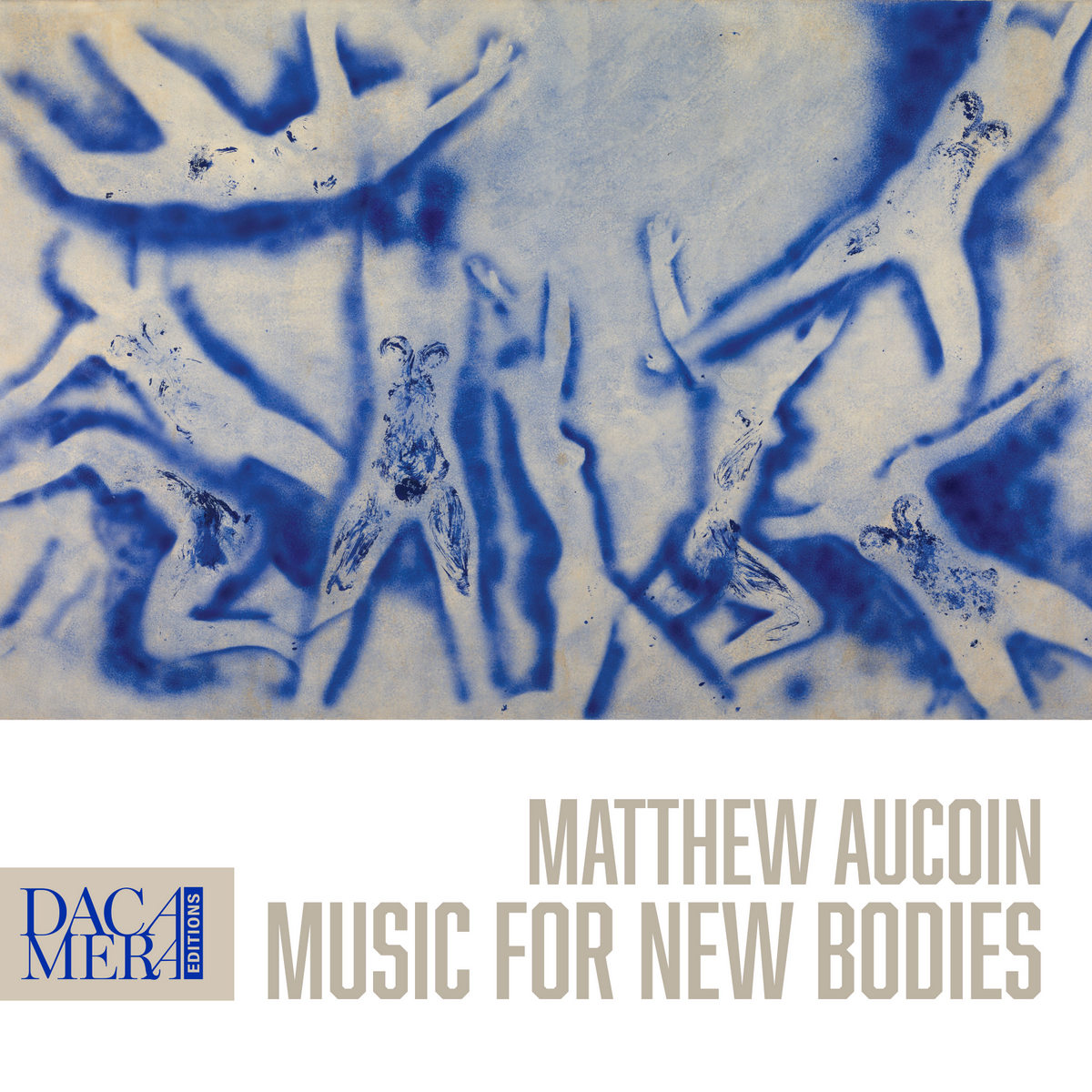
The physical edition is a pleasure in its own right. The 22-page booklet, designed by Aaron C. Lazar, features Yves Klein’s blue People Begin to Fly on the cover, a perfect image of bodies weightless and fragmented, and it prints the complete text of every movement, which is a real help in following such a dense and fragmentary libretto. It also contains Aucoin’s own liner essay, a movement-by-movement guide, full credits and a photograph from the Lincoln Center staging. If you love owning music as an object, this is a CD worth buying.
It takes courage to write a major work about the end of the world, the end of the self and the possible end of the human, and even more courage to finish it with hope. Music for New Bodies does both. It is serious without being solemn, complex without being cold, and above all deeply moving. DACAMERA Editions’ director has compared its emotional impact to that of a Mahler symphony for our time, and while such comparisons are risky, here it feels justified. This is one of the most important new vocal works of the decade, in a performance and recording that do it full justice.
Frankie Pfeiffer
Editor in chief – PARIS-MOVE
PARIS-MOVE, November 12th, 2026
Follow PARIS-MOVE on X
:::::::::::::::::::::
Tracklisting – Movements:
- Cryo
- I [know myself…]
- Deep Water Trawling – Part 1
- Deep Water Trawling – Part 2
- Prying
- Poem
Label: DACAMERA Editions
Conductor: Matthew Aucoin
Ensemble: AMOC / Sandbox Percussion Ensemble