
| Jazz |
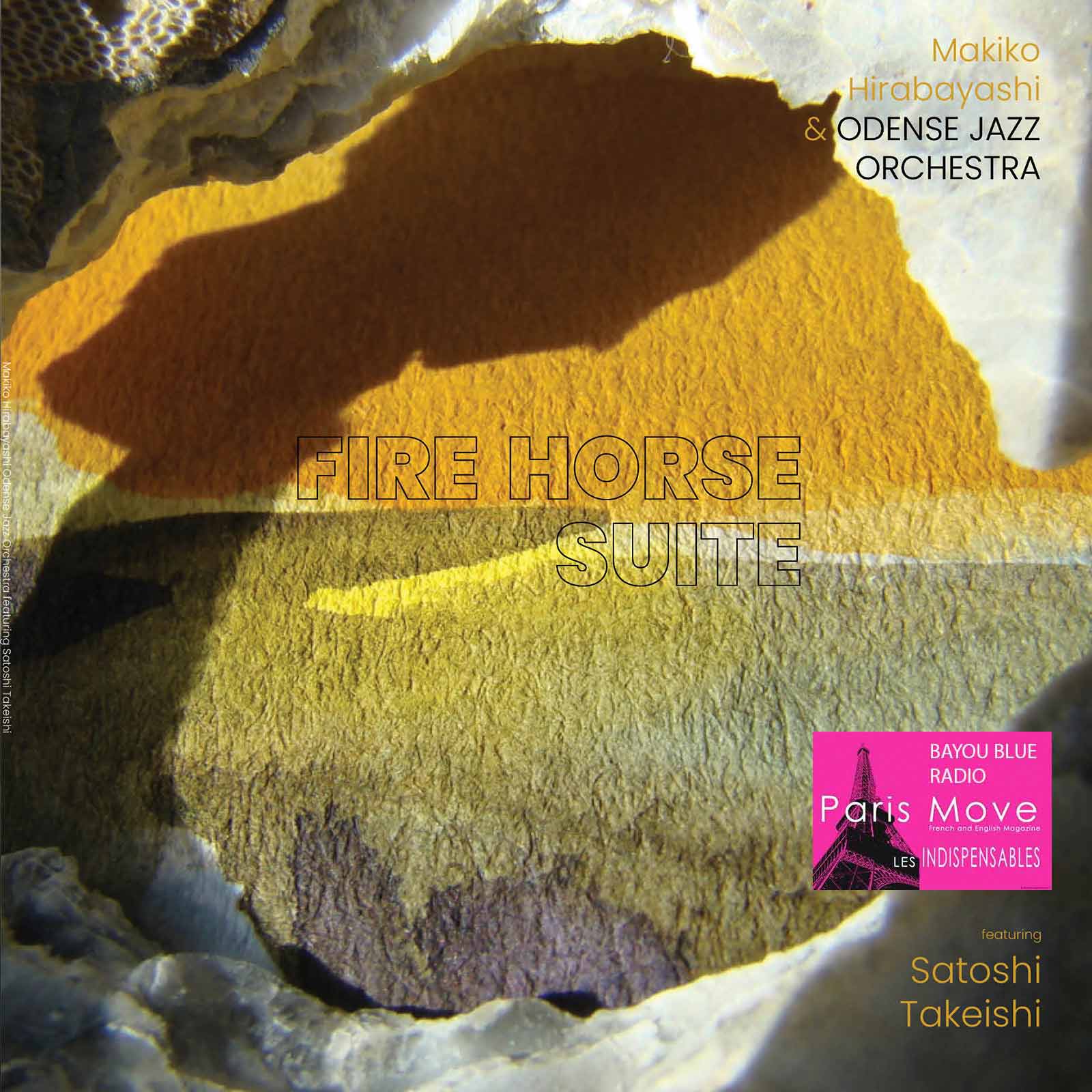
Makiko Hirabayashi: Giving a Voice to the Invisible
Some music invites us to listen. Other music asks us to imagine. With Fire Horse Suite, Japanese pianist and composer Makiko Hirabayashi creates a world in which sound becomes something more elusive: a language of mysterious presences, fleeting encounters and unexpected transformations. Moving between contemporary jazz, classical composition and the liberating possibilities of improvisation, she takes the listener somewhere beyond the familiar boundaries of musical expression. The result is an ambitious work for nineteen musicians, but one whose real subject is not orchestral power. It is the possibility of making an entire world come alive through sound. There is something immediately compelling about Hirabayashi’s musical imagination. Her compositions draw on the structural sophistication of classical music while retaining the openness, flexibility and instinctive sense of discovery associated with jazz. Yet the meeting of these traditions never feels like an exercise in musical fusion. She does not assemble influences simply to demonstrate their compatibility. Instead, she creates a language of her own, one in which carefully constructed passages can give way to moments of spontaneity, and where the smallest instrumental gesture may suddenly alter the atmosphere of an entire composition.
At times, her music has the quality of a film unfolding without images. At others, it resembles a theatrical performance in which the characters are never entirely revealed. This is particularly evident in Fire Horse Suite, a composition that seems less concerned with telling a conventional story than with creating a succession of musical personalities, landscapes and situations. Instruments become voices; voices acquire an almost physical presence. A clarinet may seem to emerge from somewhere beyond the orchestra, while an accordion takes on the character of an elusive figure. The percussion shifts the perspective, suggesting movement, tension or some mysterious exchange taking place just outside our field of vision. Who, or what, are these characters? Animals? Human beings? Spirits inhabiting an imaginary landscape? There is no need to decide. Indeed, the pleasure lies in the impossibility of assigning them a precise identity. Hirabayashi allows the imagination to move freely, without providing the reassuring explanations that so often diminish the mystery of an artistic experience. The listener is not asked to solve a puzzle but to surrender to the possibilities that the music continually presents. And when the journey becomes difficult to follow, one might as well ask the moon for directions.
The imaginative world behind the suite draws on Japanese animistic philosophy and the belief that the natural world is inhabited by spiritual presences. Mountains, stones, rivers, trees and the moon are not merely objects or elements of a landscape. They may carry an unseen life, a spiritual dimension that connects nature with human existence. This conception offers Hirabayashi a particularly fertile starting point, not because she seeks to illustrate mythology, but because she recognizes in it a way of understanding the world that is both ancient and remarkably relevant.
There is no attempt here to turn cultural heritage into musical decoration or to offer an exoticized portrait of Japanese spirituality. Hirabayashi is interested in something more fundamental: the idea that the world is alive, that its different elements are interconnected, and that human beings are only one part of a much larger existence. Nature is not a passive backdrop against which human emotions unfold. It possesses its own rhythms, its own mysteries and, perhaps, its own voice. Music becomes a means of listening to what ordinarily remains unnoticed. The title itself carries a personal significance. Born in 1966, the year of the Fire Horse in the Japanese zodiac, Hirabayashi belongs to a cycle that returns only once every sixty years. The year 2026 marks that return. Yet the significance of the horse goes beyond autobiography. It becomes an image of energy, movement and transformation, a starting point for a broader reflection on life, nature and humanity’s place within something larger. The symbolism gives the work an additional dimension without weighing it down. What matters is not the explanation of the symbol, but the way its energy seems to circulate through the music. The real achievement of Fire Horse Suite, however, lies in the composer’s ability to balance written structures with generous spaces for spontaneity. The nineteen musicians of the Odense Jazz Orchestra are not simply asked to execute a complex score. Each is given room to retain an individual voice while contributing to a larger musical identity. This distinction is crucial. Rather than making individual virtuosity the principal attraction, Hirabayashi builds the work around listening, trust and collective creativity. There is a quiet confidence in this approach. The composer establishes the framework, gives the music its direction and provides the architecture within which the ensemble can operate. But she does not attempt to control every detail. The musicians are allowed to respond to one another, discover possibilities within the written material and shape the music through their own instincts. The result is an orchestra that behaves less like a collection of separate sections than like a living organism, capable of breathing, changing direction and finding unexpected connections.
Such a balance is not easily achieved, particularly with a large ensemble. The temptation in writing for nineteen musicians is to rely on volume, density and the sheer force of orchestral color. Hirabayashi takes a more subtle route. She understands that scale does not necessarily produce depth, and that a large musical formation can be most effective when it knows how to make room for silence, contrast and individual expression. The orchestra expands and contracts, allowing different voices to emerge before returning to the collective sound. Its strength lies not simply in the number of musicians onstage, but in the quality of their interaction.
Satoshi Takeishi’s percussion is central to this process. His contribution goes well beyond providing rhythmic support. He creates an organic thread running through the composition, connecting different musical traditions through color, texture and movement. His playing can suggest the physical world, the restless activity of nature or an almost suspended sense of time. Rather than imposing a conventional rhythmic framework, he opens up new possibilities for the ensemble, sometimes grounding the music, sometimes unsettling it, and often giving it a distinctive sense of motion.
There is a particularly productive relationship between Hirabayashi’s compositional imagination and Takeishi’s approach to percussion. She creates the spaces in which musical ideas can develop; he helps transform those spaces into something unpredictable and alive. Their collaboration prevents the orchestral writing from becoming overly polished or self-contained. It allows the music to retain an element of risk, the feeling that something unexpected might happen at any moment. That quality is essential to the work’s character. It keeps the listener engaged not merely with the overall design, but with the discoveries taking place within it.
The individual movements contribute to this sense of an unfolding journey. From “Sun Ritual” and “Ask The Moon” to “Heat,” “Cocoon” and “Embraceable Night,” the titles suggest a world in which natural elements and human emotions constantly overlap. They provide clues without imposing a definitive interpretation. One can hear ritual, movement, warmth, shelter and the mystery of darkness, but the music remains open enough to accommodate very different responses. Each section changes the atmosphere, sometimes subtly, sometimes dramatically, while contributing to a larger sense of continuity. This is music that rewards repeated listening. Its details are not immediately exhausted, and its pleasures do not depend on a single striking moment. A particular instrumental color may reveal itself only after several hearings. A rhythmic shift that initially seems incidental may suddenly become essential to understanding a passage. The architecture gradually emerges, not as a rigid construction but as a network of relationships between sounds, gestures and textures. There is a remarkable amount of information contained within the music, yet none of it feels unnecessarily crowded. Hirabayashi’s artistic background helps explain this openness. Born in Tokyo, she spent part of her formative years in Hong Kong before pursuing musical studies at Berklee College of Music in Boston. Initially interested in composing for film, she eventually found in jazz and improvisation a more expansive field for her creative ambitions. Since settling in Copenhagen in 1990, she has developed a distinctive musical identity shaped by different cultural experiences and artistic encounters. Her work does not treat these influences as separate ingredients to be mixed together. They have become part of a personal language, one that moves comfortably between European musical structures, Japanese sensibilities and the expressive possibilities of contemporary jazz.
Her career has demonstrated a consistent willingness to explore different forms of musical conversation. Whether working in smaller formations or with her quartet Weavers, she has remained interested in the relationship between composed material and collective expression. Her 2025 album Gifts, which engages with the music of George Frideric Handel, offers another indication of her curiosity and her willingness to approach established traditions from a personal perspective. Across these different projects, one finds the same underlying concern: how to make music that is structurally intelligent without sacrificing emotional freedom. Fire Horse Suite brings that concern into a larger orchestral setting. The challenge is considerable. How does a composer preserve intimacy within a nineteen-piece ensemble? How can individual personalities remain audible without weakening the unity of the whole? And how can improvisation become an integral part of a carefully designed composition rather than simply an opportunity for musicians to display their technical abilities? Hirabayashi’s answer is found in the balance she establishes between discipline and openness. The written score provides direction, but the musicians are trusted to make it breathe.
There is also something particularly meaningful about the relationship between this musical philosophy and the animistic ideas behind the work. In both cases, individuality does not exist in isolation. Every presence belongs to a wider network of relationships. A stone, a mountain, an animal or a human being may possess its own identity, yet none exists entirely apart from the surrounding world. The orchestra functions according to a comparable principle. Its musicians do not disappear into a collective identity; they give that identity its substance. The ensemble becomes coherent not by eliminating differences, but by allowing them to coexist.
This is perhaps why the work feels larger than a conventional jazz project. It touches on questions that extend beyond musical categories: the relationship between the individual and the collective, between nature and humanity, between order and freedom. It also offers a quiet alternative to the increasingly familiar culture of immediacy, where artistic value is too often measured by instant impact, technical display or the ability to produce a recognizable effect within seconds. Hirabayashi asks for something different. She asks us to listen, to remain attentive and to accept that not everything meaningful needs to reveal itself immediately.
There is no need to mistake this approach for nostalgia or retreat. Fire Horse Suite is thoroughly contemporary in its language and ambitions. Its engagement with Japanese philosophical traditions is not an attempt to escape the present, but a way of looking at it from another perspective. By questioning the separation between human beings and the natural world, the music opens a space for reflection that feels especially relevant at a time when our relationship with the environment has become increasingly fragile. Its answer is not political rhetoric or an explicit message. It is a musical experience that encourages a different kind of attention. And then there is beauty.
In a world where vulgarity so often seems to set the tone, where public discourse grows harsher and cultural expression is increasingly subjected to the demands of speed, visibility and instant gratification, Makiko Hirabayashi insists on the value of beauty. Not beauty as decoration, not an agreeable surface designed to make everything comfortable, but beauty as an act of care and artistic responsibility. It resides in the precision of a musical phrase, the balance of an orchestral passage, the unexpected color of an instrument and the importance given to details that might easily have been overlooked. This distinction matters. The beauty found in Fire Horse Suite does not deny the tensions of the world. It gives them another form, another way of being heard. Even when the music becomes dense or the percussion introduces a sense of urgency, there remains a certain restraint, an elegance that never feels forced. Hirabayashi understands the value of allowing an idea to develop, of leaving room for silence and of trusting the listener’s imagination. She does not need to explain everything. She knows that suggestion can sometimes be more powerful than declaration.
What I find particularly moving about this work is precisely that combination of musical sophistication and emotional generosity. Its complexity never becomes an obstacle to feeling. The orchestral writing may be elaborate, the relationships between instruments carefully considered, but the music retains a remarkable capacity to surprise and to touch us. It offers intellectual pleasure without becoming cerebral, and emotional depth without resorting to easy sentiment. Ultimately, Fire Horse Suite reminds us that music can still be a place of discovery, wonder and uncertainty. It can take us somewhere unfamiliar without telling us exactly where we are going. It can give voices to characters whose faces remain invisible, evoke spirits without attempting to define them, and suggest a world in which every sound may contain another story. Perhaps that is the most generous thing an artist can offer: not a final explanation, but a new way of looking and listening. Makiko Hirabayashi leaves us with a few mysteries, a renewed sense of curiosity and the feeling that something beautiful has taken place.
The moon, after all, may have the final word. And perhaps it should. In the end, beauty is not a luxury. It is a necessity.
Thierry De Clemensat
Member at Jazz Journalists Association
USA correspondent for Paris-Move and ABS magazine
Editor in chief – Bayou Blue Radio, Bayou Blue News

PARIS-MOVE, November 4th, 2026
Follow PARIS-MOVE on X
::::::::::::::::::::::::
To buy this album (November 27, 2026)
Musicians :
Makiko Hirabayashi: Piano
Satoshi Takeishi: Percussion
Odense Jazz Orchestra
Torben Sminge: Conductor
Track Listing:
Fire Horse Suite:
Sun Ritual
Ask The Moon
Heat
Cocoon
Embraceable Night