| Jazz |
Summary : Lars Danielsson’s Liberetto V blends jazz, classical, and folk influences into a clear, deeply personal musical statement, showcasing his mastery as a composer and multi-instrumentalist.
Lars Danielsson’s Liberetto V: A Luminous, Intimate Statement of Clarity in Contemporary European Jazz
Over the course of a career defined by quiet rigor and restless introspection, Lars Danielsson has refined a musical language that now finds one of its clearest and most complete expressions in the Liberetto project. With its fifth installment, this long-evolving body of work feels less like a continuation than a culmination, an artistic statement in which identity, sound, and intention converge with unusual coherence. “Especially today,” Danielsson reflects, “we find ourselves asking what makes each of us a unique human being. That is precisely what I have sought throughout my life as a musician: not simply to copy what already exists, but to find something that emanates from my own heart and my innermost self.”
To understand the weight of that statement is to recognize the breadth of Danielsson’s musicianship. Known primarily as a composer and double bassist, he is also an accomplished cellist, and, across this album, a subtle multi-instrumentalist presence, moving between bass, cello, piano, and electric guitar. These are not merely tools of execution but vehicles of expression, each requiring a level of nuance capable of transmitting emotion with clarity and restraint. It is precisely this balance, between technical mastery and emotional directness, that defines the Liberetto aesthetic, here distilled into what may be its most personal form.
From the opening sequence, the album establishes its tone with quiet assurance. Following the brief introduction “Pre,” the track “Allan” unfolds with a sense of suspended motion, its lyrical phrasing carried by a luminous, almost weightless melodic line. There is a deliberate spaciousness in the arrangement: notes are allowed to breathe, silences take on structural importance, and the interplay between instruments favors suggestion over assertion. It is in this control of texture and pacing that Danielsson’s authority is most evident, not as dominance, but as a kind of gravitational center around which the music coheres.
This sense of clarity does not imply simplicity. On the contrary, Danielsson’s compositions often conceal intricate harmonic and rhythmic frameworks beneath their immediate accessibility. Like many European jazz composers, his work draws deeply from the traditions of classical music, not as ornament but as foundation. Yet this inheritance is continuously refracted through other influences: the elasticity of jazz, the melodic directness of folk, even the structural instincts of popular music. In “Echomyr,” for instance, these elements converge in a piece that balances rhythmic vitality with a finely calibrated harmonic palette, its thematic material unfolding with a logic that feels both organic and meticulously constructed.
Danielsson’s gift lies above all in melody. He possesses a rare ability to render complex musical ideas in forms that feel natural, even inevitable to the listener. This has not always been his approach. Having grown up immersed in rock ’n’ roll and free jazz, he has spoken of an earlier tendency toward dense, intricate compositions, music that, in retrospect, functioned almost as a form of concealment. What he seeks now is the opposite: transparency. The challenge, as he frames it, is not in complexity but in communication, writing music that remains intelligible without sacrificing depth or individuality. That tension, between accessibility and sophistication, runs throughout the album and largely defines its success.
At times, however, this pursuit of clarity edges close to a certain restraint. The album’s consistent tonal elegance, while undeniably beautiful, can occasionally smooth over contrasts that might otherwise introduce greater dramatic tension. For some listeners, this cohesion will register as refinement; for others, it may feel like a reluctance to fully embrace risk. Yet even in these moments, the music’s sincerity and precision prevent it from slipping into mere aestheticism.
There is, too, an unmistakable sense that Danielsson composes with the listener in mind. His music often feels invitational, as though extending a hand and guiding the audience through carefully illuminated landscapes. In a cultural moment often marked by fragmentation and noise, this gesture carries a quiet resonance. Without abandoning a tonal palette shaped by romanticism and a certain nostalgia, he constructs works in which each element, melody, harmony, silence, serves a broader expressive purpose.
Beyond his role as a composer and performer, Danielsson remains a central figure within the orbit of the ACT Music label, where he has established himself as both musician and producer. The level of artistic discipline evident in this album goes some way toward explaining that position. For listeners encountering his work for the first time, his broader catalog—including numerous collaborations, can be explored HERE.
Placed within the broader landscape of contemporary European jazz, Danielsson occupies a distinctive space, one that resists both the austerity of certain avant-garde traditions and the more overtly commercial tendencies of crossover projects. His work instead charts a middle path, where compositional integrity and emotional immediacy coexist without compromise.
In the end, Liberetto V may well stand as the recording that most closely captures the essence of Lars Danielsson’s artistic identity. Not because it is his most ambitious or most complex work, but because it is his most resolved: a music stripped of excess, grounded in clarity, and animated by a deeply personal sense of purpose.
Thierry De Clemensat
Member at Jazz Journalists Association
USA correspondent for Paris-Move and ABS magazine
Editor in chief – Bayou Blue Radio, Bayou Blue News
PARIS-MOVE, March 21st 2026
Follow PARIS-MOVE on X

::::::::::::::::::::::::
Musicians :
Lars Danielsson: double bass, cello, gimbri (#10), piano (#10), electric guitar (#6)
Gregory Privat: piano
John Parricelli: guitar
Magnus Öström: drums & percussion
Arve Henriksen trumpet on #3, 7
Magnus Lindgren flute & alto flute on #6
Carolina Grinne English horn on #8
Track Listing :
01 Pre 00:37
02 Allan 06:09
03 Supreme 06:51
04 Glòr 05:49
05 Sensitiva 04:38
06 Ascending 05:05
07 Himlen Över Dig 02:38
08 Echomyr 05:48
09 Presto 04:22
10 Something She Said 03:19
Music composed by Lars Danielsson
Horn arrangement on #3 by Arve Henriksen
Recorded April 6-9 and Oct 28-31, 2025
Recorded and mixed by Bo Savik at Tia Dia Studios, Mölnlycke, Sweden
Mastered by Klaus Scheuermann
Piano tuning by Bengt Eriksson
Photo by Peter Pousard
Produced by Cæcilie Norby, Magnus Öström & Lars Danielsson
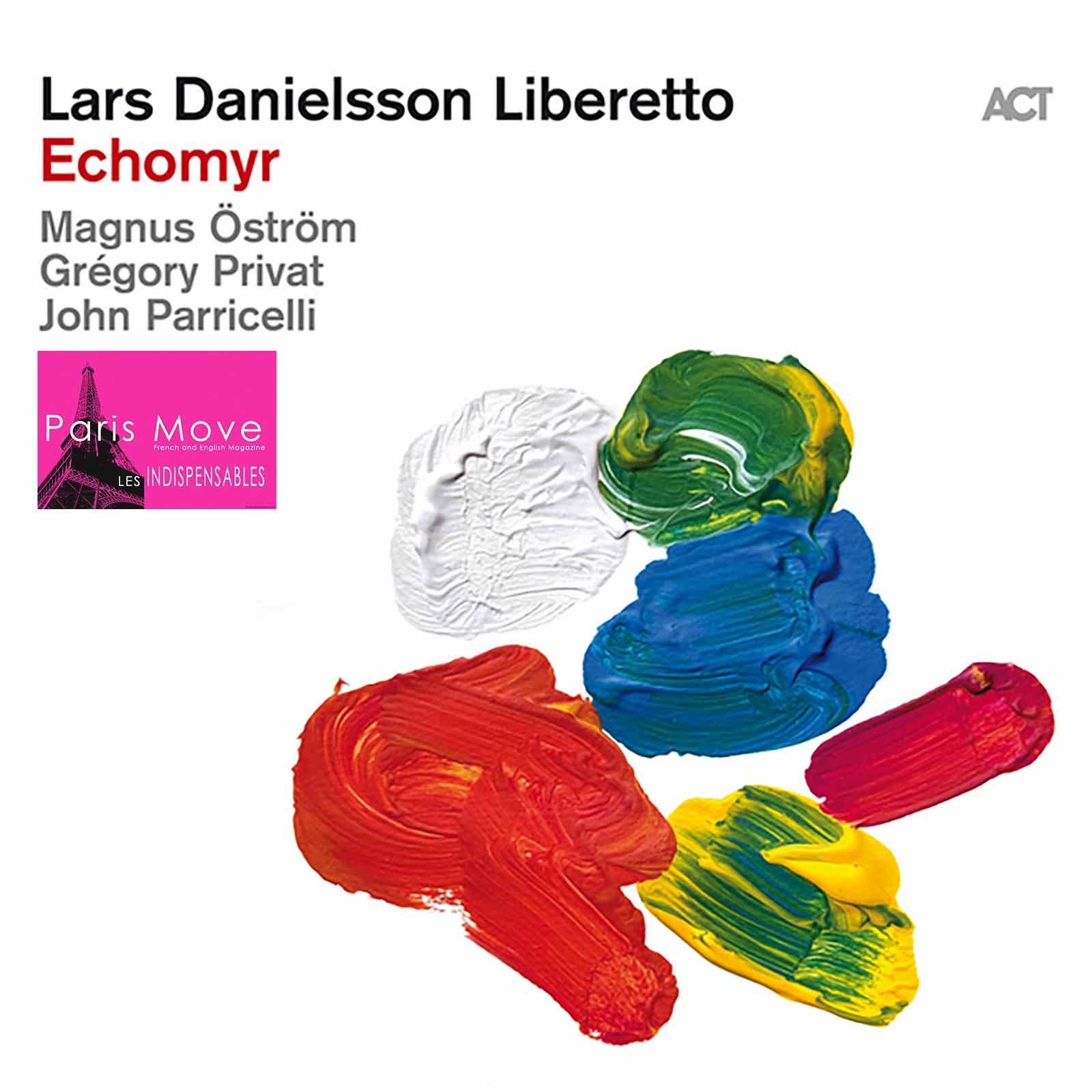
Cover art Peter Krüll, used by kind permission of the artist
Design by Siggi Loch